THE NIBBLE BLOG: Products, Recipes & Trends In Specialty Foods


Also visit our main website, TheNibble.com.

TIP OF THE DAY: The Easiest Chocolate Bark

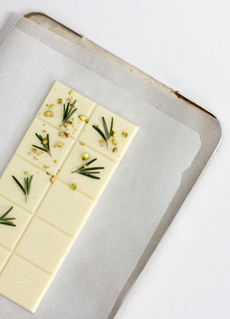
white-pistachio-bark-pan-blogerikarax-230
It couldn’t be easier to make chocolate bark. Photo courtesy Erika Rax.
 

We found this tip from Erika Rax, a home baker living in Sydney, Australia.

“I have a little secret to make really pretty and quick bark,” she says.

Forget the chopping and melting of chocolate, ladies and gents. Erika’s technique will give you almost instant bark for special family treats or gifting. In the conventional technique, the inclusions get mixed into the chocolate. Here, they sit on top—an even prettier presentation, with no dimunition of flavor.

Erika’s pistachio and rosemary bark, green ingredients on a white chocolate background, is perfect for St. Patrick’s Day. For Christmas, add some dried cherries or cranberries.

RECIPE: THE EASIEST CHOCOLATE BARK

Ingredients

  • White chocolate bar(s)
  • Chopped pistachio nuts
  • Fresh rosemary
  •  
    Preparation

    1. PREHEAT the oven to 170°F/75°C. Line a baking sheet with parchment and place the bar(s) on the parchment.

    2. ARRANGE the toppings over the bar. Place the sheet in the oven for 3-5 minutes until it just starts to soften. Take care not to overbake or the bar will lose shape.

    3. REMOVE from the oven. We lifted the parchment from the pan to cool on the counter, so the bars would not continue to get heat from the pan.
     
    Erika wrapped her gift bars in parchment paper, tied with a piece of kitchen string and a sprig of fresh rosemary. It’s charming! Here’s the photo.

    Find more of Erika’s tips at Blog.ErikaRax.com.
      

    Comments off

    ST. PATRICK’S DAY: Guacamole Recipe

    What’s Irish about guacamole, the quintessential Mesoamerican sauce, we wondered as we saw the headline in the email for St. Patrick’s Day Guacamole, sent to us by the California Avocado Commission.

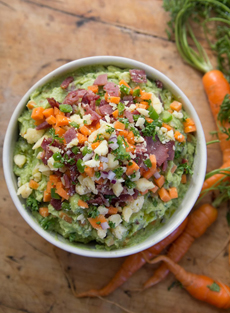
    The answer: the integration of Irish ingredients—bacon, carrots, Cheddar, onion, parsley—into conventional guacamole. The idea was developed by Sabrina Modelle of TheTomatoTart.com.

    Alas, conventional Irish crackers (cream crackers, digestive biscuits, oat cakes) don’t go well with guacamole. Instead, default to tortilla chips.

    Food Should Taste Good makes Guacamole Tortilla Chips that have a slight green tinge, but we’re going with their Yellow Corn Dipping Chips.

    And some Irish beer.

    Prep time is 20 minutes. For a beautiful presentation, set aside a small portion of the Step 2 ingredients to use as garnish.
     
    RECIPE: ST. PATRICK’S DAY GUACAMOLE

    Ingredients For 6 Servings

  • 3 ripe Hass* avocados, seeded and peeled
  • ½ lemon, juiced
  • 1/8 teaspoon salt
  •    

    guacamole-sabrinamodelle-calavocomm-230
    Guacamole with “Irish” ingredients for St. Patrick’s Day. Photo courtesy TheTomatoTart.com.

  • 1/8 teaspoon fresh ground black pepper
  • ½ cup very finely diced carrots
  • ¼ cup very finely diced red onion
  • 1 clove garlic, crushed
  • ¼ jalapeño, seeded and very finely diced (optional)
  • 3 slices cooked bacon, chopped
  • ¼ cup very finely chopped parsley
  • 2 ounces Irish Cheddar cheese, crumbled (substitute other sharp Cheddar)
  • Tortilla chips, crudités or other dippers (how about green endive leaves?)
  •  
    *While there are much larger varieties of avocado, the Haas has the creamiest, most delicious flesh. As a result, 98% of the avocados grown in Mexico are Hass, a variety discovered as a seedling by Rudolph Hass, a California postman who planted it in his front yard in the 1920s. He patented the cultivar in 1935.


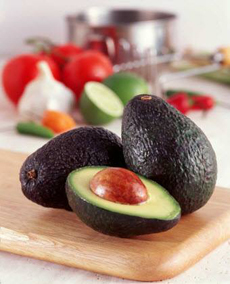
    avocados-board-hassavocado-230
    The avocado was long considered too sexual for “proper” people to eat. Photo courtesy Hass Avocado Board.
      Preparation

    1. MASH the avocado with lemon juice, salt, and pepper in a large bowl.

    2. STIR in the bacon, carrots, cheese, garlic, jalapeño, onion and parsley.

    3. GARNISH and serve.
     
    THE HISTORY OF GUACAMOLE

    Mesoamericans cultivated the avocado, a fruit which had grown there for millions of years. The conquering Aztecs called it ahuacatl; the “tl” is pronounced “tay” in Nahuatl, the Aztec language. When the Spanish conquistadors arrived in 1519 under Hernán Cortés, they heard ah-hwah-cah-tay as “aguacate,” the spelling and pronounciation they adopted.

    Guacamole was compounded in a molcajete, a mortar and pestle carved from volcanic stone.

     
    The name guacamole comes from Mexican Spanish via the Nahuatl “ahuacamOlli,” a compound of ahuacatl [avocado] + mOlli [sauce]. The chocolate-based mole sauce comes from that same word, mOlli.

    Ahuacatl means “testicle.” Aztecs saw the avocado as resembling testicles and ate them as a sex stimulant. According to Linda Stradley on the website WhatsCookingInAmerica.com, for centuries after Europeans came into contact with the avocado, it carried its reputation for inducing sexual prowess. It wasn’t purchased or consumed by anyone concerned with his or her reputation.

    American avocado growers had to sponsor a public relations campaign to dispel the myth before avocados could become popular. After then, their dark green, pebbly flesh also earned avocados the name, “alligator pear.”


    Comments off

    TIP OF THE DAY: Green Macarons

    Paris may not be as festive as Dublin or New York when it comes to celebrating St. Patrick’s Day; but rest assured, there are celebrations! Both expats and locals head to the city’s numerous Irish pubs and yes, there is green beer. (Who knew that Paris had “numerous Irish pubs?” Source)

    We, however, would head to Ladurée or Pierre Hermé for pistachio macarons, a classic flavor where the meringue is colored green.

    You don’t have to head to Paris. If there are no macarons in your neck of the woods, you can order them from Dana’s Bakery, Macaron Café or Mad Mac. There are also Ladurée outposts in New York City and Miami, but we couldn’t find online ordering options for either.

    Dana’s Bakery, which doesn’t make classic flavors*, has two green options right now: Key Lime Pie and Thin Mint. So if pistachio nuts are not your thing, she’s your gal.

    While a classic pistachio macaron is filled with pistachio or vanilla ganache, or possibly chocolate ganache, we’ve found varieties from creative macaron artists that feature matcha ganache, peanut butter ganache, red bean jam and other fillings (like Dana’s chocolate mint and Key lime). Whatever your preference, include a bit of France in your St. Patrick’s Day celebration.

       
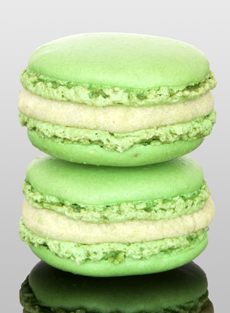
    pistachio-pierre_herme-230
    Plan in advance: green macarons (pistachio)
    for St. Patrick’s Day. Photo courtesy Pierre
    Hermé.
     

    *The current flavors at Dana’s Bakery include Birthday Cake, Cookie Dough, Cotton Candy, Fruity Cereal, Jelly Doughnut, Orange Creamsicle, Peanut Butter & Jelly, S’mores and Strawberry Shortcake, among others.


    AmarettiCookies-recchiuti-230
    Ameretti, the “original” macaroons. Here’s the recipe. Photo courtesy Michael Recchiuti.


    WHO INVENTED MACARONS?

    The ganache-filled meringue cookie sandwiches shown above are called Parisian macarons. The first macaroons, from Italy, were quite different: almond meringue cookies similar to today’s amaretti, with a crisp crust and a soft interior (see the photo at left).

    The name derived from the Italian maccarone or maccherone, itself derived from ammaccare, meaning to crush or to beat. (The reference is to the crushed almonds or almond paste, which is the principal ingredient.)

    These original macaroons arrived in France in 1533 with the pastry chefs of Catherine de Medici, who married France’s King Henri II. More than two centuries later, two Benedictine nuns, seeking asylum in the town of Nancy during the French Revolution (1789-1799), paid for their housing by baking and selling the cookies.

     
    According to Wikipedia, “[Pâtisserie] Ladurée’s rise to fame came in 1930 when his grandson, Pierre Desfontaines Ladurée, had the original idea of the double-decker, sticking two macaron shells together with a creamy ganache as filling.

    The first versions combined two plain almond meringues with a filling of chocolate ganache; but today, various varieties of ganache, buttercream or jam are sandwiched between meringues of seemingly limitless colors and flavors.

    Other stories variously give the invention date as “the beginning of the 20th century” and 1952. The latter date has credence if you believe the blog ParisPatisseries.com, that in 2012, Laduree hosted a 60th anniversary party for the macaron.

    Here’s the history of macarons.
     
    MACARONS VS. MACAROONS

    Italian Jews adopted the cookie because it has no flour or leavening, and thus can be enjoyed during the eight-day observation of Passover. It was introduced to other European Jews and became popular as a year-round sweet. Over time, coconut was added to the ground almonds and, in certain recipes, replaced them.

    When the coconut cookies arrived in England and the U.S., macaron became macaroon. Until the Parisian macaron craze began within the last ten years, coconut macaroons were far more prevalent in the U.S. and the U.K. They’re a lot easier to make and transport than the fragile Parisian variety.

    A tasting plate of amaretti, coconut macaroons and Parisian macarons would be an excellent “educational dessert.”


    Comments off


    © Copyright 2005-2026 Lifestyle Direct, Inc. All rights reserved. All images are copyrighted to their respective owners.