THE NIBBLE BLOG: Products, Recipes & Trends In Specialty Foods


Also visit our main website, TheNibble.com.

Have An Egg Cream: The Recipe & History Of The Egg Cream

Classic New York Egg Cream
[1] The classic New York egg cream. The recipe is (photo © Russ & Daughters).

Egg Cream With A Soda Siphon [2] For 100 years or more, seltzer bottlers would deliver a heavy cases of glass soda siphons to egg cream lovers in New York and other cities (cocktail lovers, too). The bottles are now collectors items, but you can buy modern soda siphons like the one in the next photo (photo © Marco Jose Gonzalez).

iSi Soda Siphon & Egg Cream
[3] iSi makes beautiful soda siphons, both old-style like this, and a modern all-stainless-steel model (photo © iSi.


[4] With a soda syphon, you can get a bubbly head on your egg cream (photo © Make Your Own Soda).

Strawberry Egg Cream
[5] A strawberry egg cream. It’s the same recipe), just with strawberry syrup instead of chocolate syrup (photo © Polar Seltzer).

Guittard Chocolate Syrup & Vanilla Ice Cream
[6] Guittard, our chocolate syrup of preference, is made with fructose instead of corn- or high fructose corn syrup, and real vanilla.

Fancy Egg Cream With A Cookie Rim
[7] Fancy: This egg cream is rimmed with cookie crumbs (photo © Empire Diner | New York City).

  There is tuna in a tuna noodle casserole. There are strawberries in a strawberry shortcake. There’s ice cream in an ice cream soda.

But there’s no egg in an egg cream—and there’s no cream, either. The ingredients are milk, seltzer and chocolate syrup. In other words, it’s a carbonated chocolate soda made creamy with milk, or carbonated chocolate milk.

Since today is Rosh Hashanah, the Jewish new year, we’ve been thinking about great Jewish-American food inventions. The egg cream, invented in a Jewish neighborhood in New York, is at the top of the list.

So our tip of the day is: Experience the legend and enjoy an egg cream.

We’ve included the regular recipe and our own diet version .

March 15th is National Egg Cream Day.

Below:

> The egg cream recipe.

> The history of the egg cream.

Elsewhere on The Nibble:

> The year’s 24 non-alcoholic beverage holidays (including juice and soft drinks).

> The year’s 16+ milk and cream holidays.
 
Classic Egg Cream Soda
[7] In earlier times, a seltzer bottle produced the force to create a large, creamy head. Today, we settle for what we can create with a regular bottle (Gemini Photo).
 
 
RECIPE: THE CLASSIC NEW YORK EGG CREAM

While U-Bet** and other supermarket chocolate syrups have been the standard, we appreciate the superior flavor of the Guittard chocolate syrup, a gourmet syrup made by a fine chocolatier, without corn syrup or high fructose corn syrup (photo #4).

In a tall fountain glass (or any tall glass you have), combine:

  • 2 tablespoons chocolate syrup (you can find Fox’s U-Bet chocolate syrup online, including a sugar-free version)
  • 6 ounces whole milk (you can substitute lowfat, nonfat or nondairy milk)
  •  
    Mix, then add:

  • 6 ounces seltzer or club soda (soda water)
  •  
    Serve with a straw. For a modern variation, use cherry- or raspberry-flavored club soda.

    Note: If you don’t have large fountain glasses, use less milk and seltzer to fit into the glass. Adjust the sweetness to your preference.

    Tip: If you want your drink extra-chocolatey, use a chocolate/fudge-flavored seltzer.

    For a diet egg cream:

  • Use sugar-free chocolate syrup and nonfat or lowfat milk, plus seltzer.
  • We fill the glass 1/3 with milk, then add the soda. /li>
  • To make the drink sweeter, we add a packet of noncaloric sweetener to the milk, and stir before adding the soda.
  •  
    Vanilla, Chocolate, & Strawberry Egg Creams
    [8] You can create an egg cream in any flavor. All you need is the flavored syrup (Gemini Photo).
     
     
    EGG CREAM HISTORY

    Many references say that the egg cream was likely invented in 1890 by a Brooklyn soda fountain and candy store owner, Louis Auster.

    However, Auster’s store was in actually in the East Village of Manhattan, at the southeast corner of Second Avenue and Seventh Street.

    In October 2008, the grandson of the founder of Ratner’s, the famous deli restaurant next door, set the record straight with his recollections of Louis Auster’s candy store and the egg creams made with Auster’s own secret chocolate syrup formula.

    More exciting than a “two cents plain” (a glass of seltzer, or carbonated water*) and less expensive than a malted milk—not to mention great-tasting—the egg cream was a hit.

    The most origin common story is that sometime in the 1890s, candy shop owner Louis Auster concocted the drink by accident. The story reports that he sold thousands a day.

    But when Auster refused to sell the rights to the drink to an ice cream chain, a company executive called him an anti-Semitic slur and Auster vowed to take the formula to his grave.

    Without Auster’s special syrup, other soda fountains relied on a Brooklyn original: Fox’s U-bet chocolate syrup, a mixture of water, sugar, corn sweeteners, cocoa and some “secret things.”

    There are at least two other origin stories for the name [source]:

  • One theory is that in the 1880s, Yiddish theater pioneer Boris Thomashevsky asked a New York City soda fountain to reproduce a drink he had discovered in Paris. But his request for the French chocolat et crème got lost in translation.
  • Some say the name is an Americanization of echt keem, Yiddish for “pure sweetness.”
  • Others suggest that it’s simply Brooklynese for “a cream.”
  • Perhaps the best is one that the foam on the top looks like beaten egg whites.
  •  
    Carbonated soft drinks were in their infancy. Coca-Cola, a fountain syrup available in Atlanta starting in 1886 and first bottled in 1894, was not a northern soda fountain feature at the time (Coca-Cola history).†

    Kids and adults alike loved the egg cream. It was enjoyed at soda fountains, with patrons sitting on stools or in booths, sipping egg creams through a straw.

    Other soda fountain owners got in on the act, spreading the egg cream throughout New York City. The chocolate syrup of choice became Fox’s U-Bet.‡

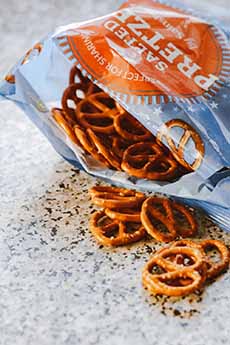
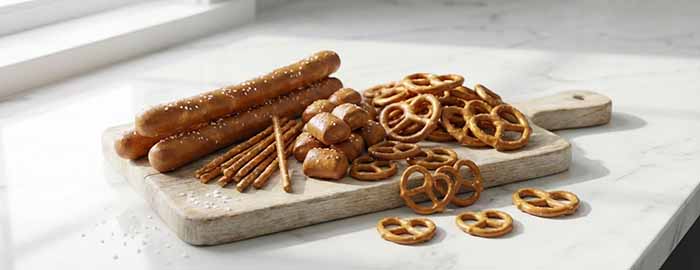
    And the egg cream was often enjoyed with a pretzel (photo #6), making the combo a sweet-and-salty snack.

    Some soda fountains served the egg cream in glasses with silvery metal holders. Others just used a tall glass.

    How did they make the famous drink?

  • First, the soda jerk pumped the syrup into the glass: two or three pumps, each pump the equivalent of a tablespoon and a half of syrup.
  • The milk followed, and then the seltzer, which produced a foamy white head.
  •  

     
    We’re old enough to have had egg creams mixed at a real soda fountain:

    A long counter, often located in a drugstore or what we would today call a convenience store.

    It had red-upholstered rotating stools, and soda taps (like beer taps) that delivered the seltzer needed for the egg cream, as well as to turn cola, cherry, and other syrups into glasses of soda (pump in the syrup, shoot in seltzer from the tap, stir gently).

    Once, we had the opportunity to step behind the counter and “jerk” the taps.

    Our attempts weren’t neat: our jerks overfilled the glasses and created a dribbled mess.

    But it was fun!

    The Wane Of The Egg Cream

    Time marches on, and in the 1960s people became more interested in fast food than soda fountains. Plus, it was easy to pick up the myriad bottles (and later cans) of soda and other soft drinks, plus ice cream, at grocers.
    After most of the remaining soda fountains and luncheonettes of New York disappeared in the 1970s.

    They were replaced by fast food restaurants and delis, neither of which made egg creams; but occasionally you can find a diner that makes them.

    So the egg cream faded from view.

    Years later, in 1990, entrepreneur Jeff Glotzer, who fondly remembered the egg cream, founded Egg Cream America to produce Jeff’s Amazing New York Egg Cream. He discovered that no one had ever succeeded in carbonating milk and hired a beverage chemist. “It took a long time but he came up with our process,” said Jeff in a 1994 New York Times interview.

    First discovered the bottles in our supermarket, and the diet version, which had negligible calories but tasted “amazing!” was our daily treat. When the supermarket no longer carried it, we found it online from Amazon, which carried them until 2014, when presumably they were discontinued.

    His line, which included Diet Chocolate (the best seller), Diet Vanilla, and Diet Orange (like a Creamsicle!), has disappeared from earth, and is on the list of the Top 10 Discontinued Foods We Mourn.

    We wax nostalgic every time we go to the movies and create our own soda from the self-service soft drink dispenser. Alas, there’s no chocolate soda, or we’d bring our own milk and make an egg cream on the spot!

     
    Old Fashioned Soda Fountain
    [8] An old fashioned soda fountain, first located in pharmacies and later in standalone stores, department stores, etc. (Gemini Photo).
     
    _________________

    *Seltzer and club soda are both soda water. The difference: seltzer is salt-free and club soda has salt.

    **There’s no particular “magic” to Fox’s U-Bet chocolate syrup. It was created around 1900 by Herman Fox in Brownsville, Brooklyn, New York, specifically to be used in soda fountains instead of Auster’s syrup. It thus became the go-to brand tradition. Our mom preferred Hershey’s chocolate syrup. But today, Hershey’s is made with high fructose corn syrup, while U-Bet retains the original corn syrup.

    It was the rise of the well-advertised Coca-Cola and other soft drinks that led to the wane of the egg cream, and the rise of fast food restaurants that led to the demise of the soda fountain itself.

    In 1894, H. Fox & Company in Brooklyn began to produce chocolate syrup. The name U-bet wasn’t created until the 1930s.
     

    CHECK OUT WHAT’S HAPPENING ON OUR HOME PAGE, THENIBBLE.COM.


    Comments off

    FOOD HOLIDAY: Kahlua Cocktail Recipes For National Coffee Day

    What better way to celebrate National Coffee Day, September 29th, than by adding some coffee liqueur to your coffee? You might not want to drink it for breakfast, but any Kahlua cocktail is a terrific after-dinner drink, rich enough to be served instead of dessert.

    Kahlúa, the word‘s largest coffee liqueur brand, suggests these two recipes to warm your day.

    You can also serve them on February 27th, National Kahlúa Day—and anytime in-between.

    Kahlúa has been produced in Veracruz, Mexico from local coffee beans since 1936. The name derives from the word “kahwa,” which is Arabic slang for coffee.
     
     
    RECIPE #1: KAHLÚA ESPRESSO MARTINI

    Ingredients Per Drink

  • 1½ parts Kahlúa
  • 1 part vodka
  • 1 part freshly brewed espresso
  •  
    Preparation

    1. COMBINE all ingredients into a cocktail shaker. Add ice and shake vigorously. Strain into a chilled Martini glass
     
     
    RECIPE #2: KAHLÚA LATTE

    Ingredients Per Drink

  • 2 parts Kahlúa
  • 2 parts hot coffee
  • 1 park cream or milk—or more to taste—heated (microwave is fine)
  • Optional garnishes: whipped cream, rolled wafer cookie (like Pepperidge Farm Pirouette cookies)
  •  
    Preparation

    1. SHAKE the ingredients and serve in a mug (a glass mug, if you have one), topped with optional garnishes.
     
     
    How about a Kahlua Ice Cream Float?


    [1] Make your evening cup of coffee special on National Coffee Day (photo © Kahlúa).


    [2] Add some Kahlua to your coffee—hot or iced (photo © Hannah Kaminsky | Bittersweet Blog).


    FAMOUS KAHLÚA DRINKS

    Famous Kahlúa cocktails include

  • Black Russian (1 ounce Kahlúa and 1.5 ounces vodka)
  • White Russian (1 ounce Kahlúa, 1.5 ounces vodka and 1 ounce heavy cream)
  • Mudslide (1.5 ounces each of Kahlúa, vodka and Baileys Irish Cream; add vanilla ice cream for a Frozen Mudslide)
  •  
     
    Preparation For All Three

    SHAKE the ingredients (with ice, except for the Frozen Mudslide) and strain into rocks glass.


    Comments off

    TOP PICK OF THE WEEK: Green Giant Fresh Potatoes In Microwave Steaming Bags

    Our Top Pick Of The Week is a first for THE NIBBLE: a product from a major manufacturer.

    THE NIBBLE focuses on specialty foods and artisan products. They’re typically made with better ingredients, are better for you and simply taste better.

    But the Green Giant Fresh line of Whole Baby Idaho Potatoes in Sauce simply couldn’t be more delicious. The four varieties in tasty sauces are all excellent. Two are absolutely seductive.

    And they’re ready to eat in five minutes or less.

    The steaming hot potatoes are delicious straight from the microwave bag. But you can never go wrong with some fresh chives, parsley, or other favorite herb.

    Find out more in the full review.

    Do you know the different types of potatoes?

    How about the history of potatoes?

     
    From fridge to plate in 4.5 minutes! Photo by
    Jaclyn Nussbaum | THE NIBBLE.


    Comments off

    TIP OF THE DAY: A Cocktail Or Dessert Of Champagne & Sorbet


    Add the right fruit sorbet to the right sparkling wine: delicious! (photo © Domaine Chandon).

      September is California Wine Month. The first sustained California vineyard was planted in 1779 by Franciscan missionaries, at Mission San Juan Capistrano (in southern California, halfway between Los Angeles and San Diego).

    The first documented imported vines (from Europe) were planted in Los Angeles in 1833. About the same time, the first vineyard using indigenous grapes was planted in the Napa Valley, in northern California.

    California wines were enjoyed locally, but were an afterthought on the world stage—if they were thought of at all.
     
     
    AMERICAN WINES FINALLY GET THEIR DUE

    The breakthrough came at the history-making Paris Wine Tasting of 1976, a competition in which French judges blind-tasted top Chardonnay and Cabernet Sauvignon wines from France and from California.

    French wines were considered the best in the world. No one thought that the California wines stood a chance.

    Surprise: California wines ranked highest in each category (the details).

    Americans, who had previously enjoyed cocktails before and with meals, began to drink lush California red and white wines.


    DESSERT COCKTAILS WITH CHAMPAGNE OR OTHER SPARKLINE WINE

    Most of us drink wine and use it in cooking, but it can also be turned into a dessert. Today’s tip: pair sparkling wine with sorbet as a cocktail or dessert.

    (FOOD 101: Only wines made in the Champagne region of France can legally be called Champagne. All other bubblies are called sparkling wines.)

    We use the sparkling wines from Domaine Chandon—established in the Napa Valley in 1973 by the great French house of Moët et Chandon—and the best sorbets from our local specialty food stores.

  • For A Cocktail: Chandon Brut Classic With Green Apple Sorbet. Place an ounce of sorbet at the base of a Champagne flute or other glass and top with the sparkling wine. The sorbet will slowly infuse into the wine, adding sweet fruitiness.
  • For Dessert: Chandon Rosé With Peach Sorbet. For a a light and elegant dessert, fill a standard wine glass or goblet halfway with wine. Add a large scoop of sorbet. Garnish with a raspberry for color and an optional chiffonade (very thin strips) of fresh basil for color and a counterpoint of flavor. You can substitute a cinnamon stick for a fall touch.
     
    It couldn’t be easier—or more delicious.
     
     
    Find more of our favorite desserts in our Gourmet Desserts Section and Gourmet Ice Cream Section, and pull down the search menu at the right.


  • Comments off

    FOOD HOLIDAY: The History Of Chocolate Milk For National Chocolate Milk Day

    It’s National Chocolate Milk Day.

    We spent two days last week at a trade show that focused on natural and healthy products. Among the many aloe and coconut water brands, we tried alternative types of chocolate milk: almond milk (Almond Breeze), soy milk (Silk), rice milk (Rice Dream), hemp milk (Living Harvest), coconut milk (So Delicious) and even oat milk (Pure Harvest).

    The oat milk tasted a bit oaty, but few people would have guessed if handed a glass, that Almond Breeze chocolate almond milk and Silk chocolate soy milk were not cow’s milk (Almond Breeze is also available as unsweetened chocolate milk, an option for those who wish to add a noncaloric sweetener).

    So there’s chocolate milk galore for those who avoid animal products, have lactose intolerance, want more soy in their diet, or simply want to benefit from the nutrition in almond milk versus cow’s milk.*

    > The history of chocolate milk is below.

    > The year’s 16+ milk and cream holidays are also below.

    > The history of chocolate.

    > Make homemade chocolate syrup for your chocolate milk.
     
     
    ADULT CHOCOLATE MILK

    While you read this, sip a glass of chocolate milk—with a shot of chocolate liqueur (crème de cacao, Godiva). Our personal favorite, however, is good old Irish cream.

    For added dimension:, try banana liqueur, coffee liqueur, orange liqueur, raspberry liqueur, etc.
     
     
    THE HISTORY OF CHOCOLATE MILK

    Who Invented Chocolate Milk?

    A cold beverage made at home by mixing chocolate syrup into milk (commercial brands often use cocoa powder), chocolate milk is one of those foods for which we actually know the inventor:

    Sir Hans Sloane (1660-1753), for whom London’s Sloane Square is named (and whose collection of objets d’art and curiosities became the foundation of the British Museum), introduced chocolate milk to Europe. It wasn’t exactly the chocolate milk we know today—made with chocolate syrup to get kids to drink milk—but it was a start.

    Cacao was brought back to Spain by the conquistadors in 1527 (some beans had been brought by a delegation of Kekchi Maya nobles from Alta Verapaz, who introduced the beverage to the Spanish court). When Cortès returned to Spain in 1527, cacao was part of the booty. For many years, it remained a Spanish secret, affordable only to the wealthy. (The story continues.)

    Sloane encountered cacao in Jamaica in the late 1680s, where it was drunk mixed with water. He found it most unpleasant (as did Christopher Columbus and the Spanish conquistadors of Mexico—see details).

    However, Sloane devised a means of mixing the ground cacao beans with milk, to make it more pleasant. He brought both cacao and his recipe (most likely unsweetened) back to England.

    A physician, Sloane was initially interested in the medicinal properties of cacao;† he thought chocolate milk had soothing qualities. The recipe was initially sold by apothecaries. You can see ads for the original product on this Cadbury blog, which found them in the Cadbury archives. The earlier ad suggests chocolate milk for “lightness on the stomach” and “all consumptive cases.”

    By the 19th century, it had become an enjoyable food product. The Cadbury Brothers sold tins of Sir Hans Sloane’s Milk Chocolate (use the Cadbury link above to see that ad). One ounce (two squares) was dissolved into a pint of boiling milk, to which sugar was added.
     
     
    THE YEAR’S 16+ MILK & CREAM HOLIDAYS

  • January 5: National Whipped Cream Day
  • January 11: National Milk Day
  • February 18: Cow Milked While Flying in an Airplane Day (a.k.a. Elm Farm Ollie Day)‡
  • March 15: National Egg Cream Day
  • May 21: National Strawberries and Cream Day
  • June: National Dairy Month
  • June 1: World Milk Day
  • June 21: National Peaches and Cream Day
  • June, Last Friday: National Cream Tea Day
  • August 7: National Raspberries ‘N’ Cream Day
  • August 12: Milkman Day
  • August 22: World Plant Milk Day
  • September, Last Wednesday: World School Milk Day
  • September 24: National Horchata Day
  • September 27: National Chocolate Milk Day
  • The Year’s 6 Milkshake Holidays
  •  
    Plus:

  • February 11: National Don’t Cry Over Spilled Milk Day
  • May 22: Harvey Milk Day
  •  
    ______________________

    *Compared to cow’s milk, almond milk has 50% fewer calories, heart-healthy monounsaturated fats instead of cholesterol, fewer carbohydrates compared to 13.1 grams of lactose (milk sugar), fiber (vs. no fiber in cow’s milk), almost as much calcium as cow’s milk (and more absorbable calcium, since lactose impedes absorption). Details.
     

    Modern research has shown that flavanol-rich cacao can impact cancer and cardiovascular disease over the long term. However, in the 1600s, health claims were speculative rather than scientifically proven. In 1631, the first recipe for a chocolate health drink was published in Spain by Antonio Colmenero de Ledesma, an Andalusian physician, in his book, Curioso tratado de la naturaleza y calidad del chocolate (A Curious Treatise of the Nature and Quality of Chocolate). A doctor who had lived in the West Indies, he claimed that chocolate was an aphrodisiac, caused fertility, and eased delivery in women. Here’s the true scoop on chocolate health claims, from the Cleveland Clinic. And, if it gets kids to drink their milk, one could interpret that chocolate milk is a health drink.

    Cow Milked While Flying in an Airplane Day, one of the stranger holidays on the books, commemorates the day a cow named Nellie Jay became the first cow to be flown and milked in an airplane. The event was part of a scientific effort to study the effect of height on cows’ ability to produce milk. In a 72-mile flight over Bismarck, Missouri, Nellie’s milk was put in paper cartons and parachuted down to the spectators to generate publicity.


    CHECK OUT WHAT’S HAPPENING ON OUR HOME PAGE, THENIBBLE.COM.

     
    [1] Chocolate milk can be made with any milk or milk substitute (photo © Midwest Dairy Association).

    Glass Of Chocolate Milk With Shaved Chocolate Garnish
    [2] Getting fancy with chocolate syrup design on the glass (before you pour the chocolate milk in) and a topping of shaved chocolate (photo © Yi Mun | Unsplash)

    Chocolate Milk With Baileys Irish Cream Liqueur
    [3] Add Baileys to your chocolate milk. Heavenly! (photo Nano Banana)

    Chocolate Milk With Homemade Chocolate Syrup
    [4] Chocolate milk with homemade chocolate syrup. Here’s the recipe (photo © Recchiuti Chocolate).

    A Glass Of Chocolate Milk
    [5] Chocolate milk drama (photo © Pariwat Pannium | Unsplash).

    A Bottle Of Trader Joe's Midnight Moo Chocolate Syrup
    [6] Elevate your chocolate milk with better chocolate syrup, like der Joe’s Midnight Moo and Whole Foods’ 365 Brand, made with cane sugar instead of corn syrup. Ghirardelli is another brand to try (photo © Becoming Betty—read her review).


    Comments off

    The Nibble Webzine Of Food Adventures


    © Copyright 2005-2026 Lifestyle Direct, Inc. All rights reserved. All images are copyrighted to their respective owners.