THE NIBBLE BLOG: Products, Recipes & Trends In Specialty Foods


Also visit our main website, TheNibble.com.

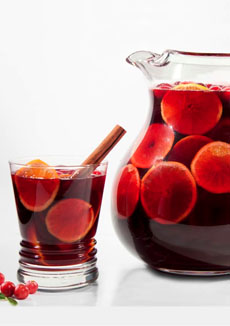
RECIPE: Red Christmas Cocktail


A Christmas cocktail. Photo courtesy
Belvedere Vodka.

  For a Christmas cocktail with seasonal ingredients, you can’t do better than “Give A Fig,” from Belvedere vodka.*

GIVE A FIG COCKTAIL RECIPE

Ingredients

  • 2 ounces (50ml) vodka
  • 1 thumbnail of ginger root, crushed
  • 1/2 cup pomegranate juice
  • 3/4 ounce (25ml) fig purée
  • 1/4 ounce (1-1/2 teaspoons, 10ml) lime juice
  • 1/4 ounce (1-1/2 teaspoons, 10ml) vanilla sugar
    (or make your own)
  • Ice cubes
  •  
    Preparation
    1. Whisk sugar into pomegranate juice in a shaker.
    2. Add rest of ingredients and shake with cubed ice.
    3. Double-strain into a rocks glass and garnish with a split fig.

     
    Find more Christmas cocktail recipes.

    *Adapted from a drink created by Aaron Rosa, Purple Bar, Sanderson Hotel.


    Comments off

    TIP OF THE DAY & GIFT OF THE DAY: Red Ale For Christmas

    What better says “Christmas” to a beer lover than a brew with crimson color?

    Red ale, or Irish red ale, is, as its name suggests, an ale with a slightly reddish color. The color is intentional, and results from the use of a small amount of roasted barley in the mash.

    If it comes from Ireland, it’s called Irish ale. In the U.S. and elsewhere, it’s called red ale or red beer. Some Americans use the term amber ale, but this typically describes a darker beer—truly amber instead of reddish.

    Serve a red ale at your holiday celebration (add a cucumber wheel for a bit of green; or a lime wedge if your guests prefer to drink from the bottle.

    If you need a holiday gift for a beer drinker, put together a six-pack of different red ale brands (see below).

    How Well Do You Know Your Brews?

    Take a look at our Beer Glossary.

     
    Serve red ale for Christmas. Photo
    courtesy Craft Brewers Association.
     
    The Best Red Ales

    Here are the top 10 red ales as rated by judges in the 2011 U.S. Open Beer Championship.

    1. Pursuit of Hoppiness – Grand Teton Brewing, Idaho
    2. O’Regan’s Revenge Irish Red Ale – Sound Brewery, Washington
    3. Bomber Mountain Amber – Black Tooth Brewing, Wyoming
    4. River Falls Red Ale, Thomas Creek Brewing – South Carolina
    5. Cameron’s Auburn Ale – Cameron’s Brewing, Canada
    6. Celtic Ale – Harpoon Brewery – Massachusetts
    7. Red Mountain Ale – Silverton Brewing, Colorado
    8. Samuel Adams Red Ale – Boston Beer Company, Massachusetts
    9. O’Hara’s Irish Red – Carlow Brewing – Ireland
    10. Kilgubbin Red Ale – Goose Island – Illinois

    Cheers!


    Comments off

    PRODUCT: Crazy Cuizine Frozen Asian Entrées

    Two of the seven Crazy Cuizine varieties.
    Photo by Elvira Kalviste | THE NIBBLE.

    We live in a city where delivered food of every type is a way of life. Chinese food, sushi or Korean BBQ can arrive at our door in 30 minutes or less.

    But in half that time, we can remove the Crazy Cuizine from the freezer and microwave our own.

    Crazy Cuizine is a line of frozen Asian entrées—Chinese, Japanese and Korean dishes—that you can find at select Costco locations and BJ’s Wholesale Clubs nationwide, and at some regional chains.

    About The Entrées

    Ready to heat and eat, the line comprises sauced meat dishes—mostly chicken—that are high in protein and free of preservatives, trans fats and MSG.

    The entrées can be microwaved in five minutes or less—one-quarter of the time it takes to microwave an appropriate amount of conventional rice. That a heaping plate of tender meat can be available in a few minutes is a great convenience.

    Microwaving rice will take you 15 to 20 minutes, depending on the amount (smaller amounts take less time). Don’t spend the money on frozen, ready-to-microwave rice packages. They may save you 10 minutes, but it’s not worth the added expense. Here’s how to microwave conventional rice for pennies a portion.


    What You Need To Add

    While the line claims “authentic recipes,” some of the authenticity needs to be added.

    • Add seasonings. Neither the sauces nor the meats have secondary seasonings that create a complex flavor. They’re fine for kids—or adults who don’t have a demanding palate—but we like to think that even these two groups deserve to have more educated tastes. We added thin-sliced green onions, toasted sesame seeds, and herbs or spices: minced fresh garlic and/or ginger, or their dried cousins; fresh or dried jalapeño; and fresh basil (which is more Thai and Vietnamese, but works well, and we always have some).
    • Add vegetables. Amost all Asian dishes use them. We used what we always have in the house: broccoli, carrots, celery, mushrooms and onions—not necessarily all at the same time. If you have water chestnuts, bamboo shoots or baby corn, toss them in. We either steamed the veggies in the microwave for three minutes prior to making the rice, or sautéed them on the stove top while the rice cooks.

    Orange chicken is ready in five minutes. Photo courtesy Crazy Cuizine.

    • Assemble the dish. You can choose to heat the sauce packets with the veggies. We used a different technique: We heated the sauce before the meat; then added it to a bowl with the meat and veggies. Then toss to blend.

    The ingredients are U.S.-sourced and the dishes are produced at the company’s state-of-the-art facility in Southern California. The chicken is all-natural white meat, and has very good chicken flavor. Some are sliced, some are breaded.

    The sauces tend to be adaptions of the same recipe, thick and slightly sweet. The choices include:

    • General Tso’s Chicken: The sweet and spicy, deep-fried chicken dish was invented in the U.S. and named after one of the greatest military leaders of China’s history, General Tso (1812-1885). This version fares well, if nowhere as hot and spicy as the real deal. The general’s name is correctly pronounced sow, not so or tso.
    • Korean BBQ Chicken: Our favorite. A delicious Korean dish featuring chicken breast topped with Korean BBQ spicy sauce.
    • Orange Chicken: Pretty good, but lacking the orange peel added to restaurant dishes. Add your own small strips of peel. We added green onions, too.
    • Potstickers, Chicken & Pork: The pork version is more flavorful. Both have the same excellent dipping sauce, made of soy sauce and vinegar.
    • Tangerine Beef: Not tasted.
    • Teriyaki Chicken: We weren’t crazy about this one. The sauce doesn’t resemble traditional teriyaki sauce, so the dish doesn’t resemble teriyaki—at least not the kind you’d get at a Japanese restaurant. It’s better to make your own: Thoroughly combine 1/2 cup soy sauce, 1/2 cup mirin (rice wine) and 2 tablespoons sugar in a sauce pan; bring to a boil over medium heat and simmer for two minutes. Cool to room temperature or slightly warmer. If you don’t have mirin, use 1/2 cup saké mixed with one tablespoon sugar. Both mirin and saké are types of rice wine.

    The 20-ounce boxes have a suggested retail price of $8.99.

    Given that we pay between $5.00 and $6.00 for an order of six poststickers, delivered or in-restaurant, the 28-30 pieces from Crazy Cuizine are a bargain.

    Learn more at DayLeeFoods.com.


    Comments off

    TIP OF THE DAY: Substitutes For Ham Hocks


    Lower cholesterol and salt by substituting
    smoked turkey for ham hocks (shown
    above). Photo courtesy CVSOP.com. Get the
    recipe for bean soup with ham hocks—or
    turkey.

      There’s nothing like a ham hock to add smoky flavor to hearty soups, bean and lentil dishes, stews, greens and other winter fare. The hock is the lower portion of a hog’s hind leg.

    But many people don’t eat ham, and many of those who do should cut back on cholesterol and salt.

    As we were preparing to make a 12-bean soup this weekend, we recalled a tip from Top Chef audience favorite Carla Hall: Use smoked turkey drumsticks instead of ham hocks.

    (If you want pork for your recipe but can’t find ham hocks, substitute two-to-four ounces per hock with: chopped bacon, guanciale [cured smoked hog jowl], cubed ham, chopped salt pork, a ham bone or smoked sausage.)

    Carla, a Nashville native, loves Southern food and eats lots of greens. To make them healthier, she uses smoked turkey instead of ham hocks, and adds Brussels sprouts—leaves separated—for extra nutrition.


    Another tip: Carla makes a healthy sweet potato mash with olive oil and orange zest.

    Things you don’t know about Carla Hall

    She’s a CPA! An alumna of Howard University’s School of Business, she worked for Price Waterhouse for two years. She then took a 180-degree turn and spent several years as a model on the runways of London, Milan and Paris. In Paris she fell in love with the art of food, and voilà!

    Know Your Pig Parts

    What’s the difference between a back rib and a spare rib? Pork belly and pancetta? American bacon and British bacon?

    Become a pig parts expert.
      

    Comments off

    GIFT OF THE DAY: A Caddy Of Tea From Le Palais Des Thés

    Today’s gift recommendation is a line of fine loose teas in decorative caddies*, from a renowned French firm, Le Palais des Thés (luh pah-LAY day tay, “The Tea Palace”).

    The company was founded in 1986 by a group of French tea enthusiasts, who went into the tea business so they could have the freshest, highest-quality teas. In handsome packaging, the teas are sold worldwide.

    But before we dig in to the tea gifts, here’s a bit of tea history. (Don’t want history? Scroll down.)

    A Brief History Of Tea-Drinking In Europe

    England is known for tea-drinking; but it actually came late to the game. Tea was first introduced to Europe via Portugal.

    *A tea caddy is a small box, can, or chest for holding tea leaves.


    The des Songes, an oolong tea, in a
    festive red caddy. Photos courtesy Le Palais Des Thés.
     
    Portuguese traders visiting Asia brought tea back from China and Japan in the late 1500s. Tea was instantly popular among the Portuguese nobility, who had the means to buy the new luxury. Tea was served daily at 5:00 p.m., still a Portuguese tradition.

    The Portuguese infanta, Catherine of Braganza, married to England’s King Charles II in 1662, introduced† the custom of drinking tea to England.

    Tea was extremely costly for more than 100 years, due to rarity and taxes. It was kept in a locked chest to prevent pinching by servants and others. But after the 1750s, smuggled tea was widely available, reasonably-priced and purchased by respectable people.

    †Catherine also introduced the fork to the England. Amazingly, although it was used by the ancient Greeks and Romans, and the Roman legions occupied England, the fork took many centuries to make the leap.


    Thé des Moines, or Monks’ tea, is a blend of green and black teas created in a Tibetan monastery.
      In the 17th century, tea caddies were made from enameled metal, glass, porcelain and silver. From about 1725, in England, they began to be made of mahogany. Shaped like small chests, caddies held three metal canisters for tea. They became a home accessory: A genteel household had to have one.

    According to A Brief History Of Tea And Tea Caddies, the word caddy derives from the Malay kati, a measure of weight equal to about 3/5 of a kilo.

    And now, for your consideration, some delicious teas in lovely caddies:

    Le Palais De The: Gift Canisters Of Fine Tea

  • Fleur De Geisha. Inspired by the Japanese tradition of viewing the flowering cherry trees, Fleur de Geisha is an elegant Japanese green tea, delicately flavored with cherry blossoms. More information.
  •  

  • Thé Des Alizés. Alizés means “trade winds.” Here the trade winds bring a lovely green tea, flavored with white peach, kiwi and watermelon and enhanced with flower petals. More information.
  • Thé Du Hammam. A flowery green tea infused with berries, green date, orange flower water and rose petals, in a pale blue caddie. A hammam is a luxurious Turkish bath house. The blend evokes the fragrances used to perfume the hamman. More information.
  • Thé Des Lordes. The French term for Earl Grey Tea. The tea has a bergamot scent and flavor, with a visual addition of bright orange safflower petals. Charles Grey, 2nd Earl of Falloden and Foreign Secretary, received the gift of this specially scented and flavored tea for saving the life of the Chinese Mandarin. The earl became Prime Minister in 1830. More information.
  • Thé Des Moines. “Monk’s tea” is a blend of black and green teas, based on a recipe made by Tibetan monks. More information.
  • Thé Des Songes. This “tea of dreams” is a delicious oolong tea scented with flowers and exotic fruits. More information.
  • Thé Des Vahines Rooibos. Caffeine-free rooibos (roy-boss) tea is flavored with with vanilla and almond. A delicious dessert tea. Vahine is the Tahitian word for woman. More information.
  •  
    A canister (caddy), 4.4 ounces, is $25.00.


    Comments off

    The Nibble Webzine Of Food Adventures
    RSS
    Follow by Email


    © Copyright 2005-2025 Lifestyle Direct, Inc. All rights reserved. All images are copyrighted to their respective owners.