THE NIBBLE BLOG: Products, Recipes & Trends In Specialty Foods


Also visit our main website, TheNibble.com.

TIP OF THE DAY: Throw An Oktoberfest Celebration


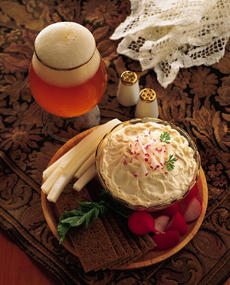
Oktoberfest beer with a spicy cheese dip.
Photo courtesy Wisconsin Milk Marketing Board.
  Each year, many people look forward to Oktoberfest, an annual 16-day beer festival held since 1810 in Munich, Germany—the country’s renowned Bavaria region, comprising southeast Germany.

Oktoberfest is said to be the world’s largest fair, with more than 6 million people attending—15% of the beer fans come from outside Germany. Other cities around the world hold their own Oktoberfests, modeled after the original.

While it’s called Oktoberfest (German for October feast), the event begins in late September and ends in early October.

As you can imagine, large quantities of Oktoberfest beer are consumed—almost 7 million liters were served during the 16-day festival in 2007. The traditional style of Oktoberfest beer is Märzen,* an amber-red, smooth, mildly sweet lager with a malty aroma, which originated in Bavaria.

 
To be designated Oktoberfest beer in Germany, the beer must conform to the Reinheitsgebot (the German beer purity law), which dictates a minimum of 6% alcohol (by comparison, America’s Budweiser has 5%). The beer must also be brewed within the city limits of Munich.

Traditional foods served with the beer include:

  • Cheese noodles (Käsespätzle, a noodle casserole with cheese and onions—here’s a recipe)
  • Grilled chicken (Hendl)
  • Grilled fish (Steckerlfisch)
  • Grilled ham hock (Schweinshaxe)
  • Potato dumplings (Knödel)
  • Potato pancakes (Reiberdatschi)
  • Pretzels (Brezeln)
  • Roast pork (Schweinebraten), and of course,
  • Sauerkraut and Blaukraut (red cabbage sauerkraut) with
  • Sausages (Würstl, including the Bavarian specialty Weisswurst, a white sausage made from veal and pork, seasoned with bacon, lemon, onions and parsley)
  •  
    *For German speakers who wonder why a beer named for the month of March (März in German) is celebrated in October: Märzen was originally brewed in March and laid down in caves before the summer heat made brewing impossible. At the end of September, any remaining kegs were consumed during the two-week Oktoberfest. While some modern brewers make Märzen seasonally for Oktoberfest, others brew it year-round.


    TIME TO PARTY

    There’s still time for you to have an Oktoberfest celebration. You don’t need to adhere to the German schedule: Consider that you’ve got all of October.

    For an adult Halloween party, combine the two events and do a tasting of Oktoberfest beers, fall beers and pumpkin beers/ales.

  • Brown Ales
  • Dunkelweizen
  • English/India Pale Ales
  • Harvest Beers/Ales
  • Oktoberfest/Märzen beers
  • Pumpkin Beers/Ales
  •  
    (Check out all the different types of beer in our Beer Glossary.)


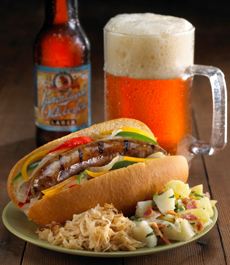
    Oktoberfest beer from Wisconsin: Leinenkugel’s Oktoberfest beer with sausage and sauerkraut. Photo courtesy Leinenkugel.


    Here’s a recipe from the Jacob Leinenkugel Brewing Company of Chippewa Falls, Wisconsin, for brats steamed in Oktoberfest beer.

    BRATS COOKED IN BEER

    Enjoy Leinenkugel’s recipe for Oktoberfest-Infused Bratwurst, brats boiled in beer, then grilled.

    Ingredients

  • 1 dozen brats
  • 1 dozen brat buns
  • Oktoberfest beer, to cover†
  • 1 medium large sweet onion, sliced
  • 1 green pepper, sliced
  • 1 yellow pepper, sliced
  • 1 red pepper, sliced
  • 2 ounces butter
  •  
    †We used 5 bottles.
     
    Preparation

    1. Place brats in a Dutch oven with sliced onions, peppers and butter; cover the brats with beer. Bring to a boil and reduce to simmer until brats are cooked. Remove brats and set aside remaining beer mixture.

    2. Grill brats until golden brown and return to beer mixture until ready to serve.

    3. Serve brats on fresh brat buns, plain or toasted, with your favorite toppings: ketchup, mustard, onions, peppers (chopped bell peppers or jalapeños) and sauerkraut.
     
    HOW MUCH BEER DO YOU NEED FOR A CROWD?

    If you’re planning a large event, use the handy calculator at Kegerators.com. We calculated that for a party of 25 guests consuming 3-5 beers apiece, we’d need 1 keg, 35 pounds of ice for a room temperature keg, and 30 cups, “Assumes 17% breakage, excluding drinking games.”


    Comments off

    PRODUCT: Multitasking Stuffed Burger Press


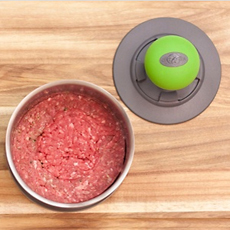
    Cut a well with the smaller ring and add your
    favorite stuffing(s). Photo courtesy HSN.com.
     

    We’ve seen a number of pieces from Cat Cora for Starfrit, a cookware line endorsed by the celebrity chef.

    But the newest, the Cat Cora by Starfrit 2-in-1 Burger Press is the one we’ll definitely use, over and over again.

    A burger press creates consistent, perfectly formed and sized burger patties.

    But this burger press has something extra: a smaller ring that can be used to form sliders and stackers, as well as to cut a well in a larger burger, to fill with your favorite complementary ingredients.

    Stuffed burgers are so much fun that we wonder how, in a country where burgers are the favorite food, they haven’t become the rage. We hope that the Cat Cora/Starfrit mold will be the beginning of a trend.


    Whatever your burger preference—beef, bison, chicken, lamb, pork, salmon, turkey (we haven’t tried it with a veggie burger)—you can make an already-delightful burger much more so.


    What should you use to stuff your burger? Whatever you like: That’s the fun of this gadget. You can look in the fridge and the pantry and find dozens of choices.

    We simply scanned our shelves. Then:

  • Beef. We stuffed different beef burgers with leftover arugula pesto, mashed potatoes, sautéed mushrooms, sautéed onions and sundried tomato concasse.
  • Lamb. We stuffed different lamb burgers with chutney, goat cheese and mint jelly.
  • Salmon. We stuffed different salmon burgers with chopped cucumber salad, mango salsa and tzatziki (yogurt sauce with garlic and mint).
  •  

    The Cat Cora For Starfrit 2-In-1 Burger Press. Photo courtesy HSN.com.


  • Bison. Tonight, we’re stuffing bison burgers with a mix of sliced cornichons and olives, and with bacon and truffle cheese (a reverse cheeeburger).
  • Surf & Turf. The next time we have some extra oysters for stuffing, we’re going to try a surf-and-turf burger.
  •  
    Intensify the flavor by adding fresh herbs—basil, chives, dill, garlic, parsley, rosemary, sage, thyme—or dried oregano and spices, to the filling.
    Imagine a pizza burger: tomato sauce and cheese stuffed into your favorite burger. How about a turkey burger filled with cranberry sauce and stuffing?

    Let us know what you’d use to stuff your favorite burger(s).
     
    The 2-in-1* burger press set includes:

  • 4.5-inch ring
  • 2.75-inch ring
  • 2 in 1 press
  • 2 lids for easy storage
  •  
    You can buy the burger press at HSN.com. At $24.95, it isn’t an inexpensive kitchen gadget. But it’s sturdy and will afford many years of bodacious burgers.

    HOW TO MAKE A STUFFED BURGER

  • Pack ground meat into the larger ring.
  • Cut a center well with the smaller ring.
  • Fill well 3/4 with the stuffing and cap the well with some of the meat you’ve removed.
  • Cook to desired doneness and serve.
  • Be prepared for squeals of delight from happy diners.
  •  
    *It’s actually more than 2 in 1. We count burgers, sliders, stuffed burgers and anything you need a round cutter for: biscuits, cookies, melon, and anything that begs to be molded (rice, veggies, etc.).


    Comments off

    TIP OF THE DAY: Greek Lamb Burger


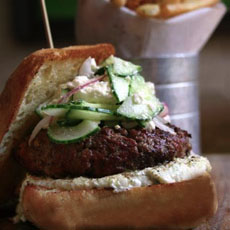
    [1] A lamb burger, Mediterranean style (photo © Hubbard Inn | Chicago).
    Ground Lamb For Burgers
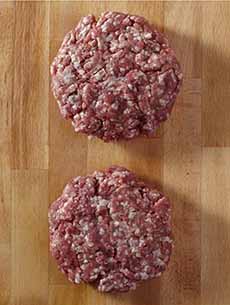
    [2] Ground lamb. Ground lamb typically contains lean meat and trimmings from the leg, loin, rib, shoulder, flank, neck, breast and/or shanks (photo © Cava Grillhttp://www.americanlamb.com” rel=”noopener” target=”_blank”>American Lamb Board).
    Tzatziki

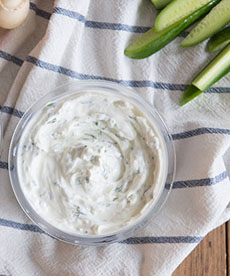
    [3] Tzatziki, a spread made with Greek yogurt, cucumbers, garlic, dill and lemon juice (photo © Cava Grill).

      Whether you prefer classic condiments and traditional toppings or would rather go the adventurous route, the hamburger lends itself to many interpretations.

    See our long list of burger variations for every day of the month, and then some.

    At Chicago’s Hubbard Inn, Executive Chef Bob Zrenner makes it even more adventurous.

    He substitutes lamb for beef, creating a Greek-style lamb burger.

    Chef Zrenner uses ground lamb from locally raised animals, and tops the patty with mint, cucumber, red onion and feta cheese.

    He topped the burger with tzatziki, a yogurt sauce, instead of ketchup.

    There’s juiciness from the lamb, creaminess from the feta and tzatziki, bright notes from the mint, and zesty red onion as a counterpoint to cool cucumber.

    You’ll note in photo #1 that Chef Zrenner’s tzatziki recipe is focused on cucumbers as the main ingredient, with a yogurt binding. The traditional Greek recipe has yogurt as the main ingredient, with added chopped cucumbers and seasonings.
     
     
    RECIPE: GREEK LAMB BURGER

    Ingredients

  • Ground lamb, 1/3 pound per person
  • 1 small red onion, thinly sliced
  • 1/4 cup chopped fresh mint leaves, plus more if making tzatziki
  • 1 small cucumber, thinly sliced*
  • 8 ounces tzatziki, purchased or homemade (recipe) (you can substitute hummus)
  • Ciabatta, hamburger buns, pita or rustic bread—or go breadless
  • Optional garnish: Kalamata olives
  •  
    Preparation

    1. PREPARE. If you haven’t purchased the tzatziki, make it with this recipe. You can make it up to a week in advance.

    2. GRILL. Cook burgers to desired doneness.

    3. LAYER. Cover the bottom bread slice (or add to the pita pocket) with tzatziki. Place patty on top. Add cucumbers, onion slices and mint leaves. Top with more tzatziki and serve.
     
    To Drink
     
    We enjoy this burger with a beer; but mint tea is also delicious.

    You can steep the leftover mint in boiling water and serve the tea hot or iced.
     
     
    _______________

    *We prefer to pickle the cucumbers for an hour or longer. It’s very easy with this recipe.


    Comments off

    TIP OF THE DAY: Three Minute Caramel Latte

    Yesterday we wound up in a long line at Starbucks. All we wanted was a plain cup of coffee. Everyone else was there for a caramel latte or pumpkin latte, which require far more prep time.

    Please don’t think we’re being self serving, but you can make your own caramel latte at home, in three minutes or less.

    The recipe below is courtesy Nescafé. I

    Recipe Variations

  • If you already have brewed coffee, substitute it for the coffee granules and the hot water. You’ll turn this into a two minute caramel latte!
  • You can substitute chocolate or strawberry toppings or flavored syrups for equally easy variations.
  • You can use sugar-free topping/syrup and lowfat evaporated milk for a low-calorie treat.
  • You can have one of these for dessert. For a richer dessert, add a scoop of ice cream.
  • You can vary the recipe with your favorite extracts (try almond extract) and other flavorings.
  •  
    You’ll save a lot of time and money. This recipe serves two, so instead of meeting at the coffee shop, invite a friend over. Perhaps s/he can pick up the muffins.
     
     
    THREE MINUTE CARAMEL LATTE

    Ingredients For 2 Servings

  • 1 can (12 fluid ounces) can Carnation Evaporated Milk (you can substitute evaporated lowfat milk or fat free milk)
  • 1/2 cup caramel ice cream topping plus additional for drizzle
  • 4 teaspoons Nescafe Tasters Choice French Roast Instant Coffee Granules
  • 1 cup very hot water (slightly less than boiling)
  •  
    Preparation

    1, MICROWAVE. Heat the evaporated milk and ice cream topping in small, uncovered, microwave-safe bowl on HIGH (100%) power for 2 minutes or until very hot.

    2. BLEND. Carefully pour the mixture into a blender. Cover and blend on high for 1 minute or until very frothy on top.

     
    [1] It’s easy to make caramel lattes at home (photo © Nescafé).


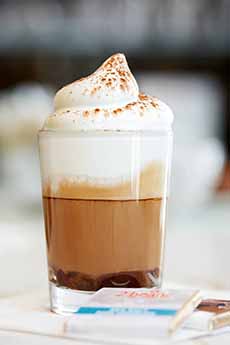
    [2] More coffee fun: a Viennese latte*, topped with whipped cream. Two shots of espresso are infused with whipped cream instead of milk, and topped with more whipped cream. Rich enough for you? (photo © 2 Beans [now closed])

    3. MAKE COFFEE. Place 2 teaspoons coffee granules into each of two 12-ounce coffee mugs. Add 1/2 cup hot water to each mug; stir.

    4. TOP. Gently pour the evaporated milk mixture into each mug, spooning foam on top. Top the foam with a thin drizzle of ice cream topping, if desired.
     
     
    > THE HISTORY OF COFFEE

    > COFFEE TERMS & TYPES

    > THE DIFFERENT TYPES OF ESPRESSO DRINKS
    ________________

    *The idea for Viennese latte comes from Viennese coffee. Here’s the recipe for Viennese coffee.


    Comments off

    COOKING VIDEO: Make Homemade Crackers


    Impress your family and friends with these homemade crackers.

    This easy recipe produces a gourmet cracker, fragrant with rosemary. Made with almond flour instead of wheat flour, the crackers are also gluten free.

    Serve them with cheese, hummus or other favorite dip or spread, salad or soup.

    Most people don’t think of baking their own crackers. But these tasty bites may just be the start of a creative cracker-baking hobby.


    Find more of our favorite crackers and bread recipes.

    Comments off

    The Nibble Webzine Of Food Adventures
    RSS
    Follow by Email


    © Copyright 2005-2026 Lifestyle Direct, Inc. All rights reserved. All images are copyrighted to their respective owners.