THE NIBBLE BLOG: Products, Recipes & Trends In Specialty Foods


Also visit our main website, TheNibble.com.

Roasted Balsamic Brussels Sprouts & Use The Leaves As Dishes

What’s the beautiful dish in the photo? Balsamic Brussels Sprouts, nested in a leaf from the stalk on which they grow. In French this presentation is called “en feuille” (pronounced “on FUY”–think of a very shortened “phooey”). The English translation is “in the leaf” or “in its leaf.”

The Brussels sprouts in this photo were grown at The Chef’s Garden in Huron, Ohio. But you can look for stalks with leaves at your local farmers market. If the leaves have already been removed, ask the farmer to bring stalks with the leaves intact next time.

In our house, buying a handsome stalk of Brussels sprouts from the farmers market is a rite of fall. But even if you buy the sprouts already trimmed from the supermarket, you can make the delicious Balsamic Brussels Sprouts recipe below.

Using the leaves of cruciferous vegetables for presentation is a free way to add interest to food. Beyond serving as a bowl or plate, the leaves can be torn into a salad not dissimilar to the now-ubiquitous kale (which is also cruciferous), julienned and stir-fried, and otherwise cooked.

And of course, you can use the leaves to hold other foods.

Even the stalk of the plant has culinary uses. Use Brussels sprouts stalks as you would use broccoli stalks.
 

  brussels-sprouts-in-jumbo-leaf-thechefsgarden-ps-230
Balsamic Brussels sprouts in a Brussels sprouts leaf. (You should put a plate under yours.) Photo courtesy The Chef’s Garden.
 
Some people get it into their heads that they should only eat the florets, but the stalks are just as delicious. If you feed those who won’t eat the stalks, slice them into rounds and steam them or sauté them with garlic.
 
 
RECIPE: ROASTED BALSAMIC BRUSSELS SPROUTS

Ingredients

  • 2 pounds Brussels sprouts
  • 1/2 cup extra virgin olive oil
  • 1/2 cup balsamic vinegar
  • 2 teaspoons garlic powder
  • 2 teaspoons salt
  • 1 teaspoon ground black pepper
  • 4 ounces pancetta, 1/4-inch-diced (substitute turkey bacon)
  • Sea salt/kosher salt and freshly ground black pepper
  • Optional: 1/4 cup pine nuts, chopped pecans, dried cranberries, raisins; 1/2 cup grated Parmesan
  •  
    Preparation

    1. PREHEAT the oven to 425°F. Trim the cores of the Brussels sprouts and cut them in half vertically. Save any loose leaves that fall off and cook them as well.

    2. TOSS the Brussels sprouts in a large bowl with the pancetta, olive oil, balsamic, garlic, salt, and pepper. Spread in an even layer on a rimmed baking sheet, place in the oven and roast until deep golden brown (30 to 35 minutes), tossing once during roasting.

    3. REMOVE from the oven and toss with the optional ingredients. Transfer to a serving plate and serve hot.


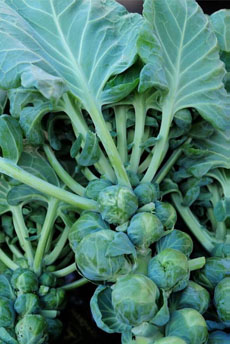
    brussels-sprouts-on-stalk-caroletopalian-ediblemadison-230
    Brussels sprouts on the stalk. Photo © Carole Topalian | Edible Madison. All rights reserved.
      ABOUT BRUSSELS SPROUTS

    The Brussels sprouts plant (Brassica oleracea) is a beauty: A stalk that grows to about four feet tall, crowned with large, wide graceful leaves. The sprouts, edible buds which resemble tiny heads of cabbage, grow from the bottom of the stalk to the top, in a charming progression from smallest to largest.

    If Brussels sprouts look like tiny cabbages, it’s because both are members of the cruciferous family of vegetables. Other members include arugula, bok choy, broccoli and broccoli rabe, cabbage, cauliflower, cress, daikon/radish, horseradish/wasabi, kale, kohlrabi, mizuna, mustard greens, rutabaga, tatsoi and turnips.

    While they are thought of as a cool-weather crop, Brussels sprouts can be found in markets year-round. The peak season is September through February.

    Few foods are more unpleasant than overcooked Brussels sprouts. The same is true with other cruciferous members: Excessive heat releases an unpleasant-smelling and -tasting chemical compound. But cook them lightly, and they are bites of pleasure.

     
    Similarly: Don’t store raw Brussels sprouts for more than a few days. The flavor gets stronger.
     
    BRUSSELS SPROUTS NUTRITION

    Brussels sprouts are exceptionally rich in protein, dietary fiber, vitamins, minerals and antioxidants, including glucosinolate, a phytochemical and an important cancer-fighting phytonutrient. All cruciferous vegetables contain glucosinolates, but Brussels sprouts are especially loaded.

    They are also cholesterol-fighters. Steamed Brussels sprouts actually have a have better cholesterol-lowering effect than raw brussels sprouts. The plant fibers do a better job of binding when they’ve been steamed.

    Brussels sprouts are an excellent source of vitamin C; one cup provides more than your daily requirement. Vitamin C, along with vitamins A and E, also found in the sprouts, protect the body by trapping harmful free radicals. Brussels sprouts are one of the best vegetable sources for vitamin K, which strengthens bones and helps to prevent, or at least, delay the onset of Alzheimer’s disease.

    Is there a better reason to eat them often?
     
     
    MORE BRUSSELS SPROUTS RECIPES

    As strange as “Brussels sprouts pizza” sounds, it is delicious. Other cruciferous members, like broccoli and arugula, often find themselves topping a pizza. Consider adding some fresh goat cheese in addition to the mozzarella and tomato sauce.

    Or, try these:

  • Brussels Sprouts Caesar Salad
  • Brussels Sprouts Potato Salad
  • Buffalo Brussels Sprouts Grilled Cheese Sandwich
  • Roasted Beets & Brussels Sprouts
  • Roasted Fingerling Potatoes & Brussels Sprouts
  •  
    TIPS

  • Bigger is not better. The most tender sprouts, with the sweetest flavor, are 1 to 1-1/2 inches in diameter.
  • Choose sprouts of similar size so they’ll cook evenly.
  • When cooking whole sprouts, make a shallow “X” on the bottom. This allows the heat to penetrate more effectively and cook them evenly.
  •  
     

    CHECK OUT WHAT’S HAPPENING ON OUR HOME PAGE, THENIBBLE.COM.


    Comments off

    FOOD 101: Lionfish & Lionfish Ceviche Recipe

    What are lionfish? You’re about to find out (and with a lionfish ceviche recipe, too). With the demand for Chilean seabass, halibut, swordfish, wild salmon, and other popular fish, retail prices for premium fish are so high that you might as well go to a restaurant for it.

  • Fresh Direct is currently listing these per-pound prices: wild Alaskan black cod fillet, $24.99; wild Chilean seabass, $29.99 (and it’s been previously frozen!); wild grey sole, $26.99; wild halibut, $23.99; wild snapper fillet, $24.99.
  • Even Ora King farm-raised king salmon (not the superior wild variety) lists at $24.99.
  • Elsewhere, yellowfin tuna is $23.99 a pound. Dean & DeLuca is selling a 2-pound combo, 1 pound of sashimi-grade yellowfin tuna, and 1 pound California halibut, for $75.00. Whew!
  •  
    We recently wrote about how trash fish, once discarded when netted along with more popular varieties, are becoming popular with restaurateurs and home cooks who want more affordable options. A fish restaurant in New York City, Seamore’s, recently opened with exactly that type of menu.

    Now there’s nuisance fish: invaders that are upsetting the local ecology. The “poster fish” is lionfish.

    Though beautiful to look at, they are the bane of the Caribbean.

    A recipe for lionfish ceviche is below, but you can substitute any fish.
     
     
    WHAT ARE LIONFISH?

    Voracious predators native to the Pacific and Indian Oceans, lionfish were brought (or tagged along) to the Caribbean, where they happily hang out among the coral reefs.

  • They have been observed consuming fish up to two-thirds their size.
  • They use their long fins to herd smaller fish and then attack them.
  • They eat crustaceans like crabs, shrimps, even juvenile lobsters.
  • The population of groupers has declined drastically because they are a preferred meal for lionfish.
  • The invaders are able to reach sizes that are twice the typical size they reach in their home waters. Females release 30,000-40,000 eggs at a time, as frequently as twice a week.
  • Unfortunately, lionfish have no natural prey. None of the large reef predators, such as snappers, groupers, and sharks, appear to want to eat them.
  • In many parts of the Caribbean, divers are encouraged to spear them. “Lionfish rodeos,” with the purpose of population control, are becoming as popular sport fishing event in resort areas. (Source)
  • Should you want to join the rodeo, be advised: Many of their long, spiny fins are venomous.
  •  
     
    TAKE A BITE

    The only good news is that, once the lionfish is cleaned and the venomous spines are removed, the meat is lovely. It is a delicate, white flaky fish, firmer in texture than halibut, with a flavor profile somewhere between grouper and mahi-mahi. It readily accepts any flavor and technique a cook wishes to use.

    With a new name, lionfish could become as popular as the Patagonian toothfish (renamed Chilean seabass for marketing purposes) and mahi-mahi/dorado (dolphinfish).
     
    Any suggestions?  
     
    RECIPE: LIONFISH CEVICHE

    Ingredients

  • 1 pound lionfish fillets
  • 1/3 cup lime juice
  • 1/3 cup rice wine vinegar
  • 1/3 red bell pepper, cubed
  • 1/3 green bell pepper, cubed
  • 1/3 red onion, diced
  • 1/3 avocado, diced
  • Small bunch cilantro, chopped
  • 2 scallions, chopped
  • 1/3 teaspoon Tabasco or other hot sauce
  • 1/3 teaspoon sesame oil
  • Salt and pepper to taste
  • Optional: fresh cilantro or parsley
  •    
    Lionfish
    [1] Beautiful but venomous: You may have seen a lionfish in a home aquarium, but they grow quite large and burdensome in the wild (photo © Christian Mehlfuhrer | Wikipedia.


    [2] Lionfish have 18 venomous spines: 2 pelvic spines, 3 anal spines, and 13 dorsal spines (photo © Jayhem | photos #1, #2 and #3 via Wikipedia).


    [3] A red lionish. Lionfish are also called firefish, turkeyfish, tastyfish, or butterfly cod (photo © Alexander Vasenin | Wikipedia).

    Lionfish Ceviche

    [4] Lionfish tastes like a cross between grouper and mahi-mahi. You can cook it or use it raw, in ceviche or sushi (photo courtesy Euro USA).


    Preparation

    1. CUT the lionfish, peppers, onion, avocado, and scallions into small cubes. Mix all ingredients together and marinate for at least two hours before serving.

    2. GARNISH with fresh herbs and serve.
     
     
    SEEK OUT THE UNFAMILIAR

    When you see an unfamiliar fish at the market, don’t hesitate to try it, especially if it’s well priced. Retailers wouldn’t sell it if it didn’t taste good—and the fresher, the better.


    CHECK OUT WHAT’S HAPPENING ON OUR HOME PAGE, THENIBBLE.COM.


    Comments off

    Fall Salad Recipe

    We were inspired by this Pear and Endive Salad from Barrel & Ashes in Studio City, California. It’s garnished with goat cheese, walnuts, and a maple balsamic vinaigrette.

    That’s a perfect salad recipe in our book. But how else can you make a fall-inspired salad? Start with your favorite lettuces. Then, add two or more selections from the fall produce list.

    Aim for fall colors: a bit of orange,

    FALL FRUITS

    Use them diced or sliced, raw or cooked:

  • Apples, skin on
  • Asian pear or American pear varieties, skin on
  • Huckleberries
  • Kumquats
  • Muscadine grapes
  • Orange slices or mandarin segments
  • Passionfruit
  • Persimmons
  • Pomegranate arils
  •  
    FALL VEGETABLES

  • Acorn, buttercup and butternut squash
  • Beets, red and yellow
  • Broccoli
  • Brussels sprouts
  • Cardoon (an artichoke relative, worth seeking out)
  • Carrot
  • Cherry tomatoes, ideally red and yellow mixed or heirloom shades
  • Cauliflower
  • Daikon radish
  • Endive
  • Jerusalem artichoke (sunchoke)
  • Kohlrabi (a cabbage relative)
  • Mushroom
  • Pumpkin
  • Radicchio
  • Red cabbage, shredded
  • Red onion
  • Red, yellow, and orange bell peppers
  • Sweet potato
  • Swiss chard
  • Turnips
  •  

    You can get lots of inspiration just by strolling up and down the produce aisles, looking for appealing colors and flavors.

       
    Fall Salad
    [1] Fall salad with maple balsamic vinaigrette. Be sure to add at least one fall color—deep yellow, orange, or red (photo © Barrel and Ashes | Studio City).

    beet & orange salad
    [2] Beets and oranges scream fall (photo © Socarrat Paella Bar | NYC).

    /home/content/p3pnexwpnas01_data02/07/2891007/html/wp content/uploads/broccoli salad souplantation 230r
    [3] Broccoli and cashew salad on pinto beans with red onion and red bell pepper (photo © Souplantation [permanently closed]).


    Yellow Beet Salad
    [4] Raw yellow beets, cooked red beets, and long strips of carrot add fall colors to a green salad (photo © Tender Greens).
     

    SALAD BASE

    Before you add the greens, fill the salad bowl with cooked beans, greens, or legumes.

  • Beans
  • Legumes: black-eyed peas, lentils, split peas
  • Rice
  • Whole grains (barley, brown rice, bulghur, quinoa, wild rice, etc.)
  •  
    SALAD GARNISHES

  • Bacon strips or lardons
  • Cheese, especially in harvest colors (Aged Gouda, Cheddar, Gjetost, Shropshire Blue and these);, cubed, julienned or shredded
  • Corn kernels
  • Chickpeas (garbanzos)
  • Dried apple or pear slices
  • Dried cranberries
  • Nuts: almonds, cashews, peanuts, pecans, and walnuts; candied, raw, or toasted
  • Seeds: pumpkin seeds (pepitas), sunflower seeds
  •  
    FALL SALAD DRESSING RECIPE: MAPLE VINAIGRETTE

    Ingredients

  • 1/3 cup balsamic or cider vinegar
  • 2 tablespoons pure maple syrup
  • 1 tablespoon Dijon mustard
  • 1/4 teaspoon salt
  • 1/4 teaspoon pepper
  • 2/3 cup olive oil
  • Optional: 1 teaspoon finely chopped garlic, 1 shallot finely diced
  • Optional: 1/2 teaspoon sage or thyme, or 1/4 teaspoon pumpkin pie spice
  •  
    Preparation

    1. COMBINE all ingredients. We like to emulsify it in the blender to prevent separation.


    CHECK OUT WHAT’S HAPPENING ON OUR HOME PAGE, THENIBBLE.COM.


    Comments off


    © Copyright 2005-2026 Lifestyle Direct, Inc. All rights reserved. All images are copyrighted to their respective owners.