|
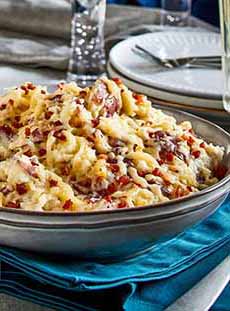
[1] Cheesy mashed potatoes with pancetta (photo © Wisconsin Cheese).

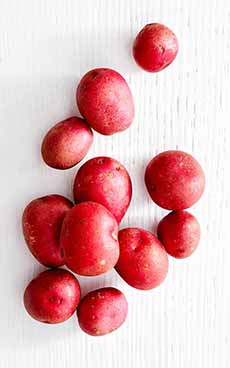
[2] Use baby red jacket potatoes (photo © Good Eggs).
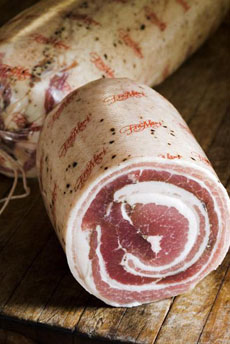
[3] Pancetta, sometimes called Italian bacon, is traditionally sold in a roll, but you can also purchase it in strips (photo © Fra Mani).
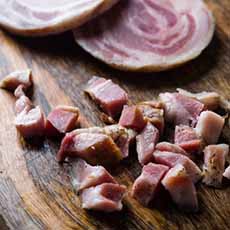
[4] You can purchase the roll and dice your own (photo © Di Bruno Bros.).
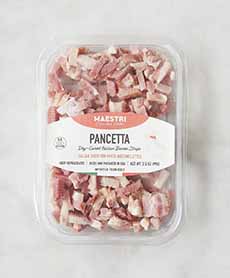
[5] You can also find pancetta cut into strips and ready to cook (product available from, and photo © Murray’s Cheese).
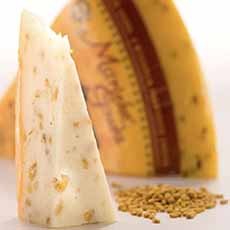
[6] Marieke Gouda with foenegreek, also spelled fenugreek, a spice that has a unique maple sweetness (it is used to make artificially-flavored maple syrup). It also has notes of curry or aged sherry wine on the finish (photos #6 and #7 © Marieke Gouda).
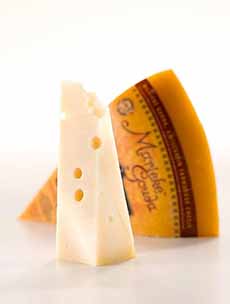
[7] Classic Gouda from Marieke.
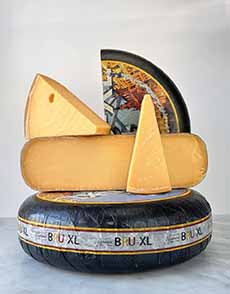
[8] A wheel and slices of Bru XL Gouda, made in the Netherlands with a traditional Gouda recipe and aged for at least 16 months (photo © Talbott & Arding).
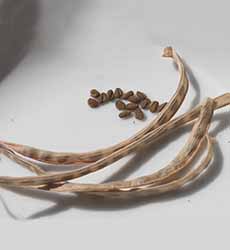
[9] Dried enugreek pods. You can see the seeds inside (photo © Luscious Green Balcony).
[10] Lager pairs well with younger Goudas, darker beers with older Goudas (photo © Unos).
[11] Or, pour a glass of red or white wine (photo © Sur La Table).
[12] Or, pour yourself a dram of Scotch (photo © Eva Elijas | Pexels).
|
|
December 30th is National Bacon Day, and we’ve got two special recipes for you. First up is a recipe for Pancetta & Gouda Mashed Or Smashed Potatoes, below. Our second special recipe is Bacon-Topped Apple Pie, the bacon woven into a lattice crust.
But first, a moment to review some nuances in the mashed potatoes recipe:
What’s the difference between pancetta and bacon?
Pancetta is sometimes called Italian bacon, but the products are not identical.
Bacon and pancetta are both cut from the belly of the pig.
Bacon is cured with salt and then smoked and sliced. It needs to be cooked before you eat it.
Pancetta is dry-cured with salt, black pepper, and spices and rolled into a cylinder. It’s fully aged, so it can be thinly sliced and eaten raw.
As with bacon, you can cook thin slices of pancetta in a pan with eggs, or by itself. Dicing and slowly rendering the fat out of the pancetta is a common way to prepare it.
What about the difference between mashed potatoes and smashed potatoes?
While some people use the terms interchangeably, there is a difference. It’s a question of what texture you prefer (and also, how much time you want to spend: smashing is faster than mashing).
To smash is to simply break the cooked potatoes into pieces.
To mash is to finely reduce the potatoes into a soft texture.
Mashed potatoes are usually skin off, fully cooked, and then mashed into creaminess with butter and milk.
Smashed potatoes are smashed with their skins on.
The skins deliver dietary fiber, vitamin C, and potassium, plus small amounts of iron, magnesium, and vitamin B6.
This recipe from the Dairy Farmers Of Wisconsin, WisconsinCheese.com turns cheesy mashed potatoes into something even more special, with pancetta.
> The history of bacon.
> The different types of bacon: a photo glossary.
> The history of cheese.
> The different types of cheese: a photo glossary.
> All about Gouda cheese.
> A brief history of Gouda is below.
.
RECIPE: CHEESY PANCETTA SMASHED OR MASHED POTATOES
The Dairy Farmers Of Wisconsin recommend Marieke® brand Gouda for this recipe, preferably Marieke Gouda Foenegreek (fenugreek*) cheese flavored with fenugreek for added flavor; but the Plain Mature version is fine.
You can substitute another Gouda, of course.
If you don’t like Gouda, you can substitute Edam, Gruyère, Havarti, or Muenster cheese, all of which closely mimic the taste and consistency of Gouda.
Other options include Cheddar, Comté, Emmentaler, Fontina Cheese, and Taleggio. Let your palate be your guide.
Prep time is 10 minutes and cook time is 22 minutes.
Ingredients For 8 Servings
10 ounces sliced pancetta, diced
2 pounds. small baby red potatoes, quartered
3 garlic cloves
1/2 cup (1 stick) unsalted butter, melted
1/2 cup heavy whipping cream
8 ounces Gouda cheese, shredded (2 cups)
Salt and pepper to taste
Optional garnish: minced chives or thinly-sliced scallions
Preparation
1. FRY the pancetta in a large skillet over medium heat until crisp. Remove it with a slotted spoon to paper towels to drain. Meanwhile…
2. PLACE the potatoes and garlic in a large saucepan; cover with water. Bring to a boil. Reduce the heat and cook, covered, for 20-22 minutes or until potatoes are tender. Drain.
3. SET aside a quarter of the potatoes in a bowl. Return the garlic and remaining potatoes to the pan; add the butter and cream. Mash the potatoes.
4. COARSELY MASH the reserved potatoes. Fold in the Gouda, pancetta and reserved potatoes. Season with salt and pepper to taste.
A BRIEF HISTORY OF GOUDA CHEESE
Today Gouda (pronounced HOW-duh in Dutch) is one of the most popular cheeses worldwide. The name is not origin-protected internationally, so anyone can make Gouda.
However, there are P.G.I. and P.D.O. designations for specific Goudas made in Holland.
Here’s how Gouda came to be.
In the Middle Ages, the Van der Goude family built a castle on the bank of the Gouwe River in South Holland. The settlement around the castle grew into the town of Gouda, which became known for its fine aged cheese, Goudse kaas (“Cheese from Gouda”) made from cow’s milk.
The cheese is named after the city of Gouda, South Holland, not because it was produced in or around that city, but because it was traded there: buying, selling, and exporting [source].
The first mention of Gouda cheese dates from 1184, making it the oldest recorded cheeses in the world still produced today with the same recipe.
In the Middle Ages, Dutch cities could obtain certain feudal rights which gave them primacy (a total monopoly) on certain goods.
Within the County of Holland, Gouda acquired market rights on cheese: the sole right to have a market in which the county’s farmers could sell their cheese.
All the cheeses would be taken to the market square in Gouda to be sold. Members of the guild of cheese-porters, identified by colored straw hats, carried the farmers’ cheeses in barrows (each cheese typically weighed about 16 kg, 35 pounds).
Buyers then sampled the cheeses and negotiated a price using a ritual bargaining system called handjeklap in which buyers and sellers clap each other’s hands and shout out prices.
Once a price was agreed upon, the porters would carry the cheese to the weighing house and complete the sale.
Modern Gouda
Modern Gouda had evolved by the Dutch Golden Age in the 17th century.
The market tradition continues today on Thursday mornings during the summer months, when wheels of Gouda wrapped in wax rinds are displayed on mats upon the city’s ancient cobblestones.
With an authentic Gouda, the longer the cheese ages, the harder and saltier it gets. Younger Goudas are creamier. Extra-aged and triple-aged Goudas, up to five years of aging, can be found.
The longer the cheese is aged, the more intense and complex the flavors. Older Goudas deliver exciting butterscotch flavors that complement the pungency. Read our full article on Gouda to learn all about this wonderful cheese and see photos of younger Goudas.
Often, herbs, seasonings and nuts are added to the milk in order to enhance the cheese’s flavor.
Some artisans also make Gouda from unpasteurized goat’s or sheep’s milk.
Because the name is not origin-protected, it can be made anywhere in the world.
Gouda is produced on a large scale in factories all over the world, with great differences in quality and taste, from Japan to Poland. The U.S. produces both artisan (like Marieke, below) and industrial Gouda.
In the Netherlands, 650 million kilos of Gouda cheese are produced every year. Most of it is produced industrially from pasteurized milk, but there are still 280 farmers throughout the country who produce farmhouse cheese from raw milk [source].
PAIRING GOUDA CHEESE
Gouda is a popular table cheese or dessert cheese that goes well with alcohol.
Beer, an amber or brown ale or a lager, is the ideal alcoholic accompaniment to a young Gouda. Light red or fruity white wines are the drink of choice with a more mature cheese.
For younger cheeses, Chenin Blanc or fruity Riesling works well.
The aged Goudas pair well with aged White Burgundy or Chardonnay, which has butterscotch and caramel tones that match those in the cheese. Or try a dry Riesling.
For reds, try a heartier fruity reds, including Cabernet Sauvignon, Merlot, Syrah, Shiraz and Zinfandel.
For beers, aged Gouda goes well with a stronger and maltier Doppelbock, Belgium dubbel, or a coffee stout or chocolate stout.
Smoked Gouda pairs well with Bock beer which has a strong toasted flavor, or a smoked porter.
For a whiskey pairing, try a single malt scotch from Speyside, the nutty and fruit flavors of which complement the cheese.
An aged Gouda goes well with an aged bourbon or rye whiskey or a Highland scotch with more intense flavors.
A smoked Gouda pairs with a peaty Scotch from Islay.
For snacking or a cheese course, pair Gouda with toasted almonds, fresh fruits (apples, peaches, pears) and dried fruits (apricots and cherries).
Add Gouda to a charcuterie board along with crudités.
A perfect bread pairing is maple oatmeal bread. Pumpernickel is another good choice.
Gouda on sandwiches, including grilled cheese and burgers, is a winner.
Gouda is a great melting cheese. Use it in macaroni and cheese, cheese-based soups, fondue, and of course, gouda mashed potatoes per the recipe above.
In the Netherlands, Gouda is often used to enhance the flavors and aromas of soups and sauces.
An aged Gouda, which is sweeter and more complex, can be paired with chocolate and even a chocolate brownies, cut into bite-size pieces. And you can have it with a snifter of dark rum.
ABOUT MARIEKE GOUDA CHEESE
Marieke and Rolf Penterman are first generation Wisconsin dairy farmers. They moved from the Netherlands to Wisconsin, America’s premier dairy state, in 2002.
Marieke Gouda is their signature cheese, a handcrafted, artisan cheese made with an authentic Old World Gouda recipe. The equipment, cultures, herbs and spices are all imported from Holland.
The rBGH-free milk from their cows, used to make the cheese, couldn’t be fresher: It’s piped directly from the first milking of the day into the processing vat.
These are raw milk cheeses; the milk is not pasteurized. Instead, after the curd is hand packed into 18-pound forms (molds) and pressed, it’s aged for at least 60 days to be as fresh and clean as possible.
But first, the curds are washed with hot water, which rapidly release moisture and removes much of the lactose. (This process unintentionally created Gouda’s sweet flavor notes, which become even more pronounced as the cheese ages.) The curds are then pressed into molds.
The cheeses age in the curing room on Dutch pine planks, which absorb the liquid as the cheeses age.
For the first 14 days the cheese is turned (flipped over) daily to ensure that the butterfat is evenly distributed throughout the cheese. The wooden planks are also cleaned daily and turned to prevent molds.
During this time a breathable coating is hand-painted on the cheese (other cheesemakers use wax; factories often use plastic). After the initial daily turning is complete, the cheese is turned twice weekly for as long as it is in the facility.
|
Goudas are available from young (aged 2-4 months) up to 24+ months, with a Gouda Reserve that’s aged for 1000+ days.
The Goudas are sweet and nutty with flavor notes reminiscent of maple syrup.
In addition to plain Gouda, there are flavored Goudas: Bacon, Burning Mélange (garlic and parsley), Cranberry, Cumin, Foenegreek, Hatch Pepper, Honey Clover, Jalapeño, Mustard Mélange, Smoked Cumin, Smoked Plain Gouda, Summer Fields (rosemary and thyme), and Thorp (with a hint of Thorp red wine).
There are also plain and flavored Gouda spreads.
The herbs and seeds are gathered in the Netherlands.
This multiple award winning cheese is a must-try for anyone interested in American Artisan cheeses. It has won prizes at the American Cheese Society Annual Cheese Competition, the U.S. Cheese Championship, and the World Dairy Expo.
You can peruse (and buy) the entire line at MarekeGouda.com.
________________
*Fenugreek (Trigonella foenum-graecum), also spelled foenegreek, is a legume that is used as a spice (photos #6 and #8). The English name derives via the Middle French fenugrec from the Latin faenugraecum, faenum Graecum, meaning “Greek hay.”
The plant stands 2–3 feet tall, with green leaves, small white flowers, and pods that contain small, golden-brown seeds (photo #6). The seeds are bitter, with a powerfully aromatic and pungent flavor. In addition to seed and powder forms, they also yield an oil that is used to flavor butterscotch, cheese, licorice, pickles, rum, syrup, and vanilla.
The seeds and powder are used in Middle Eastern and Indian cuisines, especially in spice blends (curry powder and others). Fenugreek adds a certain distinctive bitterness to curries (especially vegetable and lentil dishes), but when dry roasted, it develops a nutty maple flavor. In fact, it is one of the primary ingredients for flavoring artificial maple syrup!
In Indian cuisine, fenugreek leaves (known as kasuri methi) are eaten with potatoes and rice and are used extensively to flavor curries. Their smell is grassy and their flavor is somewhat celery-like.
CHECK OUT WHAT’S HAPPENING ON OUR HOME PAGE, THENIBBLE.COM.
|