THE NIBBLE BLOG: Products, Recipes & Trends In Specialty Foods


Also visit our main website, TheNibble.com.

Hot & Spicy Congee Recipe For International Hot & Spicy Day

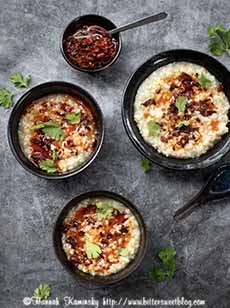
Hot and spicy congee with chili crisp
[1] Hot and spicy congee with chili crunch. The recipe is below (photo © Hannah Kaminsky | Bittersweet Blog).

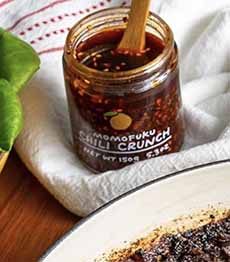
A jar of Momofuku Chili Crunch spicy condiment
[2] Chili crunch gives heat to this recipe. It’s become a popular ingredient, found in Asian stores as well as general grocers, including Trader Joe’s. This one is available on Amazon (photo © Momofuku).

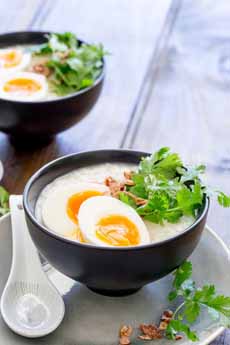
Congee With Boiled Egg
[3] Plain congee with a boiled egg. Here’s the recipe (photo © Sprinkles and Sprouts).

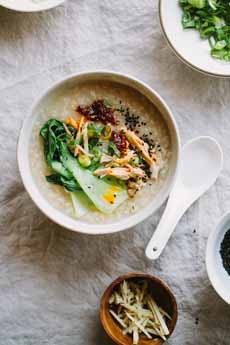
Ginger Chicken Congee made with brown rice
[4] This ginger chicken congee is made with brown rice. Here’s the recipe (photo © Honest Cooking).

Seafood Congee
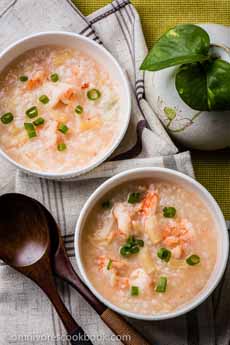
[5] Seafood congee adds shrimp and scallops. Here’s the recipe (photo © Omnivore’s Cookbook).


Have you ever eaten something that was spicy enough to wake the dead? Then try the Hot & Spicy Congee recipe below.

O.K., maybe waking the dead is an exaggeration. But though not for the weak of stomach, this recipe works for cold or flu season, and might be just what the doctor ordered: a hot and spicy alterative to Jewish chicken soup.

Just in time for International Hot & Spicy Day, January 16th, our colleague Hannah Kaminsky of Bittersweet Blog turned creamy, hearty, and soothing, classic congee (Chinese rice porridge) into something befitting the holiday.

The dish gets a spicy upgrade with a generous spoonful of chili crisp (a.k.a. chili crunch), an ingredient that’s been “discovered” in the U.S. over the past few years.

This easy-to-make dish is something spicy for breakfast, a side dish with flair, or as a main course like risotto, topped with shrimp, tofu, or other protein—even beans.

Toppings for congee are entirely up to the eater. Like risotto, the creamy rice porridge is, as Hannah says, “a gracious base for anything your heart desires.”

She’s a big fan of shiitake mushrooms paired with congee. “Add textural contrast,” she says, “with toasted pine nuts or slivered almonds.”

But the chili crunch, she advises, is “what transforms a bowl of mush into a downright addictive meal,” which she can eat straight from the jar.

And by the way, this spicy congee recipe is also helper when you’re feeling under the weather. Read more below.

> The history of congee is also below.
 
 
ABOUT CHILI CRISP

Chili crisp, also known as chili crunch, is a Chinese condiment that consists of fried garlic, onions, shallots, and chili flakes in oil. It was first made by Lao Gan Ma, a Chinese food company known for its chili sauce products.

The exact origin of chili crisp is a crisp tale as well.

Back in 1989, Lao Gan Ma’s founder, Tao Huabi, was an illiterate widow raising two sons in a rural village in Guizhou Province, one of the poorest regions in China’s southwest.

She ran a food truck and sold tofu cold noodles. She offered her homemade chile sauces for dipping.

Before long, she noticed that customers preferred her chile sauces over her tofu and noodles. And so, in 1996, the Lao Gan Ma brand was born. The name means old godmother.

More than two decades later, Tao has a reported net worth of $1.9 billion, making her one of the richest women in China. Here’s more about it.
 
 
RECIPE: SPICY CHILI CRISP / CHILI CRUNCH CONGEE 

Total prep and cook time is 1 hour.
 
Ingredients For 3-4 Servings

  • 1/2 cup sushi rice
  • 4 cups chicken or vegetable stock
  • 1/2 teaspoon salt
  • 1/2-Inch fresh ginger, peeled and finely minced
  • 2 cloves garlic, minced
  • 1 1/2 teaspoons soy sauce
  • 3-4 tablespoons Chili Crisp
  • Garnish: 2 tablespoons fresh cilantro, chopped
  •  
    Preparation

    1. COMBINE the rice, stock, salt, ginger garlic, and soy sauce in a medium saucepan. Bring the mixture to a boil, then reduce the heat to a low simmer. Stir occasionally so that the rice doesn’t clump or stick to the bottom.

    2. SIMMER for about 1 hour, or until the rice is fully cooked and the congee is thick and creamy. Ladle into bowls and top with chili crisp and cilantro, as desired. Enjoy hot.

    The congee will continue to thicken as it cools. Adjust with additional stock or water if needed to achieve your desired consistency.
     
     
    THE HISTORY OF CONGEE 

    Congee, rice porridge, has a long history and is a staple food in many Asian countries. The dish has its roots in China and has been consumed for millennia.

    Congee traces its origins back to ancient China, where it was considered a nutritious and easily digestible food. The earliest records of congee consumption date back to the Zhou Dynasty (1046–256 B.V.E.). It was initially used as a medicinal food to treat digestive ailments.

    It is also mentioned in the Chinese Record of Rites of the first century C.E., and noted in Pliny’s account of India circa 77 C.E.

    Over time, congee spread to other Asian countries, including Japan, Korea, Vietnam, and Thailand. Each region developed its own variations of the dish, incorporating local ingredients and flavors. For example:

  • In China, you may find savory congees with ingredients like preserved eggs, pickled vegetables, or meats.
  • In contrast, in Japan, okayu is a type of congee often served with toppings like pickled plums or seaweed.
  •  
    While the dish is associated with East Asian cuisine, the word “congee” itself has its origins in the Tamil kanji (also the Telugu and Kannada gañji, the Malayalan kanni and the Urdu ganji), from kanjī, “boilings,” referring to the water in which rice has been cooked [source].
     
     
    Medicinal Uses Of Congee 

    Congee was and is often prescribed by traditional Chinese medicine practitioners for its healing properties.

    The soft porridge is easy on the digestive system and recommended for people recovering from illnesses.

    Thus, it’s not only a common breakfast dish and comfort food, but is also consumed during times of discomfort.
     
     
    Modern Congee 

    Congee continues to evolve from its deep historical roots. Modern variations include sweet congees, with ingredients like red beans or fruit.

    Whatever the topping, congee remains a versatile and beloved dish, appreciated for its simplicity and adaptability, across Asia and beyond.
     
     
    THE HEALTH BENEFITS OF CAPSAICIN 

    Hot chile peppers have genuine medicinal properties thanks to their characteristic burn from capsaicin, the compound responsible.

  • For short term pain relief, biting into a blisteringly hot food releases endorphins, creating a mild “high” and dampening other discomforting sensations, like headaches, joint pain, and beyond.
  • Chile peppers are great for improving heart health! Studies have shown they can reduce inflammation, lower cholesterol, and increase blood flow.
  • Stress less with a calming dose of B-complex vitamins such as niacin, pyridoxine (vitamin B-6), riboflavin and thiamin (vitamin B-1). Deficiencies in these vitamins can lead to added anxiety or trouble regulating moods over time.
  •  
    Have tissues handy, because this stuff will clear out your sinuses and ease congestion.

    Plus, capsaicin has antibacterial properties which are effective in fighting and preventing chronic sinus infections.


    CHECK OUT WHAT’S HAPPENING ON OUR HOME PAGE, THENIBBLE.COM.


    Comments off

    Everything Bagel Popcorn Recipe For National Bagel Day

    January 15th is National Bagel Day, the first bagel holiday of the year* and we’ve got a fun recipe for you: Everything Bagel Popcorn.

    The recipe follows, but first:

    > Check out more bagel recipes below.

    > More foods waiting for “everything” topping.

    > The history of the bagel.

    > The history of the everything bagel.

    > The history of popcorn.

    > Check out all of the popcorn holidays below.
     
     
    RECIPE: EVERYTHING BAGEL POPCORN WITH
    HOMEMADE EVERYTHING SEASONING

    While it’s easy to purchase an “everything bagel” seasoning mix, this recipe shows how easy it is to make your own.

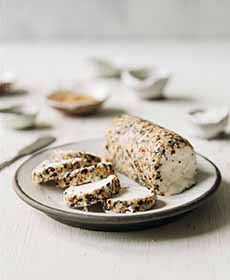
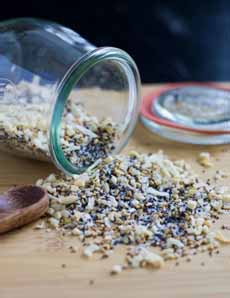
    Make extra to keep in the pantry. Use it in salad dressings, on cole slaw and potato salad, eggs, green salads, grilled chicken and fish, yogurt and cottage cheese, and of course, on soft cheeses like cream cheese and goat cheese (photo #3).

    Thanks to the National Popcorn Board for the recipe.
     
    Ingredients For 4 Servings

  • 8 cups popped popcorn
  • 2 tablespoons butter, melted
  • 2 tablespoons poppy seeds
  • 2 tablespoons black sesame seeds
  • 1 tablespoon garlic flakes
  • 1 tablespoon onion flakes
  • 1/2 teaspoon salt
  • 1/2 teaspoon black pepper
  •  
    Preparation

    1. MIX together the seeds and seasonings in a small bowl.

    2. PLACE the popcorn in a large bowl. Drizzle with the melted butter and sprinkle with seasoning mix. Toss until well-coated. Eat.

    3. STORE any leftover seasoning mix in airtight container.
     
     
    MORE BAGEL RECIPES

  • Bagel Buffet
  • Beautiful Bagel Toppings
  • Healthier Bagels
  • Homemade Bagels
  • Pumpkin Cream Cheese
  • Red Caviar Bagel
  • Strawberry Cream Cheese
  • Sweet & Crunchy Cream Cheese Spread
  • Weekend Bagel Brunch Platter
  •  
     
    POPCORN HOLIDAYS

  • January 19: National Popcorn Day
  • February, 2nd Saturday: Global Movie Day
  • March, 2nd Thursday: National Popcorn Lovers’ Day
  • April 6: National Caramel Popcorn Day
  • May 20: National Streaming Day
  • June, 2nd Friday: National Movie Night
  • July 12: National Paper Bag Day
  • September: Whole Grains Month
  • September 25: Binge Day (for movies)
  • October: National Popcorn Poppin’ Month
  • December 2: Business of Popping Corn Day†
  • December 13: National Popcorn String Day
  • December 15: National Chocolate-Covered Anything Day‡
  •  

    A bowl of popcorn with Everything Bagel seasoning
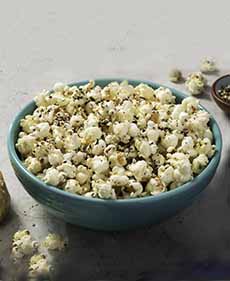
    [1] Everything Bagel popcorn (photo © National Popcorn Board).

    A tray of Everything Bagels
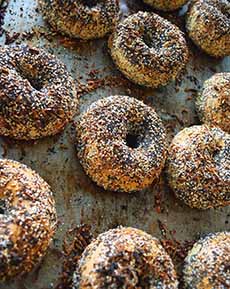
    [2] The “real” Everything Bagel (photo © Siegel’s Bagelmania | Facebook).

    A Goat Cheese Log rolled in Everything Bagel spices
    [3] You can used the Everything Bagel seasoning on just about anything, including a goat cheese log (photo © Vermont Creamery).

    Everything Bagel Topping
    [4] Make extra Everything Bagel topping and keep it stored in an airtight jar (photo © Take Two Tapas).

     
    ________________
     
    *Bagel Holidays: National Bagel Day is January 15th. National Bagels & Lox Day is February 9th. National Bagelfest Day is July 26th. In 2018, the Thomas’ English Muffin division of Bimbo Bakeries USA decided to move the date from February 9th to January 15th to avoid competing with National Pizza Day. This was a marketing decision of a single company, but today January 15th is the date that appears first in an online search, while February 9th got lox added to the bagels.

    †Business of Popping Corn Day commemorates the invention of the first large-scale commercial oil popcorn popper by Charles Cretors in 1885.

    ‡Here’s a recipe for chocolate-covered popcorn.


    CHECK OUT WHAT’S HAPPENING ON OUR HOME PAGE, THENIBBLE.COM.


    Comments off

    Dutch Crunch Bread: What It Is & Recipes To Bake Your Own

    A pastrami sandwich on San Francisco's Dutch Crunch bread
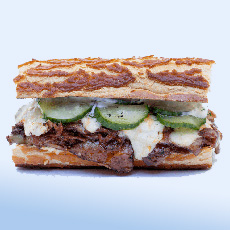
    [1] Hot Johnnie’s Dutch Crunch Pastrami Sandwich, made on Dutch Crunch bread. On this loaf, the rice paste forms “tiger stripes” (photo © Flavor & The Menu).

    Dutch Crunch Bread Mini-Loaf on a cooling rack
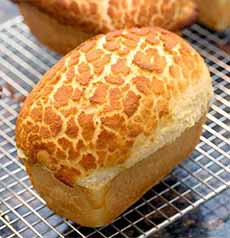
    [2] In these and the remainder of the Dutch Crunch photos, the pattern is giraffe-like. Here’s the recipe (photo © Honeyville).

    Rolls of Dutch Crunch Bread, a.k.a. Giraffe Bread
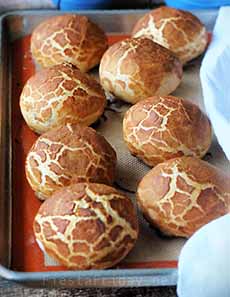
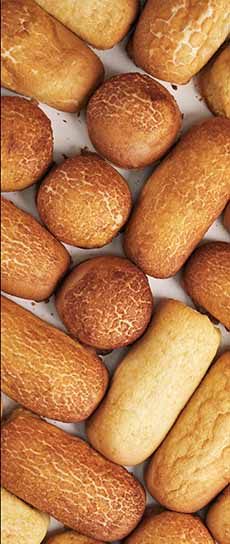
    [3] Another example of why it’s also called giraffe bread. In addition to loaves, round and oblong rolls are made for sandwiches. Here’s the recipe (photos #3 and #4 © Fiesta Friday).

    Ham & Cheese Slider on a blue plate
    [4] Enjoy a ham and cheese on a Dutch Crunch roll.

    A loaf of Bloomer Bread
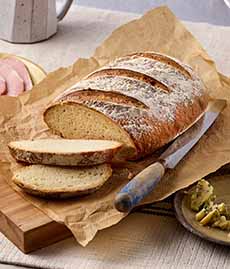
    [5] A loaf of bloomer bread. Here’s a recipe (photo © Doves Farm).

    Round and oblong Dutch Crunch rolls
    [6] Round and oblong Dutch Crunch rolls (photo © Max’s Dutch Crunch).


    January 14th is National Pastrami Day. We’d tucked a link from Flavor & The Menu about a pastrami sandwich onto our calendar, and when we checked it out we found something we knew nothing about: Dutch Crunch bread.

    First, about the pastrami sandwich in photo #1, which happens to be made on Dutch Crunch bread:

    Pastrami is beef brisket that has been cured, coated in spices (crushed black pepper, coriander, mustard seeds, garlic, and others), cold smoked, and then steamed.

    Hot Johnnie’s Dutch Crunch Pastrami Sandwich is the creation of Jonathan Young, chef/owner of pastrami smokehouse Hot Johnnie’s in San Francisco.

    Instead of the classic pastrami on rye, Hot Johnnie’s Dutch Crunch layers house-smoked pastrami and creamy, and melted Muenster cheese on Dutch Crunch bread, spread with house-made pepperoncini aïoli. Fresh dill and house-made pickles tie the flavors together.

    “Dutch Crunch is one of the most beloved types of breads in the Bay Area,” says Chef Young. “This sandwich is simple yet packed with flavor and incredible texture” [source].
     
     
    SO WHAT IS DUTCH CRUNCH BREAD?

    It turns out that this white bread with a crunchy top descends from tiger bread, which originated in The Netherlands.

    In Dutch, the bread is called tijgerbrood (tiger bread) and tijgerbol (tiger roll).

    The earliest mention of a bread with a crispy, rice flour topping comes from the Netherlands in the early part of the 20th century [source].

    Over time, it spread beyond The Netherlands and became especially popular the U.K., at both artisan bakeries and supermarket chains.

    In 2012, the giant grocery chain Sainsbury’s renamed the tiger bread to “giraffe bread” at the suggestion of a 3-year-old girl.

    Via letter to management and subsequent online petition, she astutely pointed out that the mottled pattern of the crust is much closer to a giraffe’s coat [source 1] [source 2].

    (However, you can see from photo #1 that it is possible to create tiger’s stripes.)

    Tiger bread is begins with soft and fluffy white bloomer bread loaf (photo #5).

    But it gets its “tiger” pattern (or giraffe pattern, depending on your point-of-view) from a rice flour paste which is brushed on time and bakes to a distinctive crunch.
     
     
    Tiger Bread Becomes Dutch Crunch Bread

    Dutch Crust is the San Francisco incarnation of Tiger Bread—named because the original name (and concept) was Dutch.

    It’s an oblong or rectangular loaf with a crinkled, golden-brown crust that crackles when you bite it (photo #2).

    The crumb (the inside) is soft, molding to whatever is placed between the slices.

    The golden brown color is the result of a Maillard reaction* (the same browning that colors toast).

    The crust is made up of of rice flour, sugar, oil, water, and yeast, blended into a paste and brushed on top of the bread. When heat is applied (i.e., baking), these ingredients create a much crunchier crust.

    Because rice flour is free of gluten and has more and different starches than wheat flour, this paste creates the crinkle topping.

    Because of the absence of gluten, the top coat does not spread. Thus, while the wheat bread beneath is expanding from the heat of the oven, the rice flour paste on top dries, cracks, and crisps up to create the patterned look [source].

    The appeal is not only visual, but also textural and aural (you can hear it crunch).
     
     
    WHERE TO BUY DUTCH CRUNCH BREAD

    Unless you live in the San Francisco Bay area, it’s tough to find Dutch Crunch bread. It can sometimes be found in the Pacific Northwest.

    On the East Coast, Wegmans grocery once sold something similar under the name “Marco Polo” bread, but it is not currently on the website. Here’s a photo from 2009—close but no cigar.

    We hope that bakers nationwide get hip to the opportunities Dutch Crunch—or Tiger—or Giraffe—or What Will You—presents.

    In the interim, we found two resources online. While we haven’t tried them, here are two options if you don’t want to bake:

  • Max’s Dutch Crunch
  • Boudin Bakery
  •  
     
    MORE TO DISCOVER

    > The history of pastrami.

    > The different types of sandwich: a photo glossary.

    > The history of the sandwich.

    > The different types of bread: a photo glossary.

    > The history of bread.
     
     
    ________________
     
    *If you’re into science, the color comes from a reaction between the sugar and an amino acid in the bread or other food. Called the Maillard (my-YARD) reaction after the French physician and chemist Louis Camille Maillard, it’s a form of non-enzymatic browning that usually requires heat. Each type of food has a very distinctive set of flavor compounds that are formed during the Maillard reaction. The color and flavor of toasted bread and nuts; barbecued, roasted and seared meats; and roasted coffee (and many others—the browning on fried dumplings, cookies and other kinds of biscuits, breads, toasted marshmallows, and many more) are the result of Maillard reactions. Thus caramel candy is the result of a Maillard reaction. However, the process called caramelization—the caramelization of sugar, as opposed to the creation of the candy—is not a Maillard reaction but a different type of non-enzymatic browning, not involving amino acids. Instead, the sugar is oxidized.


    CHECK OUT WHAT’S HAPPENING ON OUR HOME PAGE, THENIBBLE.COM.


    Comments off


    © Copyright 2005-2026 Lifestyle Direct, Inc. All rights reserved. All images are copyrighted to their respective owners.