THE NIBBLE BLOG: Products, Recipes & Trends In Specialty Foods


Also visit our main website, TheNibble.com.

PRODUCT: Bumble Bee Flavored Tuna

There’s lots of excitement at Bumble Bee. The iconic canned tuna brand has launched new flavored tunas plus fresh-frozen, ready to heat-and-eat fish and shrimp entrées.
NEW CANNED TUNA FLAVORS

Following the growing preference for spicy flavors in everyday foods, Bumble Bee launched new Prime Fillet Gourmet Flavors. The seasoned premium white albacore tuna is ready to go directly onto salad greens, pasta or rice—along with the healthful olive oil they’re canned in. There’s no need for mayonnaise here!

To add to a burrito, sandwich, wrap or other “holder,” drain the oil—but save it to use with a can of plain tuna.

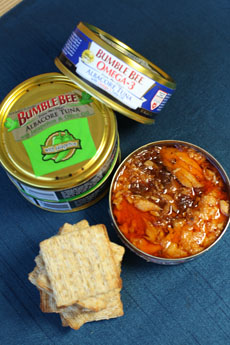
  • Chipotle Tuna has bold, smoky chipotle taste with mild heat. Drain it to add to a burrito, taco or wrap.
  • Jalapeño Tuna is dotted with minced jalapeños, little nuggets of heat. Drain it to add to pizza, quesadillas and sandwiches. We made toasted crostini, with some diced cherry tomatoes for color and flavor contrast.
  •  


    Bumble Bee’s latest canned tuna offerings. Photo by Elvira Kalviste | THE NIBBLE.

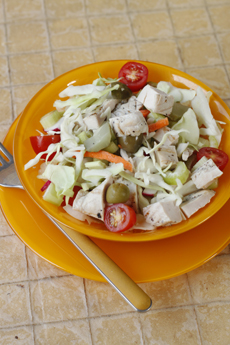
  • Sundried Tomatoes Tuna has a burst of tomato flavor that works in any of the above applications. We also enjoyed it in a green salad with mozzarella balls (bocconcini), cherry tomatoes and olives.
  •  

    A new non-flavored variety, Omega-3 Prime Fillet Albacore Tuna, offers amped up levels of Omega-3 EPA and DHA. Each serving contains 500 mg of EPA and DHA—312% of the 160 mg daily value. For consumers who want to add more of these important nutrients to their diets, it is used as any canned tuna, in all your favorite tuna recipes.


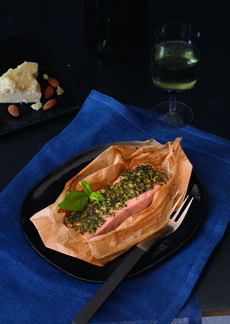
    Salmon with garden pesto. Photo courtesy
    Bumble Bee.


    BUMBLE BEE SUPERFRESH PREMIUM FRESH
    FROZEN

    Bumble Bee fish and shrimp never get to the cannery. Instead, they’re filleted and turned into all-natural, premium frozen fish entrees in parchment paper, ready to heat and enjoy. The flavor-rich, protein-rich gluten-free choices include:

  • Spicy Shrimp Romesco*
  • Lemon Shrimp with Garlic & Herbs
  • Salmon with Garden Pesto
  • Salmon with Garlicky Black Pepper & Extra Virgin Olive Oil
  • Tilapia with Lemon, Pepper & Herbs
  • Tilapia with Garlic & Extra Virgin Olive Oil
  •  
    We all know we should eat more fish, and research confirmed that consumers are looking for high-quality seafood that tastes fresh and delicious. These new frozen entrées are flavorful and moist and taste freshly made: a restaurant-quality meal.


    Each premium fish fillet is wrapped in parchment paper, which seals in flavor and juices. The packets go from freezer to table in 20 minutes or less. The shrimp entrées sauté quickly on the stove top.

    The line launched in the Northeast in June, and is rolling out nationwide. The MSRP ranges between $8.99 and $9.99 for two portions.

    That’s the buzz!
    *Romesco sauce (salsa romesco) is a nut and red pepper-based sauce that originated in Catalonia, Spain. It is typically made from roasted or raw almonds, pine nuts, and/or hazelnuts, roasted garlic, olive oil, bitxo chiles and/or nyora peppers (a small, round, variety of red bell pepper). Other common ingredients can include roasted tomatoes, red wine vinegar and onions. It is a popular sauce with seafood (with fennel or mint leaves added) and anything from poultry and lamb to vegetables.


    Comments off

    PRODUCT: Lovely Caramels, Vanilla & Chocolate Swirl

    The Lovely Candy Company of Woodstock, Illinois is committed to all natural, gluten-free and non-GMO candies made from the best ingredients. Its products include caramels, fruit chews and licorice.

    We love good caramels, and devoured the two bags we received: Original (vanilla) and Chocolate Swirl. We also received Fruit Chews—not our thing—which were devoured by the rest of THE NIBBLE team.

    Buttery and soft yet chewy, no dentures or fillings will compromised by these tender caramels. They’re made from brown rice syrup (a lower glycemic* sweetener), sweetened condensed whole milk, butter, dried cane syrup, molasses, vanilla and lecithin, with chocolate liquor† added for the Chocolate Swirl variety.

    Our preference is for the Chocolate Swirls, which are less sweet than the Original. We’ve earmarked them for stocking stuffers.

    But give us either flavor—the contents will disappear just as quickly.

    The line is certified kosher by KOF-K.

     
    We couldn’t stop eating them until the bags were empty. Photo by Elvira Kalviste | THE NIBBLE.
     
    We’ve seen the caramels at a number of specialty food stores; there’s a store locator on the company website.

    Or, head to Amazon.com for:

  • Chocolate Swirl Caramels, $5.50 for 6 ounces, a 4-pack for $19.96 or a 12-pack for $59.88
  • Original Caramels, 6 ounce bag, 4 pack and 12-pack
  •  
    You can also find the Fruit Chews on Amazon.
     
    ABOUT BROWN RICE SYRUP

    Brown rice syrup, also called rice bran syrup and rice malt, is a low-glycemic sweetener. This means that its complex sugars are absorbed more slowly into the bloodstream—usually a boon for people with diabetes (see the next paragraph). It’s about half as sweet as table sugar and one-third as sweet as agave syrup/nectar.

    Although brown rice syrup has a GI (glycemic index) of 20,* it is not recommended for diabetics. That’s because its sweetness comes from maltose, which causes spikes in blood sugar. But, check with your healthcare provider if you are a diabetic who’d like to try brown rice syrup or products it contains.

    *Table sugar has a GI value of 60-65. Pure maple syrup maple syrup has a GI of 54.

    †A misleading term, chocolate liquor contains no alcohol. It is a thick, gritty, dark brown paste. Here’s a longer explanation of chocolate liquor.
      

    Comments off

    Bake This Angel Food Cake Recipe For National Angel Food Cake Day


    [1] Angel food cake with strawberry glaze (photo © American Egg Board).


    [2] Berries are a perfect garnish for angel food cake (photo © Anna Ozerova | Dreamstime).

    Angel Food Cake
    [3] Angel food cake is baked in a tube pan because the hollow center provides support for the delicate, egg-white based batter as it rises, preventing it from collapsing in the middle. The tube allows the batter to climb the sides of the pan evenly (photo © Chicago Metallic).

    Angel Food Cake
    [4] Light and fluffy angel food cake made with egg whites is the opposite of dense, heavy cakes. (photo © Bhofack | Dreamstime).

    oulade Angel Food Cake
    [5] You can also make a roulade of angel food cake. This one is filled with lemon curd; here’s the recipe (photos #5, #7, and #10 © Taste Of Home).

    Chocolate Angel Food Cake
    [6] How about a chocolate angel food cake? Here’s the recipe from Martha Stewart, with a double fudge frosting (photo © Martha Stewart).

    Angel Food Cake with berries and whipped cream
    [7] Bake one, invite friends.

    Angel Food Cake
    [8] You can ice it if you like (photo © Wilton | Facebook).

    Lemon Meringue Angel Food Cake
    [8] Fusion food: a lemon meringue angel food cake. Here’s the recipe (photo © King Arthur Baking).

    Rainbow Sherbet Angel Food Cake
    [9] An ice cream cake—or in this case, a rainbow sherbet cake. Here’s the recipe.


    October 10th is National Angel Food Cake Day. Bake one from scratch, or pick up a ready-made cake and serve it with this delicious strawberry glaze.

    Angel food cake is a white sponge cake: a light, flourless cake made with sugar, cream of tartar, salt, vanilla or almond extract, and a dozen or so egg whites, depending on the recipe. There is no leavening.

    Chocolate angel food cakes were developed much later, adding cocoa powder.

    The cake is popularly served with berries and whipped cream, although it can be served plain or with a dessert sauce (caramel, chocolate, custard, fruit, etc.).

    Angel food cake originated in the U.S. and first became popular in the late 19th century. See the history of angel food cake below, along with Fanny Farmer’s 1884 recipe, the first time the recipe appeared in a cook book.

    Angel food cakes are generally made in a tube pan (photo #4). If you’re going to purchase one, get one with a removable bottom.

    BONUS: Check below for a third recipe, the original Fanny Farmer Angel Food Cake recipe from 1884, plus the history of angel food cake.

    Two recipes follow, but first:

    > The year’s 55 cake holidays.

    > The different types of cake and the history of cake: a photo glossary.

    > The history of angel food cake is below.

    > The history of cake pans.
     
     
    RECIPE #1: STRAWBERRY GLAZE FOR ANGEL FOOD CAKE

    Ingredient For The Strawberry Glaze

  • 1/2 cup orange juice
  • 1 tablespoon cornstarch
  • 2 cups frozen strawberries, partially thawed, quartered (you can use fresh strawberries, of course)
  • 1/4 cup sugar
  • 1 tablespoon orange marmalade
  • 1 prepared angel food cake (or use a mix or the from-scratch recipe below)
  • Optional garnish: whipped cream
  •  
    Preparation

    1. STIR orange juice into cornstarch in a medium saucepan. Add strawberries, sugar and marmalade. Bring to a boil, stirring occasionally.

    2. REDUCE heat to low; cook 2 minutes, stirring, or until sauce thickens. Cool or chill.

    3. CUT cake into 12 slices. Spoon sauce over each slice. Garnish with optional whipped cream.
     
     
    RECIPE #2: ANGEL FOOD CAKE

    Ingredients

  • 1-1/2 cups powdered sugar
  • 1 cup cake flour
  • 12 large egg whites (1-1/2 cups), room temperature
  • 1-1/2 teaspoons cream of tartar
  • 1 cup granulated sugar
  • 1-1/2 teaspoons vanilla
  • 1/2 teaspoon almond extract
  • 1/4 teaspoon salt
  •  
    Preparation

    1. PREHEAT the oven to 375°F, with rack in the lowest position.

    2. MIX the powdered sugar and flour in medium bowl; set aside. In a large bowl, beat the egg whites and cream of tartar with an electric mixer on medium speed until foamy.

    Both the bowl and the whisk attachment must be clean, dry, and free of grease in order to get the maximum volume from the egg whites.

    Similarly, angel food cake pans are not greased so that the batter can cling to the sides of the pan as it bakes, and reach its full volume.

    3. BEAT in the granulated sugar, 2 tablespoons at a time, on high speed, adding the vanilla, almond extract and salt with the last addition of sugar. Continue beating until stiff and glossy. Do not over-beat.

    4. SPRINKLE the powdered sugar-flour mixture, 1/4 cup at a time, over egg white mixture, folding in with a rubber spatula just until the sugar-flour mixture disappears. Use the spatula to cut down vertically through the center of egg whites, across the bottom of the bowl and up the side, turning the egg whites over.

    Rotate the bowl one-fourth turn and repeat. Continue folding this way until the ingredients are just blended (do not over-blend). Use the spatula to break large air pockets, pushing the batter gently against the side of the pan and the tube.

    This folding technique is used so that the batter will not lose its volume. At each step, take care not to over-mix, over-blend, or over-combine the cake batter; this will deflate the meringue, creating a dense cake.

    5. PUSH the batter into an ungreased 10 x 4 inch angel food cake pan (tube pan). Cut gently through the batter with a metal spatula or knife to break the air pockets.

    6. BAKE 30 to 35 minutes or until the cracks feel dry and the top springs back when touched lightly. Immediately turn the pan upside down onto a heat-proof funnel or an empty wine bottle. This is so the baked cake will maintain its volume and not shrink as it cools.

    7. KEEP the cake inverted about 2 hours or until it’s completely cool. Loosen the side of the cake with a knife or long metal spatula; remove it from the pan.
     
     
    RECIPE #3: FANNY FARMER’S 1896 ANGEL FOOD CAKE

    Fannie Farmer’s 1884 angel food-like cake was published in The Boston Cooking-School Cook Book. Although it wasn’t yet called angel food cake, you can see that her recipe was nearly identical to today’s cakes. Some earlier recipes used cornstarch flour.

    Cornstarch, a starch, is a thickening agent. It is not a substitute for cream of tartar, which is an acid used for helping to stabilize the egg whites when whipped (leading to a better rise in cakes and meringues), leavening, and preventing crystallization.

    This cake was sometimes called snow-drift cake or white sponge cake before angel food cake became the official name in later edition in the 1886 edition of the cook book.

    > See the history of angel food cake below.

    Ingredients

  • 1 cup egg whites (about 10–12 large eggs)
  • 1 ¼ cups granulated sugar
  • 1 cup pastry flour (or cake flour)
  • 1 teaspoon cream of tartar
  • ½ teaspoon salt
  • 1 teaspoon vanilla extract
  •  
    Preparation

    Editor’s Note: For ease in reading, we have numbered the steps and given them modern formatting.

    1. PREPARE the oven and pan. Preheat the oven to 350°F (175°C). Use an unbuttered tube pan (the batter needs to climb the sides).

    2. SIFT the dry ingredients. Sift the flour and salt together four to five times to ensure a light texture.

    3. WHIP the egg whites. In a large bowl, beat the egg whites until foamy. Add cream of tartar and continue beating until soft peaks form. Gradually add sugar, one tablespoon at a time, and beat until stiff, glossy peaks form.

    4. FOLD in dry ingredients. Gently fold the sifted flour mixture into the egg whites, a little at a time, using a spatula. Add vanilla extract and fold gently to maintain the airiness.

    5. BAKE the cake. Pour the batter into the unbuttered tube pan and smooth the top. Bake for 40–50 minutes, or until the top is golden and springs back when touched.

    6. COOL upside down. Immediately invert the pan over a bottle or on its feet (if it has feet). Let cool completely before removing the cake. [Source: ChatGPT 2025-01-24]
     
     
    THE HISTORY OF ANGEL FOOD CAKE

    Angel food cake likely originated in the early 19th century. The first angel food cakes were probably baked in the South by enslaved African-American, due to the strength required to whip the air into the whites. They evolved from sponge cakes (the history of sponge cake).

    Other names for sponge and foam cakes included Hot Water Sponge Cake, “”Sunshine Cake,” and “Moonshine Cake.”

    These cakes relied on beaten eggs for leavening, resulting in their characteristic lightness—although unlike Angel Food Cake, they recipes used the egg yolk as well as the white (Angel Food Cake is whites-only, thus the white color).

    By the late 1800s, with the invention of the egg beater, it had become a widely recognized and beloved American dessert.

    The earliest known recipes for angel food cake appeared in the late 19th century, specifically in the 1870s and 1880s. Here are some key milestones in its recorded history:

  • 1839: The first recipe in a cookbook for an almost identical cake, called a white sponge cake, appears in Lettice Bryan’s The Kentucky Housewife.
  • 1857:The first mechanical egg beater in the U.S. is invented in 1857. See 1884.
  • 1871: The first print reference appears in The New York Times although, as in Fanny Farmer’s 1884 cook book, it wasn’t yet called by that name.
  • 1881: The Snow-Drift Cake recipe appears. in the Christian Advocate newspaper. A cake made with only egg whites, sugar, and flour yielding a light and airy texture, the name and recipe may be an adaption of the white sponge cake and the New York Times recipe.
  • 1884: Willis Johnson patents an improved egg beater in 1884, enabling an average housewife to beat egg whites efficiently.
  • 1884: The first appearance of the recipe in a major cookbook is believed to be in the 1884 edition of The Boston Cooking-School Cook Book. This marks one of the first times—if not the first time——that the cake appears in a widely distributed cookbook. You can see the cake recipes online
  • 1896: The name “Angel Food Cake” first appears in the 1896 edition of The Boston Cooking-School Cook Book. The name emphasizes the cake’s light, airy, and “heavenly” qualities.
  •  


    CHECK OUT WHAT’S HAPPENING ON OUR HOME PAGE, THENIBBLE.COM.


    Comments off

    HALLOWEEN: Haunted Popcorn Hands


    Creative Halloween fare. Photo courtesy
    Popcorn.org.
     

    We love this party favor idea from Popcorn.org. We’d suggest them as trick-or-treat items, but many parents don’t let kids eat the “open” food for safety reasons.

    So, bring them to friends, to the office, and anywhere else you like.
     
     
    RECIPE: HAUNTED HALLOWEEN POPCORN
    HANDS

    Ingredients

  • Clear polyethylene food service gloves
  • Candy corn
  • Popcorn
  • Ribbon or yarn
  •  
    Preparation

    1. PLACE 1-3 pieces of candy corn at the end of each finger (depending on size of glove), pointy side first, to make fingernails.

    2. FILL the glove with popcorn and tie it off with ribbon or yarn.

     
    If you want to make the Halloween popcorn balls in the photo, here’s the recipe.


    Comments off

    TIP OF THE DAY: Pickled Garlic

    Pickled garlic is a healthful, tasty garnish and ingredient. You can buy it in jars, but it’s almost as easy to make your own.

    Don’t worry about being overwhelmed by garlic flavor: The cloves lose a lot of their pungency in the pickling process. They are still garlicky, but tame.

    Enjoy pickled garlic on salads, sandwiches, skewered appetizers or main courses, as a Martini garnish or as a snack like any pickles. You can also bring jars of it as house gifts—so much more interesting than most bottles of wine.

    You can make the pickled garlic more of a condiment by pickling sliced onions and cucumbers along with the garlic cloves.

    RECIPE: PICKLED GARLIC

    Ingredients

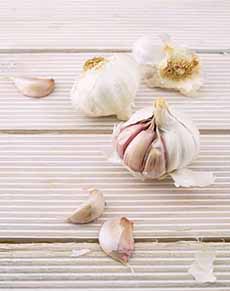
  • 6 bulbs garlic
  • 4 cups white wine vinegar or apple cider vinegar
  • 1/4 cup white sugar (you can cut back to 1 tablespoon if you want to minimize your sugar intake)
  • 1 teaspoon whole black peppercorns
  • 4 whole cloves
  • 1 bay leaf
  •  

    Use pickled garlic to garnish just about anything, including canapés and crostini. Above, turkey and hummus with pickled garlic garnishes.Photo by Elvira Kalviste | THE NIBBLE.

  • 2 dried red chile peppers (choose the type according to your desired level of heat)
  • 1-1/2 tablespoons lemon zest
  • Optional: sliced onion and cucumber
  • Optional: more herbs, such as dill and/or oregano
  •  


    Pickled garlic with a choice of seasonings:
    Give it as gifts. Photo by Elvira Kalviste |
    THE NIBBLE.
     

    Preparation

    1. SEPARATE the heads of garlic into cloves, with the outer skin removed. Set aside. TIP: To soften and loosen the skins, blanch the cloves in rapidly boiling water for 30 seconds, immediately immerse in cold water, drain and peel the cloves.

    2. COMBINE the vinegar, sugar, peppercorns, cloves, bay leaf, chiles and lemon zest in a saucepan. Bring to a boil; continue to boil for 2 minutes.

    3. ADD the garlic, and continue to boil for 4 more minutes. Remove from heat and let stand overnight at room temperature.

    4. TRANSFER to a clean jar. You can strain out the herbs and spices or keep them (we keep them for the aesthetic effect). Cover and store in the refrigerator; the pickled cloves will keep for 6 to 8 weeks. Over the first week, the cloves will become even more pickled.

    TIP: When the garlic cloves have been consumed, taste the brine. You may want to incorporate it with oil into a salad dressing.

     
    RABBIT’S PICKLED GARLIC

    If you’d like to simply purchase pickled garlic, consider Rabbit’s Pickled Garlic, a NIBBLE Top Pick Of The Week.

    We love these pickled cloves, made in chipotle, habanero, habanero dill, smoke and spicy dill. Read our review.


    Comments off

    The Nibble Webzine Of Food Adventures
    RSS
    Follow by Email


    © Copyright 2005-2026 Lifestyle Direct, Inc. All rights reserved. All images are copyrighted to their respective owners.