|
When we were in college, we went often to the Brigham’s Ice Cream Parlor in Harvard Square for a Raspberry-Lime Rickey. The coffee shop craze that began in Seattle had not yet become a destination elsewhere. Rickeys were the Frappuccinos of the day.
To us, a Rickey was raspberry syrup mixed into club soda with a big squeeze of lime.
We had no idea that the Rickey (originally the “Joe Rickey”) was a fizzy highball, created in 1883 at Shoomaker’s bar in Washington, D.C. (the different types of fizzy water).
THE HISTORY OF THE RICKEY
The drink was named for “Colonel” Joe Rickey, a Democratic lobbyist from Missouri. Each morning, he went to Shoomaker’s for a Bourbon with Apollinaris sparkling water over lump ice (today’s cubes).
Cocktail history was changed one day when the bartender, said to be George A. Williamson, squeezed half a lime into the glass and tossed the squeezed lime in after it. The Rickey was born.
It has evolved to include simple syrup and bitters. If you want the authentic experience, tell the bartender.
Another variation substituted ginger ale for the fizzy water; but either way, the drink was served in a tall (highball) glass with lots of ice.
A decade later, the Gin Rickey became a worldwide cocktail sensation. It remains a relatively popular drink today, while Joe Rickey’s Bourbon Rickey has faded into obscurity.
Omit the spirits altogether and you have a mocktail/soft drink that you can layer with other flavors. Omit the bitters in the cocktail and trade the simple syrup for fruit syrup, and you have the Raspberry-Lime Rickey of our youth (fondly referred to as a Razz-Lime Rickey. We had to have at least one a day).
MODERNIZE YOUR RICKEY
Create your signature Rickey: the [Your Name] Rickey instead of the Joe Rickey.
Soft Drink Variations
In addition to the squeeze of lime, freeze pieces of lime to substitute for all or some of the ice.
Use a different fruit syrup. Blueberry Rickey? Peach Rickey?
Instead of fruit syrup, puréed the fruit. Fresh raspberries are better than syrup; frozen raspberries are just fine (and less expensive than fresh ones). Plus, you can use less sugar, another sweetener or no sweeter at all.
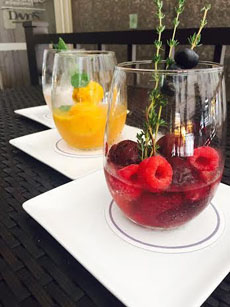
Garnish with a pick of matching fruit (raspberries, blueberries, cubed peaches, etc.)
Try flavored club soda.
Add bitters.
Cocktail Variations
Try a different spirit. Tequila Rickey? Vodka Rickey? Flavored Vodka Rickey?
Play around with some of the modern flavored bitters: cardamom, grapefruit, lavender, orange, etc.
RECIPE: THE RAZZ-LIME RICKEY: COCKTAIL
We turned our college favorite, the Razz-Lime Rickey soft drink, into a cocktail.
Ingredients Per Drink
2/3 to3/4 cup (3 ounces) fresh or frozen raspberries (or a store-bought raspberry syrup)
2 teaspoons sugar (omit if using raspberry syrup)
1 ounce lime juice
1/2 cup sparkling water
2 ounces raspberry vodka
Ice
Garnish: fresh raspberries and/or a lime wheel or wedge
|
|


[1] A Gin Rickey from from Elegant Affairs. [2] A Raspberry Lime Rickey soft drink rom CooksCountry.com. [3] A Blueberry Rickey with a blueberry cocktail pick (photo courtesy Essence Designs). [4] The original Rickey, made with bourbon (the mint must be left over from a Mint Julep (photo via Tumblr). |
|
Preparation
1. MAKE the raspberry-lime syrup: Place the raspberries in a bowl, sprinkle the sugar on top and add the lime juice. Mash with a muddler or the back of a wooden spoon. Set aside and let the mixture marinate for 10 minutes. Strain it through a sieve to remove the seeds.
2. FILL a glass with ice and add the syrup add the sparkling water. Stir, add the vodka and stir again.
3. TOP OFF with sparkling water. Garnish and serve
You can make four drinks at a time with these proportions. In a pitcher combine as above:
1-1/3 cups raspberries
1/2 cup lime juice
3 tablespoon sugar
2 cups sparkling water
1 cup raspberry vodka
Refrigerate until ready to serve. Stir again before pouring into ice-filled glasses.
__________________
*The Brigham’s chain of ice cream parlors is defunct (along with its competitor, Bailey’s). The company closed most of its locations in 2008 and sold the rights to its ice cream brand to HP Hood. The chain declared bankruptcy in 2009, but Hood still produced quarts under the Brigham’s name, sold in supermarkets in New England.
|