|
You know something is really good when, the minute you finish it you want another.
We don’t know what the chocolates tasted like when the company was founded in 1857; but Neuhaus Chocolates’s new “Haute Pâtisserie” collection is the best Neuhaus chocolate we’ve ever tasted, and stands on the podium with the finest chocolates in the world.
“Haut pâtisserie” means high-class pastry, a reference to the nine internationally-reknowned pastry chefs/chocolatiers who each contributed a unique piece to the collection.
A pâtissier typically creates a suite of sweets: biscuits (cookies) and macarons, cakes, chocolates, confectionery (caramels, dragées, fondant/nougat, fudge, hard candies, marshmallows, marzipan, pâte de fruit, etc.), ice cream and, of course pastries.
|
|
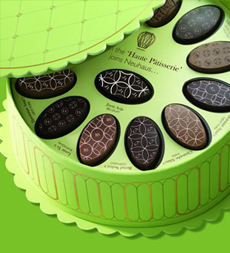
Neuhaus Haut Patisserie collection. Photo
courtesy Neuhaus. |
Haut, by the way, is pronounced “oat,” and not “hoat,” as the people responsible for “Haut Goth” or “Haut Look” would have it. The complete pronunciation: oat pah-TEE-suh-ree.
THE MOST BEAUTIFUL BOX FOR THE MOST EXQUISITE CHOCOLATES
The exquisite round gift box is a keeper. In pale green with textured gold accents, it is may be the nicest package from any chocolatier and evocative of the luxurious boxes that were used to package chocolates in earlier times. It holds 27 chocolates: three pieces from each of nine pastry chefs. It is available with an elegant coordinated bag and an illustrative booklet with the story of each praline for $45.00, at NeuhausChocolate.com.
The pralines—what Belgians call bonbons (here’s an explanation of the difference between Belgian and French chocolates), are thick shells of wonderful chocolate. Each pastry chef was guided by his own creative, cultural and gastronomic inspiration. The initials of each chef are worked into the design patterns on the top of each chocolate.
In alphabetical order of surname, the pastry chefs are:
Christophe Adam
Paris, France
Adam achieved fame as creative director at Fauchon, and currently focuses on sweet delicacies in his own business. He bonbon is dark chocolate with a ganache of Sicilian pistachios and oranges from Valencia, enriched with black raisins from Chile. The orange flavor prevails, and we love it.
Dominique Ansel
New York, New York
Ansel is originally from Paris, but is one of the best (if not the best) pâtissiers in New York right now. His awards include “Best New Pâtisserie of New York” and “Top 10 Pastry Chefs in the United States.” We voyage to his pastry shop as often as we can. For this collection, he created a milk chocolate shell filled with ganache inspired by childhood memories: roasted peanuts on a layer of caramel “à l’ancienne.” The sensation begins with savory peanuts and finishes with sweet milk chocolate.
Joost Arijs
Ghent, Belgium
Arijs eventually became Chef Pâtissier at the three-star Michelin restaurant Hof van Cleve. In 2012 he and his bakery’s co-owner were awarded the title of “Best Pâtisserie in Belgium”—which says something, given the high standards in that country. Chef Arijs enjoys combining chocolate with fresh notes of fruit and citrus. For Haute Pâtisserie he has created a dark chocolate shell with a crumble of cacao nibs. The couverture is 70% Ecuadorian cacao ganache wit a layer of Indian mango coulis. We also detected a hint of citrus—perhaps some exotic lime.
|

The gift set: box, bag, brochure. Photo
courtesy Neuhaus.com. |
|
Oriol Balaguer
Barcelona & Madrid, Spain
Balaguer’s honors include “Best Dessert in the World” and “Best Pâtissier in Spain.” His piece is a milk chocolate shell filled with popping sugar on a layer of praline (using the world’s finest Piedmont hazelnuts) and passion fruit. We don’t generally go for hazelnut praliné, but we’d gladly take a few boxes of these. They are perhaps the best praline ever. Website. In the U.S. you can purchase his chocolate at Borne Confections.
Martin Chiffers
London, England
Chiffers is president of the U.K. Pastry Team, which won the European Pastry cup in 2012. Inspired by berries and flowers from Cornish gardens, his milk chocolate piece features rose on a layer of praline “à l’ancienne,” made with hazelnuts and fresh raspberries. The raspberries dominate, deliciously. The burst of fresh raspberries makes this perhaps our favorite piece in the collection.
|
|
Raphaël Giot
Namur, Belgium
This Belgian pâtissier is known as “the goldsmith of pastry.” His dark chocolate piece is a salted caramel “à l’ancienne” on a layer of velvety praliné, enriched with pieces of hazelnuts and enrobed with dark chocolate. We—previously noted, not generally a hazelnut chocolate fan—really liked it. Website.
Koji Tsuchija
Tokyo, Japan
Koji Tsuchija has seven luxury chocolate shops in Tokyo, called Théobroma. His dark origin chocolate ganache infused with yuzu is a perfect marriage between the bittersweet chocolate and refreshing acidity of the citrus. We can never get enough of tart-yet-sweet yuzu. It’s another winner. Website.
Bernd Sierfert
Michelstadt, Germany
Sierfert held the title of “Best German Pâtissier” for five years running. His milk chocolate piece, called “Chinese Girls,” is chocolate ganache infused with Chinese jasmine tea on a thin layer of crunchy praline with Oriental ginger. The flavors are subtle, the crunch is lovely, the overall chocolate is sweet happiness. Website.
Louie Ye
Shanghai, China
Ye is the executive pastry at the world’s tallest hotel, the Park Hyatt in Shanghai, and has represented China in the World Pastry Championships. His piece represents Asian cuisine and combines sweet and savory flavors. An herb-accented caramel, lush and lovely with a hint of salt with dark origin chocolate from Ecuador. The finish of the chocolate goes on and on. Hotel website.
CHOCOLATE TERMS
What the French call bonbons and Americans call filled chocolates, Belgians call pralines. It’s a confusing because in France, praline is a caramelized almond and in the U.S., it’s a brown sugar patty with pecans. In fact, Belgian chocolatier Jean Neuhaus started the confusion in 1912, when he developed a process for creating hard shell filled chocolates that he called pralines.
The different types of praline
The difference between Belgian and French chocolates
|
|