THE NIBBLE BLOG: Products, Recipes & Trends In Specialty Foods


Also visit our main website, TheNibble.com.

VALENTINE GIFT: Red Moka Pot

moka-pot-red-imusa
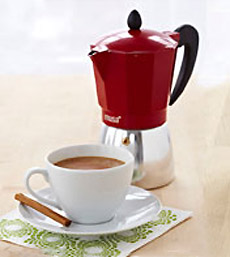
The classic moka pot dons a red coat.
Photo courtesy IMUSA USA.
  Here’s a no-calorie Valentine gift for someone who loves strong coffee: a red moka pot.

You can purchase the six-cup version at Macy’s for $14.99; it also is available in pumpkin orange and cobalt blue. A three-cup version is available at Kohl’s.

Bialetti, originators of the moka pot, make six-cup versions in solid red, orange, blue and violet.

Up until few decades ago, before the introduction of electric-powered espresso machines for the home, people with money made espresso in a moka pot, a manual Italian espresso maker. People without money, space or a frequent need for an electric espresso machine still do.

WHAT’S A MOKA POT?

A moka pot is a stove top coffee pot that makes strong coffee. Instead of the more recent drip coffeemakers, where water drips down through ground coffee into a carafe below, the moka pot holds the water in its bottom half. When heated on the stove, the steam pushes boiling water up through the grounds into a top chamber, from which it is poured.


HISTORY OF THE MOKA POT

The aluminum Moka Express, with its octagonal body, was patented in 1933 by the Italian inventor Luigi De Ponti and acquired by Alfonso Bialetti. It enabled Bialetti, a metals engineer, to transform his company into a leading Italian coffee machine designer and manufacturer.

Before the moka pot, only people of means could brew café-quality coffee at home, using large and expensive commercial machines that required training. Most people drank their coffee at a café or coffee bar.

The creation of the small, efficient, user-friendly and affordable Moka Express allowed anyone to quickly brew at home the bold, robust-tasting coffee beloved by Italians. It replaced the more primitive coffee-makers developed in the late 19th century such as the Napoletana.

Although today there are electric moka pots, it the original survives in its original form—a feat for a kitchen appliance designed more than 80 years ago. The major change has been a move to stainless steel by some the versions, as well as novelty designs like the one above and Bialetti’s cappuccino moka pot with a fun cow-pattern enamel coating (there’s also a plain, elegant cappuccino pot).


WHY IS IT CALLED “MOKA?”

The Red Sea port city of Mocha in Yemen was the major marketplace for coffee—grown in Africa—from the 15th century through the 17th century. The principal port for Yemen’s capital city, Sana’a, it was later eclipsed by the ports of Aden and Hodeida.

Because the name is transliterated from Arabic letters, there are a variety of spellings: Mocha, Mocca, Moka, Mokha, etc.

Even after other sources of coffee were developed, Mocha beans (also called Sanani or Mocha Sanani beans, meaning “from Sana’a”) continued to be prized for their distinctive flavor—and remain so today.

  moka-pot-red-coffee-imusa-230
Be my Valentine—have an espresso. Photo courtesy IMUSA USA.

HOW TO BUY A MOKA POT

Remember that a “four cup pot” means four wee espresso cups. If you like a double espresso—or a standard coffee cup full—buy the largest pot you can find—typically nine cups. Bialetti’s largest makes 12 cups.

If you have the option, stainless steel will look better over time than aluminum.

Typically, Italian roast coffee is used in a moka pot; but you can use whatever you have.

 
MAKE TEA IN A MOKA POT

What if you have two moka pots? Use one for tea. See our moka pot tip from ten days ago.


Comments off

RECIPE: Chinese Steamed Dumplings With A Twist

buffalo-chicken-dumplings-IMUSA-230
[1] Buffalo chicken dumplings: fusion food (photo and recipe © IMUSA USA).

Chinese Egg Rolls with sweet chili dipping sauce
[2] Traditional Chinese egg rolls (photo © Melissa’s Produce).


The Chinese New Year begins on January 31st; the Super Bowl is February 2nd. Here’s a dish that combines both concepts: Buffalo Chicken Steamed Dumplings.

The recipe for this fusion food—Chinese steamed dumplings crossed with Buffalo chicken wings—was developed by IMUSA USA. The company manufacturers cookware for international cuisine, including the bamboo steaming basket in the photo.

> The history of Chicken & The History Of Buffalo Wings.

> The Top 10 Chinese dishes in the U.S.
 
 
RECIPE: BUFFALO CHICKEN STEAMED
DUMPLINGS

Ingredients

  • 1 pound ground chicken
  • ½ small onion
  • 3 garlic cloves
  • 3 tablespoons curly parsley
  • ½ cup celery
  • ½ cup crumbled blue cheese
  • 2 eggs
  • ½ teaspoon salt
  • ¼ teaspoon pepper
  • Dumpling wrappers (you can use won ton
    wrappers)
  • Nonstick cooking spray
  • 1 cup Buffalo style hot sauce, like Frank’s
  • 6 tablespoons butter
  •  
    Preparation

    1. MIX first 9 ingredients (chicken through pepper) by hand in a medium bowl until evenly combined.

    2. ASSEMBLE dumplings by placing dumpling wrapper on a flat surface. Roll a small ball of the chicken mixture between your hands, about a tablespoon, and place in the center of the wonton wrapper.

    3. DIP a finger in a cup of water and run it around the edges of the wrapper. Pick up a wrapper and chicken ball with one hand (between your thumb and index finger) and begin pinching hard around the wrapper until it tightly wraps the chicken ball. Re-pinch if necessary.

    4. SPRAY the steaming basket with non-stick spray and add the dumplings. Steam for 10 minutes until fully cooked.

    5. MAKE the hot sauce by gently heating the hot sauce and the butter. Spoon some sauce on a plate and place dumplings on top. Garnish with more crumbled blue cheese, if desired.


    CHECK OUT WHAT’S HAPPENING ON OUR HOME PAGE, THENIBBLE.COM.


    Comments off

    Chicken Liver Pâté Recipe

    Here’s a treat for everyone who loves pâté but can’t afford the duck and goose versions; as well as those who won’t eat their enlarged livers due to animal welfare concerns.*

    This chicken liver pâté recipe, sent to us by the New York Times to share, was published in the January 26th Sunday Magazine section. It is gourmet Super Bowl fare or a spread for any party or special occasion. (Why a special occasion? The cholesterol!)

    Not only is chicken liver pâté a luxurious spread; it is affordable and quick and easy to prepare. Here’s the full article.

    The concept dates back centuries if not millennia. In modern times, there’s a similar recipe in Julia Child’s Mastering The Art Of French cooking.

    Our grandmother and her grandmother made a Jewish version; her fat of choice was schmalz (rendered chicken fat, discussed below)—no butter or cream—yellow onions instead of shallots, no wine.

    Nana’s tip: Don’t overcook the livers—the insides should still be pink.


    chicken-pate-ChristopherTestani-NYT-230
    A crock of chicken liver pâté with a side of bacon jam. Photo by Christopher Testani for the New York Times.

    ________________

    *The issue of whether or not gavage, the force-feeding of ducks and geese to enlarge their livers, is complex and is not discussed here.
     
     
    WAYS TO SERVE CHICKEN LIVER PATÉ

    You can serve chicken liver pâté in a crock with toast or crackers and a side of bacon jam (make this recipe or buy ready-made bacon jam like Skillet Bacon Spread. (Here’s our review; you can buy it on Amazon.com).

  • Serve the pâté with toast points, toasted baguette slices, toasted rye bread, crackers (try Saltines or water crackers), or a mix.
  • Make tea sandwiches, or spread on chicken, roast beef or turkey sandwiches.
  • Spread pâté on a large crouton to serve alongside soup or salad.
  • Spread it atop a filet mignon for a crustless Beef Wellington; or make crustless Wellington hors d’oeuvre by spreading pâté on toast points, topped with a slice of beef and fresh herbs or microgreens.
  • Tuck some under the skin before broiling a chicken. It will melt away during cooking but leave a rich flavor.
  •  


    chicken-livers-raw-anuzhealthykitchen.blogspot-ps-230s
    Raw chicken livers. Photo courtesy Anu Shoj
    | Anu’s Healthy Kitchen | Blogspot. Check
    out her recipe for fried chicken livers.
     

    RECIPE: CHICKEN LIVER PATÉ

    You can make this recipe in 20 minutes, plus a couple of hours to chill in the fridge.

    Ingredients For 6-8 Servings

  • 8 tablespoons unsalted butter, cut into cubes
  • 2 medium shallots, peeled and finely chopped
  • 1 pint fresh chicken livers, approximately 1 pound, trimmed
  • 1 tablespoon fresh thyme leaves, chopped
  • 1/3 cup Madeira or Port
  • 3 tablespoons heavy cream, plus more as needed
  • Kosher salt to taste
  •  

    Preparation

    1. HEAT a large, heavy sauté pan over medium heat and melt 4 tablespoons of the butter until it begins to foam. Add the shallots and sauté until translucent, taking care not to brown.

    2. ADD the livers, thyme, and Madeira or Port, and turn the heat to high. Cook, occasionally stirring the livers with a spoon, until the wine has reduced and the livers are lightly browned but still very soft and pink on the inside—approximately 5 minutes.

    3. REMOVE the pan from the stove, and transfer the contents into a blender or food processor, along with the cream and the remaining butter. Purée until smooth, adding a little more cream if necessary. Taste and adjust seasoning, adding salt if necessary.

    4. PACK the pâté into a glass jar or bowl, then smooth the top with a spatula. Cover with plastic wrap and refrigerate until firm, about two hours or up to five days. Serve with bacon-onion jam and copious amounts of toast.
     
     
    WHAT IS SCHMALTZ?

    Schmaltz, also spelled schmalz or shmalz, is rendered (clarified) chicken or goose fat. It is used both for cooking and as a spread on bread in Ashkenazi Jewish cuisine (Austria, Germany and Poland, and other Northern European countries).

    The term is Yiddish, derived from the German Schmalz, meaning “rendered animal fat.” While both tallow and lard are forms of Schmalz in German, as is clarified butter, in English the term follows the Yiddish use, referring to fat rendered from poultry.

    Schmaltz was an important fat in the lives of European Jews, who were forbidden by Kosher dietary laws from combining meat and dairy products. They could not use butter in meat dishes, and of course, could not use pig-based lard.

    So in order to cook meat and poultry dishes or the sides served with them (potatoes, for example), schmaltz or vegetable cooking oil was required. It was also used to butter bread. The impact on cardiovascular health has become an issue in the last 40 to 50 years.


    CHECK OUT WHAT’S HAPPENING ON OUR HOME PAGE, THENIBBLE.COM.


    Comments off

    VALENTINE GIFT: A Different Take On Chocolate Kisses

    Chef François Payard is making it easier to send kisses this Valentines Day. Check out his Dark Chocolate Raspberry Lips.

    Packaged in a red clutch-shaped box, the chocolate lips are filled with chocolate ganache that has a hint of ginger, and are packaged with with a white chocolate raspberry lipstick—a real lipstick that is both edible and tastes like chocolate.

    Each box of chocolates comes with 18 lips and one lipstick for $55: a gift that’s sure to be remembered.

    Get yours at Payard.com.

    Want something more conventional? While you’re on the website, take a look at the:

      rasberry-kisses-2-payard-230
    Chocolate raspberry kisses with an edible raspberry-white chocolate lipstick. Photo courtesy Payard.
     

  • Champagne Truffles, Champagne-infused balls of chocolate ganache, lightly dusted with cocoa powder
  • Valentine’s Day Chocolate Collection, 70% dark chocolate squares, beautifully decorated and filled with salted caramel, raspberry and fresh ginger
  • Valentine’s Day Macarons In A Heart Box: caramel coriander, strawberry basil, lemon thyme and mint chocolate
  •   

    Comments off

    FOOD FUN: Football Steak

    football-filet-mignon-empiresteakhouse-230sq
    A football filet mignon. Photo courtesy
    Empire Steak House | NYC.
     

    To some, watching a football game while digging into a big, juicy steak is a slice of heaven. That’s why more than a few steak houses have big-screen TVs.

    Chef Jack Sinanaj of Empire Steak House in New York City has gone one better, preparing a special Empire Super Bowl Steak: a 20-ounce filet mignon carved in the shape of a football.

    And yes, you can eat your steak while watching the game on three large screen plasma TVs. There’s a “viewing party” on Super Bowl Sunday, February 2nd.

    Or, you can try carving your own at home.


    The restaurant used grill marks to add the laces. That may be a challenge for some home cooks, but if you’re good with a piping bag, you can add the laces with piped blue cheese butter or other compound butter.


    Comments off

    The Nibble Webzine Of Food Adventures
    RSS
    Follow by Email


    © Copyright 2005-2026 Lifestyle Direct, Inc. All rights reserved. All images are copyrighted to their respective owners.