THE NIBBLE BLOG: Products, Recipes & Trends In Specialty Foods


Also visit our main website, TheNibble.com.

Seafood Gravy With Biscuits Or Toast: Biscuits & Gravy

Biscuits & Gravy
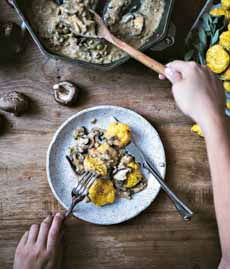
[1] Elevate your biscuits, like these kabocha sage biscuits. Here’s the recipe from Betty S. Liu (photo © Betty S. Liu).

Biscuits & Oyster Gravy
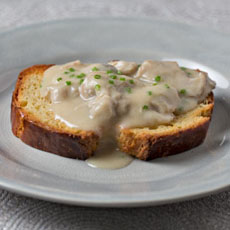
[2] Simple oyster gravy. Here’s the recipe from Anson Mills (photo © Anson Mills).

Fried Egg, Biscuits & Gravy
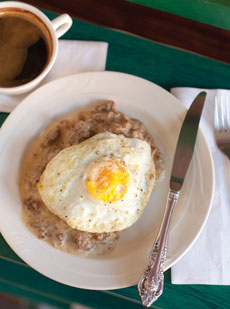
[3] Put an egg on it (photo © Pillsbury).

Biscuits & Gravy Recipe
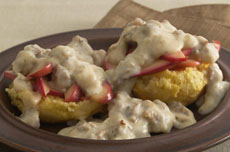
[4] Surf and turf: oyster gravy over ham and biscuits (photo © Pillsbury).

Shucked Oysters
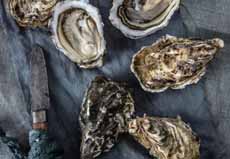
[5] Shucked oysters. Your store may also sell a container of shucked oyster meats (photo ©y The Spectator Hotel).


Biscuits and gravy is a popular breakfast dish in the southern United States, a comfort food of biscuits smothered in sawmill or sausage gravy (see the different types of gravy, below).

It’s a hearty gravy, made from the drippings of cooked pork sausage, white flour, milk, and often bits of sausage, bacon, ground beef or other meat. The meat gives heft to the dish as a main dish.

Last year we featured biscuits and gravy as a Tip Of The Day. Check out a classic recipe and the history of biscuits and gravy.

This week, Anson Mills sent us a recipe for oyster gravy on toast, using their local Sea Island oysters. It sure is an improvement on butter or jam.

If fish for breakfast sounds strange, think of:

  • American shrimp and grits, bagels and lox, smoked salmon scramble (a.k.a. lox and eggs), and brunch dishes like seafood quiche or frittata and crab casserole and smoked salmon Eggs Benedict.
  • British kedergee—smoked fish with rice and eggs (based on the Indian khichri, from the days of the Raj).
  • Chinese congee (porridge).
  • Japanese grilled fish*.
  • Scandinavian smoked fish and pickled fish.
  •  
     
    GRAVY CULTURE

    Time out for an accolade: Anson Mills, founded by food visionary Glenn Roberts, has managed to reclaim America’s heirloom grains from oblivion. Bred for flavor, not for efficiency and profit, whatever products bear their name are the best of the breed.

    If you want the best, or know someone who does, take a look. You’ll be overwhelmed at the riches, so be prepared to return.

    Says Glenn Roberts: “We won’t quibble with anyone outside our region over Southern ownership of gravy culture. But we will go to the mat defending the high art and undervalued virtues of seafood gravy.

    “Stop and think about it: When was the last time you heard anyone talk about seafood gravy? When did you last hear someone utter the phrase ‘gravy culture’?”
     
     
    RECIPE: OYSTER GRAVY

    Seafood gravy “flowed exclusively from the Sea Islands of Carolina and Georgia,” says John. About the oyster gravy recipe, he elaborates:

    “…This recipe is really about secret ingredients within a lost cannon of Sea Island slave food culture: one from the big house larder, the other from hidden gardens.

    “From the big house, the aforementioned beurre manié—made with local butter and white lammas wheat flour grown on the Sea Islands—to thicken this gravy and create a silk and satin finish to match the voluptuousness of freshly shucked oysters.”

    In his recipe, the deglazing liquid is white wine and the flour is added at the end, in the form of beurre manié (a mash of flour and butter).

    And, he serves the oyster gravy over toast (photo #2), in the manner of another old breakfast favorite, creamed chipped beef on toast. But biscuits are an easy substitute.

    Here’s the recipe. Try it for breakfast or brunch, or:

  • As a first course at dinner.
  • As a tea-time snack, instead of tea sandwiches.
  • When you need some comfort food, more elegant than mac and cheese.
  • Whenever life gives you a bounty of oysters.
  • As surf-and-turf, topping a slice of ham on the biscuit.
  • With specialty biscuits, like these sage and kabocha squash biscuits, or these dill biscuits with smoked salmon.
  •  
    Which Oysters To Use?

    The freshest ones! If you live on or near one of the coasts, ask for the best. Size doesn’t matter since you’ll be quartering them. Any plump, briny-aroma oysters will do.

    Anson Mills chose local oysters, but you can make seafood gravy with any fish or shellfish or snails. Or, order the best oysters, whole or already shucked, from Willapa Oysters.

    Seafood Gravy

    Fish gravies are parts of global cuisines from Indian fish curries to African fish gravy, a breakfast and dinner dish.

    TIP: You can add oysters or other seafood to a hearty mushroom gravy recipe.
     
     
    DIFFERENT TYPES OF GRAVY

    Gravy is a category of sauce made in its simplest form from flour (a thickener), fat (and pan drippings) from meat and poultry, and seasonings (salt and pepper). Vegetables can be added, as well as wine and additional thickeners, such as cornstarch.

    The word originally referred to a sauce made from the drippings (fat and uses) from cooked meat and poultry, there are now vegetarian and vegan gravies, and gravies that add milk or buttermilk, even tomato.

    Jus (pronounced ZHOO), is the French term for a meat gravy that has been refined and condensed into a clear liquid.

    All gravies are sauces, but not all sauces are gravy.
     
    In classic American cooking, gravies are white or brown. Popular gravies include:

  • Brown gravy, made with the drippings from roasted meat or poultry.
  • Cream gravy is the white gravy used in Biscuits and Gravy and Chicken Fried Steak. It is a béchamel sauce made with meat drippings and optionally, bits of mild sausage or chicken liver. Other names include country gravy, milk gravy, sawmill gravy, sausage gravy, and white gravy.
  • Egg gravy is a béchamel sauce that is served over biscuits, essentially cream gravy with a beaten egg whisked in. The egg creates small pieces in the gravy.
  • Giblet gravy is a brown gravy that includes the giblets of turkey or chicken, and is served with those fowl. It is the traditional Thanksgiving gravy.
  • Mushroom gravy is a brown or white gravy made with mushrooms.
  • Onion gravy is made from large quantities of slowly sweated, chopped onions mixed with stock or wine. Commonly served with bangers and mash, eggs, chops, or other grilled or fried meat which by way of the cooking method would not produce their own gravy.
  • Red-eye gravy is a gravy made from the drippings of ham fried in a skillet, a Southern specialty served over biscuits, grits or ham. The pan is deglazed with coffee, and the gravy has no thickening agent.
  • Vegetable gravy is a vegetarian gravy made with boiled or roasted vegetables plus vegetable stock, flour and fat. Wine and/or vegetable juice can be added.
  •  
    And let’s not forget our favorite dessert “gravy”: chocolate sauce, made with fat (butter), flour, cocoa powder, and sugar.

    ________________

    *A traditional Japanese breakfast is what Americans might order or dinner at a Japanese restaurant: rice, grilled fish, miso soup, pickles and a Japanese-style omelette (tamago). Here’s more information.


    CHECK OUT WHAT’S HAPPENING ON OUR HOME PAGE, THENIBBLE.COM.


    Comments off

    RECIPE: Chocolate Sea Salt Almonds

    February 25th is National Chocolate Covered Nuts Day.

    While you can easily head to the nearest store to pick up some chocolate-covered nuts, nut clusters or turtles, chocolate-covered nuts are something that you can easily make at home.

    Prefer to buy them?

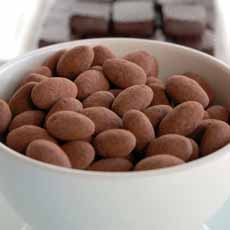
    Our favorites are the Triple Chocolate Almonds from Charles Chocolates, coated in milk chocolate, dark chocolate and cocoa powder.

    They’re also made in Mint Chocolate Almond and in Dark Chocolate Hazelnuts.

    RECIPE: CHOCOLATE-COVERED SEA SALT ALMONDS

    The recipe is from Sally’s Baking Addiction, a wonderful place to find delicious baking ideas.

    Prep time is 25 minutes, plus setting time; total 1 hour.

    Ideally, use the 3-pronged tool from the chocolate tool set to lift the nuts out of the chocolate pool and shake off the excess chocolate. We used fondue forks; but if we make these again, we’re going for the chocolate tools.

    Ingredients For 1-1/2 Cups

  • 6 ounces bittersweet or semi-sweet chocolate, high quality*/li>
  • 1 and 1/2 cups raw, unsalted whole almonds*
  • Sea salt
  • Turbinado sugar or other raw sugar
  •  
    Preparation

    1. TOAST the almonds by spreading them on a large baking sheet; bake for 10-12 minutes in a preheated 300°F oven. Allow to slightly cool before coating with chocolate.

    2. LINE a large baking sheet with parchment paper or a silicone baking mat. Set aside.

    3. MELT the chocolate in a double boiler or in the microwave in a heat-proof bowl at 30-second increments. Stir every 30 seconds until the chocolate is completely melted and smooth.

    4. STIR the almonds into the chocolate, making sure to coat each one. Using a dipping tool or a fork, lift the almonds out one by one. Gently tap the fork against the side of the bowl to remove excess chocolate, and place the nut onto the prepared baking sheet. Repeat with remaining almonds.

    5. SPRINKLE the almonds with a bit of sea salt and turbinado sugar. Allow the chocolate to completely set. You can place the baking sheet in the fridge to speed up the setting.

    6. STORE the almonds in the fridge for up to 4 weeks, in an airtight container.
     
     
    ________________

    *Dark, milk, white: Use whatever chocolate you prefer, as long as it’s a premium brand. Ditto with the nuts: You can substitute hazelnuts, macadamias, pecans, walnuts, mixed nuts, etc.


    Chocolate Sea Salt Almonds
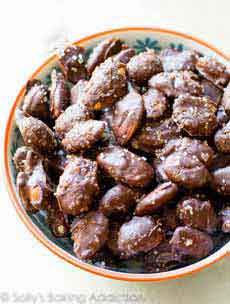
    [1] Warning: addictive! Photo and recipe © Sally’s Baking Addiction.

    Chocolate Covered Almonds

    [2] For you or a friend: Sally’s Candy Addiction, the cookbook by Sally McKenney of Sally’s Baking Addiction (photo © Race Point Publishing).

    Sally's Candy Addiction
    [3] Our favorites to buy are these Triple Chocolate Almonds from Charles Chocolates (photo © Charles Chocolates).


    Comments off

    TIP OF THE DAY: Aïoli, The Original, The Modern, Easy Recipe & A Party

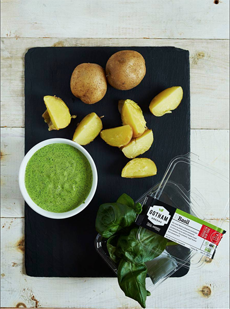
    Aioli Dip With Seafood
    [1] As a sauce or dip with boiled potatoes (photo © Quinciple).

    Basil Aioli
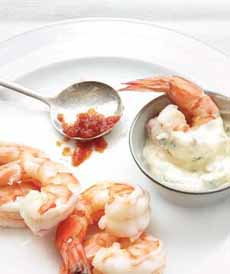
    [2] Tarragon aïoli as a dip with shrimp. Here’s the recipe from Real Simple (photo © Real Simple).

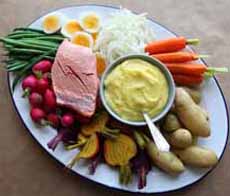
    Aioli Platter
    [3] Le Grand Aïoli: Make a platter for your next gathering. Here’s a story from Edible Seattle (photo © Edible Seattle).

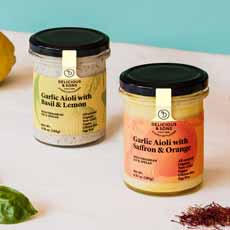
    Saffron Aioli
    [4] Just open the jar and use these flavorful aïolis from Delicious And Sons: Basil Lemon Aïoli and Saffron Orange Aïoli (photo © Delicious And Sons).

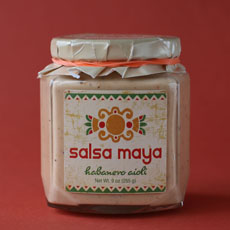
    Habanero Aioli
    [5] Southern Europe meets South America: Habanero Aïoli from Salsa Maya. In Spanish, salsa is a generic word for sauce (photo © SalsaMayaUS).


    Americans eat a lot of mayonnaise, but not enough aïoli: garlic mayonnaise.

    The word is pronounced eye-OH-lee from the French word for garlic, ail (pronounced EYE). An easy recipe using store-bought mayonnaise is below.

    What we think of as a bread spread is used as a dip and sauce from Catalonia (the northeast tip of Spain; think Barcelona) through Provence (Marseilles along the coast through Toulon, Cannes, Nice and Monaco.

    It hopped the border of Monaco to the Liguria region of Italy. It spread to the south of Catalonia to Valencia, Catalonia, Murcia and eastern Andalusia, and offshore to the Balearic Islands. It crossed the sea to Malta.

    In fact, mayonnaise was invented in France by the great chef Marie-Antoine Carême, around 1800. You may think of mayo as a spread, but it was created as a sauce (the history of mayonnaise).

    But before then, the original sauce was made with just garlic and olive oil, which, by the way, was not an easy combination to emulsify into a sauce in the centuries before blenders.

    Later, possibly inspired by Carême’s mayonnaise, Provençal cooks incorporated egg yolks and lemon juice and voila: a richer, more flavorful, more stable mixture than mashed garlic and olive oil. (When you look at your food processor or blender, remember that everything prior to modern times was done in a mortar and pestle.)

    There are numerous seasoning variations. In France, it can include a bit of Dijon mustard. In Malta, some tomato is added.

    Everywhere, aïoli is served at room temperature.

    Ingredients vary by region, too. Catalan versions leave out the egg yolk and use much more garlic. This gives the sauce a more pasty texture, while making it considerably more laborious to make as the emulsion is much harder to stabilize.
     
     
    AÏOLI USES

    Yes, you can put it on your sandwich or burger; but aïoli can be used instead of mayonnaise anywhere, from canapés to to dips to potato salad.

    You can even plan a luncheon or dinner party around it. And you can buy it or make it.

    Then, serve it:

  • With escargots, a French favorite.
  • With fish and seafood: boiled fish (in France, cod and aïoli are a popular pair), bourride (Provençal fish soup).
  • In the U.S. with broiled, poached or grilled fish and shellfish, crab cakes, shrimp cocktail
  • Spread on hard-cooked eggs.
  • On vegetables, especially artichokes, asparagus, boiled potatoes and green beans.
  • As a substitute for butter, oil or vinaigrette.
  • Fries!
  • Salted boiled potatoes and bay leaf (a Ligurian specialty).
  • Mixed into chicken salad, egg, tuna and potato salads.
  • As a crudités dip.
  • On Mexican corn (elote).
  •  
     
    SERVE LE GRAND AÏOLI

    In Provence, Le Grand Aïoli (a.k.a. Aïoli Garni or Aïoli Monstre) is a special-occasion dish consisting of boiled vegetables (artichokes, beets, carrots, green beans, potatoes); salt cod or other poached fish, snails, canned tuna, other seafood; hard-boiled eggs, and a large dish of aïoli.

    In Provence, the dish is served in a celebration around August 15th, after the garlic has been harvested. If you like the idea, plan an occasion.

    You don’t have to wait until August. A room-temperature dish, Le Grand Aïoli delightful in the spring or summer with a lightly-chilled Côtes de Provence rosé or a red Bandol.

    If you like crème de cassis (cassis liqueur, made from blackcurrants), it’s a local product; so serve a Kir or Kir Royale as an aperitif.
     

    AIOLI HISTORY

    Aioli, aïoli, alhòli, aiòli or allioli, arjoli or ajjoli: Depending on the country and region, they are different spellings for a Mediterranean sauce (in southeastern Spain, it’s called ajoaceite or ajiaceite).

    Made of garlic and olive oil—two staple ingredients of the area—the name means garlic and oil in Catalan and Provençal.

     
    There are numerous flavored mayonnaises. Since the expansion of specialty food producers in the late 1980s, it became fashionable for producers and chefs to call all flavored mayonnaises—basil, chili, cilantro, red pepper, saffron, etc.—aïoli.

    While purists insist that only the garlic-seasoned recipe should be called “aïoli,” we think, logically, that as long as there’s garlic in the recipe, it can still be called aïoli. Consumers will understand.

    Otherwise, you’ll find even purer purists who insist that only the original garlic-oil sauce—no egg, no lemon juice—be called aïoli.
     

    RECIPE: A QUICK AÏOLI WITH STORE-BOUGHT MAYONNAISE

    If you want to make your aïoli from scratch, here’s a recipe.

    If you want to cut calories, use Greek yogurt for a different take.

    Ingredients For 1 Cup

  • 3/4 cup mayonnaise
  • 1/3 cup finely chopped fresh basil or other herb*
  • 1 tablespoon fresh lemon juice
  • 1-1/2 teaspoons minced garlic
  • 1-1/2 teaspoons grated lemon peel
  • Pinch salt
  • Optional: 1-1/2 teaspoons Dijon mustard
  • Optional: 1/2 teaspoon olive oil (to thin)
  •  
    Preparation

    1. BLANCH the basil in boiling water for 15 seconds. Mix all ingredients in medium bowl. Season to taste with salt and pepper.

    2. REFRIGERATE, covered, for at least 1 hour or overnight, to allow flavors to meld.

    ________________

    *If you want a spice instead of an herb, season to taste.


    Comments off


    © Copyright 2005-2026 Lifestyle Direct, Inc. All rights reserved. All images are copyrighted to their respective owners.