Lobster Caesar Salad, More Caesar Recipes & Fun Caesar Trivia
|
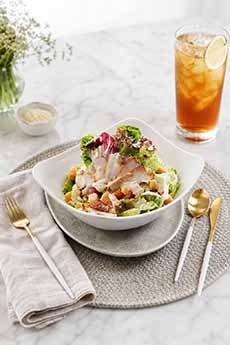
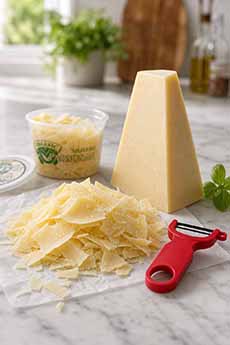
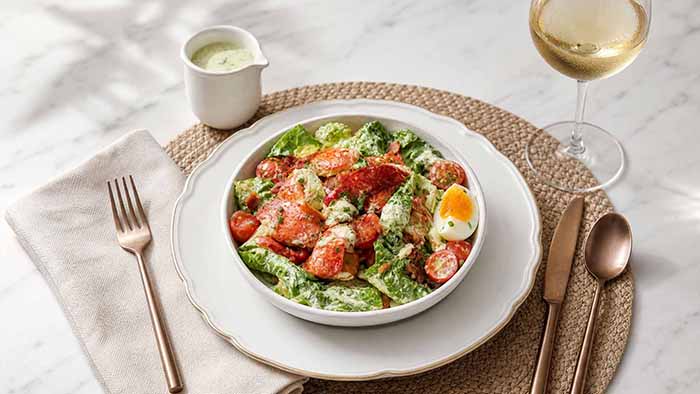
Looking for something special to serve for Mother’s Day or other special occasion? Turn the ever-popular Caesar salad into an elegant first course or luncheon dish by adding lobster. Below: > Recipe: Lobster Caesar salad. > Recipe: Classic Caesar dressing. > Recipe: Tarragon-yogurt dressing. Elsewhere on The Nibble: > The original Caesar salad recipe. > The history of Caesar salad. > The history of Parmigiano-Reggiano cheese. > The year’s 40+ salad holidays. > The year’s 60+ fish and seafood holidays. This recipe makes two luncheon-size salads or four first course plates. If you don’t want to use raw egg in the classic Parmesan Caesar dressing, look for pasteurized eggs at the grocer. Or, you can swap the yolk for 2 tablespoons of mayonnaise. You also can substitute tarragon dressing. Tarragon pairs especially nicely with lobster. Both recipes follow. A photo of the finished salad is waiting for you just below. Ingredients For The Salad Although it moves away from the definition of a Caesar salad, some people like to add sliced avocado or strips of bacon to the top of the salad. Our mother, nicknamed Bun, was a root vegetable fan. She added grated celery root or parsnip to the tossed romaine and called it Bun’s Caesar. You can make the croutons a day in advance and store in an airtight container. We always make a double batch to enjoy with subsequent salads. 1. MAKE the croutons. Toss the bread with the olive oil and seasonings and place in a single layer on a foil-lined baking pan. Bake at 350°F for about 15 minutes, flipping halfway through. They should be dry, crispy, and light golden brown. 2. SLICE the lobster tail meat lengthwise to place atop the salad; the claw meat can be tossed with the romaine unless you can remove it whole. 3. ASSEMBLY. Some people toss the lobster with the romaine and dress the salad before serving. We prefer to show off the lobster by placing it on top of the salad. Some people toss the croutons with the romaine and dressing. We prefer to arrange them around the periphery of the bowl or plate. Then the croutons remain crunchy, and when speared with some romaine will have enough dressing. You can also make extra dressing to serve in a pitcher for people who want more. Ingredients |
|
|
|
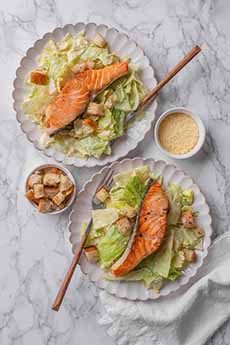
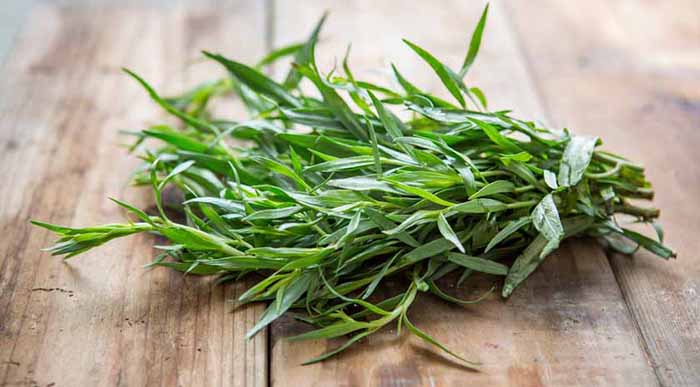
Preparation 1. STIR the egg yolk with a fork and add it to a small jar through a fine mesh strainer. Add the remaining ingredients, cap the jar and and shake well to emulsify the ingredients. Set aside until ready to serve the salad. If you don’t like yogurt you can substitute mayonnaise, but keep the buttermilk or kefir. You can make the dressing 3 days in advance and keep it in the fridge while you prepare the salad. 1. ADD the ingredients to a food processor and process on high until fully blended. Taste and adjust as desired. You can add anything: the seafood group (crab, grilled/poached salmon, lobster, scallops, shrimp), the chicken group (Buffalo chicken, grilled chicken, fried chicken tenders, even chicken salad) and the meat group (beef, lamb, pork—a great use of leftovers). Some people switch the romaine for Brussels sprouts, cabbage, kale, or other greens, and use ranch dressing instead of the Parmesan-based original Caesar. It isn’t an authentic Caesar, but we’d never stop creative interpretations like these: Based on an A.I. sor entrée salads—the kind typically ordered for lunch—the rough “popularity order” on American restaurant menus appears to be: National Caesar Salad Day is July 4th because that’s the day, coincidentally, that it was created on-the-fly by restaurateur Caesar Cardini in his Tijuana, Mexico restaurant. 1. It’s not named after a Julius Caesar. As mentioned earlier, it was named after Caesar Cardini, an Italian immigrant who operated restaurants in Mexico and the United States. 2. It was created in Mexico during Prohibition. Cardini lived in San Diego but operated a restaurant in Tijuana, Mexico, to bypass the restrictions of Prohibition in the U.S. On the Fourth of July weekend in 1924, a massive rush of Hollywood celebrities and tourists consumed much of the restaurant’s food. Caesar allegedly threw together what remained—romaine stalks, garlic, olive oil, croutons, Parmesan, and eggs—and prepared it tableside with a flourish to distract from the simplicity of the ingredients. 3. There were no anchovies in the original. Caesar Cardini was actually against them. The subtle “fishy” flavor in his original recipe came solely from the small amount of anchovies that are in the Worcestershire sauce he used in the dressing. The addition of whole anchovy fillets was a later modification, reportedly by Caesar’s brother, Alex, who called his version the “Aviator’s Salad.” 4. It was meant to be finger food. At the beginning, the salad was not served chopped. Cardini used whole romaine leaves, chilled until crisp, and arranged them points-out on the plate garnished with grated Parmesan and dressing. Guests were expected to pick up the leaves by the stem and eat them with their hands. It wasn’t until the salad moved to more formal dining restaurants in the U.S. that the romaine was chopped/torn and served with a fork. 5. The Coddled Egg Secret. The original recipe used a coddled egg (an egg boiled for exactly one minute) in the dressing. It helped to create the creamy, emulsified texture without it becoming as thick as mayonnaise. 6. It’s a Hollywood Legend. The salad became a sensation because of the Hollywood stars who traveled to Tijuana. Julia Child—although not yet a celebrity—recalled eating a Caesar Salad at Cardini’s restaurant in Tijuana as a young girl in the 1920s, and described the experience of seeing the “legendary” Caesar himself whip it up at her table. 7. The Guinness World Record. In 2007, the Tijuana Restaurant Association created the world’s largest Caesar Salad to celebrate their city’s history. It weighed approximately 7,246 pounds (3,287 kg) and required about 160 people to prepare it. According to Guinness World Records, it contained over 2.5 metric tons of romaine lettuce, 480 kg of dressing, 200 kg of Parmesan cheese, and 68 kg of croutons. It was assembled in a long, transparent acrylic trough measuring about 60 meters (197 feet) in length. The clear trough allowed spectators to watch the chefs and culinary students toss the ingredients along its entire length. The salad was served to the thousands of spectators who attended the event. For a nominal admission fee, visitors could enjoy what was essentially an all-you-can-eat Caesar salad while enjoying music and family activities at the Tijuana Cultural Center. ________________ †Tarragon pairings: Strong and savory, tarragon gives its licorice-and-lemony flavor and aroma to (in alphabetical order): ‡Taco salad and Southwest salad share several Tex-Mex ingredients, but they differ significantly in their construction and presentation. The iconic feature of a taco salad is its large, deep-fried flour tortilla bowl filled with the components of a taco including warm seasoned ground beef, lettuce, cheese, beans, diced tomatoes or pico de gallo, diced tomatoes (or pico de gallo), diced red onion, and sliced jalapeños. Extras can include diced avocado or guacamole, corn kernels, and chopped fresh cilantro. The dressing can be salsa (often mixed with sour cream, ranch or cilantro-lime ranch, or Catalina dressing. The garnish is tortilla strips or chips. A Southwest salad, on the other hand, is served on a plate or in a standard bowl, usually with a grilled chicken breast atop romaine or mixed greens, black beans, corn, diced tomatoes, bell peppers, avocado, and shredded cheese. The dressing is often a creamy, chipotle ranch or a light, zesty vinaigrette. CHECK OUT WHAT’S HAPPENING ON OUR HOME PAGE, THENIBBLE.COM. |
||