|
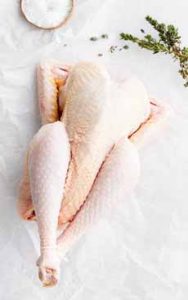
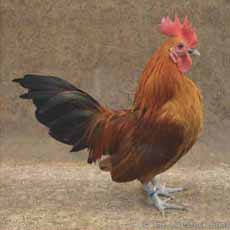
This chicken looks scrawny, you say?
You’re right. The next time you’re at a farmer’s market—or near an artisanal butcher—bring one home. Ask for a heritage chicken.
This longer, leaner chicken will yield flavor unlike that plump pullet or roaster you’re used to.
Good Eggs, the most wonderful specialty grocer in the Bay Area, sent us an email announcing that these chickens are now available (frozen), and we can’t wait to try one.
It’s the chicken great-grandma roasted, until consumer demand for fatter breasts led to the creation of the generic supermarket chicken we know today. It’s the chicken that Americans ate for centuries after colonists arrived in the New World.
Good Eggs’ birds are bred by Root Down Farm in Pescadero, California. If you’re not in Northern California, check for a local heritage breeder.
THE HISTORY OF HERITAGE CHICKEN
Chickens are members of the pheasant family, Phasianidae. Our domesticated chicken is the subspecies Gallus gallus domesticus.
Wild chickens were domesticated in Asia, possibly as far back as 7000 B.C.E. The Chinese had domesticated them by about 5000 B.C.E., along with East Asia neighbors such as Thailand and Vietnam. Evidence shows domestication in India around 3000 B.C.E.
The tasty little animals were carried from West Asia to Africa. Chicken bones have been found in Egyptian tombs: slaughtered chickens that fed the deceased on his or her journey to the other side.
For normal folk, chicken eggs and meat were excellent sources of protein. Almost anyone could afford to purchase two chickens to breed.
Chickens were the ultimate low-maintenance protein, easy to keep at home. They ran around the yard and ate bugs and food scraps. At night, they didn’t mind tight confinement in a cage.
And in the millennia before refrigeration*, a chicken was a single-meal proposition. Unlike slaughtering a pig or a goat, which provided many potential meals, there was no meat to go bad in the millennia before home refrigerators.
When All Chickens Were Heritage
Until the mid-20th century, all chickens were heritage chickens.
In the late 1940s, poultry geneticists engineered a fast-growing chicken, the Cornish Cross, that could be raised exclusively indoors. Fast-growing and indoors meant the bird reached market weight faster, saving on feed and maintenance for a longer-maturing heritage chicken.
Since then, the Cornish Cross has been served in almost every restaurant, and sold in every grocery store. It is what 99% of the U.S. eats.
This bird grew at an abnormally fast rate, reaching six pounds in six weeks (42 days). Today, the average processing age of the Cornish Cross has been gotten down to 37 days (source).
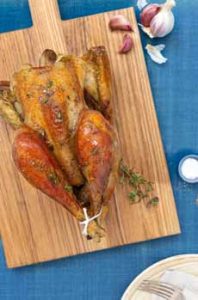
Not everyone is ready to buy a heritage chicken—because of its smaller breast and larger legs, and because it requires slower cooking. To ease the transition, the chickens in photos #1 and #2 are a cross between heritage and the Cornish Cross.
Root Down Farm raised this breed, which they named the Red Ranger. It grows at a rate in-between heritage and Cornish Cross, and has natural heritage behaviors. It spends up to 22 weeks roaming in sunny pastures. It has great flavor!
(Note that while roaming in pasture or an outdoor yard is known as “free range,” the law allows chickens that roam anywhere outside of a cage to be called “free range.” Thus, many birds that spend their lives roaming only the crowded floor of a barn, can also be called free range.
Cooking A Heritage Chicken
Why does a heritage, or part-heritage, chicken require lower temperatures, and thus longer cooking time? Says Root Down Farm:
There is a direct correlation between the rate of growth and the cooking method.
The faster something grows, or the less muscles get used over a short period of time, the more it can sustain high heat.
The slower something grows, allowing it to use its muscles more over a longer period of time, the longer and lower it needs to be cooked.
Heritage birds should be braised and stewed, techniques that yield the tenderest and most flavorful chicken. Your Instant Pot, pressure cooker or other slow cooker is waiting for you to bring it a heritage chicken.
WHAT ARE HERITAGE CHICKENS?
According to The Livestock Conservancy, a nonprofit organization focused on preserving and promoting rare breeds of livestock.
Terms such as “antique,” “heirloom,” “old-fashioned” and “old timey” imply heritage birds, and are understood to be synonymous with the definition provided here.
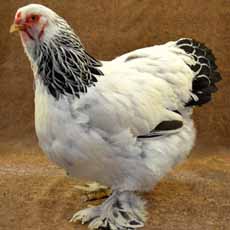
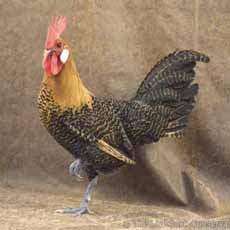
Pasture-raised heritage chickens look noticeably different from faster-growing breeds, with slimmer bodies and darker, more flavorful meat (we think they look like the marathon runners of chicken).
A heritage chicken:
Must be from a parent and grandparent stock of breeds recognized by the American Poultry Association (APA) prior to the mid-20th century; whose genetic line can be traced back multiple generations; and with traits that meet the APA Standard of Perfection guidelines for the breed.
Is hatched from a heritage egg, sired by an American Poultry Association standard-bred chicken, whose breed was established prior to the mid-20th century.
Must be reproduced and genetically maintained through natural mating. Chickens marketed as Heritage must be the result of naturally mating pairs of both grandparent and parent stock.
Must have a moderate to slow rate of growth, reaching appropriate market weight for the breed in no less than 16 weeks. This gives the chicken time to
develop strong skeletal structure and healthy organs prior to building muscle mass.
Chickens marketed as heritage must include the variety and breed name on the label.
Are you ready to buy yours?
CHECK OUT OUR CHICKEN GLOSSARY
Can you name the different parts of a chicken? You’d be surprised.
Check out all this at more in our Chicken Glossary.
________________
*While home refrigerators debuted around 1911, most American homes did not have refrigerators until after World War II.
|