THE NIBBLE BLOG: Products, Recipes & Trends In Specialty Foods


Also visit our main website, TheNibble.com.

TIP OF THE DAY: How To Make The Best Grilled Cheese Sandwich


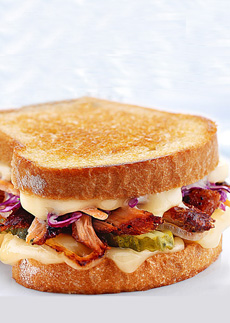
The Biloxi: pork butt, bacon and fontina
cheese. Photo courtesy Grilled Cheese
Academy.
  For National Grilled Cheese Month (there’s also a National Grilled Cheese Day, April 12th), feast your eyes upon 30 creative grilled cheese recipes from the Grilled Cheese Academy.

You’ll find more than a few must-try recipes. In fact, you might be inspired to host a grilled cheese party.

To make the best grilled cheese sandwiches, here are 10 tips from the experts at EatWisconsinCheese.com, creators of the Grilled Cheese Acadmey.

CHEESE TIPS

1. To Slice Or Not To Slice. Often it’s best to grate or shred the cheese. This promotes faster melting, as well as a smooth and more even melt.

2. Slicing And Melting. It’s easier to slice and grate cheese when it’s cold. Furthermore, cheese melts best at room temperature.

 
3. More Is Better. Don’t be shy: Pile on the cheese. Expand your horizons by using several types of cheese at once, as well as different toppings (arugula, caramelized onions, chutney, cranberry sauce, figs, garlic-sauteed spinach, gherkins, grapes, grilled vegetables, jalapeño, olives, pepperoncini, pesto, pickled vegetables, relish, sprouts, sautéed pineapple, sundried tomatoes, tomato sauce….whatever’s in the fridge or pantry). Remember, American, Cheddar and Swiss aren’t the only cheeses in town.


BREAD & BUTTER TIPS

4. Use The Real Deal. For great flavor, use real butter to pan-toast your grilled cheese sandwich. Margarine and other butter wannabes win you no points.

5. Soft Is Good. Butter at room temperature is the way to go. Not only does it spread easily, but it also browns the bread more evenly.

6. Use Your Imagination. White bread is not the only answer; in fact, it’s often not the best answer. Pick specialty unique breads to create equally more exciting and flavorful grilled cheese sandwiches.
COOKING TIPS

7. Size Matters. Always use the right size skillet or suffer the consequences. If you opt for a skillet that’s too small, your sandwich will cook too slowly and not evenly.

 
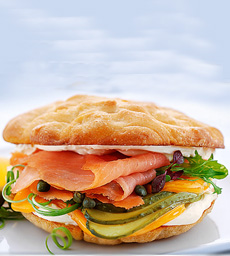
The Nantucket: smoked salmon, cream cheese, scallions and melted aged Cheddar. Photo courtesy Grilled Cheese Academy.
 
8. Cast Off Cast Iron. Cast-iron pans and grilled cheese sandwiches are not friends. Always use a nonstick pan to minimize “stickage.” It also makes cleanup easier.

9. Flip. Press. Repeat. You want the cheese to spread evenly as it melts. So always press the sandwich with a spatula after you flip it. (Open-faced grilled cheese sandwiches do not require flipping.)

10. Low And Steady. Don’t grill over high heat. Not only will the bread brown too fast, but the cheese will not melt completely. Be patient and always grill over low heat.


Comments off

Recipe: Turn Espresso Into Affogato & The History Of Affogato

Affogato Recipe Ice Cream & Espresso
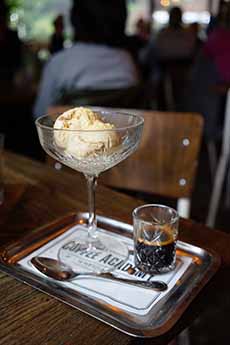
[1] Affogato: an Italian sundae (photo © Tony Liao | Unsplash).

Affogato Sundae Ice Cream & Espresso
[2] A coupe glass (photo #1) is nice, but most people use a rocks glass (photo © Williams Sonoma).

Affogato Recipe Ice Cream & Espresso
[3] After the first ball of ice cream melted, a fresh scoop was plopped on top.

  When life gives you lemons, make lemonade. When it gives you gelato, make affogato (ah-foe-GOT-toe).

We’re perplexed as to why this quickie Italian sundae—a scoop of gelato topped with a shot of espresso—is rarely found on Italian restaurant menus in the U.S.

Most of them serve both gelato and espresso. Did someone lose the affogato recipe?

The next time you’re at an Italian restaurant, order an affogato for dessert. If they won’t make it for you, unleash your inner Robert Eroica Dupea—the character played by Jack Nicholson in “Five Easy Pieces”: 

Order an espresso and a dish of gelato and combine them yourself.

Affogato means “drowned” in Italian. You can further drown the gelato with a flavored syrup or a shot of liqueur.

Consider amaretto, chocolate, coffee, hazelnut or vanilla syrups or liqueurs—or go fusion with some Irish cream liqueur.
 
 
MAKE AFFOGATO AT HOME

It’s easy to make affogato at home—as a treat for yourself or a surprise for family and friends. While vanilla is the traditional gelato flavor, chocolate, coffee and hazelnut gelato are even more delicious. (While it goes without saying, we’ll say it: You can substitute ice cream for gelato.)

In this cooking video, Giada Di Laurentiis tops vanilla gelato with syrup and then adds a shot of hazelnut liqueur before topping the “sundae” with hot espresso.

You can re-concept affogato from a sundae to a beverage by adding a scoop of gelato to a glass of iced espresso.
 
> Check out all the different types of espresso

> The difference between gelato and ice cream.

 
THE HISTORY OF AFFOGATO

The origin of affogato al caffè, the Italian term for gelato drowned in a cup of coffee, is unknown. (Affogare means “to drown.”)

What is known is that the fashion of drinking wine with snow or ice emerged in Italy in the 16th century [source].

The Florentine polymath Bernardo Buontalenti (1531-1608) invented gelato for a special banquet given by Grand Duke Cosimo I de’Medici (1519-1574).

(The history of gelato.)

We don’t know the precise date of that banquet, but given that Cosimo reigned as Grand Duke from 1569 to 1574, we can guess that it was during this five-year period.

While gelato could have been spooned into a regular cup of coffee, the affogato uses espresso. Modern espresso emerged in the latter half of the 19th century. The first espresso machine was presented at the Universal Exposition in Paris in 1855.

 
It’s not difficult to envision some early-20th-century cook or foodie dropping a scoop of vanilla ice cream into a cup of coffee. Heck: If it hadn’t already been invented, we would have done it!

But we’ll have to wait until someone discovers an old menu in a dusty archive, that lists “affogato”; or an old newspaper or magazine article that reports on the delicious new recipe.

Otherwise, what we do know is that affogato emerged in Italy during the 1980s or early 1990s. While it would seem as if there is more information on something so recent, exact documentation is scarce.

It’s often enjoyed as dessert, instead of a separate coffee enjoyed with something sweet.


CHECK OUT WHAT’S HAPPENING ON OUR HOME PAGE, THENIBBLE.COM.


Comments off

TIP OF THE DAY: Try A New Ingredient Every Month

Today’s tip is from Chef Johnny Gnall. If you have questions or suggestions for tips, email Chef Johnny.

Home cooks can get intimidated by the thought of trying new ingredients. There’s a time-and-money issue of experimenting with something that might not turn out well.

But cooking is exploration. Sometimes explorers find that the trip yields nothing exciting, other times they happen upon a game-changer. With all the information and recipes on the Internet, you‘ve got all you need to add vivid new flavors to your cooking.

Ever heard of galangal (pronounced guh-LAHNG-ull, with a broad “a,” also called galanga and blue ginger)? Native to Indonesia, it is best known in America as an herb that flavors Thai soups.


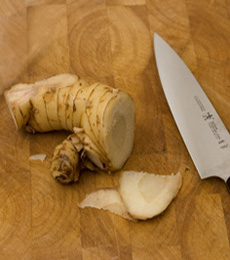
Galangal. It looks like ginger but is used in a very different way. Don’t be intimidated by it! Photo by Piano Non Troppo | Wikimedia.

A member of the ginger family, Zingiberaceae, galangal is similar in appearance to ginger; but instead of ginger’s spice heat, it delivers an earthy, complex favor profile with notes of citrus, pine and cedar (and it’s usually removed prior to serving, not consumed in the same way as ginger). It’s also delicious in stews and stir-fries.

Once you know what something tastes like—kaffir lime or shrimp paste, for example—you can add it to your favorite recipes to give them new life.

DON’T BE INGREDIEN-TIMIDATED

Unleash your inner explorer and plan to try a new ingredient every month. Your supermarket may have enough to start you off—from enoki mushrooms in the produce department, quinoa with the grains, and the spice rack (check out black cardamom, cubeb pepper, fenugreek, grains of paradise, mastic, za’atar and many others).

Next, look up international markets and produce stores in your area and go browsing. If there are no local markets, search on the internet. Peruse African, Asian, Latin American and Middle Eastern grocery sites.

Then, make yourself a list of 12 ingredients you want to try over the next year. Here are some ideas to start you off:

  • Kamut, an ancient, high-protein wheat with a nutty flavor. More about kamut, a whole grain.
  • Laver/Nori, the dried sheets of seaweed used to make sushi rolls. Roll something else in it (we’ve used it for seasoned goat cheese and tuna “rolls”) or use matchstick slices as garnishes on salads, seafood or poultry.
  • Mushrooms—not the ubiquitous white buttons, but some of the more flavorful varieties. You can try a “mushroom of the month.” They’re low in calories and very flavorful. Check out our Mushroom Glossary.
  • Nigella seeds, tiny black peppery seeds popular in Middle Eastern and Asian cooking that are just as much at home in chicken salad, omelets and other American dishes.
  • Nopales, prickly pear leaves with a flavor similar to green beans. Popular in Mexican cuisine, they can be added to salads, scrambled eggs and most Mexican dishes.
  • Quinoa, a grainlike seed that’s one the world’s great complete proteins (it contains all eight essential amino acids). More about quinoa.
  • Sweeteners, from demerara to jaggery, try a new type of sugar instead of refined white sugar on your cereal. Check out our Sugar Glossary for the different types of sugar worldwide; then visit an international market and pick up some.
  • Yuzu, a delightful Asian citrus that we use instead of lemon or lime juice in just about everything. (More about yuzu.)
  • Seasonal vegetables and fruits—our favorite spring dish is a combination of fava beans and ramps. We look forward to it every year, during the fleeting weeks when both are available. We feel the same about stewed rhubarb, a dessert we learned at our grandmother’s knee.
  •   

    Comments off


    © Copyright 2005-2026 Lifestyle Direct, Inc. All rights reserved. All images are copyrighted to their respective owners.