THE NIBBLE BLOG: Products, Recipes & Trends In Specialty Foods
Also visit our main website, TheNibble.com.
|
May 20, 2014 at 8:37 am
· Filed under Recipes, Vegetables-Salads-Herbs
|
|
What to bring to a barbecue? Barbecue potato salad, a recipe from QVC’s chef David Venable, who blends barbecue sauce in with the mayonnaise.
Says David: “In my opinion, it’s really not a barbecue without a side of potato salad. While the classic version is near perfection, sometimes it’s fun to play with the flavors (a sure sign of a confident cook!) This dish mirrors the flavor of your favorite barbecued meats.”
RECIPE: BARBECUE POTATO SALAD
Ingredients
4 pounds new potatoes, quartered
1/2 pound smoked bacon
1-1/3 cups mayonnaise
2-1/2 tablespoon Dijon mustard
3 tablespoons barbecue sauce
1 hard boiled egg, diced
2 celery stalks, diced
1/2 red onion, minced
1/2 teaspoon dried thyme
Salt and freshly ground pepper
Optional garnish: fresh chives, chopped
|
|
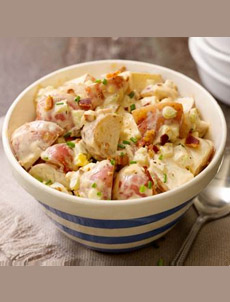
Barbecue potato salad. Photo courtesy QVC. |
Preparation
1. COVER the potatoes with water and bring to a boil in a large stockpot over high heat, with 1 tablespoon salt. Cook until the potatoes are tender, about 30 minutes; drain. While the potatoes are cooking…
2. RENDER the bacon until crisp in a large skillet over medium-high heat, about 5 minutes. Drain the bacon on several paper towels and break into small, bite-size pieces. Set aside.
3. MIX the mayonnaise, mustard, barbecue sauce and hard boiled egg in a large bowl. Slowly add the potatoes to the dressing and let them absorb the liquid, about 15 minutes. Add the celery, red onion, thyme, salt and pepper and refrigerate until well chilled.
4. GARNISH with the bacon and chives just before serving.
Find more of David Venable’s recipes at QVC.com.
|
|
|
Permalink
|
|
May 20, 2014 at 8:30 am
· Filed under Beer & Hard Cider, Books, Giftable
|

A gift for beer lovers. Photo courtesy Dog ‘N’
Bone. |
|
Looking for a gift for your Memorial Day hosts, or for Father’s Day? Instead of a bottle of wine, how about some craft beer?
Package the beer with a copy of Craft Beer World by Mark Dredge
With the explosion in the popularity of craft beers across the globe, more must-try beers are available than ever before.
Craft Beer World presents more than 300 of the world’s most innovative and delicious, showcasing the best of each style in 50 different categories.
From an American IPA bursting with citrusy C-hops or an Imperial Stout full of dark roasted malts, the book explains the key characteristics of each, from classic to cutting edge brews.
There are also nuggets of beer information, including how to serve different beers and how to pair beer with food.
|
|
|
|
Also consider a beer flavor wheel, a shortcut to comparing styles.
Another type of beer flavor wheel provides descriptions of the myriad flavors of beer.
Whether you’re looking for bitter beers or brews with hints of chocolate or coffee, these guides reviews will point you in the right direction. There’s not just one perfect beer to suit your taste buds; there are many!
Check out the different types of beer in our Beer Glossary.
|
|
A beer flavor wheel provides instant comparisons. Photo courtesy Beverage Ideas.
|
|
|
|
|
Permalink
|
|
May 20, 2014 at 8:06 am
· Filed under Meat & Poultry, Recipes, Tip Of The Day
|
Bacon cheese dogs, cousins to the bacon
cheeseburger. Photo courtesy Kraft. |
|
Like the hamburger, the hot dog is a sandwich: meat “sandwiched” in bread. It was invented in the U.S. in 1871, when an enterprising Coney Island sausage vendor thought to serve a Frankfurt-style sausage in a roll. The rest is history.
Over time, fans have created gourmet hot dog recipes, but nowhere to the extent of burger variations.
Even looking at the basics: How many bacon cheeseburger lovers have ever tried a bacon cheese dog? So today’s tip is: serve up bacon cheese dogs along with bacon cheeseburgers in your Memorial Day grillfest.
Start with this from Kraft, which used Oscar Mayer hot dogs, Kraft Singles and Claussen sweet pickle relish.
RECIPE: BACON CHEESE DOGS
Ingredients For 6 Servings
6 hot dogs
6 hot dog buns
6 cheese slices, cut diagonally in half
6 slices bacon, cooked
1/4 cup sweet pickle relish
|
|
Preparation
1. HEAT grill to medium-high heat.
2. GRILL franks 7 to 9 minutes or until heated through, turning occasionally.
3. PLACE in buns; top with remaining ingredients.
Variations
Use brioche or whole wheat hot dog buns (toasted, of course).
Try different cheeses. In this recipe, we prefer mozzarella, provolone or Swiss instead of American or Cheddar cheese.
Serve with chopped onions.
Add optional heat with fresh jalapeño slices.
Kraft calls this recipe “Steamwhistle Hot Dogs”; but we’re not sure why. Steam whistles are a familiar sound of yore, the “woo woo” of the old locomotive. Steam whistles were also used in factories and elsewhere to signal the start or end of a shift.
TIP: The opposite of the bacon cheese dog—all three main ingredients chock full of saturated fat—is the garden hot dog. Wrap the dog in a lettuce leaf before placing it in the bun. Tuck sliced radishes and cucumbers on either side of the dog, and top with diced tomatoes or sliced grape tomatoes.
MORE ABOUT HOT DOGS
The history of hot dogs.
Conventional versus organic hot dogs.
Hot dog trivia quiz.
How to set up a hot dog bar.
|
|
|
Permalink
|
© Copyright 2005-2026 Lifestyle Direct, Inc. All rights reserved. All images are copyrighted to their respective owners.