|

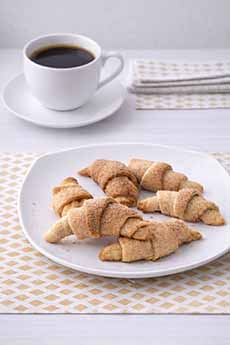
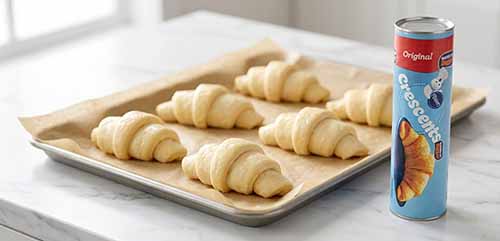
[1] Make warm and fragrant cinnamon crescents for breakfast or brunch. The recipe is below (photo and recipe © Taste Of Home).
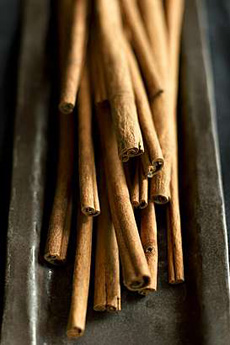
[2] One of the three different types of cinnamon (photo © Ben Fink from Indian Home Cooking by Suvir Saran.
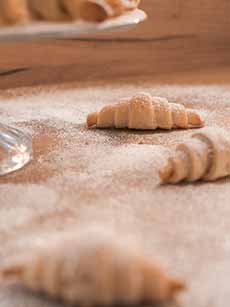
[3] After shaping and just before baking, croissants and other breads undergo roofing—a.k.a. final fermentation, final rise, second rise, or blooming (photo © Mateusz D | Unsplash).
[4] Golden brown classic croissants. Here’s the recipe (photo © King Arthur Baking).
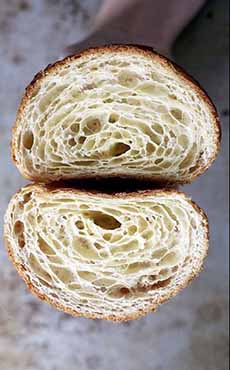
[5] The airy inside of the croissant is a result of lamination, the process of folding and rolling butter into dough over and over again to create super-thin layers. These layers, which alternate between butter and dough, are what give croissants their signature honeycomb interior structure and their flaky texture. As a croissant bakes, the water in the solid butter vaporizes into steam, which puffs up the dough and creates steam pockets between the layers. Here’s more about it (photo © King Arthur Baking).
|
|
April 10th is National Cinnamon Crescent Day, an ideal warm, fragrant companion to a cup of coffee or tea.
Crescent is the English translation of croissant, the buttery, crescent-shaped laminated dough breakfast rolls so integral to French breakfasts.
Cinnamon Crescents are an American adaptation of the croissant. Because Americans have a sweet tooth, the crescents have a filling of cinnamon sugar and are topped with a vanilla glaze.
Below:
> The recipe for cinnamon crescents from scratch.
> How to make cinnamon crescents from Pillsbury refrigerated dough.
> The history of croissants.
> The history of cinnamon crescents.
> Other crescent-shaped baked goods.
Elsewhere on The Nibble:
> The history of cinnamon.
> The history of bread.
> The history of pastry.
> The history of breakfast.
> The different types of bread: a photo glossary.
> The different types of pastry: a photo glossary.
> The year’s 20+ bread holidays.
> The year’s 15+ pastry holidays.
RECIPE: CINNAMON CRESCENTS (CROISSANTS)
Thanks to Taste Of Home for the recipe.
Ingredients For 4 Dozen Small Rolls
2-1/2 cups all-purpose flour
1 teaspoon baking powder
1 cup cold butter
1/2 cup milk
1 large egg, beaten
1 cup sugar
4 teaspoons ground cinnamon
Optional Glaze
1 cup confectioners’ sugar
1 to 2 teaspoons ground cinnamon
4 teaspoons 2% milk
Preparation
1. COMBINE the flour and baking powder in a large bowl; cut in the butter until crumbly. Stir in the milk and egg. Divide into three portions; shape each portion into a ball.
2. COMBINE the sugar and cinnamon; sprinkle a third of it over a pastry board or a surface. Roll one ball into a 12-inch circle; cut the circle into 12 wedges.
3. ROLL UP from wide edge. Repeat with the remaining dough and cinnamon sugar.
4. PLACE the rolls with the point side down on a lightly greased baking sheets; form into crescent shapes. Bake at 350° for 16-18 minutes or until lightly browned (do not overbake).
5. MAKE the glaze. Combine the confectioners’ sugar, cinnamon and milk until smooth. Drizzle over the cooled crescents.
HOW TO MAKE CINNAMON CRESCENTS FROM PILLSBURY PACKAGED DOUGH
For a faster result, you can make crescent rolls from the Pillsbury Crescent Roll dough. The concept was the winner of the 1973 Pillsbury Bake-Off!
Just press the pre-cut triangle perforations of a crescent sheet together, spread it with butter and cinnamon-sugar, roll the whole sheet into a log, and slice it into rounds.
[6] Just BYO cinnamon sugar (Abacus Photo).
THE HISTORY OF THE CROISSANT
Meaning “crescent” and pronounced kwah-SAWn (the “n” is just a hint of the consonant at the end of kwah-SAW) in French, this rich, buttery, crescent-shaped roll is made of puff pastry that layers yeast dough with butter—a technique known as laminating.
Traditionally a breakfast bread served with jam and butter, two classic variations include the almond croissant, filled with frangipane (almond paste) and topped with sliced almonds, and the “chocolate croissant,” correctly called pain au chocolat, baked with a piece of dark chocolate in the center.
In the early 1970s, croissants became sandwich substitutes as they evolved from their two traditional fillings, chocolate, and almond paste, into many savory variations, from broccoli to ham and cheese, as well as additional sweet varieties.
There’s also the Bavarian croissant or pretzel croissant, made of a pretzel-like dough that combines bread flour and whole wheat flour with salt sprinkled on the top, like a pretzel. Some are made of puff pastry, others of soft pretzel-type dough in a triangle wrap, like a croissant.
|
The Real Vs. Alleged History Of Croissants
Stories of the croissant being made in the shape of the crescent of the Turkish flag, after the defeat of the Turks in the Siege of Vienna in 1683, are a perpetuated myth. Recipes for croissants do not appear in recipe books until the early 1900s, according to the Oxford Companion To Food. The earliest French reference is in 1853.
The croissant is a descendant of the Austrian kipfel, a yeast roll usually filled with chopped walnuts, dried or candied fruit, or other filling, and shaped like a crescent. It arrived in Paris in 1838 or 1839 with August Zang, an Austrian military officer. He opened a bakery, Boulangerie Viennoise, and introduced Viennese techniques which would one day lead to the baguette and the croissant. The crescent-shaped kipfel was ultimately made with puff pastry by French bakers.
You can read this history in Jim Chevallier’s book, August Zang and the French Croissant: How Viennoisserie* Came To France (Kindle edition).
The History Of Cinnamon Crescents
While the concept of crescent-shaped pastries is and old European traditions, the prominence of crescent (croissant) rolls and pastries in the U.S. began with the invention of the packaging technology: the metal tube can that pressurized dough and opened with a “pop.”
In 1931 the pressurized can format, created by a third-party inventor†, was patented, subsequently becoming iconic for refrigerated dough products. Pillsbury acquired the patent in 1951, and launched its line of refrigerated biscuits.
The refrigerated dough in a pop-open tube, portioned to bake quickly, allowed home cooks to serve the “home-baked goodness” of cookies and rolls frequently.
Pillsbury Original Crescent Rolls arrived in 1965, along with the Pillsbury Doughboy (his name is Poppin’ Fresh).
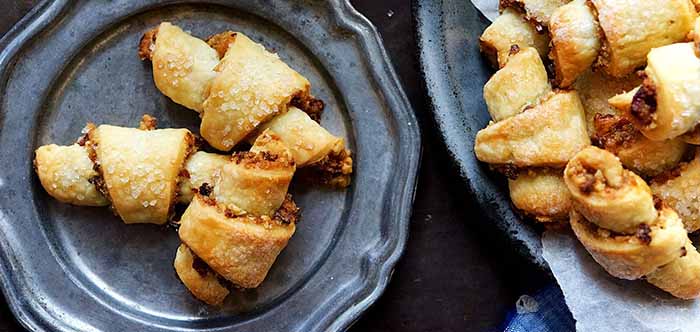
[7] Another favorite “crescent”: rugelach. Here’s the recipe (photo © King Arthur Baking).
OTHER CRESCENT-SHAPED FOODS
Crescent shapes in baking show up often: in pastries, rolls, and even cookies. A few examples:
Bread-Like: Crescent-Shaped Pastries & Rolls
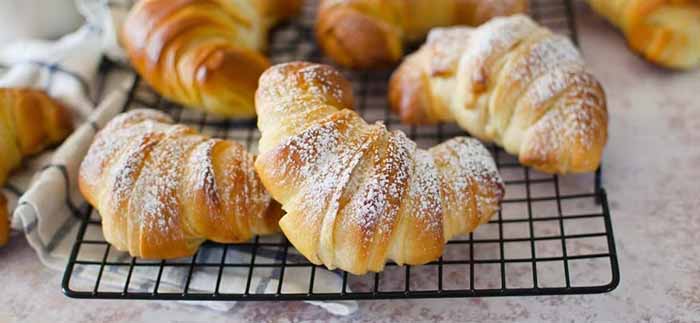
Cornetto (Italy): Similar silhouette to a croissant, but commonly sweeter/softer (often enriched dough; sometimes lightly laminated), frequently filled with pastry cream or jam (photo #8, below).
Medialuna (Argentina/Uruguay): “Half-moon” pastries descended from European traditions; usually smaller and glazed, sold as sweet or sometimes more buttery/savory versions.
Kifli (Hungary/Serbia/Croatia and nearby regions): A broad family of crescent rolls—some are soft and bread-y, others more pastry-like; can be plain, walnut, poppy seed, etc.
Kipferl (Austria/Central Europe): Often cited as an older crescent-shaped yeast pastry/roll tradition (typically less flaky than a croissant; can be plain or nutty/sweet).
Cookie/Pastry Hybrids: Crescent-Shaped Filled Pastries
Rogaliki / rohlíky / rogal (various Slavic/Central European cuisines): Many regional names for small crescent-shaped pastries/cookies, often filled with jam, poppy seed, or nut pastes.
Rugelach (Jewish/Eastern European–Ashkenazi: Rolled from a circle and cut into wedges, then rolled into small crescents with fillings like cinnamon, nuts, chocolate, or jam (photo #7, above).
Crescent-Shaped Cookies
Vanillekipferl (Austria/Germany): Classic vanilla crescent cookies, tender/crumbly, usually dusted with powdered sugar; a popular Christmas cookie.
Savory Pastries
Although they’re half-moons rather than crescents, we give a shout-out to baked savory pastries like calzones and empanadas; and another nod to sweet turnovers.
[8] https://www.tasteofhome.com/recipes/cinnamon-crescents/The cornetto (“little horn”) is called the “Italian croissant.” Here’s the recipe (photo © Cookist).
_______________
*Viennoiserie are buttery, flaky breakfast breads and pastries made with laminated dough, a technique of layering and folding a yeast dough to create brioche, croissants, danish, pain au chocolat and other so-called “Viennoiserie.” It is a marriage between traditional bread baking and sweet pastry baking. The technique of lamination produces many buttery layers that can be pulled apart to reveal thin leaves within. You can see the striations, or layers, of pastry when you look at the top of the Viennoiserie or when you cut into them (photo ##5). This technique is time-consuming and expensive (because of the amount of butter needed).
†The pressurized can/tube was patented in 1931 by Lively Willoughby, a Kentucky bakery owner, to sell his biscuits. He later sold the patent to Ballard & Ballard Flour Co., and biscuits had become a key refrigerated dough item by the 1950s, when Pillsbury acquired Ballard (1951), enabling it to expand into packaged refrigerated biscuit doughs. In 1958 Pillsbury filed a patent for the “breakable tube,” which was granted in 1961.
CHECK OUT WHAT’S HAPPENING ON OUR HOME PAGE, THENIBBLE.COM.
|