|
Updated July 2026
Do you know your Gran Gala from your Grand Marnier? Or other orange liqueurs?
Orange liqueur is a popular ingredient in cocktails, from classics like the Margarita and Sidecar to the contemporary Cosmopolitan. It’s also used in foods from chicken to mousse.
Orange liqueurs are made from the peel of bitter oranges—generally varieties that are too bitter to enjoy as a fruit.
Does it make a difference which one you buy? Name brands like Cointreau, Grand Marnier and Grand Gala are generally better products than generics like Curaçao and triple sec, even if those products are made by well-known producers.
Some will be sweeter, some more bitter, some more complex. What you can do is hit your favorite bar with some friends, order shots of all their orange liqueurs, and decide which you like the best.
A primer follows.
> October 16th is National Liqueur Day and July 14th is National Grand Marnier Day.
Below:
> The different types of orange liqueur.
> The history of orange liqueur.
Elsewhere on The Nibble:
> The year’s 7 liqueur holidays.
> The history of liqueur.
> The difference between liqueur, eau de vie, cordial, and schnaps (also spelled schnapps).
> How about a recipe to make your own orange liqueur?
TYPES OF ORANGE LIQUEUR
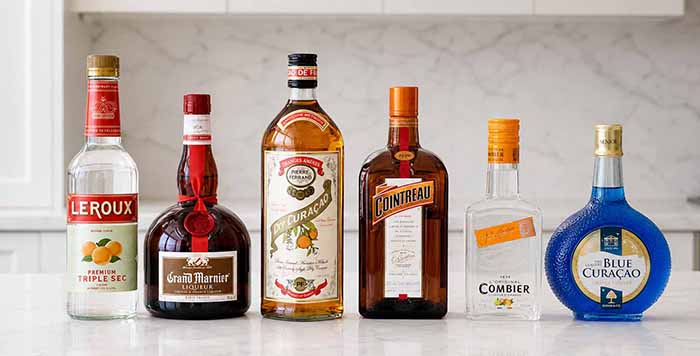
Just search for “orange liqueur” in Google Images, and you’ll find scores of brands you’ve never heard of. But in the U.S., these rule the roost:
Cointreau is a brand of triple sec, a finer product than products simply labeled “triple sec.” It was first produced in 1875 by Edouard Cointreau in his family’s distillery in Angers, France. It is stronger-flavored and more complex than most triple secs.
Curaçao is a style of liqueur made from the dried peels of the laraha citrus fruit, grown on the island of Curaçao in the Netherlands Antilles (southeast of the Virgin Islands in the Caribbean). The name is generic. The laraha developed from the sweet Valencia orange planted by Spanish explorers. The orange would not grow successfully in the climate of Curaçao; the fruits produced were small, bitter and inedible. However, the peel remained aromatic and true to the Valencia varietal, and made a delicious liqueur. The trees were bred into the current laraha species, still inedible. Some brands are colored blue or bright orange; the color adds no flavor.
Grand Marnier is a Cognac-based brand of orange liqueur, generally considered to be the finest quality of the orange liqueurs. It is made by blending macerated bitter orange skins in neutral alcohol with Cognac, and aging this spirit in oak barrels. It was created by Louis-Alexandre and first sold in 1880 as Curaçao Marnier. It became referred to as a “Grand Curaçao” because of the power of the Cognac.
Grand Marnier is an orange liqueur made in the Curaçao tradition, and Cointreau is a triple sec (less sugar).
|
|

[3] Grand Marnier has its own holiday: July 14th (photo © Sobe Liquor Store).

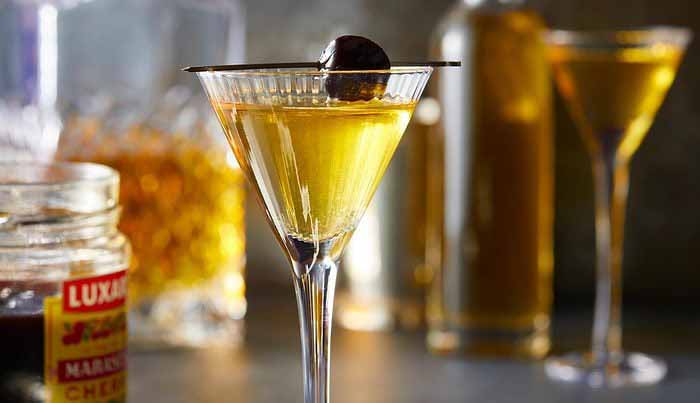
[2] The original Margarita recipe was made with Cointreau (Wikipedia photo).
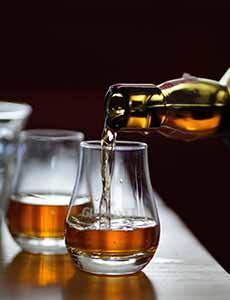
[3] Enjoy orange liqueur in a snifter, as an apéritif or digestif, an after dinner drink (photo © Dylan De Jonge | Unsplash).
|
|
Gran Gala is the Italian competitor to Grand Marnier, made by Stock Spirits of Trieste in Italy since 1884. It suffers from a lack of advertising awareness: The spirit is as fine as Grand Marnier; a side-by-side tasting shows it to be more assertive and more complex. Because of the layers of flavor in both Grand Marnier and Gran Gala, neither gives as pure an orange flavor as Cointreau.
Triple sec is a generic name for an orange-flavored liqueur made from the dried peel of oranges; the name means triple distilled. It is made from the same bitter oranges grown on the island of Curaçao as the liqueur Curaçao; the difference is that triple sec is about 1/3 as sweet as Curaçao. The orange skins are macerated (steeped) in alcohol and then distilled. Some brands you may encounter include Bols, Combier, DeKuyper and Marie Brizard.
TIP:
When you taste different orange liqueurs, keep tasting notes. You may prefer one for sipping, another for mixed drinks.
How about a BYO orange liqueur tasting on National Liqueur Day, October 16th? Ask friends to participate, each one bringing a different brand; you supply the food—or vice versa.
[4] Which is your favorite? Are you ready for an orange liqueur tasting party to find out (photo © The Nibble)?
THE HISTORY OF ORANGE LIQUEUR
Who invented orange liqueur?
Curaçao. According to Wikipedia, the Dutch East India Company (1602-1799) created orange liqueurs by steeping dried orange peels from the island of Curaçao, among others, with herbs and spices.
The Dutch West Indies Company made the island of Curaçao a Dutch colony in 1634. It is not known who developed the first Curaçao liqueur, and when.
Valencia oranges first brought to Curaçao by Spanish settlers.
But the Valencia orange didn’t take well to the dry Curaçao climate, and produced oranges that were so bitter as to be inedible.
The groves were abandoned and the trees began to grow wild.
A person whose name is lost to history discovered that the sun-dried skins of these wild oranges produced a pleasantly fragrant aroma, and they were then distilled [source].
The Bols distillery, founded in 1575 in Amsterdam, had shares in both the West and East India Companies to guarantee its access to spices required for their distilled spirits.
According to the early 19th-century French culinary chronicler Alexandre Grimod de la Reynière, Curaçao liqueur was pot-stilled into orange-flavored brandy in Flanders, the proximity to the province of Holland providing distillers easy access to the necessary peels [source].
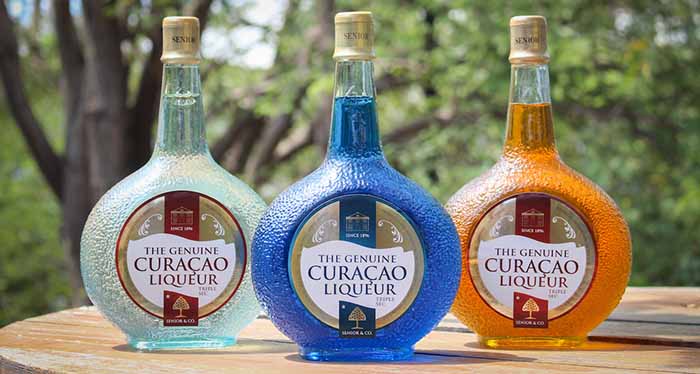
Curaçao was later made in various colors, the most common of which are clear, orange, and blue (the colors are added).
[5] The original Curaçao liqueur was completely clear. The other colors are simply the clear, orange-flavored liqueur that’s artificially dyed. The blue, green, orange, and red colors began appearing in the 1920s to make tropical cocktails look more attractive (photo © Senior & Co.).
Triple Sec. The Combier distillery, established in 1834 in the Loire Valley of France by Jean-Baptiste Combier and his wife Josephine, invented triple sec in their kitchen in the town of Saumur.
Orange liqueur was rising in popularity after the Dutch introduced Curaçao, and the Combiers sought to create a version that would be true to the orange fruit: crisp and clean from the peel’s orange essential oils without added flavors.
The Combiers used sun-dried bitter orange peels native to Haiti along with sweet Valencia oranges to balance the flavor and put them through three distillations to purify the flavor.
It was originally made with less sugar than Curaçao, which led to the name “sec,” French for “dry.”
Some sources claim that Triple Sec was not thrice distilled, and that the word “triple” was a marketing claim of superiority to Curaçao [source].
Cointreau. In 1875, Cointreau launched its version of triple sec in 1857, also in the Loire Valley.
Grand Marnier. The distillery, located in the Île de France region of France, was established by Jean Baptiste Lapostolle and began production of spirits in 1827.
His granddaughter Julia married Louis-Alexandre Marnier in 1876, and we deduce that his idea was to capitalize on the triple sec trend by wedding Cognac with Hatian bitter orange.
The brand was reportedly named by Swiss hotelier César Ritz (1850–1918) for Louis-Alexandre Marnier, who in return helped the hotelier purchase and establish the Hotel Ritz Paris.
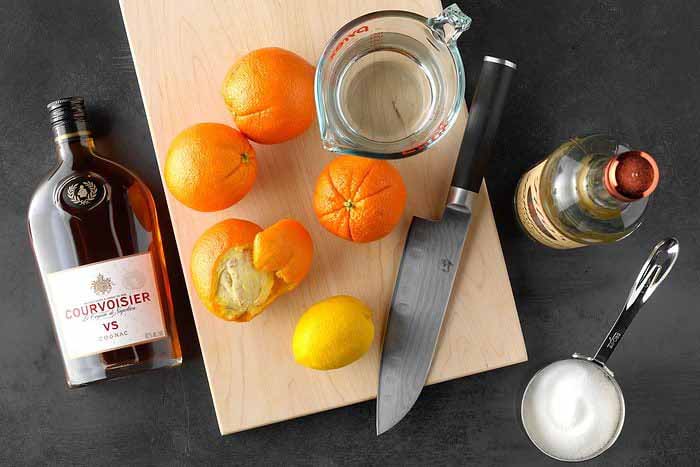
[6] Make your own orange liqueur from Cognac, vodka, lemon, sugar, and water. Here’s the recipe (photo © Taste Of Home).
Orange Liqueur Takes Off
Triple sec gained popularity and was widely known by 1878; at the Exposition Universelle of 1878 in Paris, several distillers were offering “Curaço [sic] triple sec” and “Curaço doux.”
The latter, a crème liqueur is known today as Crème de Curaçao as well as Curaçao doux. It’s the most rich and bitter of all Curaçao-style crèmes and regular orange liqueurs.
Orange liqueur is the general category for any orange flavor-distilled spirit that contains sugar.
The alcohol used can be either a column-distilled neutral spirit (similar to vodka) or a pot-distilled spirit, such as grape brandy.
> The world’s top orange liqueurs.
[7] Let the ingredients stand for two weeks and you’re ready to sip away (photo © Taste Of Home).
CHECK OUT WHAT’S HAPPENING ON OUR HOME PAGE, THENIBBLE.COM.
|
|