THE NIBBLE BLOG: Products, Recipes & Trends In Specialty Foods


Also visit our main website, TheNibble.com.

Pumpkin Sage Mashed Potatoes Recipe For National Pumpkin Day

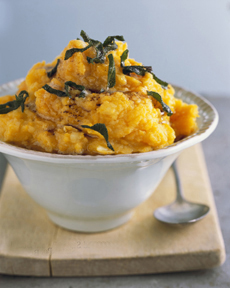
A bowl of Pumpkin Sage Mashed Potatoes
[1] Mashed potatoes x pumpkin puree (photo © Potato Goodness).

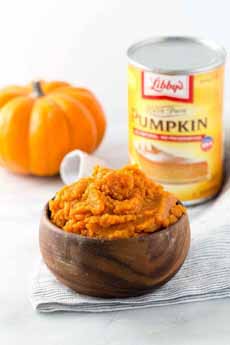
Canned Pumpkin Puree Can & Bowl
[2] Pumpkin puree (photo © Jessica Gavin | Libby’s).

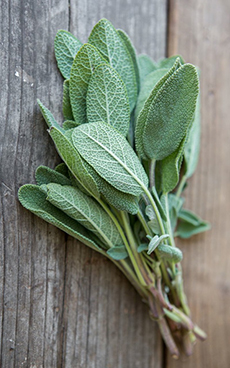
A Bunch Of Fresh Sage
[3] Fresh sage, fragrant and herbal, with a flavor that is earthy and slightly peppery, with hints of mint, eucalyptus, and lemon (photo © Good Eggs).

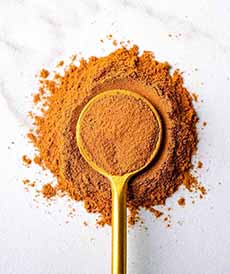
A heaping spoonful of ground cinnamon.
[4] A bit of cinnamon gives a fall touch to the recipe (photo © Savory Spice | Facebook).


We enjoyed this fusion food recipe from Valentina Wein of Cooking On The Weekends. It’s perfect for National Pumpkin Day, October 26th.

> The history of pumpkins.

> The history of potatoes.

> Here’s another pumpkin-potato recipe: Pumpkin Cheddar Mashed Potatoes.

> More mashed potato recipes.

> National Potato Day is August 19th.
 
 
RECIPE: PUMPKIN SAGE MASHED POTATOES
 
Ingredients For 8 Servings

  • 2½ pounds Idaho® Russet potatoes, washed and peeled
  • ¼ cup plus 2 tablespoons butter
  • 1 cup onion, finely diced
  • ¼ cup fresh sage leaves, finely chopped
  • ¼ cup half and half
  • 1¼ cup pumpkin purée
  • 1 teaspoon ground cinnamon
  • 1½ teaspoons sea salt
  • Freshly ground black pepper, to taste
  •  
    Preparation

    1. COOK the potatoes. Fill a large pot about halfway with water. Cut the peeled potatoes into sixths, adding them directly to the water as you go. (If the water isn’t completely covering the potatoes, add more until it covers by at least one inch.)

    2. COVER the pot and bring to a boil. Keeping the lid on, turn the heat to low and gently simmer the potatoes until they’re tender—when you can easily pierce them with a fork—about 20 minutes. While the potatoes are cooking…

    3. ADD the butter to a large sauté pan and place it over low heat. Add the onions once the butter has melted and cook until they’re soft about 5 minutes. Stir in the sage and cook until it’s aromatic about 30 seconds. Turn off the heat and set aside.

    4. WHISK the half and half in a medium-sized mixing bowl with the pumpkin, cinnamon, salt, and a few turns of pepper. Add the onion mixture and stir to blend. Set aside.

    5. DRAIN the potatoes and place them in a large mixing bowl. Mash them with a large fork or a potato masher, leaving a few chunks here and there for texture.

    6. FOLD in the pumpkin mixture until it’s evenly blended. Serve warm or hot.
     
     
    MORE PUMPKIN RECIPES

    Savory Recipes

  • Chicken & Pumpkin Tacos
  • Pumpkin Pasta Sauce
  •  
    Sweet Recipes

  • Cinnamon Swirl Pumpkin Spice Coffee Cake
  • Frozen Pumpkin Tiramisu
  • Ginger Pumpkin Pie With Pumpkin Seed Crust
  • Mocha Pumpkin Cheesecake Perfectly Pumpkin Cheesecake With A Mocha Glaze
  • No Bake Pumpkin Cheesecake (photo #2)
  • Pumpkin Cheesecake Brownies
  • Pumpkin Cheesecake Ice Cream
  • Pumpkin Cheesecake Pie (photo #3)
  • Pumpkin Cheesecake With A Gingersnap & Nut Crust
  • Pumpkin Cheesecake With A Pecan Crust (Chef Terrance Brennan)
  • Pumpkin Cupcakes With Pumpkin Cheesecake Frosting
  • Pumpkin Mousse Cheesecake With A Gingersnap Crust
  •  
    Plus:

  • Cranberry Cheesecake
  • Pumpkin Cream Cheese Danish
  • Sweet Potato Cheesecake
  •  


    CHECK OUT WHAT’S HAPPENING ON OUR HOME PAGE, THENIBBLE.COM.


    Comments off

    Try Pig Wings To Celebrate National Pork Month

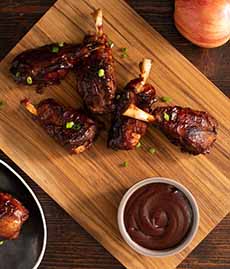
    Barbecue Pig Wings with a side of barbecue sauce.
    [1] Barbecue pig wings (photos #1, #3, and #4 © Smithfield Food).

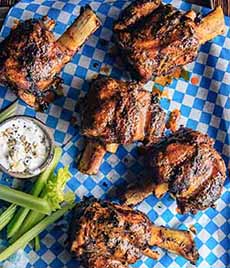
    Pig Wings Buffalo-style with celery sticks and blue cheese dressing.
    [2] Buffalo wings—pig wings, that is (photo © Kingsford).

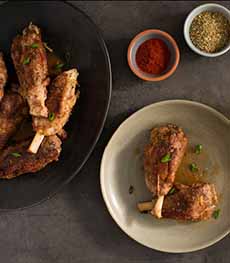
    Pig Wings with different rubs.
    [3] Plain pig wings served with a choice of dips.

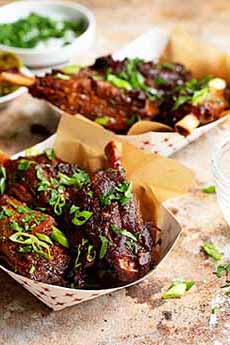
    Grilled Pig Wings with scallions and Thai chili sauce.
    [4] Grilled pig wings. Here’s the recipe (photo © Real Food By Dad).

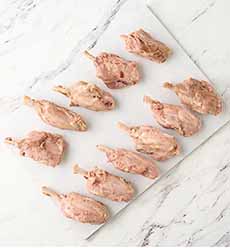
    A tray of uncooked pig wings.
    [5] Raw pig wings.


    October is National Pork Month (October 12th is National Pork Day). How about something new in pork..say, pig wings?

    Say what?

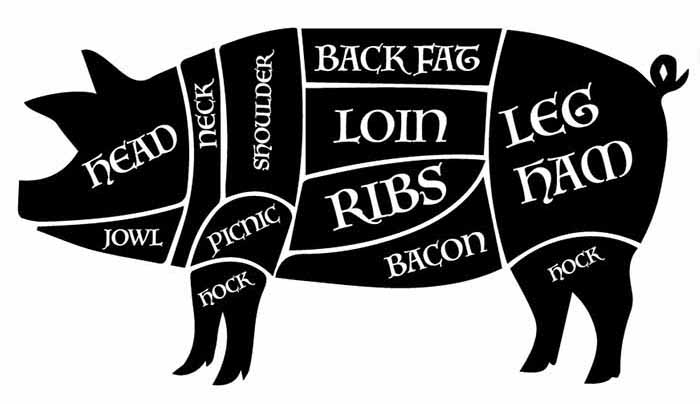
    Pig wings are a whimsical name for a relatively new pork cut made from the fibula of a pig’s lower shank, a single bone surrounded by lean, tender meat (photos #1, #2, and #3—see where the shank is in the diagram below).

    They’re fun food, great with a beer, great game day food.

    Pig wings may have been around for the better part of 20 years but didn’t make it to our neck of the woods. We discovered them online, and we’re thankful.

    Pig wings are similar to ribs but are leaner, with juicy meat, and easier to prepare.

    They’re even easier when you buy them already cooked, ready to add your own dipping sauces.

    Their name was bestowed because some people felt that when they are cooked they look like chicken wings. Earlier names included pork hammers and sluggers.

    We think they look more like pork lollipops.

    They’ve also been called “pork on a stick” and “pork without the fork.” The meat has the tender mouthfeel of a chicken wing but with the flavor of pork.

    This specialty cut of pork is made by the butcher from the lower shank of a hock. Here’s a video from the Bearded Butchers.

    The wings are typically marinated, seasoned, and cooked in a choice of methods (baked, fried, grilled, or smoked).

    They can be served as tasty finger food, like chicken wings, or can be the protein on a lunch or dinner plate.

    You may not find pig wings in your grocery store’s meat case, but you can buy the pork shanks and ask the butcher to cut them (or cut them yourself with the instructions in the video).

    You may find them at Costco and certainly online. A few purveyors:

  • Nueske’s Pig Wings fully cooked, just heat and eat.
  • Smithfield Foods, fully cooked.
  • Pioneer Meats (the company that began the movement), uncooked.
  •  
    Here are instructions from Pioneer Meats for baking, grilling, and frying.

    > The different cuts of pork.

    > The history of pork is below.
     
     
    RECIPE: PIG WINGS

    Here’s a basic recipe:

    Ingredients

  • Pig wings (pork shanks)
  • Marinade or seasoning of your choice (e.g., barbecue sauce, beer-braised, buffalo sauce, dry rub, mustard sauce, teriyaki marinade)
  • Dipping sauce(s): blue cheese dressing, fruit sauce (apricot or cherry, e.g.), honey mustard, ranch dressing, sweet chili sauce, or more of the marinade
  •  
    Preparation

    1. MARINATE the pig wings. Coat them generously and let the wings marinate for at least 30 minutes to several hours to infuse flavor into the meat.

    2. PREHEAT your grill or oven to the desired temperature.

    3. COOK until the pig wings are cooked to an internal temperature of 145°F (63°C). Use a meat thermometer to check the temperature.

    4. SERVE hot with your favorite dipping sauces.
     
     
    THE HISTORY OF PIG WINGS

    Pig wings weren’t invented by an entrepreneurial ex-pig farmer.

    Bob File, a former pig farmer and the president of Pioneer Meats, became aware that meat from the lower shank of the pig usually went into the trim bucket and got turned into ground pork.

    He saw the untapped potential to turn it into a valuable cut. He presented it to commercial channels who are always looking for something new to appeal to consumers. And the rest is history [source].

    He and his partner, Bob George, trademarked the name “Pig Wings” in 2003.

    They then began selling it to chain restaurants, membership warehouses, and online.

    “Pig wings” emerged as an attractive marketing concept: fun, appealing, and recognizable (via comparison to chicken wings) to consumers.

    This fun and tasty finger food has the legs (or is that, wings?) to last.

     
    THE HISTORY OF PORK

    The history of pork started, of course, with the domestication of pigs, more than 10,000 years ago.

    They were first domesticated in the Fertile Crescent, which includes what are now Egypt, southern Iraq, Israel, Lebanon, Jordan, Palestine, Syria, and parts of Turkey and Iran. (Ironically, in some of these countries Islam prohibits the consumption of pork by Muslims.)

    Domestication occurred during the Neolithic period (also called the New Stone Age), the final stage of cultural evolution and technological development among prehistoric humans.

    It was characterized by the use of stone tools shaped by polishing or grinding; on settlement in permanent villages by the former nomadic hunter-gatherers, which enabled the domestication of, and dependence on, farmed plants and animals*; and the appearance of such crafts as pottery and weaving [source].
     
     
    Domesticating The Pig

    The process of domestication involved the selective breeding of wild boars (Sus scrofa), into what is basically today’s domestic pig (Sus scrofa domesticus).

    Pigs are relatively easy to raise and they provide valuable meat, leather, and fat. Their domestication played a crucial role in the development of early agriculture and human settlements.

    Pigs were raised by the major ancient civilizations, including the Chinese, Egyptians, Greeks, Mesopotamians, and Romans.
     
     
    The Role Of Pork

    The role of pork in religious and cultural practices varied widely. In some ancient societies, pigs were sacred animals, while in others, they were used as sacrifices.

    In Abrahamic religions such as Judaism and Islam, pork was and is considered unclean and forbidden for consumption.

    In contrast, many other cultures, especially in Europe, embraced pork as a staple in their diets.

    Pork as a major food source in Europe. Pork became a significant part of European cuisines, very popular in Germany, Italy, and Spain. Cured and smoked pork products such as bacon, ham, and sausages were created, and many regions developed their own unique pork dishes.

    Pork in the Americas. Pigs were first brought to the Americas in the 1500s by early explorers and settlers as a source of food.

    Free-range livestock management practices and escapes from enclosures led to the first establishment of feral swine populations in North America.

    The pigs quickly adapted to their new environment and became an important source of meat for the indigenous populations as well as the European colonists [source].

    Modern Pork Production. The industrialization of agriculture in the 19th and 20th centuries led to significant changes in pork production. Large-scale pig farms and breeding programs were developed to meet the growing demand for pork. Pork processing and packaging also became more efficient during this time.

    Pork today. Today, pork is consumed all around the world, and it plays a central role in the diets of many people.

    The pork industry is a significant part of the global food supply chain. Pork production involves various breeds of pigs, specialized facilities, and modern techniques to ensure food safety and efficiency. The industry also faces ongoing challenges related to animal welfare, environmental sustainability, and public health concerns.

    The latest data shows that Americans eat an annual 66.18 pounds of pork per capita [source].

    Iowa is the top producer by far, with 2.5 times more pigs than its nearest rival, Minnesota, with North Carolina in third place. Illinois, Indiana, Nebraska, Missouri, Ohio, Oklahoma, and South Dakota round out the top 10. Here’s the data.
     

    WERE ARE THE WINGS? BELOW THE HOCKS!

    Butcher's diagram of the cuts of pork.
    [6] Diagram of the cuts of the pig. Pig wings come from the area right below the hock, which is the shank—but not labeled (illustration courtesy The Webb Ranch | Etsy).
     
     
    _____________________

    *Goats were probably the first animals to be domesticated, followed closely by sheep. In Southeast Asia, chickens were also domesticated about 10,000 years ago. The first domesticated plants in the Fertile Crescent were wheat, barley, lentils, and types of peas.


    CHECK OUT WHAT’S HAPPENING ON OUR HOME PAGE, THENIBBLE.COM.


    Comments off

    Cooking Tip: What To Do With Celery Seeds

    Do you have a package of celery seeds languishing in your pantry? Here’s what you can do with them. First…
     
     
    WHAT ARE CELERY SEEDS?

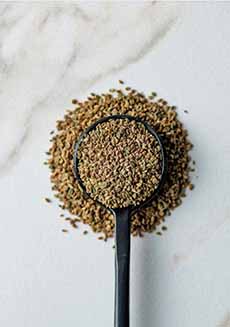
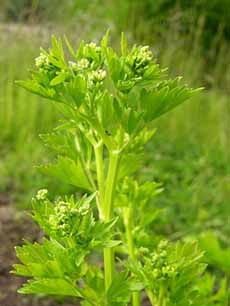
    Celery seeds are tiny brown seeds (photo #1) that are harvested from the flowers of the wild celery plant (photo #2)—a different variety from the celery we eat. They are one of the smallest seed spices, and (trivia alert!) there are approximately 750,000 seeds in 1 pound, 45,000 in one ounce.

    Diminutive though they may be, it takes very few of these aromatic seeds to deliver a mouthful of celery stalk flavor. Yes, the seeds taste just like the stalk.

    (Food 101: The whole bunch or head of celery is called a stalk. It is composed of individual pieces called ribs. Celery hearts are the tender innermost ribs of the celery stalk. The darker the color, the stronger the flavor.)

    In addition to their use as a spice, celery seeds are rich in antioxidants, which have been shown to have anti-inflammatory and antibacterial properties.

    Celery seed has been used medicinally in Ayurvedic medicine since ancient times, to treat arthritis, colds, poor digestion, flu, certain diseases of the liver and spleen, and water retention.

    Whole celery seed lasts for years in the jar. But to test if your years-old product is still good, see the footnote† below.

    > The history of celery seeds is below.

    > The history of celery.

    > March is National Celery Month.
     
     
    USES FOR CELERY SEEDS

    Celery seeds are commonly used to flavor pickles, coleslaw, and other salads. In Indian and Middle Eastern cuisines, they add a punch to soups, stews, and curries.

    They’re also common in Russian and Scandinavian foods, including cabbage dishes (we use them in our stuffed cabbage recipe).

    The seeds are also ground and mixed with other spices to create Cajun and Creole seasonings, celery salt, and Old Bay Seasoning, among others.

    Tip: In smooth foods where texture isn’t expected, such as barbecue sauce, grind the seeds before adding them. Another tip: It’s better to buy it whole than ground, as the flavor will dissipate much faster from the ground spice.

    Celery seeds are very strongly flavored, so just a pinch is usually enough. Add celery seed to:

  • Bread Dough: Add celery seeds to bread dough for a special flavorful element. Ditto for dressing and stuffing.
  • Barbecue Sauce & Ketchup: Add some celery seeds to store-bought or homemade.
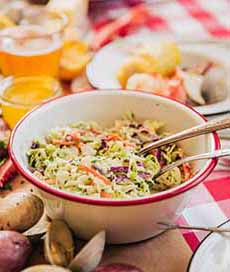
  • Coleslaw: Celery seeds, along with dill seeds, are our favorite coleslaw seasonings (photo #3).
  • Curry: Add celery seeds to your favorite curry recipe for added depth of flavor and aroma.
  • Deviled Eggs: Ditto.
  • Meatloaf: Mix celery seeds with the ground beef, breadcrumbs, and other seasonings.
  • Pickles: Add celery seeds to your pickling brine to give homemade pickles a deliciously tangy and savory flavor. Or, use them to give more flavor to store-bought pickles and relishes.
  • Potato Salad: Add celery seeds to your potato salad dressing, be it mayonnaise or vinaigrette, for a flavorful twist.
  • Protein Salads: Add a pinch to chicken, egg, and tuna salads.
  • Roasted Vegetables: Toss the cut vegetables, or potatoes, with olive oil and celery seeds before roasting.
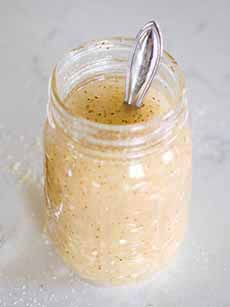
  • Salad Dressings: Use celery seeds to add a savory and herbaceous flavor to vinaigrettes and other homemade salad dressings (photo #5)
  • Spice Rubs: Add some to rubs for grilled or smoked meat. You can also add the seeds to marinades.
  • Soups and Stews: Celery seeds add complexity to soup and stew recipes.
  •  
     
    THE HISTORY OF CELERY SEEDS

    Wild celery, also called smallage, is believed to be native to the Mediterranean and the Middle East, where celery seeds have been used in cooking for thousands of years.

    Initially, celery seeds were used in homeopathic and Ayurvedic medicine.

    The medicinal plant in Homer’s Odyssey, written about 850 B.C.E.†, is thought to be celery seed.

    The visual record of mankind’s historical link with celery seeds is in ancient Egypt, where it has been found in tombs [source].


    A spoonful of celery seeds.
    [1] Celery seeds are the tiniest of spice seeds (photo © Savory Spice Shop).

    Wild celery is cultivated for celery seed.
    [2] Wild celery is too bitter to eat, but is cultivated for celery seed (photo © Memphis Herb Society).

    A large bowl of cole slaw with serving spoons.
    [3] Celery seed and coleslaw are a classic pairing (photo © Vermont Creamery).

    Cans of Dr. Brown Cel-Ray, celery-flavored soda.
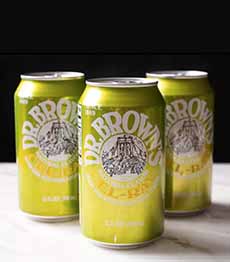
    [4] Dr. Brown Cel-Ray has been America’s celery-flavored soft drink since 1868. Here’s a recipe to make your own (photo © Serious Eats).

    A jar of homemade celery seed dressing.
    [5] Celery seed dressing. Here’s the recipe (photo © Cleverly Simple).

     
    The Romans were the first to value celery seeds as a seasoning. Much later it found its way into French and Italian cuisines.

    The Italians domesticated wild celery and developed it into a plant with a solid stem, without the bitterness of smallage. Thus began the development of the Pascal celery variety that we find in grocery stores today [source].

    It was only in the 19th century that North Americans began to use celery seed, mainly in pickling solutions [source].

    The 19th century also saw the debut, in 1868, of Dr. Brown’s Cel-Ray Soda, a celery-flavored soft drink that is made from celery seeds.

    It was developed as a tonic that was touted as “good for calming stomachs and bowels.” It paired well with salty, fatty foods, like pastrami, and became popular in New York’s Jewish delicatessens, where it can still be found.

    Here’s the history of Cel-Ray, which may be poised for a renaissance.
     
     
    __________________

    *If the seeds are odorless or their aroma is very faint, chances are that they have lost their flavor. Similarly, if the seeds taste weak or bland, they’re past their prime.

    †The Iliad and The Odyssey are dated by scholars to the late 8th or early 7th century B.C.E. By this time the invention of writing was becoming widespread in Greece, and it seems that the poems in these two epics were also set down then for the first time [source].


    CHECK OUT WHAT’S HAPPENING ON OUR HOME PAGE, THENIBBLE.COM.


    Comments off


    © Copyright 2005-2026 Lifestyle Direct, Inc. All rights reserved. All images are copyrighted to their respective owners.