THE NIBBLE BLOG: Products, Recipes & Trends In Specialty Foods


Also visit our main website, TheNibble.com.

Have A Moscow Mule: For National Vodka Day & Moscow Mule Day

 
October 4th is National Vodka Day. Do you know the first vodka cocktail invented in the U.S.? (If you read the headline of this article, you do; and Moscow Mule Day is celebrated on March 3rd).

Today vodka and vodka cocktails are ubiquitous. In 2011, roughly 62 million 9-liter cases of vodka were sold in the U.S: the most of any spirit category.*

Below:

> The original Moscow Mule recipe. National Moscow Mule Day is March 3rd.

> The history of the Moscow Mule.

Elsewhere on The Nibble:

> The year’s 50+ cocktail and spirits holidays.

> The history of vodka.

> The history of cocktails.
 
 
RECIPE: THE ORIGINAL MOSCOW MULE

Ingredients Per Drink

  • 2 shots Smirnoff (or other)vodka
  • Juice from 1/2 fresh lime
  • 4-6 ounces ginger beer to taste
  • Optional garnish: lime wedge/wheel and optional mint sprig
  • Crushed or pebble ice
  •  
    Preparation
     
    1. COMBINE vodka and lime juice in a cocktail shaker.

    2. SHAKE with ice and strain into a copper mug or rocks glass filled with ice. Garnish and serve.
     
     
    THE HISTORY OF THE MOSCOW MULE

    In the 1940s, vodka represented a tiny fraction—just $50,000—of the then-$2,000,000,000-a-year U.S. spirits industry. Most people had never tasted it.

    Heublein, the producer of Smirnoff vodka††, knew that it was time to shake up interest (pun intended).

    One evening in 1941, three executives gathered at the Chatham Hotel in New York City: John G. Martin, president of Hartford-based spirits producer/istributor Heublein; Jack Morgan, president of Cock ‘n’ Bull Products (named after the Hollywood restaurant hangout [closed 1987]); and Rudolph Kunett, president of Heublein’s Pierre Smirnoff vodka division.

    The trio wondered what would happen if they mixed a two-ounce shot of Smirnoff vodka with Cock ‘n’ Bull Ginger Beer ginger beer and a squeeze of lime.

    Four or five drinks later, the new cocktail was christened the Moscow Mule. Why?

    Vodka is associated with Russia, and ginger beer has a kick “like a mule.”

    You’ll find modern variations that turn the Moscow Mule into a tall drink, add cranberry juice, orange bitters, substitute lemon juice for the lime juice, and so forth.

    But that night at the Chatham Hotel, the three inventors used only vodka, lime juice, ginger beer and ice. Follow suit for an authentic Moscow Mule.

    To aid vodka sales, Martin and Morgan promoted the new cocktail at the Cock ‘n’ Bull restaurant.
     
    (continues below)


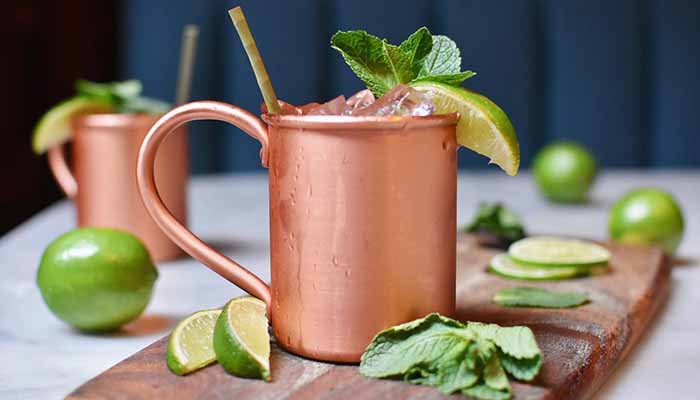
    Moscow Mule In Copper Mug
    [1] A Moscow Mule in the traditional copper mug (photos #1 and #3 © Smirnoff Vodka).

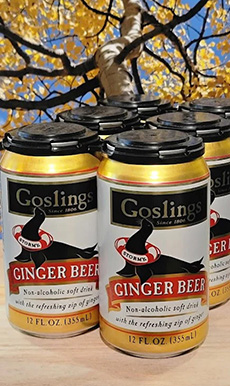
    Cans Of Goslings Ginger Beer
    [2] Gosling’s Ginger Beer is non-alcoholic. Here’s more about ginger beer (photo © Sovereignty Wines).

    Bottle Of Smirnoff Vodka [3] Smirnoff is the world’s #1 vodka brand.

    Moscow Mule Vodka Cocktail
    [4] The Moscow mule, named because vodka is from Russia† and the ginger beer has a kick like a mule (photo © Society Cafe | NYC).
     
    Why The Copper Mug?

    To amp up the marketing, the Cock ‘n’ Bull restaurant served the drink in a copper mug engraved with two mules kicking up their heels. Many stars had their own mugs engraved with their names hanging over the bar.

    You don’t need copper mugs, but you can buy them on Amazon.com, with or without an engraved kicking mule.

    Following the Moscow Mule promotion, Heublein went on to promote more vodka drinks: the Bloody Mary, the Bullshot (vodka and bouillon), the Ice Pick (vodka and iced tea), and the Screwdriver.

    ________________

    *Source: Distilled Spirits Council of the United States 2011.

    **Ginger beer is a carbonated beverage produced by natural fermentation, offering a more intense flavor than ginger ale. Some Caribbean brands contain a small amount of alcohol; otherwise, it is a soft drink.

    Vodka actually originated in Poland.

    ††The Smirnoff brand was founded in Moscow in the 1860s by Pyotr Smirnov, but the family fled during the 1917 revolution, and it has been produced elsewhere since—including in the U.S.
     

    CHECK OUT WHAT’S HAPPENING ON OUR HOME PAGE, THENIBBLE.COM.


    Comments off

    TIP OF THE DAY: Broccoli Rabe Or Rapini


    Raw broccoli rabe at top, and sautéed in
    garlic over orecchiete pasta. Photo by M.R.
    Kornflakes | Dreamstime.

      Perhaps 15 years ago, broccoli rabe began to appear in some restaurants. Also called broccoli rape, raab (pronounced rob), rapini, Chinese broccoli and Italian broccoli in the U.S., it then became available in produce markets. Now, it’s a familiar friend to some people.

    Descended from a wild herb, like many of our greens, versions of broccoli rabe originated in the Mediterranean and in China.

    Although it bears the name “broccoli,” tastes like a bitter and pungent form of broccoli (think broccoli crossed with mustard greens with some nuttiness) and looks like a relative of broccoli—it has broccoli-like buds and florets at the top of slender stalks—broccoli rabe is not related to broccoli but turnips.

    That’s why the leaves look like turnip greens and the vegetable is also called Italian turnip and turnip broccoli.

    HOW TO SERVE BROCCOLI RABE

    You can braise the rabe or add it to a stir-fry; but a quick sauté in olive oil with garlic is all you need. Then, serve this tasty green as a side, or as a topping for pasta.

     
    We like to blanch it first to remove some of the bitterness.

  • Clean and trim the ends.
  • Cut the stalks into 2-inch pieces (you can leave them whole if you want to slice them as you’re eating) and drop them into boiling salted water for a minute.
  • Remove with slotted spoon and drain on a paper towel.
  • Heat olive oil in a sauté pan with a minced garlic clove and add the blanched broccoli rabe. It you like heat, add some red pepper flakes.
  • Cook until tender, 3 to 5 minutes until tender.
  •  

    Find more of our favorite vegetables and recipes.
      

    Comments off

    TIP OF THE DAY: Treat Yourself To Better Dish Liquid

    Cooking at home more often as an economy move is enjoyable: It’s doing the dishes afterward that are a chore.

    So treat yourself to a more fragrant and alluring dishwashing liquid.

    In the past, Caldrea (debuted 2000) and Mrs. Meyer’s Clean Day (founded afterwards with lower price points by the same entrepreneur) were the luxury brands for people who wanted to pay more for more fragrant, non-harsh cleaning products. Sold outside of supermarket distribution, you had to go to gift stores or specialty shops to find them.

    The more affordable Method, also founded in 2000, followed a different distribution model to supermarkets and big box stores.

    And now a venerable national brand has come to the rescue: Palmolive Fresh Infusions Dish Liquid. This egalitarian brand brings the scent of luxury for the same price as other name brands on the shelf.

     
    Make washing dishes more pleasant with charming scents from Palmolive Liquid Infusions. Photo courtesy Colgate-Palmolive Company.
     

    The concept with specialty lines is to offer scents reminiscent of foods.

  • Method offers Clementine, Cucumber and Ginger Yuzu.
  • Mrs. Meyer’s adds some floral scents, too, in a roundup that includes Basil, Bluebell, Lavender, Lemon Verbena, Geranium, Honeysuckle, Orange Clove and Rosemary.
  • Caldrea also offers foods and flowers: Basil Blue Sage, Ginger Pomelo, Lavender Pine, Mandarin Vetiver, Palmarosa Wild Mint and Sea Salt Neroli.
  • Palmolive Liquid Infusions sticks to the food: Ginger White Tea, Lemon Thyme and Lime Basil.
  •  

    Great With Grease

    The new kid on the block, Palmolive Fresh Infusions, is an excellent grease cutter. We don’t cook meat often because we have to wash greasy pans multiple times. Palmolive Fresh Infusions did an equal or much better job than different national brands we had at home. And with a more charming aroma.

    Combining marks for cleaning power and scent, we have to call it a better dish liquid.

    So pick up one (or all) of the fragrances the next time you shop. Tie a ribbon around a set of three for a house gift. You can find coupons all over the Internet.
      

    Comments off

    TIP OF THE DAY: Bitter Greens


    Dandelion greens for your salad. Photo courtesy Rawology-
    Webstarts.com.
     

    It’s not easy eating green. That dinner salad can be so boring, it requires a cloak of fat (salad dressing).

    Most people stick to delicately-flavored greens for salads: celery, cucumbers, lettuce,

    But in a country that likes its bold flavors, why not try something more robust? Bitter greens add excitement in both flavor and texture.

    Almost a year ago we suggested perking up salad with spicy greens. Today, we take on bitter greens. Some of them, like arugula and radish, add both bitterness and heat.

    Add one or more of these to your lettuce salad:

  • Amaranth (rocket)
  • Arugula (rocket)
  • Bok choy
  • Broccoli rabe
  • Brussels sprouts
  • Cabbage: green, Napa, red, Savoy
  • Chicory
  • Chinese broccoli
  • Collard greens
  • Dandelion greens
  • Kale
  • Kohlrabi
  • Mâche (lamb’s lettuce)
  • Mizuna
  • Mustard greens
  • Radishes
  • Red onions
  • Sorrel
  • Spinach
  • Vegetable tops: beet, cauliflower, daikon, turnip greens
  • Tatsoi
  • Watercress
  •  
    In salads and other dishes, balance the bitter flavor of the green with an acidic counterpoint: vinegar or lemon juice/lime juice in a vinaigrette, a splash of citrus, vinegar or white wine in other recipes.

    Try a new variety of bitter green each month. Look in farmers markets for less commonly found greens (that’s where we first encountered the exciting bitter greens, mizuna and tatsoi, 15 years ago).

    If you find that you don’t enjoy a particular bitter green in its raw state, stir fry or braise them (a recipe follows). You can top a lettuce salad with braised greens and warm vinaigrette, or serve them as a side with dinner. Either way, bacon lovers: Try this warm bacon vinaigrette.


    RECIPE: BRAISED BITTER GREENS

    This recipe uses chard and kale, but you can use any bitter greens alone or in combination. Thanks to New Hope 360 for the recipe.

    Ingredients

  • 1 Maui, Vidalia or other sweet onion, chopped
  • 1 tablespoon olive oil
  • 1/2 pound mushrooms, sliced
  • 1 tablespoon lemon juice
  • 1 bunch kale, cleaned and shredded
  • 1/4 cup dry white wine
  • 1 clove garlic, minced
  • 3/4 cup vegetable or chicken stock
  • 2 bunches chard, cleaned and torn
  • 1/2 teaspoon salt
  • 1/4 teaspoon nutmeg
  • Freshly ground black pepper
  • 2 tablespoons butter (optional)
  •  

    Sorrel is typically used as an herb, but makes a delicious salad green or stir-fry green. Photo of red sorrel courtesy SassAndVeracity.com.


    Preparation

    1. SAUTÉ. In a large skillet, sauté the onion in the olive oil until translucent, about 5 minutes. Add the mushrooms. Toss to coat with oil, then continue to cook for about a minute. Sprinkle the lemon juice over the pan and cook until the mushrooms have softened, about 5 minutes.

    2. COMBINE. Add the kale to the skillet, mixing it with the mushrooms and onion. Cook on high flame for about 1 minute, then add the wine and allow it to cook until the smell of alcohol evaporates, stirring constantly. Stir in the garlic and half the stock, then reduce to a simmer. Cover the pan part way and continue to cook until the kale has begun to soften, about 8 minutes.

    3. COMBINE. Add the chard, toss and cook until it begins to soften. Stir in the remaining stock, salt, nutmeg and pepper. Cook, partly covered and stirring often, until the greens are tender. Raise the heat and cook quickly for a minute or so until most of the stock has cooked off. Remove the pan from the heat and stir in the butter, then immediately turn out onto a serving dish.


    Comments off

    COOKING VIDEO: Easy Homemade Applesauce Recipe


    With all the lovely apples piled high in markets, it’s time to make homemade applesauce. Homemade applesauce is so head and shoulders above store-bought, that you’ve got to try it at least once.

    In the video below, the cook doesn’t core the apples. Instead, the apple cores, seeds and all, go into the pot.

  • We prefer to core the apples first. Either way, keep the skins on for a lovely pink color.
  • Then cook them down and run them through a food mill.
  • Next, sweeten to taste. Another benefit of making your own: You can use a low glycemic sweetener, like agave nectar; or use a noncaloric sweetener.
  • You can personalize the recipe by varying the spices. Some people use only cinnamon. Others add some allspice, clove, nutmeg or a combination.
  • You can also add a second fruit to the mix: Try 25% pears or raspberries, for example.
  •  
    WHAT TYPE OF APPLE SHOULD YOU USE?

    It’s a matter of taste, and you can try different varieties. We prefer a tart apple for more complex flavor. But we like red skin to add color and flavor to the sauce, so we bypass the popular (and easy-to-find) Granny Smiths.

    Instead, we look for Braeburn, Jonagold, McIntosh, Northern Spy, Paula Red and Stayman varieties.

    You may like your homemade applesauce so much that you’ll consider giving it as holiday gifts. Applesauce freezes nicely.


    Comments off

    The Nibble Webzine Of Food Adventures
    RSS
    Follow by Email


    © Copyright 2005-2026 Lifestyle Direct, Inc. All rights reserved. All images are copyrighted to their respective owners.