THE NIBBLE BLOG: Products, Recipes & Trends In Specialty Foods


Also visit our main website, TheNibble.com.

RECIPE: White Chocolate Pumpkin Fondue

For pumpkin season, treat everyone to this White Chocolate Pumpkin Pie Chocolate Fondue from The Melting Pot, with a few modifications from THE NIBBLE.

Why not make it this weekend? Don’t like to cook? Find the nearest Melting Pot.

> The history of chocolate fondue is below.

> Chocolate fondue recipes.

> A year of fondue holidays.
 
 
RECIPE: WHITE CHOCOLATE PUMPKIN FONDUE

Ingredients For The Fondue

  • 8 ounces white chocolate, chopped (look for Green & Black’s, Lindt or other premium brand)
  • 1 tablespoon heavy cream
  • 1 heaping teaspoon pumpkin purée (not pumpkin pie filling)
  • 1-1/2 teaspoons Bacardi 151 Rum*
  • Pinch nutmeg
  • Optional: chopped graham crackers or white chocolate shavings
  •  
    For The Dippers

  • Cake cubes: blondies, brownies, doughnut holes or pieces, loaf cakes (carrot, chocolate, pound)
  • Cookies: amaretti, biscotti, graham crackers, granola bars, lady fingers, meringues, shortbread fingers, tea biscuits
  • Dried fruits: apples, apricots, dates, figs, mangoes, prunes
  • Fresh fruits: apples, bananas, grapes. mandarins/oranges, pears, pineapple, strawberries
  •  
    _______________

    *Bacardi 151 is a brand of highly alcoholic rum, named for its alcohol proof level of 151 (75.5% alcohol by volume or A.B.V.). This is about double the alcohol of conventional rum (35%–40% A.B.V.). You can substitute a liqueur instead; see Step 3 below.

      White Chocolate Pumpkin Fondue
    [1] White chocolate pumpkin fondue, garnished with white chocolate shavings. Photo courtesy The Melting Pot.

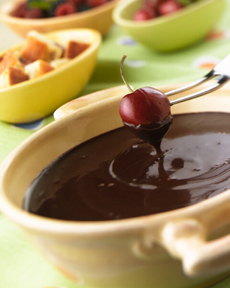
    Chocolate Fondue With Fruit & Cake For Dipping
    [2] The first dessert fondue was invented in New York City by a Swiss chef. See the history of chocolate fondue below (photo © Dairy Farmers Of Wisconsin).

    Preparation

    1. PLACE the chocolate and cream in the top of a double boiler pot over medium heat, stirring constantly so as not to scorch the chocolate. Alternatively, melt in the microwave in 45 second increments, stirring after each one.

    2. POUR the melted chocolate into a fondue pot. Add the pumpkin purée, blending gently. Taste and add more pumpkin if you like.

    3. ADD the rum to the pot and light with a long match or fireplace lighter. As the rum burns away, carefully stir the mixture together. If you don’t want to purchase 151 rum or flambé, stir the equivalent amount of orange liqueur into the melted chocolate and blend.

    4. SPRINKLE the nutmeg into the pot and gently fold in. The Melting Pot garnishes the top of the fondue with chopped graham crackers, but we prefer to use the graham crackers as dippers.
     
     
    THE HISTORY OF CHOCOLATE FONDUE:
    WHO INVENTED DESSERT FONDUE?

    Konrad Egli, a Swiss chef and restaurateur (nicknamed Konni), invented chocolate fondue in the 1960s at his midtown Manhattan restaurant, Chalet Suisse.

    Egli created chocolate fondue as a promotion for the Swiss chocolate bar Toblerone, which was introduced to the U.S. at the 1964 World’s Fair in New York.

    The company wanted to expand the knowledge of their chocolate, and after some consideration, Egli hit on the idea of using it to make something equally new and exciting: a sweet fondue. It was on the menu by 1966.

    It caught on like wildfire [source].

    It was not his first fondue innovation: Egli had previously introduced fondue bourguignonne (beef fondue) at the restaurant, in 1956.

    His original recipe included creamy Swiss Toblerone chocolate and kirsch, a German cherry brandy. Here’s close to the original recipe.

    Earlier references, starting in the 1930s, refer to types of chocolate mousse or chocolate cake as “chocolate fondue.”

    But since “fondue” is French for “melted,” the only true chocolate fondue is the pot of melted chocolate created by Egli, from those Toblerone bars.


    CHECK OUT WHAT’S HAPPENING ON OUR HOME PAGE, THENIBBLE.COM.


    Comments off

    TIP OF THE DAY: International Nachos For National Nachos Day

    Nachos
    [1] Classic nachos (photo by Chee Hong | Wikipedia).

    spicy-tuna-tartare-nachos-RAsushi-orlando-230
    [2] International style: Japanese nachos, made with rice chips and spicy tuna (photo © RA Sushi).


    Today is National Nacho Day, and our tip is: Go where no Mexican nacho has gone.

    The appeal of Tex-Mex nachos—crunchy, creamy, spicy—cannot be denied.

    But how about fusion nachos, with culinary accents (crunchy, creamy, spicy) from the world’s favorite cuisines? Below you’ll find 13 types of chips in addition to classic tortilla chips, plus recipes for 15 different “international” nachos beyond Mexican. But first…
     
     
    THE HISTORY OF NACHOS

    Nachos are an example of necessity being the mother of invention.

    As the story goes, in 1943 a group of Army wives from Fort Duncan, in Eagle Pass, Texas, had gone just across the border to Piedras Negros, Mexico, on a shopping trip.

    By the time they arrived at the Victory Club restaurant for a meal, the kitchen was closed.

    But the accommodating maître d’hôtel, Ignacio “Nacho” Anaya (Nacho is a nickname for Ignacio), threw together a snack for the ladies from what was available in the kitchen: tortillas and cheese.

    He cut the tortillas into triangles and fried them, added shredded Cheddar cheese, quickly heated them to melt the cheese, and garnished the dish with sliced jalapeño chiles.

    When asked what the tasty dish was called, he answered, “Nacho’s especiales,” Nacho’s Special. (Food trivia: In Mexico, nachos are called totopos, the local word for tortilla chips).

    The dish quickly spread throughout Texas and the Southwest. The first known appearance of the word “nachos” in English dates to 1950, from the book. A Taste of Texas. [Source]


    WHAT’S IN TEX-MEX NACHOS?

    In the beginning, nachos were a simple dish as Ignacio made them: tortilla chips, shredded melted cheese, and jalapeños.

    But as time marched on, so did nachos, leading to “loaded” Tex-Mex nacho options with:

  • Beans: black beans, pinto beans, refried beans, chili con carne, chile con queso.
  • Condiments: garlic, hot sauce, lime, olives, pickles.
  • Meat: carne asada, chicken, chorizo, ground beef, sliced steak.
  • Salsa and dressings: cooked salsa, guacamole, pico de gallo, ranch dressing, salsa fresca, sour cream (see the different types of salsa).
  • Vegetables: chive, cilantro, diced tomato, elote (grilled corn), jalapeño, lettuce, onion, scallion.
  •  
    And while these ingredients offer a huge number of combinations, why not look outside Central American ingredients to international combinations. First…
     
     
    PICK A BASE CHIP

    Step away from tortilla chips (a.k.a. taco chips) or other corn chips. There are lots of different chips to be had, representing all corners of the world. Pick your base, and it will inspire the toppings.

  • Bagel chips
  • Bean chips
  • Cassava/yucca chips
  • Flavored tortilla chips (taco chips)
  • Kale chips
  • Lentil chips
  • Pasta chips
  • Pita chips
  • Plantain chips
  • Potato or sweet potato chips
  • Rice chips
  • Soy crisps
  • Vegetable chips (e.g. beet, lotus root, yucca)
  •  

     
    INTERNATIONAL NACHOS

    Top the base chip with the main ingredients and cheese, melt the shredded cheese under the broiler or with a kitchen torch, and top with the sauces and garnishes.

  • American Nachos: potato chips, popcorn, sliced hot dogs, dill pickles or relish, shredded American cheese, onion dip.
  • Barbecue Nachos: tortilla chips, barbecued pork, melted cheese, barbecue sauce, and sliced jalapeños.
  • California Nachos: vegetable chips, kale chips, guacamole, shredded Monterey Jack cheese, sprouts.
  • French Nachos: French fries, goat cheese, crème fraîche, frizzled onions.
  • German Nachos: potato chips, munster cheese, sliced sausage, caramelized onions (or sauerkraut, if you want a pucker).
  • Greek Nachos: pita chips, mini lamb meatballs, crumbled feta cheese, shredded saganaki (melting cheese; substitute mozzarella), sliced pepperoncini, tzatziki, kalamata olives.
  • Hawaiian Nachos: plantain chips or sweet potato chips, kalua pork (smoky; made from a whole, slow-roasted pig), melted cheese, barbecue sauce, diced pineapple.
  • Healthy Nachos: vegetable chips, roasted vegetables or jarred pimentos, fat-free plain Greek yogurt, salsa fresca.
  • Indian Nachos: lentil chips, shawarma (spit-grilled meat) with Indian spices, raita, green peas.
  • Irish Nachos: Fried potato slices topped with corned beef, shredded Irish cheddar, cooked bacon, lettuce, chopped tomatoes and scallions.
  •   /home/content/p3pnexwpnas01 data02/07/2891007/html/wp content/uploads/Oyster Nachos zagat 230
    [3] “Pacific” nachos with oysters (photo © Zagat).

    bbq-pork-nachos-supermancooks-230
    [4] Barbecue pork nachos (photo © Superman Cooks).

  • Italian Nachos: pasta chips, Italian sausage or pepperoni, sweet peppers, marinara sauce and shredded mozzarella and chili flakes.
  • Japanese Nachos: rice chips, cooked or raw fish/seafood, wasabi-accented plain yogurt or sour cream, shichimi togarashi (Japanese seven-spice blend).
  • Jewish Nachos: bagel chips, chopped herring, sour cream, dill.
  • Middle Eastern Nachos: pita chips, grilled meat or vegetables, hummus, plain yogurt.
  • Pacific Nachos: Crispy wontons, cornmeal-crusted fried oysters (substitute any seafood), shredded Swiss, cocktail sauce or tartar sauce.
  •  
     
    MORE TAKES ON NACHOS

    Beyond the chip, here are other spins on nachos:

  • Baked potato nachos recipe
  • Nacho stuffed shells recipe
  • Naked nachos recipe
  •  
     

    CHECK OUT WHAT’S HAPPENING ON OUR HOME PAGE, THENIBBLE.COM.


    Comments off

    Stuffed Acorn Squash Recipe For National Acorn Squash Day

    Whole Acorn Squash
    [1] Whole acorn squash (photos #1 and #2 © Good Eggs).

    /home/content/p3pnexwpnas01 data02/07/2891007/html/wp content/uploads/acorn whole halved 230

    [2] Halved and seeded acorn squash.

      Last night we were out with a group of friends, the majority of whom ordered healthy roast vegetable plates for dinner. Roasting vegetables at home arose as a topic, and surprise:

    While most of us roasted sliced root vegetables, only two baked halved acorn or butternut squash.

    The reason given: It’s difficult (and scary) to cut the hard squash with a knife. So they purchased already-peeled and diced squash.

    Anyone with a sharp knife and a degree of caution can cut open a hard squash. Do not be intimidated by a vegetable!

    Sharpen your knife and watch this video.

    When you get comfortable with the process, you don’t even need to cut off the ends. We prefer to leave them on for aesthetic appeal and use this technique—a rocking knife motion—to slice the squash in half.

    Now there’s nothing wrong with baking the squash halves with a bit of butter or oil, salt, and pepper—or a drizzle of maple syrup.

    But baked stuff squash is such a festive dish. You can stuff it with absolutely anything, from grains to other vegetables, as a first course or a vegetarian entrée. It’s a great Meatless Monday dish, but you can also add sausage or other meat.

    One squash serves two people. The following recipe is from QVC’s chef David Venable.

    The photo of the recipe is below the preparation instructions.

    Mark your calendars: September 7th is National Acorn Squash Day.

    > The history of squash is below.

    > So is some squash trivia!

    > Acorn vs. butternut squash.

    > Check out the different types of squash.

    > More acorn squash recipes.


    RECIPE: BAKED STUFFED ACORN SQUASH

    This recipe uses wild rice, but you can use barley, brown rice, quinoa, or another grain.

    Want a different filling? Here are more ingredients for stuffed squash.

    Ingredients For 4 Servings

  • 2 acorn squash, halved lengthwise and seeded
  • Salt and pepper
  •  
    For The Stuffing

  • 1 tablespoon olive oil, plus more for coating squash
  • 1/2 onion, diced
  • 1 stalk of celery, diced
  • 3/4 cup chicken or vegetable stock
  • 3/4 cup dry stuffing mix
  • 1/2 cup dried cranberries
  • 1 bag (8.8 ounces) precooked long grain and wild rice blend
  • 1/2 cups grated Gruyère, Cheddar or substitute*
  • 1/2 cup pecans, lightly toasted and chopped
  •  
    _________________

    *Semi-firm cheese or semi-hard cheeses include American Swiss, Appenzeller, Asiago, Beaufort, Caciotta, Caerphilly, Cantal, Cheshire, Colby, Comte, Emmental, Fontina, Gloucester, Gjetost, Jarlsberg, Caserri, Manchego, Tête de Moine and Tomme d’Abondance, among others.
     
    Preparation

    1. PREHEAT the oven to 350°F. Lightly oil and season the flesh of each squash with salt and pepper. Place the halves flesh-side down on a baking sheet. Bake for about 45 minutes or until fork tender. While the squash is baking…

    2. MAKE the stuffing. Add 1 tablespoon oil to a skillet over medium heat, and sauté the onion and celery until cooked through, about 5-7 minutes. Add the chicken stock and bring the mixture to a simmer. Add the stuffing mix and cranberries. Stir and remove the pan from the heat. When the stuffing has cooled slightly…

    3. SPOON it into a medium-sized bowl and add the rice, cheese, and pecans. Mix until combined. When the squash has finished baking…

    4. TURN each squash half flesh-side up and spoon the stuffing into the cavity. Bake for about 30 minutes, or until the stuffing is heated through and is golden brown on top.
     
    TIP: Whole acorn squash can be stored for up to a month in a cool, dry spot. Only cooked or cut acorn squash should be refrigerated.


    THE HISTORY OF ACORN SQUASH

    Squash is indigenous to Central and South America. It was introduced to the Spanish conquistadors in Mexico and to the English settlers in Virginia and Massachusetts.

    It was easy to grow and hardy enough to store for months, providing a nutritious dietary staple throughout the winter.

    Acorn squash (Curcubita pepo, var. turbinata) is so called because its shape resembles an acorn. The most common variety is dark green in color, often with a splotch of orange on the side or top. Some varieties are variegated (multi-color) and newer varieties include the yellow Golden Acorn squash and white-skinned varieties.

    Like the other popular winter squash, butternut squash, the skin of acorn squash is thick and hard, and it is an effort to peel it.

    But either squash is easily cut in half with a large, sharp knife. It can then be baked, plain, or stuffed with grain, meat, or vegetable mixtures.
     
     
    EATING ACORN SQUASH

    Acorn squash is smaller than butternut squash (acorn is one to two pounds, four to seven inches long), and half of an acorn makes a convenient individual portion. It is similar in flavor to butternut.

    While acorn squash is most commonly baked, it can also be microwaved, sautéed, or steamed.

  • The seeds of the squash are toasted and eaten. (Trivia: Initially, the seeds were eaten instead of the flesh until plumper-fleshed varieties were bred.)
  • The yellow trumpet flowers that are produced before the squash is fully developed are also edible. They are stuffed and considered a delicacy.
  •   Stuffed Bake Acorn Squash
    [3] Stuffed acorn squash, the recipe above (photo © QVC).

    quinoa-stuffed-acorn-squash-smellslikebrownies-230sq
    [4] Go trendy: Stuff acorn squash with quinoa and kale. Here’s a recipe from Smells Like Brownies.

  • The green tops, about three inches’ worth from the end of the squash, are also edible (but not the prickly stem). Squash greens are a popular vegetable in the Philippines. Unless you grow your own or your local farmer doesn’t remove them, you aren’t likely to see them for sale in the U.S.
  • Squash in salads. Don’t hesitate to add cooked squash to green salads, grains, omelets, and any place you’d like another level of flavor and color.
  •  
    Acorn squash is a good source of dietary fiber and potassium, with smaller amounts of vitamins C and B, magnesium, and manganese. Surprisingly, because of the color of the flesh, it is not a good source of beta-carotene.
     

    SQUASH TRIVIA

  • The word “squash” comes from the Wampanoag Native American word, askutasquash, meaning “eaten raw or uncooked.” This may refer to the summer squash varieties, yellow squash, and zucchini, which can be enjoyed raw. Summer squash, which belongs to the same genus and species as most winter squash, are small, quick-growing varieties that are eaten before the rinds and seeds begin to harden.
  • There are three species of squash, all native to the Americas. Curcubita pepo includes acorn, butternut, pumpkin, summer squashes, and others. Curcubita moschata, represented by the Cushaw, Japanese Pie, Large Cheese Pumpkins, and Winter Crookneck Squashes arose, like Cucurbita pepo, in Mexico and Central America. Both were and are important food, ranking next to maize and beans. Curcubita maxima, includes Boston Marrow, Delicious, Hubbard, Marblehead, and Turks Turban, and apparently originated near the Andes, or in certain Andean valleys.
  • Before the arrival of Europeans, Curcubita pepo, Curcubita moschata had been carried to all parts of North America that were conducive to growth. Many Native American tribes, particularly in the West, still grow a diversity of hardy squashes and pumpkins not to be found in our markets.
  • Squash was unknown in the Old World until the 16th century, brought back by the returning conquistadors. The oldest known print record of it is dated 1591.
  • Much of canned pumpkin consists of Curcubita moschata squash, not from the jack-o-lantern variety of pumpkin. The best commercially canned varieties are Boston Marrow and Delicious varieties. The flesh of these varieties is much richer and more nutritious than that of pumpkin.
  •  
    [Source]


    CHECK OUT WHAT’S HAPPENING ON OUR HOME PAGE, THENIBBLE.COM.


    Comments off


    © Copyright 2005-2026 Lifestyle Direct, Inc. All rights reserved. All images are copyrighted to their respective owners.