THE NIBBLE BLOG: Products, Recipes & Trends In Specialty Foods


Also visit our main website, TheNibble.com.

TIP OF THE DAY: A Slow Cooker For Entertaining


Beef stew stays warm to the last spoonful in
Cuisinart’s Multicooker. Photo courtesy Sur La
Table.

  If you’re old enough to remember the original Crock Pot, you know how far slow cookers have come in functionality and aesthetic appeal. Today’s gleaming slow cookers can go from kitchen counter to dining table. And they do more than slow cook. Even the highly rated Crock Pot has gone glam, in gleaming stainless steel.

Slow cookers have been a boon to people who don’t have the time or the desire to spend hours in the kitchen. Just add the ingredients to the unit, press a button and leave. After cooking, the appliance keeps food at the perfect serving temperature until you’re ready to eat it.

But the slow cooker has evolved: Welcome the multicooker.

The Cuisinart Multicooker does everything the stove will: It sears, browns, sautés, simmers, steams and slow cooks, all in one pot. It will keep food warm for up to 24 hours. And the parts clean easily in the dishwasher.

 
For food cooked in conventional pots and pans, a slow cooker serves as a chafing dish or hot tray, keeping food warm. As you plan your Super Bowl fare, consider how you could use it for chicken, chili, stew or other hot fare.

If you’re new to slow cooking, once you get the hang of it you’ll find that it does much more than you ever imagined:

  • Barbecue, including pulled chicken and pulled pork, ribs and wings
  •  

  • Breads
  • Braises
  • Casseroles
  • Chilis
  • Chutneys, jams and fruit butters
  • Desserts, from puddings to cakes
  • Eggs and other breakfast foods
  • Fish and shellfish
  • Meat loaf and meat balls
  • Pasta Sauce
  • Rice and other grains
  • Roasts, including pot roast (for a full roast you
    need an oval shape slow cooker and a capacity of 6
    quarts or larger)
  •  

    Crock Pot today: The company that started it all still makes one of the best slow cookers. Photo courtesy Cuisinart.

  • Sides
  • Soups
  • Stews
  • Tex-Mex favorites (enchiladas, tacos)
  •  
    Pick up a cookbook, such as Slow Cooker Revolution, and start planning the menu!

    FOOD TRIVIA

    The original Crock Pot, introduced in 1971 by the Rival Company, was developed as an electric bean cooker. It was originally called the Beanery. Earlier, the Rival Company had introduced the electric can opener.


    Comments off

    TIP OF THE DAY: Warm Potato Salad, Mix & Match Your Recipe


    [1] Potato salad bound with pesto (photo © U.S. Potato Board.


    Many people think of potato salad as warm weather fare, or a side with a sandwich. But different recipes are served at temperatures beyond the familiar chilled, mayonnaise-bound potato salad: warm southern German potato salad served with sausage and other meats and room temperature vinaigrette-dressed potato salad as a side.

    So today’s tip is: During the cooler months, serve a warm potato salad. Bypass the mayo and dairy dressings (buttermilk, sour cream, yogurt) for a warm vinaigrette (add a teaspoon of lemon juice or mustard, plus salt and pepper) or simply a good olive oil, as in the recipe below.

    If you have flavored olive oil—basil, blood orange, chile, garlic, rosemary, etc.—this is the time to use it!

    If you make the dish in advance, warm it—or the dressing—in the microwave. You can serve the potato salad at room temperature with a warm vinaigrette; or dress the salad and heat it briefly in the microwave.

    Instead of vinaigrette, consider another olive oil-based dressing, such as pesto.


    WHAT POTATOES SHOULD YOU USE?

    Chose waxy potatoes, such as fingerlings, new potatoes, red jacket and small white round potatoes. They have more moisture and less starch. The lower starch enables them to hold their shape well during cooking. When boiled, steamed or roasted, waxy potatoes come out firm and moist—the ideal consistency for potato salad.

    We keep the skins on to preserve the nutrients; we actually prefer the “rustic” look the skins impart.
    See our Potato Glossary for the different types of potatoes.
     
     
    WHAT TO MIX INTO YOUR POTATO SALAD?

    It’s sad that take-out potato salad has convinced most Americans that all you need are potatoes, mayonnaise and perhaps some shredded carrot for color. The great thing about potato salad is that it can take on a different personality—and layers of flavor—with each added ingredient. Look through the fridge and pantry and add any ingredients and leftovers.

    All of these combinations are made with vinaigrette or olive oil, but can be bound with any dressing you choose:

  • Bacon: chopped or crumbled, with or without anchovies, in a mustard vinaigrette
  • “Green goddess”: combine broccoli florets, chopped steamed green beans, scallions, gherkins, capers, parsley and dill in a fresh herb vinaigrette (we add snipped tarragon to the vinaigrette)
  • “House salad”: add potatoes to your regular green salad (lettuce, tomatoes, carrots, celery, onion, etc.)
  • Onion: Mix in caramelized onions or pickled onions;try some optional grated raw onion for garnish
  • Potato-egg salad: a combination of potato salad and egg salad, with hard-cooked eggs, pickle relish and a Dijon vinaigrette
  • Salade piemontaise: a French recipe with cubed ham, hard-cooked egg, diced tomato, pickles and corn
  •  
     
    NEED MORE INSPIRATION?

    Toss in whatever you have—anything that is begging to be tossed in—including, but not limited to:

  • From the produce drawer: bell pepper, broccoli, cabbage, carrot, celery, fennel, fresh herbs, diced apple, halved grapes, diced orange segments
  • From the freezer: broccoli, corn kernels, green peas
  • From the fridge: diced or shredded cheese; leftover fish, meat, poultry, cooked vegetables; salami, sausage, sliced frankfurters
  • From the refrigerator door: mustard, pesto, relish, Worcestershire sauce or other condiments
  • From the pantry: baby corn, beets, capers, corn, gherkins, olives, peas, pickles, pimiento, tuna, water chestnuts
  •  

     
    BEER-ROASTED POTATO SALAD RECIPE

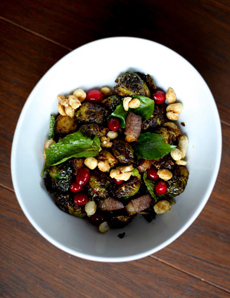
    This delicious warm potato salad with bacon was a finalist in the United States Potato Board-sponsored “Healthy Potato Salad” Recipe Redux Challenge. This recipe was created by Love And Zest, a blog written by a registered dietician. Prep time is 15 minutes, cook time is 45 minutes.

    Ingredients For 6 Servings

  • 24 ounces fingerling potatoes (tri-color if you can find them)
  • 1 pound Brussels sprouts
  • 1 cup beer
  • 1 teaspoon toasted onion, minced
  • 1 teaspoon garlic, minced and dried
  • 5 slices center-cut bacon, cooked and chopped
  • 4 fresh rosemary sprigs
  • Extra virgin olive oil
  • Kosher salt
  •  

    [2] Brussels sprouts and bacon enhance this warm potato salad (photo © Potato Goodness).

     
    Preparation

    1. PREHEAT oven to 450°F.

    2. SLICE potatoes and Brussels sprouts lengthwise. Place in a large bowl and soak in beer for 5 minutes.

    3. PLACE on a rimmed baking sheet and top with onion, garlic and rosemary; drizzle with olive oil.

    4. BAKE 45 minutes, stirring midway through baking. Remove from oven.

    5. SPRINKLE roasted vegetables with kosher salt. Top with bacon. Add extra olive oil if desired.
     
     
    FIND MORE OF OUR POTATO SALAD RECIPES.


    Comments off

    TIP OF THE DAY: Healthy Milk Alternatives


    Cows need not apply: Soy milk is made from
    soybeans and water. Photo courtesy
    Mercola.com.

      Americans have been embracing dairy milk alternatives for a variety of reasons. Almond, hemp, oat, rice and soy milks are cholesterol-free, lactose-free, parve kosher, sustainable and vegan. They are low carb, low calorie, low fat and most are a good source of protein and fiber. They also require no refrigeration until the container is opened.

    Milk alternatives can be substituted for dairy milk in any situation: from drinking a glassful to lightening coffee and tea to baking to pouring over cereal, to sauces and soups. They are available in plain, sweetened and flavored varieties, and can be fortified with vitamins and nutrients.

    All of the alternatives have the creamy texture of dairy milk; each has different nutritional benefits. But the key is what tastes best to you. When a plain variety has a subtle flavor, such as the nuttiness of almond milk, that nuance is often covered up in the flavored/sweetened varieties.

  • Soy milk, made from ground soybeans and water, has been on store shelves the longest, and is the most mainstream (as evidenced by the soy lattes at Starbucks). While soy milk lacks the calcium and Vitamin D of dairy milk, it is an excellent source of thiamine and magnesium, plus other essential minerals. The flavored varieties are as appealing as a smoothie.
  •  


    There have been issues with consuming large quantities of soy milk, including the amount of phytoestrogens which can block estrogen. Check with your healthcare professional before using more than a few ounces a day.

  • Rice milk is made from brown rice and water. It has both vitamin D and calcium but lacks protein and fiber. It is lower in calories and has less fat than soy milk. It is slightly higher in carbs.
  • Almond milk is made from ground almonds and water. The plain variety has a subtle nutty flavor. Almond milk is low in calories, carbs and fat and has a small amount of protein. We love the flavored varieties, especially the chocolate milk.
  • Oat milk is made from primarily from oats but other grains—barley, rice, soybeans—can be incorporated. Oat milk is low in fat, with a slightly higher amount of protein than almond milk, but has a higher amount of calories and carbs than the other milk alternatives.
  •  

    Granola with Blue Diamond Almond Breeze almond milk. Photo courtesy Blue Diamond.

  • Hemp milk is made from ground hemp seeds and water. Rich in protein and nutrition, hemp milk contains omega-3 and omega-6 fatty acids, vitamins A, E, B-12 and folic acid, magnesium, potassium and iron and the amino acid, GLA. Hemp contains anti-inflammatory agents and improves circulation. That’s all great news; we just prefer the flavor of the mother milk alternatives. Hemp milk does not contain the hallucinatory chemical, THC.
  •  
    While many people view these alternatives as “health food,” the flavored varieties—particularly almond milk and soy milk—are as delicious as any glass of chocolate milk or creamy dairy treat.

    As an old commercial advised: “Try it, you’ll like it!”


    Comments off

    TIP OF THE DAY: How To Soften Stale Bread


    Stale? Not for long! Photo of ciabatta loaf
    by Vincent Talleu | Wikimedia.


    Most people believe that when bread goes stale, it’s because the moisture evaporates. It’s more complex than that: Bread will go stale even in a moist, humid environment (details).

    Refrigeration doesn’t help: According to Bread.com, bread goes stale most rapidly at refrigerator temperatures—around 41°F/5°C. So keep bread at room temperature rather than in the fridge. (Refrigeration does delay the growth of mold.)

    Toasting is a solution for slightly stale bread, pound cake and other non-iced baked goods. But if the product is more than a little stale, it’s time to bring out the “heavy artillery”:

    THE MICROWAVE TECHNIQUE

  • If the bread is just slightly stale, slice and toss it into the microwave for 10-15 seconds.
  • If it’s very hard, wrap it in a damp paper towel. We place it right on the microwave turntable—no additional dish needed.
  • If it’s still hard, repeat for another 15 seconds.
  •  

    Warning, though: once the bread cools off, it will revert to being hard. So enjoy it while it’s warm.

    THE OVEN TECHNIQUE

    If you don’t have a microwave but do have an oven, use it to freshen bread, rolls and other baked goods:

    1. PREHEAT the oven to 450°F/250°C.

    2. WRAP the bread, muffins, pound cake, etc. in foil.

    3. HEAT for 5 to 10 minutes.

    4. SERVE immediately. Keep the bread wrapped in the foil until ready to eat.


    STALE BREAD DISHES

    For millennia, cooks have repurposed stale bread, resulting in dishes that are quite wonderful. Popular recipes include:

  • Bread crumbs—just pulse stele bread in a food processor; add optional seasonings
  • Bread dumplings, a Middle European dish (recipe)
  • Bread pudding (recipe)
  • Bread sauce, a British specialty served with poultry (recipe)
  • Brotzupa/wodzionka, a Silesian soup made from stale bread, fat, water, bacon, lard and seasonings
  • Croutons (recipe)
  • Flummadiddle, an Early American baked pudding of stale bread, pork fat, molasses and spices
  • Fondue (recipes)
  • French toast (recipe)
  • Garlic bread (recipe)
  •  

    Turn baguettes or other crusty breads into garlic bread. Photo courtesy Floriole Cafe | Chicago..

  • Garbure, a French soup or stew of ham with cabbage, root vegetables, cheese and stale bread
  • Gazpacho (recipe)
  • Haslet, a British pork meat loaf
  • Skordalia, a Greek garlic dip (potatoes can be substituted for the stale bread)
  •  
    In medieval Europe, slices of stale bread, called trenchers, were used instead of plates.

    If you have a dish to add to our favorite uses for stale bread, let us know!
     
    CHECK OUT THE DIFFERENT TYPES OF BREAD IN OUR BREAD GLOSSARY.


    Comments off

    TIP OF THE DAY: Seafood Watch & Swordfish Livornese


    Swordfish Livornese. Photo courtesy Fabio
    Viviani.
      Sustainable or not sustainable: That is the question.

    Whenever we come across an appealing fish recipe or look at the choices at the fish market or on a restaurant menu, we check Seafood Watch to see if the species is an “Avoid” or a “Best Choice.”

    Seafood Watch is a service of the Monterey Bay (California) Aquarium, dedicated to helping preserve the oceans’ fish supplies. It monitors which species are endangered (overfished to very low levels) and to be avoided, and which are a “Good Alternative” or a “Best Choice.”

    To see what’s sustainable, head to Seafood Watch.com.
    When we received the swordfish recipe below from one of our favorite Top Chef alumni, Fabio Viviani, we headed to Seafood Watch. Here’s the chart we checked:


    So our tip of the day is: Make Seafood watch a go-to resource. You can check it online or with an iStore app.

    Now onto Chef Viviani’s Swordfish Livornese, swordfish Livorno-style.

    WHAT’s LIVORNESE?

    Livorno is a Tyrrhenian Sea port on the western coast of Italy: a large span of water with Sicily to the south; Basilicata, Calabria, Campania, Corsica, Lazio, Sardinia and Tuscany to the east on the Italian mainland; and the islands of Corsica and Sardinia to the west.

    Livornese sauce, a regional specialty, combines tomatoes, olives and capers. Added to fish fillets or fish steaks, it’s an easy and healthful dish with lots of flavor.

    You can substitute any firm-fleshed fish, such as cod, grouper or red snapper; or use chicken or tofu. Chef Viviani likes swordfish because it is a lean fish but has a good fat content.

    This recipe serves 4.


    FABIO VIVIANI’S SWORDFISH LIVORNESE
    RECIPE

    Ingredients

  • 1/3 cup olive oil (not extra-virgin*)
  • 3 medium shallots, finely chopped
  • 2 garlic cloves, smashed
  • 2-3/4 pounds swordfish loin steaks, skin removed
  • 2 cups quartered cherry tomatoes
  • ½ cup tomato sauce or fish broth
  • 1 cup of pitted Kalamata olives, pitted and sliced in half
  • 2 tablespoons capers
  • Salt and pepper to taste
  • Fresh basil leaves for garnish
  •  

    You can get this leaping swordfish as free wallpaper from AnimalsTown.com.


    *Avoid cooking with extra virgin olive oil: It has a low smoke point. Use regular oil, labeled simply “olive oil,” for cooking.

    Preparation

    1. HEAT the olive oil in a pan very quickly, over a medium fire.

    2. SAUTÉ the shallots until completely caramelized. Add the cherry tomatoes, olives, capers and tomato sauce, plus salt and pepper to taste. Reduce for 5 minutes.

    3. RUB the swordfish steaks on both sides with olive oil and season them with salt and pepper to taste. Sear the fish in a frying pan.

    4. PLACE the fish in an oven pan (or use the frying pan if it is oven-safe) and cover with half of the sauce. Bake in the oven at 425°F for 10-15 minutes, until the fish is done and flaky.

    5. TOP with remaining sauce and basil and enjoy!
    See Chef Viviani in action on the television program “Home & Family,” on the Hallmark Channel.

    Find more of our favorite fish recipes.


    Comments off

    The Nibble Webzine Of Food Adventures


    © Copyright 2005-2026 Lifestyle Direct, Inc. All rights reserved. All images are copyrighted to their respective owners.