THE NIBBLE BLOG: Products, Recipes & Trends In Specialty Foods


Also visit our main website, TheNibble.com.

TIP OF THE DAY: Healthier Shrimp Salad


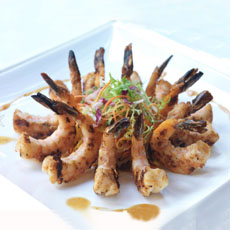
Grilled shrimp with a green salad. Photo
courtesy Haru Restaurant | New York City.


Shrimp salad loaded with mayonnaise: not good for you. Grilled shrimp with a vinaigrette-dressed salad or the grilled shrimp salad recipe below: A better idea. Other low-calorie shrimp dishes include ceviche; the classic shrimp cocktail or its update, the shrimp Martini (recipe below); or a lightly-dressed shrimp Caesar salad. Think Eat This, Not That.

Americans eat four pounds of shrimp a year—and it might be much higher if the tasty little swimmers were more affordable!

Shrimp may be small in size, but they’re huge in taste and health appeal. This little crustacean ranks as the #1 selling seafood in America. High in protein, low in carbohydrates and an abundant source of heart-healthy omega-3 fatty acids, shrimp are a good-for-you food. We obtained these shrimp health notes from SeaPak, a producer of frozen shrimp products.

 
According to the George Mateljan Foundation, a non-profit organization that utilizes unbiased scientific information to promote health, shrimp is one of the healthiest and most nutrient-rich foods in the world.

HEALTH BENEFITS OF SHRIMP

Nutrition.
A four-ounce serving of shrimp provides a whopping 23.7 grams of protein, which is 47% of the recommended daily allowance (RDA); nearly 40% of the RDA of vitamin D; and nearly 30% of the RDA of vitamin B12. Shrimp is also very high in tryptophan, an essential amino acid, and selenium, which induces the repair process in damaged cells and inhibits the proliferation of cancer cells.

Omega-3s. Studies show that shrimp and other seafoods that are rich in omega-3 fatty acids can improve cardio-vascular health and lower the incidence of heart disease and stroke. The American Heart Association recommends that people include these protective oils in their diets by eating at least two servings of seafood per week.

Cholesterol-Friendly.
Shrimp doesn’t deserve its old bad rap for high cholesterol. A study at Rockefeller University Hospital, co-sponsored by the Harvard School of Public Health, confirmed in 1996 that the cholesterol content of shrimp should not be a concern. The research results revealed that a shrimp diet raises levels of HDL, or “good” cholesterol, and decreases levels of LDL, or “bad” cholesterol (lowering LDL in the bloodstream significantly reduces susceptibility to heart disease).


SHRIMP MARTINI RECIPE

Ingredients For 4 Servings

This recipe is served in oversized Martini glasses (about 10 ounces), but you can substitute another dish or goblet.

  • 16 jumbo shrimp, peeled and deveined
  •  
    For The Salsa

  • 1 ripe mango (small), diced
  • 1 ripe papaya (small), diced
  • 2 roma tomatoes (small), diced
  • ½ red onion (small), diced
  • 1 red bell pepper (small), diced
  • 1 green bell pepper (small), diced
  • 1 bunch cilantro chopped (2 tablespoons)
  • 1 lime, juiced
  • 1 teaspoon honey
  • 1½ -tablespoons vegetable oil
  • Salt and pepper to taste
  •  
    Garnishes

  • 4 pitted green olives
  • 4 slices lime
  •  
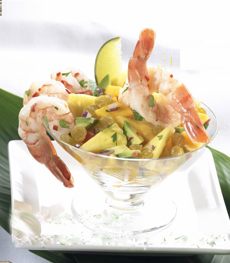
    A shrimp cocktail has a cocktail sauce garnish. But fill the same glass with anything else, and you’ve got a Shrimp Martini. This photo shows diced avocado substituting for the diced bell peppers in the recipe. Photo courtesy California Raisins.
     
    Preparation

    1. POACH shrimp in 2 quarts salted water until cooked through (3 minutes). Remove and chill in ice water.

    2. MIX all salsa ingredients; season with salt and pepper.

    3. DIVIDE salsa evenly among the glasses. Arrange 4 shrimp per glass. Garnish each with olive and lime slice. Place 1 glass on each plate and serve with a ramekin of cocktail sauce.
     
    Source: Ocean Garden Products, Inc. and Chef Lou Imbesi, Catelli Ristorante, Voorhees, NJ, via EatShrimp.com.

    GRILLED SHRIMP SALAD RECIPE

    Ingredients For 2 Servings

  • 6 jumbo shrimp
  • ½ red bell pepper
  • ½ green bell pepper
  • ½ yellow bell pepper
  • 2 slices red onion
  • ¼ cup olive oil
  • ½ lemon
  • ½ cup chickpeas
  • 10 fresh parsley leaves
  • Chili flakes
  •  
    Preparation

    1. CUT the peppers in thin slices, grill shrimp 4 to 5 minutes.

    2. MIX with remaining ingredients in a stainless bowl. Season with salt.

    3. DIVIDE into two portions; garnish with onion slice and serve.

    Source: Ocean Garden Products and Chef Marino Tavares, Ferreira Café Restaurant, Montreal, Quebec, via EatShrimp.com.


    Comments off

    RECIPE: Linguine Alla Vongole, With Clam Sauce & Asparagus


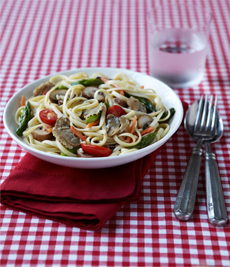
    [1] Linguine and clam sauce with asparagus. The recipe is below (photo © Dole).


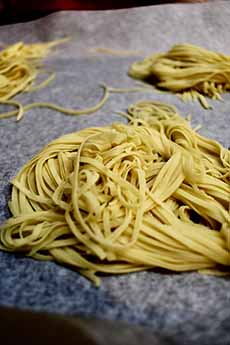
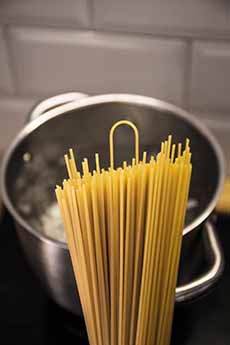
    [2] Fresh linguine pasta, the “flat” version of spaghetti (photo © Mindaugas Petrutis | Unsplash).


    [3] Dry fettuccine (photo © Isaac Quesada | Unsplash).

    Linguine With Pesto & Pine Nuts
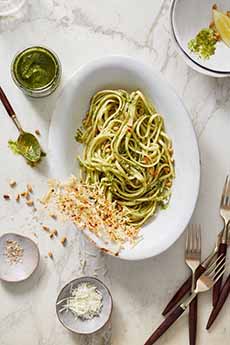
    [4] Linguine with pesto is a classic dish from Liguria, where both originated (photo © DeLallo).


    Before asparagus season ends, get your fill by adding it to your favorite dishes.

    Here’s an example of how easy it is, courtesy of Dole, which adds its fresh asparagus to the classic pasta dish, linguine with clam sauce.

    Consider using whole wheat linguine for fiber and flavor. If asparagus season has passed, add green beans or snow peas.

    This recipe makes 4 servings; prep time 10 minutes; cook time 25 minutes.

    Speaking of linguine (lin-GWEE-nay)…Americans often misspell it linguini.

    Show you’re a food connoisseur and use the original Italian!

    Originating in the Liguria, the costal region of northern Italy (capital Genoa), linguine is a narrow, flat version of round spaghetti (it is sometimes referred to as flat spaghetti).

    It’s a narrower version of another popular flat ribbon pasta, fettuccine.

    September 15th is National Linguine Day.

    > The history of linguine is below.

    > The history of pasta.

    > Check out the different types of pasta in our Pasta Glossary.
     
     
    RECIPE: LINGUINE & CLAM SAUCE (“ALLA VONGOLE”) WITH ASPARAGUS

    If asparagus is out of season, use broccoli florets.

    Ingredients

  • 8 ounces linguine
  • 1 tablespoon olive oil
  • 1 package (8 ounces) sliced mushrooms
  • 2 teaspoons minced garlic
  • ½ teaspoon salt
  • ½ teaspoon freshly ground black pepper
  • 1 pound asparagus, trimmed of woody ends and chopped into 2” pieces
  • 1 cup shredded carrots
  • 1 cup grape tomatoes, halved
  • 1 can (10 ounces) whole baby clams, drained (juice reserved)
  •  
    Preparation

    1. BRING a large pot of water to a boil. Cook linguine according to manufacturer’s instructions. Meanwhile…

    2. HEAT the oil in a large nonstick skillet over medium-high heat. Add the mushrooms, garlic, salt and pepper. Cook for 5 minutes until mushrooms begin to brown.

    3. ADD the asparagus, carrots and two tablespoons of water. Toss to combine and cover skillet. Cook 4 minutes longer.

    4. ADD the tomatoes and the clam juice. Cook uncovered 1 minute longer. If the pasta is not yet cooked, remove vegetables and clams from heat and cook pasta until it is al dente.

    5. DRAIN pasta and add to the vegetable mixture along with the reserved clams. Raise heat to high and cook 2-3 minutes longer until pasta is thoroughly coated and most of the liquid is absorbed.

    6. PLATE and serve.
     
     
    LINGUINE vs. SPAGHETTI vs. FETTUCCINE

    Do you know the difference between popular pasta cuts and shapes?

    Linguine is a flat ribbon, a narrower version of fettuccine (or, fettuccine is wider linguine.

    Spaghetti is a round ribbon pasta, thin like linguine. Bucatini is a thick round ribbon with a hole in the center (like a sipping straw).

    There are hundreds of pasta shapes in Italy—estimates range from 350 to as many as 600. Some are very similar, but with different names because they originated in different regions, in the days before mass communications could get the word out.


    THE HISTORY OF LINGUINE

    Linguini, a flat ribbon pasta that is wider than spaghetti but narrower than fettuccine, appears to have originated in 1700s in the region of Liguria, in northwestern Italy.

    Giulio Giacchero, author of a book on the economy of Genoa at that time, writes about trenette (another name for linguini) served with pesto, green beans and potatoes*. He notes that trenette al pesto was a typical festive dish of Ligurian families of the time [source].

    It was served for special occasions, and as a Sunday dish, until the mid-20th century, when it became part of the everyday repertoire [source].

    Both linguine and trenette are narrow, flat, and long, trenette just a smidge wider and elliptical in cross section rather than flat. Often, the terms are used interchangeably. Why does one region have two almost identical pastas with different names?

  • Linguine means “little tongues” in Italian, possibly referring to its flatness.
  • Trenette may derive from the Genoese dialect trenna, or strings.
  •  
    And in modern times, when pasta can be made by machine to within a millimeter, a thinner version of linguine is made called linguettine.

    As a coastal region, Ligurians had plenty of seafood to mix with their pasta. Hence, the popularity of linguine alla vongole (VAWN-go-lay), linguine in clam sauce and linguine misto mare, linguine with mixed seafood (mussels, scallops, shrimp, squid tentacles).

    Since basil pesto (pesto alla Genovese) also originated in Liguria (a major basil-growing region), pasta with pesto sauce was, and is, also very popular.

    By the last century, linguine had spread throughout Italy. And yes, red sauce lovers: Linguine is also popularly served with arrabbiata and marinara sauces.
     
     
    ________________

    *Pasta with potatoes? Strange? No. Remember that the days before refrigeration, meals had to be made from foods that were in season, or could be stored into the next season.


    CHECK OUT WHAT’S HAPPENING ON OUR HOME PAGE, THENIBBLE.COM.


    Comments off

    PRODUCT: Wheat Thins Lime, Limited Edition


    Limited-edition Lime Wheat Thins. Photo by Elvira Kalviste | THE NIBBLE.
     

    “Taste the bold lime flavor,” beckons the entire back side of the new, limited edition Wheat Thins.

    Fans of Wheat Thins, those crunchy little cracker squares from Nabisco, might note that lime and salt are also flavors of that popular drink, the Margarita. In fact, we received two boxes of Wheat Thins from the manufacturer, along with two Margarita glasses (we enjoyed them with a beer, instead).

    Wheat Thins are one of the few foods we enjoyed in grade school that are still on our grocery list. We like them instead of chips with a beer, with soups and salads (use them instead of croutons), and as a better-for-you snack, with or without a nonfat yogurt dip.

    Wheat Thins are made with whole grain flour. Each serving of 14 crackers (30g) equals 20g of whole grains. That really helps toward the 48g RDA recommended by the USDA (more about whole grains).

    Nutritionists recommend that we consume at least 3 servings of whole grains daily. It’s fun when Wheat Thins is one of those servings.


    Comments off

    TIP OF THE DAY: Read Those Nutrition Labels…

    According to a 2012 study by the U.S. Centers for Disease Control and Prevention, people who read the nutritional information on food labels are generally thinner than those who don’t read labels.

    Not only do they understand what a portion size is; some foods appear to be much healthier than they really are, with much more salt and sugar than you’d like. Dr. Wendy Bazilian, nutritionist and author of The SuperFoodsRx Diet: Lose Weight with the Power of SuperNutrients, shared some tips on understanding nutrition labels.

    1. Look for real ingredients—words you recognize. Avoid artificial dyes, preservatives, high fructose corn syrup, hydrogenated oils (trans fats) and MSG.

    2. If you have food allergies, look at the bottom of the ingredient list. The eight most common allergens—milk, eggs, peanuts, tree nuts, fish, shellfish, soy and/or wheat—are required to be highlighted in a separate line, such as, “Contains milk and soy.”


    Read those labels for portion size as well as salt, sugar and fat grams.

     
    3. Check the serving size AND the servings per container. The serving size is an amount of the food that represents one single serving. The rest of the nutrition facts then provide information based on that amount. If the serving size says 1/2 cup, then the calories, fat, cholesterol, sodium, protein, carbohydrates, fiber and other nutrients shown are for 1/2 cup of that food.

    The servings per container line indicates how many servings there are in the entire package. Many portion sizes are much smaller than are logical; you may note that the serving size is half a cookie or energy bar; for beverages, it can be half of a 16-ounce bottle or a 12-oounce can.

    So if the serving size is half a cookie and you eat two cookies, you’ll be eating four times the calories, fat, protein, carbs and other nutrients. Do the math before diving in. As to what to do with the other half of a can of soda, especially when you’re on the go and can’t pour half in a glass for someone else…the choices seem to be to consume the extra calories or toss the other half.


    This barbecue sauce has 11g sugar in two
    level tablespoons. If you slather it on, you
    might as well eat the sugar bowl! Photo by
    Elvira Kalviste | THE NIBBLE.
      4. Take a close look at energy bars. “Energy” doesn’t mean “healthy.” Look for real, not artificial, ingredients on the list; aim for 2 grams (or more) fiber and look for sugar of 10 grams or less. And check that portion size: Is the bar one serving or two?

    5. Choose better-for-you frozen meals. Many prepared meals are packed with fat, sodium and sugar. Look for real ingredients: whole grains, whole foods,* lean proteins, vegetables and fruits. Keep the calories under to 400-600 per servings and aim for 450 mg or less sodium per serving, 600 mg as an absolute maximum. Dr. Bazilian, by the way, is a consultant to CedarLane Frozen Foods, an all-natural line that is modest in calories and low in sodium.

    Dr. Bazilian advises to add something fresh and whole on the side when you enjoy a frozen meal—some baby carrots or cherry tomatoes as a starter, a green salad, an apple or grapes for dessert.

     
    *Whole foods are unprocessed and unrefined food products, or those that are processed and refined as little as possible. They typically do not contain added ingredients such as sugar, salt, fat, food dyes, artificial ingredients, fillers, etc. Examples include whole grains, fruit, vegetables, nuts, seeds, unprocessed meats, fish, unprocessed dairy and eggs.


    Comments off

    Different Types Of Whiskey For World Whiskey Day

    May 18 is World Whiskey Day. If you’re not normally a whiskey drinker, why not take a vacation from the tequila and vodka and sip a glass of:

  • American whiskey: bourbon (at least 51% corn, red winter wheat and barley malt), corn whiskey, Tennessee whiskey (identical to bourbon except filtered through sugar maple charcoal, which provides a unique flavor and aroma), rye (made with at least 51% rye in the mash).
  • Canadian whisky: Canadians produce both Bourbon-style whiskey, smoother and lighter than American bourbon, made with rye (e.g. Canadian Club, Crown Royal and Seagram’s VO), and Scotch-style whiskey made with barley (e.g. Canadian Mist).
  • Irish whiskey: triple-distilled for extra smoothness; unmalted barley means a sweet perfume with no smokiness.
  • Scotch whisky: malted barley used in the mash provides the distinctive, smokey flavor.
  •  
    Whiskey is a spirit, or alcoholic distillate, made from a fermented mash of grain or malt and aged in barrels. The brown color comes from barrel aging. Each different type of whiskey is distinguished by the type of grain (barley, corn, rye) used in the fermentation process, as well as the distinct distillation and aging process.


    A shot of Irish whiskey with a wee wedge of lime (photo © Jameson).

     
    Australia, England, Germany, Japan, New Zealand, Switzerland and Thailand, all strong markets for whiskey, now produce their own. Regardless of the variety or country of origin, a general rule of thumb is that all straight whiskeys must be aged at least two years in wood, generally oak. Each nation has its own rules and regulations about what constitutes a true whiskey.

    Whiskey sales have skyrocketed in the past year, in both the U.S. and abroad. In the U.S., bourbon and Tennessee whiskey led the growth. American whiskies also accounted for 70% of the total U.S. spirits exports for 2012.

    See all the different types of whiskey in our Whiskey Glossary.

    If you don’t want to drink a glass, use whiskey in a recipe. It adds dimension to sauces for meats and in desserts like cake, ice cream and mousse. You can even make a whiskey vinaigrette: Add a tablespoon to any recipe.

     
    WHISKEY VS. WHISKY

    Canadians spell “whisky” without the “e,” as do the Scots and most other countries except Ireland and the U.S.

    Scholars can’t determine why the “e” was dropped by the Scots many centuries ago. One theory is that the Irish made whiskey first and pronounced it with a broad “e.” When the Scots began to make it, they dropped the “e” to differentiate their product.

    A 1968 directive of the Bureau of Alcohol, Tobacco and Firearms specifies “whisky” as the official U.S. spelling, but allows the alternative spelling, “whiskey,” which most U.S. producers prefer.


    An Old Fashioned is based on the earliest
    known American cocktail. Photo courtesy
    Maker’s Mark.
     

    OLD FASHIONED COCKTAIL RECIPE

    Here’s an easy way to enjoy World Whiskey Day: with a classic Old Fashioned cocktail. The recipe is courtesy Maker’s Mark.

    The first documented use of the word “cocktail” dates to 1806; it combined liquor of any kind with sugar, water and bitters. As cocktail styles evolved, this early recipe became known as the Old-Fashioned. Later, it evolved into a particular drink made with American whiskey.

    Ingredients

  • 1-1/2 parts bourbon
  • 1/2 part club soda
  • 2 orange slices
  • 2 maraschino cherries
  • 1 teaspoon sugar
  • Ice
  •  
    Preparation

    1. MUDDLE 1 orange slice, 1 maraschino cherry and the sugar in a rocks glass.

    2. FILL the glass 3/4 full of ice. Add bourbon and splash of club soda.

    3. GARNISH with additional orange slice and maraschino cherry.
     
     
    A BRIEF HISTORY OF WHISKEY

    Distillation was discovered in the late eighth century by an Arab scholar known as the Father of Modern Chemistry, Abu Masa Jabir ibn Hayyam (?-803 C.E.). He wondered what would happen if he put wine into an al-ambiq, a round vessel like a tea pot with a tall spout on the top, and boiled it.

    The vapors rose through the spout, were collected and condensed, creating the world’s first distilled alcohol. In fact, since the al-ambiq was often used to boil powdered antimony into a liquid called al-kohl (used to make the cosmetic kohl), the liquid became known as alcohol and the al-ambiq became the alembic still, which remains in use today.

    The distillate was originally used as medicine, and remained a secret process, ultimately shared with the monks in Spain for medicinal purposes. Some orders created their own special distillations, such as Benedictine and Chartreuse liqueurs.

    As for our word whiskey: The Scotch uisce and the Gaelic uisge, pronounced ISH-ka, became usky and then whisky in English.

    Here’s more on the history of whiskey.
     
     
    MORE ABOUT WHISKEY

  • Types Of Whiskey
  • Whiskey Style By Country
  • Tasting Whiskey: The Role Of The Senses
  • Planning A Whiskey Tasting
  •   

    Comments off

    The Nibble Webzine Of Food Adventures
    RSS
    Follow by Email


    © Copyright 2005-2026 Lifestyle Direct, Inc. All rights reserved. All images are copyrighted to their respective owners.