THE NIBBLE BLOG: Products, Recipes & Trends In Specialty Foods


Also visit our main website, TheNibble.com.

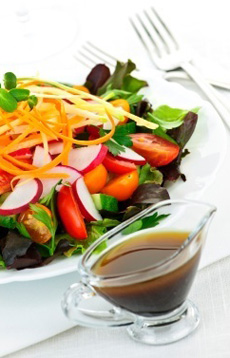
TIP OF THE DAY: Homemade Vinaigrette


Forget the bottled dressing and mix your
own. Here, a balsamic vinaigrette: olive oil
and balsamic vinegar. Photo by Elena
Thewise | IST.
  Having spent the weekend at a home with a fridge-full of bottled dressings, we’re inspired to revisit the homemade vinaigrette. It’s better, it’s cheaper and it takes up less space—no space in the fridge—than half a shelf of bottles.

The components of a vinaigrette couldn’t be simpler: oil and acid in a 3:1 ratio, plus a pinch of salt and pepper and optional herbs. Some people prefer a 3:2 ratio. It’s up to your palate. Start with 3:1 and if you want more acidity/tartness, move to 3:2.

What if your family prefers creamy dressings? Wean yourself away from them, except for special occasions when you’ve simply got to have chunky blue cheese. Bottled dressings are clogged with calories, added sugar and with creamy dressings, cholesterol.

In the time it takes you to shake and uncap the bottle, you can combine 3 tablespoons of olive oil with 1 tablespoon of vinegar. After you whisk together your vinaigrette, dip a lettuce leaf and taste it. Adjust proportions and seasonings as needed.

 
SALAD OIL

The choice of oils is up to you. Foodies prefer the flavor and healthful qualities of olive oil, but you can use any vegetable oil—ideally, a monounsaturated (heart healthy) oil. Here are the good fats and the bad fats.

  • Flavored oils. A great aid in the kitchen, flavor-infused oils make it easy to add a seasoning—basil, chile, garlic, lemon, rosemary, and on and on—with no added work.
  • Combined oils. Nut and seed oils—hazelnut, sesame and walnut, for example—add great flavor. But they can be overwhelming at a 100% strength, so cut them with a milder-flavored oil. We use we half olive oil, half nut oil. Some sesame oils are particularly potent; try a 3:1 ratio instead of 1:1.
  •  

    VINEGAR & OTHER ACIDS

    There’s a legion of vinegar types out there (see our Vinegar Glossary for starters). You can use a simple cider vinegar, but wine White vinegar: sorry, it’s harsh and should be reserved for pickling and cleaning.

  • Flavored Vinegar. As with flavored oils, these are great additions. You can use both a flavored vinegar and a flavored oil for combined flavors—basil oil and garlic vinegar, for example.
  • Citrus Juice. You can substitute all or part of the vinegar with any citrus juice: grapefruit, lemon and lime. If you use a lower-acid juice like orange juice, you may have to amp up the acid with some cider vinegar.
  •  
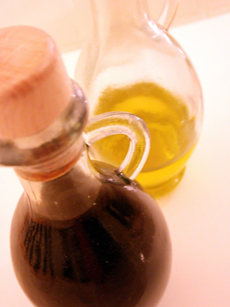
    You don’t even have to pre-mix: Just put oil and vinegar cruets on the table. Photo | IST.

    MORE FLAVOR DIMENSIONS

  • Heat. Spice it up with a few drops of sriarcha or other hot sauce, or 1/4 teaspoon of grated ginger (more to taste).
  • Condiments. For flavor as well as texture, consider pickle relish or chutney, chopped olives or giardiniera.
  • Mustard. You can use any type, but in our book, there’s nothing better than a Dijon mustard vinaigrette. Adjust the recipe to 3 parts oil, 1 part vinegar and 1 part mustard.
  • Honey & Maple. Some people want a sweet vinaigrette. Add a half teaspoon of agave, honey or maple syrup to the vinaigrette. You can also go the calorie-free route and use noncaloric sweetener.
  •  

    KEEP TWEAKING

    In addition to playing with the proportions of oil, acid and seasonings, play around with other ingredients at hand. For example, in a 3:2:1 proportion of oil, acid and “other,” consider one part of:

  • Pomegranate juice, with arils (seeds) tossed in for color, flavor and texture.
  • Fruit purée, such as apple, with apple cider vinegar.
  • Fresh berries, whole or diced.
  • Herbs. Fresh or dried, they add zing to a vinaigrette.
  • Spices, such as a dash of cinnamon and nutmeg in a holiday vinaigrette. Don’t be shy: try a dash of whatever spice you enjoy.
  •  
    Keep working at it, and don’t be surprise if everyone asks for the recipe.


    Comments off

    PRODUCT: belVita Breakfast Biscuits, Soft Baked


    belVita Soft Baked breakfast biscuit in
    Mixed Berry. Photo courtesy Nabisco.
      In various surveys, fewer than half of Americans report eating breakfast every day—even though studies show that breakfast eaters can benefit from improved concentration during the morning, a positive impact on managing body weight and other advantages.

    That’s why Nabisco launched belVita Breakfast Biscuits last year. A better grab-and-go alternative, the flavorful, whole-grain biscuits are delicious with coffee, tea or a yogurt. They earned their place as a NIBBLE Top Pick Of The Week.

    The whole-grain biscuits are meant to be part of a balanced breakfast, along with a serving of lowfat dairy and fruit, such as:

  • Apple slices and lowfat cheese
  • Banana and a nonfat latte
  • Fresh strawberries and nonfat Greek yogurt
  • Smoothie made with lowfat Greek yogurt and frozen blueberries
  •  

    But even if all you do is munch on belVita with your coffee, you’ll be ahead of the game—if your game consists of a less nutritious, higher calorie bagel, danish, muffin or other carb. belVita Breakfast Biscuits are portioned in convenient, individual packs that make grab-and-go easy and control your portion size.


    Now, the original crunchy biscuits have been joined by Soft Baked.

    Personally, we prefer the original crunchy biscuits—we love to crunch. But those who like a muffin in the morning should opt for the Soft Baked. They’re similar to a muffin consistency, rolled flat in the shape of a bar, in:

  • Mixed Berry
  • Oats & Chocolate
  •  

    One biscuit, a 1.76 ounce/50 g serving, contains 20% of your daily value of fiber (11 g per serving), 180 (Mixed Berry) or 200 (Oats & Chocolate) calories and 7 g fat.

     
    Boxes of the two Soft Baked biscuit* flavors. Photo courtesy Nabisco.
     

    The line is certified kosher (dairy) by OU and is carried by supermarkets and other retailers nationwide.
     

    *Having said “biscuit” more times in this article than we typically say in a year, we can’t sign off without offering for your amusement the biscuit tongue twister of our youth. Say this three times quickly:

    A box of biscuits.
    A box of mixed biscuits.
    A biscuit mixer.
      

    Comments off

    TIP OF THE DAY: Parchment Paper Vs. Waxed Paper


    Cookies on parchment paper. Photo courtesy
    King Arthur.
     

    We’ve gotten a few inquiries about waxed paper versus parchment paper. The easiest way to remember which to use is that wax melts when it’s near heat. So:

  • Parchment paper can take the heat. It’s thinly coated with silicone, which is nonstick and heat-resistant. It’s nonstick, which is why it is recommended to line cookie sheets and pans. It costs more than wax paper, but is more versatile.
  • Waxed paper can’t take the heat. The soybean or paraffin wax surface will melt and can even catch fire! The paper is coated with a thin-layer of food-safe wax, which keeps the food from sticking. You can use wax paper to line pans, as long as the wax paper is completely covered by the food. Otherwise, the wax will melt, and the paper will smoke and burn.
  •  
    For some tasks you can use either.

    WHEN TO USE PARCHMENT PAPER

  • Baking. Most brands can withstand temperatures up to 420°F for up to 30 minutes. (For higher-heat and longer baking, check the package to be sure.) Popular uses include lining cookie sheets instead of greasing them. This also keeps grease from fragile cookies like meringues.
  •  

  • Cooking. The most popular use is “en papillote,” a technique of wrapping food in a pouch of parchment paper before baking. It locks in flavor and keeps the moisture in as it steams the fish and other foods—a low calorie preparation. You can also microwave leftover pizza on a piece of parchment to help crisp the bottom.
  • Lining. The elegant-looking parchment can be used instead of a napkin.
  • Serving. Restaurants use it to present cones of French fries and other fried foods. You can also use it to serve popcorn and other snacks. Use a piece of tape to seal the cone.
  •  
    Don’t use parchment in the broiler: It can catch fire. Use foil instead.

    Parchment paper can be purchased in rolls or in precut sheets that fit different size baking pans. There are two “grades”: the original silicon-treated parchment and a newer, much cheaper variety treated with Quilon. The Quilon parchment has a lower heat tolerance, but is fine for most baking needs.

    Some bakers use Silpat: washable, reusable silicon pan liners. They’re great for some needs, but don’t give cookies the crispiness they need on the bottom.


    WHEN TO USE WAXED PAPER

    Wax paper was designed to repel moisture. It was first invented to keep bags of potato chips from getting soggy.

  • Covering. When slicing raw meats, lay a sheet of wax paper atop the cutting board to keep the surface sanitary.
  • Lining. Line the produce drawers of the fridge, and you won’t have to remove and wash the entire bin as often. Similarly, you can use it to line kitchen drawers.
  • Mixing. Here’s a baking tip: Mix the dry ingredients on a sheet of wax paper on the counter. Lift it to form a funnel and easily transfer the ingredients into the mixer bowl.
  • Dustbuster. Mom’s favorite use: Place wax paper on top of the upper kitchen cabinets where dust and grease accumulate. Every few months, change the paper.
  •  

    WHEN TO USE EITHER

  • Dripping. Catch the drips from candy apples, chocolates and other foods that “drip dry.”
  • Pouring. Roll the paper to make a funnel/cone.
  • Separating. Layer squares of paper between burgers, steaks, or chops before freezing. It will be easier to separate them for thawing.
  •  


    Caramel apples on wax paper. Photo by Karcich | IST.


  • Separating. Separate burger patties or other foods prior to cooking.
  • Wrapping. While waxed paper works for longer periods to keep the moisture in, you can use either for cheese, meats, sandwiches, etc.
  •  
    WAXED PAPER VS. WAX PAPER

    Since the product is made from unbleached paper that’s coated with wax, the proper name is waxed paper.

    “Wax paper” would imply that the sheet is made of wax.
      

    Comments off

    TOP PICK OF THE WEEK: Jif Whips Peanut Butter & Chocolate Spread


    Style your own cookies with Jif Whips. Photo
    by Elvira Kalviste | THE NIBBLE.
     

    We focus on specialty foods, so rarely name a mass-marketed supermarket product as a Top Pick.

    But Jif’s new Whipped Peanut Butter & Chocolate spread is just so yummy, special and, well, welcome, that it takes this week’s top honors.

    Everyone who loves peanut butter cups should run out and buy a tub, possibly several.

    The whipped PB spread, which also includes an unsweetened Creamy Peanut Butter variety, is spreadable, dippable, mixable, pipeable, frostable and topable.

    If you don’t want to do any of those things, just dip a spoon into the tub and enjoy!

    Read the full review.

     
    FIND MORE OF OUR FAVORITE PEANUT BUTTER BRANDS.


    Comments off

    FOOD FUN: “Who” Made This Owl?

    We found this owl on the Facebook page of Euforia Cake, but there was no attribution. If you know who should be credited, let us know!

    If only we had the talent to sculpt fruit and vegetables into fantastic creatures! Instead, we’ll take pleasure in sharing the ones we find.

    We’ve counted up the ingredients:

  • Head: cantaloupe
  • Eyes: grapes
  • Neck: chicory
  • Body: watermalon
  • Wings: spinach and zucchini
  • Legs: broccoli stalks
  • Tail: green onions and chilis
  •  
    We love it, but we don’t know who made it…or shot it.


    Comments off

    The Nibble Webzine Of Food Adventures
    RSS
    Follow by Email


    © Copyright 2005-2026 Lifestyle Direct, Inc. All rights reserved. All images are copyrighted to their respective owners.