THE NIBBLE BLOG: Products, Recipes & Trends In Specialty Foods


Also visit our main website, TheNibble.com.

Lady M Sesame Ti Kuan Yin Tea Mille Crêpes For Lunar New Year

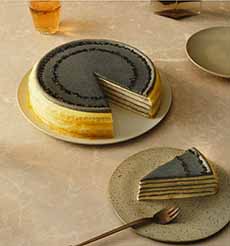
A Sesame Mille Crepes Cake from Lady M for the Lunar New Year
[1] Sesame Mille Crêpes Cake (both photos © Lady M).

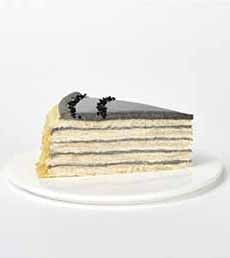
A slice of Sesame Mille Crepes Cake from Lady M for the Lunar New Year
[2] Close-up on a slice.


Looking for gourmet inspiration to celebrate the Lunar New Year? Check out this deluxe Sesame Ti Kuan Yin Tea Mille Crêpes from Lady M.

Layers of delicate and nutty black sesame cream, paper-thin French crêpes, and floral Ti Kuan Yin oolong tea-infused whipped cream come together in this limited-edition Mille Crêpes cake.

Each cake is elegantly finished with a black sesame glaze and topped with roasted sesame seeds: a beautifuence of flavors to celebrate the New Year.

Tieguanyin or ti kuan yin is a variety of Chinese oolong tea that originated in the 19th century in Anxi, in Fujian province.

While this bit of information may not sync with a luscious, creamy cake, Tieguanyin tea is rich in antioxidants and has been shown to have numerous health benefits.

Studies have shown that tieguanyin tea can help improve heart health, lower cholesterol levels, and reduce cancer risk. The tea has also been shown to boost cognitive function and memory [source].

So, while you’re enjoying the cake, have a second piece. It may not boost your cognitive function, but it is irresistible.

The 2024 Lunar New Year, the Year of the Dragon, begins on February 10th and is observed through February 15th.

> Here’s more about the Lunar New Year.
 
 
> Get your cake here.

> The history of Mille Crêpes cake.

> The history of cake.

> The different types of cake: a photo glossary.


CHECK OUT WHAT’S HAPPENING ON OUR HOME PAGE, THENIBBLE.COM.


Comments off

Woodford Reserve x Compartes Chocolate: A Great Valentine Gift

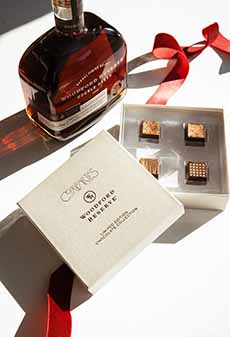
Woodford Reserve Double Oaked Bourbon invites Bourbon lovers to partake of a special Valentine treat: a bottle of the acclaimed Kentucky Bourton along with a limited-edition four-piece chocolate collection of chocolates by prominent artisan chocolatier Compartes (photo #1).

Compartés chocolatier Jonathan Grahm teamed up with Woodford Reserve Master Distiller Elizabeth McCall to create unique chocolate designed to pair seamlessly with Double Oaked.

Handcrafted by a small team of chocolatiers in Los Angeles, each of the four ganache flavors complements the Double Oaked sweet aromatic flavor profile, starting with beautiful gold surface design.

Compartés x Woodford Reserve chocolates are handcrafted and include four unique flavors that accentuate specific characteristics of Double Oaked:

  • The Butterscotch chocolate compliments the sweet aromatic flavors in Double Oaked, enhancing the butterscotch notes and bringing out the roasted coffee flavor. The combination of the bourbon and butterscotch chocolate tastes like chocolate-covered espresso beans.
  • The Maple Pecan chocolate complements Double Oaked’s grain, wood, and sweet aromatic notes. The chocolate highlights sweet brown sugar and maple notes, as well as the sweet oak and nutty pecan, almond, and walnut flavors of the bourbon.
  • The Oak Smoked Salt Caramel chocolate pairs with the wood, spice, and sweet aromatic flavors of Double Oaked. The smoked salt makes the mouth water, followed by herbal tea and tobacco notes and a dry cocoa finish.
  • The Pear Nutmeg chocolate highlights Double Oaked’s fruit, floral, and spice flavors. It brings out the sharp cedar, pepper spice and the dark raisin character of the bourbon.
  •  
    It’s a sophisticated—and might we say fun—way to pair chocolates with Bourbon.
     
     
    GET YOUR COMPARTÉS x WOODFORD RESERVE SET 

    The limited edition Compartés x Woodford Reserve Double Oaked bundle includes a 750ml of Woodford Reserve Double Oaked and four-piece chocolate box.

    Online, it is available for $87.94 exclusively on Reserve Bar. It’s also available at large and small retailers nationwide, and at Woodford Reserve Distillery.

    > Get your Compartés x Woodford Valentine’s Day gift here.
     
     
    Is It Bourbon with a B or a b? 

    The Nibble capitalizes the word Bourbon because it’s a proper name.

    Bourbon is the name of the county in Kentucky where it was first made, which in turn was named for the ruling dynasty of France.

    Bourbon vanilla is named for them, too. After the French took possession of the island in the 17th century—where the vanilla pods grew—they named it Bourbon.

    > National Bourbon Day is June 14th.

    > National Chocolate Day is October 28th.
     
     
    > What is Bourbon?

    > The four top Bourbon cocktails.

    > The history of Bourbon.

    > The different types of whiskey.


    A bottle of Woodford Reserve Boubon with a box of Compartes chocolates
    [1] Woodford x Compartes, a memorable Bourbon-and-chocolate Valentine gift (photos #1 and #2 © Brown-Forman).

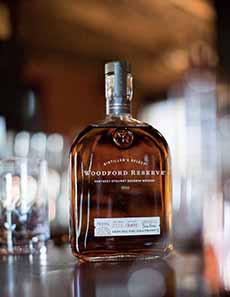
    Woodford Reserve Bourbon Bottle
    [2] A bottle of Woodford Reserve.

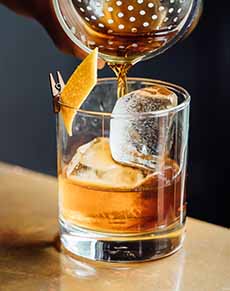
    Old Fashioned Cocktail
    [3] Old Fashioned, one of the top Bourbon cocktails (photo © Adam Jaime | Unsplash).

     
    ________________
     
    *About Vanilla: The term “Bourbon vanilla” refers to a variety of Vanilla planifolia that is only grown on certain islands in the Indian Ocean: Comoros, Madagascar, Mauritius, Mayotte, Reunion Island, and the Seychelles. Other types of vanilla include those grown in Indonesia, Madagascar, Mexico, and Tahiti. Each has a different flavor profile. Vanilla is native to Mexico. Here’s ore about vanilla, including the history of the spice.


    CHECK OUT WHAT’S HAPPENING ON OUR HOME PAGE, THENIBBLE.COM.


    Comments off

    Brigadoon Tea Gift For Leap Year (Leap Day is February 29th)

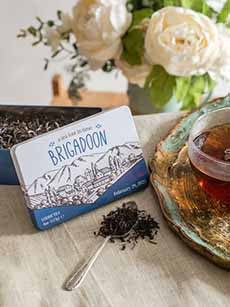
    Gift tin of Brigadoon leap year tea from Adagio Teas
    [1] Brigadoon breakfast tea, available on February 29, 2024 (photos #1 and #2 © Adagio Teas).

    A tin of Brigadoon leap year tea from Adagio Tea
    [2] The charming Brigadoon tea tin is a keeper.

    Brigadoon Movie Poster
    [3] A poster of the 1954 film (image via Wikipedia).


    The elusive Brigadoon Breakfast tea appears only on Leap Day, February 29th—a day that only appears on the calendar every four years (see the origin of Leap year below).

    Named after the mystical Scottish village that comes to life only once every 100 years, on Leap Day, this rare blend of loose teas and cornflower petal, Brigadoon Breakfast, created by Adagio Teas is a lovely gift for a tea connoisseur, and a calorie-free gift.

    Like English Breakfast and Irish Breakfast teas, Brigadoon Breakfast is blended to be enjoyed in the morning (but only avid tea connoisseurs would restrict it to then).

    It brews up with a pleasant malty flavor with a hint of floral notes from the cornflower petals.

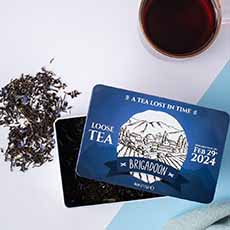
    The tea tin is a keeper that can be repurposed for many years to come. There are illustrations of the mythical town of Brigadoon both on top and underneath the lid.

    Alas, like the village of Brigadoon, the tea can be purchased on one day only: February 29th, 2024. Mark your calendar, and:

    > Head here to get your Brigadoon tea.

    To better understand tea, head to:

    > The different types of tea: a photo glossary.

    > The history of tea. (It’s one of the most popular of our 100 food glossaries.)

    > How to brew tea.
     
     
    BRIGADOON: THE STORY 

    Brigadoon is a wonderful musical and film.

    Written by the lengendary Broadway team of Lerner and Lowe, Brigadoon tells the story of a Scottish village that comes to life only once every 100 years (it’s fiction, of course).

    That’s because in way back 1746, 200 years before the present-day setting of the play [the 1950s], Brigadoon’s minister prayed that his village would disappear into the mist to protect it from a plague of witches.

    > Here’s more about the plot. You can currently stream the film on Paramount+. It stars Gene Kelly, Van Johnson, and Cyd Charisse.

    > Here’s an excerpt from YouTube.
     
     
    THE ORIGIN OF LEAP YEAR 

    In 45 B.C.E., Julius Caesar decreed that every four years, an extra day be added to the calendar.

    This reform created the Julian calendar. Why was the change necessary? The previous Roman calendar, which was based on lunar cycles, had become out of sync with the seasons.

    The observation engendered the change to the Julian calendar.

    All would have been perfect if a solar year were exactly 365¼ days, but it’s actually 365.242 days, not 365.25.

    Over time, those teeny bits added up.

     
    In fact, by 1582 C.E. that slight discrepancy in the Julian calendar added up to 10 days.

    So Pope Gregory XIII (or rather, the lay people doing all the work) created the Gregorian calendar and coined the term “leap year.”

    This proclamation established February 29th as the official date to add to a leap year. Why February? We couldn’t find a reference, but we’re guessing that it was because February is already the shortest month.

    Now, a leap year occurs in every year that is divisible by four—but only in century years that are evenly divided by 400.

    Therefore, 800, 1200 and 2000 were leap years but 1700 and 1900 were not, because even though they are divisible by four, they are not divisible by 400.

    Fortuitously, 2024 passes both requirments and is also a leap year.

    Now: Modern astronomical techniques and measurements have since provided even more precise calculations of the solar year’s duration. But there’s no need to switch to a new calendar!

    Back to the beginning:

  • The discovery that a solar year is approximately 365 days is attributed to early observations of the celestial bodies, particularly the motion of the Earth in its orbit around the sun. Ancient civilizations, such as the Egyptians and Babylonians, were among the first to develop calendars based on their astronomical observations.
  • Why is February only 28 days when all the other months are 30 or 31 days? Well, the months of the calendar were revised during the reign of the legendary second king of Rome, Numa Pompilius (753 B.C.E. – 673 B.C.E.), who succeeded Romulus, the first king. In his reshuffling of the months, it just ended up that way. Here’s more about it.
  •  
     

    CHECK OUT WHAT’S HAPPENING ON OUR HOME PAGE, THENIBBLE.COM.


    Comments off


    © Copyright 2005-2026 Lifestyle Direct, Inc. All rights reserved. All images are copyrighted to their respective owners.