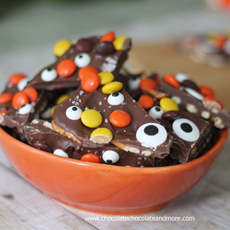
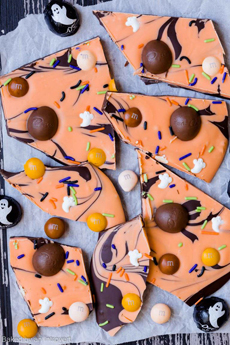
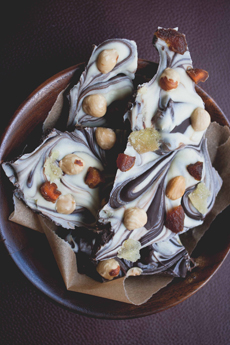
[1] White chocolate bark from Family Fresh Meals. [2] Orange Halloween bark from As The Bunny Hops. [3] The eyes have it—two sizes of eyes on bark from Chocolate Chocolate And More. [4] An elegant approach from Baked By An Introvert.
|
|
Chocolate bark is like a chocolate bar, but vive la différence!
Unlike chocolate bars, bark is not molded into individual rectangles. Instead, the melted chocolate is spread onto large pans to harden. While semi-hard, toppings—nuts, dried fruits, candies and more—are tossed on top in random order.
When set, the bark is broken into shards, like brittle.
Why is it called bark?
HOW BARK GOT ITS NAME
The Word Detective reminds us of the three basic “bark” nouns in English, none of which refers to chocolate:
Tree bark: Our word for the skin of a tree derives from the Old Norse “borkr.” It is first found in print in English around 1300.
Boat: “Bark” refers to a small sailing ship, is also spelled “barque.” It derives from the French, based on the Latin “barca,” and first appears in English in the late 15th century.
Dog’s bark: The sound made by dogs first appeared in print in 1562 as a noun, while the verb “to bark” dates back to Old English*. “Bark” in this sense is supposed to sound like an actual dog’s bark.
Yet, most dictionaries omit the tastiest meaning of bark:
Chocolate: A layer of hard or semi-hard candy into/onto which other confections are embedded.
Why is this type of chocolate confection called bark? Most authorities agree that it’s because the chocolate shards bear a slight resemblance to rough pieces of tree bark.
WHO INVENTED CHOCOLATE BARK?
We don’t know, even though it’s a relatively modern concept.
1500 B.C.E.: The Olmecs begin to cultivate cacao in Central America. The roasted nibs were ground and turned into a drink flavored with local spices, including chile, cinnamon, musk, pepper and vanilla. It was thickened with cornmeal, then frothed in a bowl and served at room temperature—not a food we would recognize today as chocolate (the Spaniards who first tasted it spit it out).
1527 C.E: Cacao beans and equipment to make chocolate were brought to Spain by the returning conquistadors. The pricey chocolate drink was reformulated for European palates by the chefs of the wealthy—the only ones who could afford it.
1847: Solid-form chocolate was invented. Called eating chocolate, it was stone-ground, rough, grainy and chewy, the style that today is called “rustic.” As its popularity grew, confectioners created bonbons, chocolate-covered creams, gianduja, and in 1861, heart-shaped boxes for Valentine’s Day. If you want to experience rustic chocolate, try the Taza brand.
1875: Milk chocolate was invented. Chocolate was still grainy and chewy.
1879: The conch machine was invented. The process called conching heated and rolled the chocolate into a smooth consistency, creating the smooth and creamy chocolate we know today. It melted on the tongue—no chewing required.
TBD: Mendiants, chocolate disks studded with nuts and dried fruits, mimic an ancient recipe that repurposed stale brioche or kougelhopf into a dense bread pudding studded with dried fruits and nuts. It’s a safe bet that chocolate mendicants happened after 1900.
View the entire chocolate timeline chart.
________________
*Old English was the language of the Anglo-Saxons, from the 5th century to the 11th century. It was very different from modern English, a highly inflected language with a largely Germanic vocabulary based on Old Norse from Scandinavia. After the Norman Conquest of England in 1066, Old English was replaced by the French-based Anglo-Norman for the upper classes, and Old English developed into Middle English for everyone else (centuries later, Russia adopted the convention of speaking and writing French at court and in the homes of the upper class). Middle English lasted until the 15th century, when modern English spelling and pronunciation began to codify. Early Modern English was the language in which William Shakespeare wrote.
________________
|
READY TO MAKE BARK?
It couldn’t be easier: Melt the chocolate, throw toppings on it and break it into pieces.
1. PICK YOUR CHOCOLATE
Chocolate bark can be made with any kind of chocolate: dark, milk or white; plain, layered or two-tone swirled. You can also tint white chocolate; for example, to make an orange base or layer.
Some recipes advise you to use chocolate substitutes: almond bark (which is not chocolate with almonds unless you buy it from a good chocolate shop), candy melts, Candiquick or other base made with partly hydrogenated palm kernel oil instead of cocoa butter.
These are not real chocolate but confectionary coating, made with vegetable oil instead of cocoa butter. It’s less expensive, it melts faster, and maybe with all the candy on top, nobody will notice. Right?
For us: wrong. We can really taste the difference. To save money with a treat for young children, who don’t have refined palates and won’t notice, O.K. Anyone else who knows what good food is deserves better.
Almond bark is another commonly found bark, topped with almonds or other nuts. But there’s a catch: Almond bark is also a more appealing name given to vanilla flavored candy coating, a chocolate-like confection made with vegetable fats instead of cocoa butter, with artificial vanilla and possibly other artificial flavors (for example, almond). Be aware, and avoid it!
|
|
2. PICK YOUR HALLOWEEN TOPPINGS
Pile on the seasonal candies:
Candy corn (see if you can find the yellow, orange and purple [instead of white] variety)
Candy Corn M&Ms (orange, yellow, white)
Candy eyeballs (you can mix larger and smaller sizes or different colors)
Chocolate chips: butterscotch, peanut, vanilla
Coarse sea salt (especially red alea salt)
Gummy pumpkins or mini gummy worms
Gold leaf bats
Halloween Oreos (with the orange centers), chopped
Edible Confetti: black cats, ghosts and pumpkins, holiday colors,
Sixlets: orange or yellow
Reeses Pieces (they’re perfect: brown, orange and yellow)
Anything else you find: mini candy bats, jack o’lanterns, skulls, etc.
Save the standard bark toppings—dried fruit, mini-marshmallows, nuts, pretzels, etc.—for non-holiday bark.
3. PUT THEM TOGETHER
RECIPE: HALLOWEEN CHOCOLATE BARK
These ingredients are for an 8″ x 8″ pan. For a larger pan, e.g. 13″ x 17″, use 1 pound of chocolate and double the toppings.
Ingredients
For 1-color chocolate: 3 cups chocolate, chopped (or chocolate chips)
For 2-color chocolate: 2 cups primary color and 1 cup secondary color, each chopped
2-1/2 cups toppings of choice, proportioned as you wish (from list above)
Preparation
1. LINE a baking sheet or pan with parchment paper.
2. PARTIALLY MELT the chocolate in a medium-size microwave-safe bowl, heating at 30-60 second intervals until about half the chocolate is melted. Remove the bowl and stir or whisk until smooth. This process essentially tempers the chocolate.
3. POUR the chocolate onto the parchment paper and spread out slightly, ideally with an offset spatula, to a depth of 1/8″ to 1/4″ thick (bark should be thinner than a chocolate bar). If using a large pan with less chocolate, you do not have to spread the chocolate to the edges. Gently smooth the chocolate into an even layer. If layering or drizzling a second color, the lighter color should be on top. Melt the chocolate after the first layer has been smoothed.
4. SPRINKLE on the toppings and place the baking sheet in the refrigerator until chocolate is set—solid enough to cut, about 20 minutes. Then score the sheet of chocolate, so it’s easier to break into pieces. With a sharp knife, create individual triangles and other shapes of varying sizes. Nothing should be even or uniform: It’s bark!
|
|
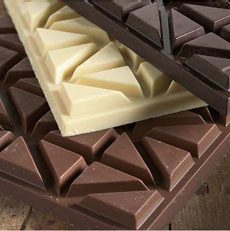
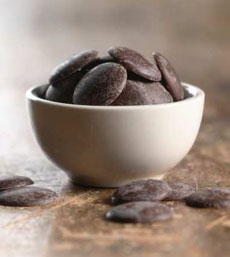
[5] These are not eating bars, but are couverture chocolate—large bars or blocks of two pounds or more, used by professionals. [6] Professionals also use disks of real chocolate to melt and form. Don’t confuse them with candy melts, which are not real chocolate (photos #5 and #6 courtesy King Arthur Flour). [7] Here’s how to make swirled bark from The Road Not Processed.
|
5. USE a large, sharp knife to cut the set chocolate into random pieces: shards, triangles, irregular rectangles, etc. Store in an airtight container.
|
|