THE NIBBLE BLOG: Products, Recipes & Trends In Specialty Foods


Also visit our main website, TheNibble.com.

TOP PICK OF THE WEEK: Gakwiyo Provisions Jams & Jellies

Gakwiyo means “good food” in the Cayuga Indian language. A few years ago the Cayuga Nation, headquartered in Seneca Falls, New York, began an initiative to can and preserve the fruits and vegetables that are grown on its ancestral lands.

Patti Costello, manager of the initiative, explains that her goal was to make popular foods healthier. “There are approximately 500 members of the Cayuga Nation across the United States,” she notes, “and quite a few of them have problems with weight, diabetes and other heath issues.”

Plus, members of the Nation “also love getting products that have been grown on their ancestral lands!”

While they’re not reduced-calorie products per se, the ingredients are excellent. We tasted the samples that Patty sent, and particularly love the conserves, jams and jellies. Be sure to try the “sweet heat”—jams and jellies made with jalapeños.

We’ve already laid in a supply for Mother’s Day party favors.

The products include:

  • Conserves
  • Jams
  • Jellies
  • Pickled Vegetables & Fruit
  • Salsas & Sauces
  • Jams
  •  

    strawberry-jalapeno-jar-230s

    Fruit and jalapeños combine to make exciting jams and jellies. Photo by Elvira Kalviste | THE NIBBLE.


    Everything we tried was delicious; the Green Tomato Raspberry Jam, an old-fashioned standard that is hard to find these days, is a knockout. We were so sad when the last drop was gone; but we can say the same about the Blueberry Rhubarb Jam, Strawberry Jalapeño Jam, and everything else we tried in the jam-jelly group.

    You can see the full line at GakwiyoProvisions.com.


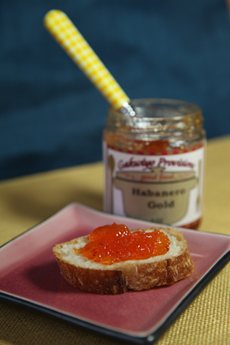
    habanero-gold-bread-2-230
    It’s delicious on everything from bread to ice
    cream. Here, Habanero Gold Jelly. Photo by
    Elvira Kalviste | THE NIBBLE.

      SERVING SUGGESTIONS

    If you need guidance on how to use “hot” jams and jellies, here’s how we enjoy them:

    1. Breads & Crackers. Use them on anything and everything: from toast and bagels to biscuits and muffins to flatbreads and crackers. Hot pairs well with dairy; the jams are terrific with cream cheese.

    2. Breakfast Foods. Dab some on pancakes, waffles and French toast; use as a condiment with eggs or in an omelet; mix into a spicy fruit yogurt.

    3. Sandwiches. Replace your regular jam—including on peanut butter sandwiches.

    4. Hors D’Oeuvres. Top a block of cream cheese or a log of goat cheese and serve with crackers or sliced baguette; top a baked Brie (optional: sprinkle with sliced or chopped toasted almonds).

    5. Savory Sauce Or Marinade. Add to marinade or basting sauce for meats or fish; deglaze the pan by adding jam plus water, stock or wine to make a sweet-and-sizzling sauce.


    6. Meat Or Fish Condiments. The jams are a delicious accent to pretty much any grilled or roast meat, poultry or fish. The first night we tasted them, we enjoyed them with a Certified Angus Beef strip steak, grilled outdoors over coals. Delicious!

    7. Dessert Sauce. Serve over ice cream, sorbet, frozen yogurt, cheesecake, or pound cake (with whipped cream).
     

    Gakwiyo makes some 35 different products, and have recently started to sell them online and at farmers markets and festivals, to a great response.

    Try some and you’ll see why!


    Comments off

    April Fool—It Isn’t Tomato Soup & Grilled Cheese (Orange Pound Cake Recipe)

    We’re cooking up some food fun for tomorrow, April Fool’s Day. This year, it’s trompe-l’oeil food.

    Trompe-l’oeil (pronounced trump LOY), French for “deceive the eye”, is an art technique that creates the optical illusion that a piece of two-dimensional art exists in three dimensions.

    You may have seen some amazing sidewalk art that fools you into thinking you’re about to step into a hole, a pool, etc.

    Here’s one of our favorite trompe l’oeil paintings, of a boy “climbing out of” the picture frame.

    We’re adapting the “deceive the eye” reference to “food trompe-l’oeil”—food that looks like one thing but is actually another. Serve this “grilled cheese and tomato soup” dish, which is actually orange pound cake and strawberry soup.

    Thanks to Zulka Morena sugar for the recipes and fun idea. If you’ve got a great palate or simply prefer less processed sugar, try it. The top-quality sugar is minimally processed and never refined. You can taste the difference!
     
     
    RECIPE #1: ORANGE POUND CAKE

    Ingredients

    For The Pound Cake

  • 1 cup unsalted butter, room temperature
  • 1-1/4 cups sugar
  • 2 tablespoons orange zest
  • 5 large eggs, lightly beaten
  • 2-3/4 cups all-purpose flour
  • 1/4 teaspoon baking soda
  • 1/4 teaspoon sea salt
  • 8 ounces sour cream
  • 2 tablespoons orange juice
  •  
    For the Frosting

  • 1/2 cup butter
  • 2 cups powdered sugar
  • 1 teaspoon orange extract or juice
  • 2-5 drops natural orange food color
  •  
    Preparation

    1. PREHEAT oven to 325°F. Butter and flour a standard loaf pan.

    2. CREAM together in a medium bowl the butter, sugar, and orange zest until fluffy. Add the eggs in 3 parts, combining well after each addition. In a separate small bowl…

    3. COMBINE the flour, baking soda, and salt. Add flour mixture to butter mixture until just combined. Add the sour cream and orange juice and mix well.

    4. POUR into the prepared loaf pan, smoothing the top, and bake for 1 hour or longer, until a toothpick placed in the center comes out clean. If the top starts to brown too much before the cake is done, tent it with a piece of foil.

    5. REMOVE from oven; cool in pan for 10 minutes then remove to wire rack to cool completely.

    6. MIX the frosting ingredients together until well combined. Add more food color as needed to reach the desired color.

    7. ASSEMBLE: Slice the pound cake into 1/2 inch slices. Spread a small amount of butter on one side and grill on a griddle or skillet until toasted looking, being careful not to burn. Let cool completely. Repeat with remaining slices. Once all are cool…

    8. CUT them each in half to make the two halves of each “sandwich.” Spread about a tablespoon of frosting on a non-toasted side of the cake, spreading some to the edges to make it look like melted cheese, and then top with the other half. Repeat with the emaining slices.
     
     
    RECIPE #2: CHILLED STRAWBERRY SOUP

    Ingredients For 6 Servings

  • 2 pounds strawberries, stems removed and hulled
  • 2/3 cup sugar
  • 1/2 cup orange juice
  • 1/2 cup cranberry juice
  • 1-1/2 cups plain or vanilla yogurt
  • Optional: yellow food color
  • Optional garnishes: 1-2 tablespoons heavy cream, fresh basil leaves
  •  
    Preparation

    1. DICE the strawberries, sprinkle the sugar over the top, and let sit for 15 minutes. Combine all the ingredients in a blender and purée until smooth. Let chill completely. If you want the color to be more orange, like tomato soup, add a few drops of yellow food color.

    2. DIVIDE among 6 bowls. Drizzle a little heavy cream over the top and garnish with basil leaves.


    strawberry-soup-orange-pound-cake-zulkasugar-230
    [1] April Fool’s food: Standing in for tomato soup and a grilled cheese sandwich are strawberry soup and pound cake (photo © Zulka Sugar).

    Orange Zest
    [2] Orange zest and juice create a delicious orange pound cake (photo © Eva Elijas | Pexels).

    Types Of Cream
    [3] Sour cream adds richness (photo © Yelena Yemchuk | Panther Media).

    zulka-morena-cane-sugar-2-230
    [4] Zulka makes less processed, better tasting sugar. (photo © Zulka Sugar).

    Pint Of Strawberries
    [5] Turn fresh strawberries into delicious strawberry soup (photo © Good Eggs).


    APRIL FOOL’S DAY HISTORY

    The origin of April Fools’ Day, sometimes called All Fools’ Day, is obscure. The most accepted explanation traces it to 16th century France.

    Until 1564, the Julian calendar, which observed the beginning of the New Year in April, was in use. According to The Oxford Companion to the Year, King Charles IX then declared that France would begin using the Gregorian calendar, which shifted New Year’s Day to January 1st.

    Some people continued to use the Julian Calendar, and were mocked as fools. They were invited to bogus parties, sent on a fool’s errand (looking for things that don’t exist), and other pranks.

    The French call April 1st Poisson d’Avril, or April Fish. French children sometimes tape a picture of a fish on the back of their schoolmates, crying “Poisson d’Avril” when the prank is discovered.

    What a fish has to do with April Fool’s Day is not clear. But in the name of a kinder, gentler world, we propose eliminating this holiday. (Source: Wikipedia)


    CHECK OUT WHAT’S HAPPENING ON OUR HOME PAGE, THENIBBLE.COM.


    Comments off

    TIP OF THE DAY: Frisée Salad With Lardons (Salade Frisée Aux Lardons)

    One of our favorite salad greens, not served often enough in the U.S., is frisée (free-ZAY), curly endive that’s a member of the chicory family. In France, it is formally known as chicorée frisée. (See the different types of endive.)

    There are many ways to serve a salade frisée, but a universal favorite is frisée aux lardons, Lyonnaise-style frisée salad.

    This salad tops the frisée with a poached egg and lardons—crisp, browned chunks of pork belly—and a sherry vinaigrette. When you cut into it, the runny egg yolk gives the salad a wonderful, silky coat.

    Another favorite variation includes crumbled Roquefort cheese or goat cheese with a fan-sliced pear and a few toasted walnut halves. It’s a great flavor layering of bitter from the frisée, salty and smoky from the lardons, sweet from the fruit and tangy vinaigrette.

    You can serve salade frisée as a light lunch with crusty rustic bread, as a first course, or with soup for a light dinner.


    frisee-burrata-ilmulinoNY-FB-230
    An Italian touch: burrata cheese. Photo
    courtesy Il Mulino Restaurant | NYC.

     
    GETTING CREATIVE WITH FRISÉE

    You can create your own signature frisée salad by adding some of these mix-and-match ingredients:

    Fruits, Nuts, Vegetables

  • Apple or pear, red skinned, fan-sliced
  • Arugula or watercress
  • Avocado (pair it with grapefruit)
  • Citrus: grapefruit, orange, blood orange or mandarin
  • Dried fruit: cherries, cranberries, currants
  • Figs (combine with prosciutto)
  • Fresh herbs: chives, tarragon, thyme, parsley
  • Nuts, toasted: pecans, pistachios, walnuts
  • Red accent: diced red pepper, tomato or watermelon; halved grape tomatoes; pomegrante arils
  •  

    frisee-salad-michaelminaFB-230
    Chef Michael Mina varies the frisée salad by
    substituting a Scotch egg for the traditional
    poached egg. Photo courtesy Michael Mina.


    Proteins

  • Bacon, pork belly lardons, pancetta, prosciutto, slab bacon lardons
  • Cheese: burrata, fried cheese (recipe), goat cheese, Parmigiano-Reggiano, Roquefort or other blue cheese
  • Chicken or duck breast, sliced
  • Cracklings & sautéed liver: chicken or duck
  • Egg, poached (hen or quail)
  • Fish or seafood: crab, lobster, scallops, shrimp
  •  
    You can also add a touch of the sea with this side of white anchovy bruschetta.
     
    Dressings

    You can use a classic vinaigrette or a Dijon vinaigrette, but consider these special variations:

  • Bacon vinaigrette (recipe)
  • Sherry or red wine vinaigrette with olive oil
  • Truffle vinaigrette, with truffle oil
  • Walnut vinaigrette, with walnut oil
  •  
    For another special touch, warm the vinaigrette in the microwave right before dressing the salad.

    WHAT IS FRISÉE

    Frisée is a salad green with distinctive pale, very narrow, curly leaves that grow in a bush-like cluster and are feathery in appearance. The name means “curly.”

    Frisée is often included in mesclun and other salad mixes. It is extremely labor-intensive to grow, and therefore one of the costliest salad ingredients.

    For that reason, it isn’t a conventional supermarket item, but can be found at upscale markets and purveyors of fine produce.

    Frisée has a distinctive flavor and a delightful bitterness—less bitter than its cousins endive and radicchio. Its exotic feathery appearance has great eye appeal. Tips for using it:

  • As with many salad greens, tear it rather cut it with a knife, or the edges may brown. Tear it shortly before use.
  • The tough, external leaves are best used as a plate garnish or fed to the gerbil.
  • Dress the salad right before bringing it to the table, so that it doesn’t discolor or become waterlogged.
  •  
    The chicory genus is rich in fiber, vitamins and minerals, especially folate and vitamins A and K.
      

    Comments off

    The Difference Between Kefir & Buttermilk

    “Kefir tastes like buttermilk,” writes a reader. “What’s the difference?

    Both are cultured beverages—meaning that probiotic bacteria cultures are added to ferment fresh milk. But the “recipes” differ significantly. For starters, kefir may contain a dozen or more different bacterial strains and yeast cultures; buttermilk typically contains only one probiotic strain: lactic acid bacteria.

    Kefir (kuh-FEAR, not KEE-fur) is fermented from whole milk using special kefir grains (more about them in a minute). Buttermilk, more formally called cultured buttermilk, is made by fermenting skim milk with lactic acid bacteria, Streptococcus lactis.

    The probiotics enable both beverages to be digested more easily than milk. Both beverages have a yogurt-like tang.

    Modern kefir is made in the original (plain) plus fruit flavors, to capitalize on the popularity of yogurt, and some people think that kefir is “drinkable yogurt.” But the kefir grains and a different fermentation process make it a different recipe from yogurt.

    Both can be drunk straight and used instead of milk or buttermilk in cooking and baking. Some popular uses:

  • To tenderize meat
  • As a leavening agent
  • To make ice cream
  • In smoothies and shakes
  • On cereal
  • As a sourdough starter
  • In salad dressings and sauces
  •  

    buttermilk-cartons-230

    [1] Buttermilk, a staple in great-grandma’s kitchen. If you need just a cup, see the footnote below for how to make it from whole milk (photo © Wisconsin Milk Marketing Board).

     
    Kefir and buttermilk have almost the same number of calories. An eight-ounce serving of kefir has 162 calories, while buttermilk has 150 calories.


    evolve-flavors-emilychang-230
    [2] Kefir is available in flavors that make it resemble “drinkable yogurt” (photo © Emily Chang | THE NIBBLE.
     

    MAKING KEFIR & BUTTERMILK

    Cultured buttermilk. Before universal pasteurization, butter was made by letting whole milk stand to allow the cream to separate, rising to the surface; the cream would be skimmed off, leaving “skim milk” below. Natural fermentation would occur, souring the milk slightly.

    Today, nonfat (skim) milk is acidified with lactic acid bacteria, which add tartness and cause the formation of more protein. This is why buttermilk is thicker than ordinary milk, and why modern buttermilk, made with added cultures, is called cultured buttermilk.

    Kefir. Kefir is made with kefir grains—colonies of bacteria, yeast, proteins and sugars that resemble tiny buds of cauliflower—that ferment the milk. These granules of active cultures are strained from the fermented milk before it is bottled. Here’s more on how kefir is made, and a photo of the grains.

    Homemade kefir continues to ferment as it ages. It’s a bit effervescent (bubbly) from the fermentation, where the cultures consume the sugars in the milk and release carbon dioxide. Commercial kefir cuts back on the effervescence.

    You can make both kefir and buttermilk at home; but as with many foods, it’s much more convenient to simply buy a bottle or carton. If you want to try your hand at it, here’s a resource.

     
    HEALTH BENEFITS

    Drinking buttermilk and kefir can be beneficial to one’s health. The bacteria aid in the digestion of food, and consistent consumption can help to resolve certain intestinal conditions.

    Some sources claim that the regular intake of either drink can reduce the risk of colon cancer.

    But if you like yogurt in general, and haven’t enjoyed a glass of buttermilk or kefir, pick up one of each and taste them side by side.

    And if you’re not going to drink all of it or whip up some smoothies, definitely bake or cook with it.

    ________________

    *How to make buttermilk. You don’t have to buy a quart of buttermilk when you need a cup or less. You can make 1 cup of buttermilk by adding 2 tablespoons of fresh lemon juice or vinegar to a one-cup measure, plus enough milk to make 1 cup. Stir and let sit. For 1/2 cup, halve the recipe.


    Comments off

    TIP OF THE DAY: Pillow Pasta

    Butternut-Squash-Ravioli-pom-wonderful-230
    Butternut squash ravioli. Photo courtesy Pom
    Wonderful. Here’s the recipe.
      When studying culinary history, you learn lots of fun food facts. For example, in the history of pasta, Marco Polo may have brought pasta back from China—but it wasn’t spaghetti or other “long cut” pasta, and it wasn’t “short cut” pasta like farfalle (bowties) or penne.

    Credit for the spread of boiled pasta in the West is given to Arabs traders who packed dried spaghetti-type pasta on long journeys over the famed “Silk Road” to China. It was easy to reconstitute into a hot meal along desolate trails. They brought it to Sicily during the Arab invasions of the 8th century and planted the seeds of an Italian culinary breakthrough.

    There are records of pasta in Italy before Marco Polo returned from the Far East (he set out in 1271 and returned in 1295). In 1279, in his last will and testament, a Genoan soldier named Ponzio Baestone bequeathed “bariscella peina de macarone,” a small basket of macaroni.

    So what part did Marco Polo play? The record is so scant, we’ll never know; but it is conjectured that he brought back “pillow pasta”—boiled dumplings that evolved into agnolotti and ravioli.

     
    Polo returned from the Far East at the very end of the 13th century. The earliest mention of ravioli appears in the writings of Francesco di Marco, a merchant of Prato in the 14th century, and other 14th century mentions follow. (Source: Wikipedia)

    Here’s a brief history of pasta.

    TYPES OF PILLOW PASTA

    Pillow pasta is stuffed pasta, but not all stuffed pasta is pillow pasta. The other sub-category includes the large tubes that are stuffed and baked, like manicotti. (Other tube pasta, such as penne, rigatoni and ziti, are too small to be stuffed but are covered with heavier sauces, which are meant to catch in the hollows of the tubes.)

    Pillow pasta comprises fresh pasta sheets stuffed with a filling. The filling is placed on the flat sheet of pasta, another sheet is placed on top, the shapes are cut and the edges are sealed.

  • The pasta can be stuffed with almost any kind of filling, either single or combinations of different meats, cheeses, vegetables, seafood and herbs.
  • They can be sauced, tossed with butter or olive oil, or added plain to soups.
  •  
    How many of these pillow pastas have you had?


    Agnolotti: Small stuffed pasta in the shape of a half moon, similar to mezzalune and pierogi. The term is Italian for “priests’ caps.” Photo.

    Cannelloni: Rectangular sheets of pasta dough that are filled and rolled into tube shapes. The name is Italian for “large reeds.” They can easily be confused with manicotti, which are pre-formed tubes that are stuffed (the word comes from the Italian word manica, sleeve).

    Gnocchi: These oval bites are technically dumplings, and do not have a noodle wrap. But because they’re pillowy bites we want to include them on this list. Gnocchi can be made of semolina or potatoes with cheese or eggs added to the dough. They can be flavored with basil, saffron, spinach or tomato, then boiled, baked or even fried.

    Mezzalune: Literally “half moons,” a crescent-shaped stuffed pasta.

    Ravioli: The original “pillow pasta” can be oval, rectangular, round, square, sunflower-shaped (called girasole) and triangular (called pansotti). There are also specialty shapes, from fish to hearts. The name is a diminutive of rava, little turnip, which may or may not have been an early stuffing.

    Raviolini: Miniature ravioli. They can be served as a pasta dish, hors d’oeuvres or put into soup, like won tons.

    Ravioloni: Very large ravioli. They can be as large as three-inch circles and four inch squares or rectangles. In this photo, you can see that the piece at the right is almost as long as the fork.

      sauce-ravioli-2-230
    Giovanni Rana’s tasty ravioli and sauces. Photo by Elvira Kalviste | THE NIBBLE.
     
    Sacchette: Sacks, or “beggar’s purses.” (More)

    Tortellini: Thin strips of raw filled pasta pinched to form a navel-like shape. A popular dish with sauce, it is also served in soups, as in the classic dish, tortellini in brodo. We serve them as cocktail party appetizers with a dip. More.
     
    GIOVANNI RANA PASTA

    We recently celebrated March 20th, National Ravioli Day by pigging out on a huge supply of Giovanni Rana pasta, along with another fresh pasta brand.

    Hands down, Giovanni Rana was the winner. The venerable Italian artisan producer—who now makes most of the products for the U.S. market here—uses ingredients that are top-knotch; you can taste the difference. We were sent four of the seven varieties ravioli: Artichoke, Cheese “Delicato,” Cheese “Forte” and Spinaci e Ricotta, plus four sauces.

    The other flavors including Caprese (basil and mozzarella), Chicken Rosemary and Mushroom. We’ll be seeking them out. (The company also makes tortellini, long cut pasta and gnocchi.)

    The ravioli, sold fresh in bags, cook up in two minutes—it takes longer to heat the sauce! The sauces are very dense; a little goes a long way.

    Ravioli Vs. Tortellini: A Revelation

    After tasting the prosciutto tortellini at the same time as the ravioli, we’ll probably never buy tortellini again.

    With all due respect to this popular dish and the quality of Giovanni Rana’s product, we had a revelation: It’s too much pasta and not enough filling. Since one eats pillow pasta for the filling, there’s too little of it in tortellini to deliver on expectations.

    Check out all of the delicious pastas at GiovanniRana.com.

    If you’re in New York City, head to Chelsea Market, where Giovanni Rana has a restaurant (cucina) and fresh pasta shop (pastificio).


    Comments off

    The Nibble Webzine Of Food Adventures
    RSS
    Follow by Email


    © Copyright 2005-2026 Lifestyle Direct, Inc. All rights reserved. All images are copyrighted to their respective owners.