THE NIBBLE BLOG: Products, Recipes & Trends In Specialty Foods


Also visit our main website, TheNibble.com.

TIP OF THE DAY: Crown The Best Croissant…Or Anything Else

We’ll get to today’s tip in a minute or so. But here’s what inspired it.

Frenchly.us is a website for Francophiles in the U.S. that covers news, arts, culture, style and all things French.

Which includes food.

In the past, the website sponsored a Best Baguette competition in different cities, naming some 15 finalists from the best in bakeries the city. Buy a ticket, and taste them all in one place.

This year it was the Best Croissant competition, which we attended recently. If you’re a croissant lover, imagine being in a venue with the city’s 15 best croissant bakers, who bid you to sample as much as you’d like.

More than 700 eager eaters went from station to station in a Manhattan location, eating as much as they desired. How many croissants do you think you can eat?

We’d be stuffed at two…although we calculated that if we only ate two bites of 15 croissants, that would be about three croissants.

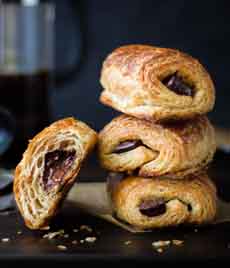
But the bakeries brought more than classic croissants. They brought almond croissants, chocolate croissants (pain au chocolat), specialty flavors like pistachio, along with muffins, fruit breads and rustic loaves.

Plus unlimited coffee, tea, jam, butter, and other French delights like pâté.

What’s a taster to do?

For one thing, don’t order the optional brunch. You won’t have room to sample the cornucopia of croissants.

The competing bakeries are shown in image #2.

While every bakery’s products were of the highest quality, participants were asked to vote for their favorites.

And the winners are…

  • Grand Prix Best Croissant: Financier Patisserie
  • Best Chocolate Croissant: Maison Kayser
  • Fan Prix (Public): Choc ‘o’ Pain
  •  
     
    PARTY IDEA!

    Coordinate your own Best Croissant competition. Ask friends and family to bring the best from their neighborhoods.

    You can do this with any food, from eclairs to chicken wings. Our friend Cricket has an annual Super Bowl event where everyone brings their favorite wings for a wing-off.

      Croissants & Coffee
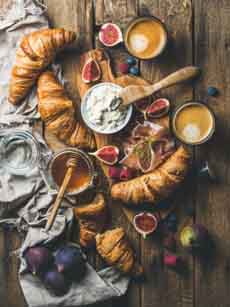
    [1] How many croissants do you think you can eat…in under 3 hours?

    Best Croissants
    [2] The 15 finalists in the 2018 Best Croissant competition.

     
    CROISSANT HISTORY

    Croissants are breakfast breads, traditionally a breakfast bread served with jam and butter, and coffee.

    Variations include the almond croissant, filled with frangipane and topped with sliced almonds, and the “chocolate croissant,” correctly called pain au chocolat, baked with a piece of dark chocolate in the center.

    There are also pretzel croissants, which adapt German soft pretzel dough into the crescent shape.

    The rich, buttery, crescent-shaped rolls are made of puff pastry. Puff pastry layers yeast dough with alternate layers of butter, a process known as laminating.

    Stories that the roll was made in the shape of the crescent of the Turkish flag, after the defeat of the Turks in the Siege of Vienna in 1683, are a perpetuated myth.

  • Recipes for croissants do not appear in recipe books until the early 1900s, according to the Oxford Companion To Food. The earliest French reference is in 1853.
  • There is an Austrian connection, however: The croissant is descendant of the Austrian kipfel, a crescent roll that was brought to Paris in 1938 or 1939 by August Zang, an Austrian military officer.
  • The kipfel was ultimately ported into puff pastry by the French, where it achieved immortality as the croissant. (You can read this history in Jim Chevallier’s book, August Zang and the French Croissant: How Viennoiserie Came To France [Kindle edition].
  • In the early 1970s, croissants became sandwich substitutes as they evolved from their two traditional fillings, chocolate and almond paste, into many savory variations, from broccoli to ham and cheese, as well as additional sweet varieties.
  •   

    Comments off

    FOOD 101: Chile Or Chili or Chilli or…Pepper?

    Assorted Chiles
    [1] Assorted chiles that are popular in U.S. kitchens (photo courtesy Melissa’s).

    Cayenne Chiles
    [2] Cayenne chiles (photo courtesy Good Eggs).

      Wild chiles have been a part of the diet in the Americas since about 7500 B.C.E.

    While the first chile may have been domesticated in Bolivia, the oldest known traces of have been found in bowls in Ecuador, dating back 6,100 years*.

    Chiles were carried to different parts of Latin America, where soil, climate and cross breeding created many different species. Today there are six species of chiles in the genus Capsicum.

    But how did we get so many different spellings for the chile? And why are chiles called peppers?

  • Chilli: The original word in Nahuatl, the language of the Aztecs, is “chilli,” the spelling that is used in the U.K. and its former colonies.
  • Chile is the spelling used by the Spanish, the first Europeans to taste them, who adapted the spoken word to their spelling conventions. They first brought chiles to Europe in the mid-1500s.
  • Chile is used in the U.S. to describe any hot Capsicum.
  • Bell pepper: The mildest member of the genus became known as bell pepper in the U.S. (because of its shape), but is called capsicum in the U.K.
  • Chile pepper is a misnomer that has stuck, unfortunately, thanks to Christopher Columbus. Upon first tasting chiles in the Caribbean, he equated them to the only other spicy hot food he knew: black pepper, which had been available in Europe since Roman times.
  • Black pepper (Piper nigrum) and chiles (Capsicum) are not related in any way. See the details below.
  • Chili powder, a mixture of ground chiles and other ingredients cumin, garlic powder, onion powder, oregano), is a spelling common among American spice manufacturers.
  •  
    And by the way:

    Chiles are a fruit, not a vegetable. Here’s the difference between fruits and vegetables.

     
    SO WHAT SHOULD YOU CALL THEM?

    But Columbus’ name stuck, but it isn’t correct. Our suggestion is to simply call hot chiles—ancho, jalapeño, habanero, serrano, etc.—chiles.
     
    If you live in the U.S. (we can’t address other countries):

  • For the fruits: chile. (In New Mexico, a big chile state, this official spelling was entered into the 1983 Congressional Record [source]).
  • For the ground spice and the Tex-Mex dish it’s used in: chili.
  • As for chilie and chilly: Don’t even go there!
  •  
    MORE

  • The History Of Chiles
  • The Scoville Scale, classifying chiles by hotness
  • The Different Types Of Chiles
  • _____________________
    *Science magazine, February 16, 2007.

    †Taxonomy includes Kingdom, Subkingdom, Infrakingdom, Superdivision, Division, Subdivision, Class, Superorder, Order, Family, Genus, Species. The simplified list is Kingdom, Division, Class, Order, Family, Genus, Species. Black pepper (Piper nigrum genus and species) and chiles (Capsicum genus, 6 different species), are not related at all, although both are in the plant kingdom.


    IS BLACK PEPPER RELATED TO CHILES IN ANY WAY? NO!

    Their only relationship is that they are both members of the plant family in the official taxonomy.

    Taxonomy is the branch of science concerned with classification of organisms plants and animals.

    PIPER NIGRUM

    Kingdom Plantae Plants
    Subkingdom Viridiplantae
    Infrakingdom Streptophyta – land plants
    Superdivision Embryophyta
    Division Tracheophyta – vascular plants, tracheophytes
    Subdivision Spermatophytina spermatophytes, seed plants
    Class Magnoliopsida
    Superorder Magnolianae
    Order Piperales
    Family Piperaceae – peppers
    Genus Piper L. – pepper
    Species Piper nigrum L. – black pepper

    [Source]

    CAPSICUM

    Kingdom Plantae – Plants
    Subkingdom Tracheobionta – Vascular plants
    Superdivision Spermatophyta – Seed plants
    Division Magnoliophyta – Flowering plants
    Class Magnoliopsida – Dicotyledons
    Subclass Asteridae
    Order Solanales
    Family Solanaceae – Potato family
    Genus Capsicum
    Species Capsicum annuum
    Species Capsicum baccatum
    Species Capsicum chinense
    Species Capsicum frutescens
    Species Capsicum pubescens
    Species Capsicum praetermissum

    [Source]

      Jalapeno & Habanero Chiles
    [3] Jalapenos, habaneros and a glimpse of red bell peppers. The pink peppercorns shown in the photo are not related to Piper nigrum, nor to Capsicum. They’re berries from the Baies Rose Plant (Genus and species Schinus molle, Family Anacardiaceae), a small mastic tree related to the rose bush, from the French Island of Reunion in the Indian Ocean. Green peppercorns are immature black Piper nigrum peppercorns, picked while unripe.

    Red & Green Bell Peppers
    [4] Bell peppers, the non-spicy chile.


    Comments off

    RECIPE: Pistachio-Chocolate Muffins For St. Patrick’s Day

    Pistachio Muffins
    [1] The chocolate remains hidden until you dig into the muffin (photo courtesy Agnese Italian Recipes.

    Pistachio Flour
    [2] You can buy pistachio flour or grind your own from pistachio nuts. See the technique below (photo courtesy Gourmet Food World).

    Green Foil Muffin Liners
    [3] For more festiveness, look for green foil muffin/cupcake liners (photo courtesy Fox Run).


    February 26th is National Pistachio Day: a perfect day to bake something with pistachio nuts.

    We love the concept of pistachio “surprise” muffins: The surprise is the melted chocolate center.

    A lesser surprise is that they’re sweet enough to be served as dessert; in which case you can call them cupcakes and serve them with ice cream or whipped cream.

  • The difference between a muffin and a cupcake is largely the level of sweetness and the denseness of the crumb.
  • Some muffins are savory, made without any sugar; for example, cheddar-jalapeño muffins.
  •  
    This recipe was adapted from an Italian recipe blog, Agnese Italian Recipes. Here’s Agnese’s original recipe.

    Jumping from Italy to Ireland:

    St. Patrick’s Day is in less than three weeks: Another occasion to make these tasty green muffins.

    Use green food coloring to make the batter as green as you like.
     
     
    RECIPE: PISTACHIO MUFFINS WITH CHOCOLATE CENTER

    Ingredients 12 Muffins

  • 5/8 cup flour (1/2 cup plus 2 tablespoons, or 8.8 ounces)
  • 1/2 cup sugar
  • 7 tablespoons oil
  • 1 egg
  • 1 cup plain yogurt (full fat)
  • 2 teaspoons baking powder
  • 12 squares of Baker’s Semisweet Chocolate, or 12 ounces chocolate of choice*
  • 7 tablespoons milk or cream
  • 2 tablespoons instant coffee
  • 2 tablespoons pistachio flour (grind your own†)
  • Pinch salt
  • Pinch baking soda
  • Optional: green food coloring
  •  
    Preparation

    1. PREHEAT the oven to 350°F. Prepare the muffin tins: Line the wells with paper or foil liners.

    2. WHISK together the flour, sugar, baking powder, salt, baking soda. In a separate bowl, whisk together the yogurt, egg, oil and milk. Add the dry mixture into the wet, and blend with a wooden spoon.

    3. ADD the coffee and the pistachio flour, and the optional food color. Divide the mixture into 2 bowls.

    4. ADD a heaping spoonful of the batter into each muffin cup. Next, place a square of chocolate in the center of the cup, and top with another spoonful of batter. The muffin cups should be 2/3 full.

    5. BAKE for 20-25 minutes or until a toothpick comes out dry.


    MAKE PISTACHIO FLOUR FROM PISTACHIO NUTS

    What You Need

  • Shelled, unsalted pistachio nuts
  • Food processor or spice grinder
  • Sieve or sifter
  •  
    Preparation

    1. PLACE the nuts in the food processor and pulse until they are a flour-like consistency. Don’t over-pulse or they will turn into pistachio butter.

    2. ADD the ground nuts to a sieve and sift them into a bowl. Re-pulse pieces that are too large to fit through the sieve and repeat as necessary.

    You can store the flour for one month in the fridge or several months in the freezer. Don’t keep it at room temperature: The oil in the nuts can become rancid.

    ________________

    *Each Baker’s Chocolate package has 8 one-ounce squares. You can also use squares from 3.5-ounce chocolate bars, which are better-tasting chocolate. You’ll need 3-1/2 large chocolate bars.

    †Pistachio flour is expensive. Since you need only a small amount, it may make sense to grind your own from whole pistachios (or pieces).


    Comments off


    © Copyright 2005-2026 Lifestyle Direct, Inc. All rights reserved. All images are copyrighted to their respective owners.