THE NIBBLE BLOG: Products, Recipes & Trends In Specialty Foods


Also visit our main website, TheNibble.com.

RECIPE: Corn & Zucchini Omelet

Corn & Zucchini Omelet
[1] A delicious oven-baked omelet, for brunch, lunch or dinner (photo courtesy Fruit & Veggies More Matters).

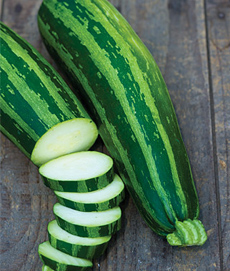
Zebra Zucchini
[2] An heirloom variety, tiger zucchini. It tastes like supermarket zucchini, but is nicer to look at—especially raw, in crudités or salads. You can get the seeds from Burpee.


Serve this omelet for brunch, lunch or dinner with a side salad.

The recipe was sent to us by Fruit & Veggies More Matters, the consumer website of the Better Health Foundation. We made it last night, and look forward to a repeat appearance soon.

You don’t have to be a skilled omelet-flipper: This omelet is baked in a pan in the oven. In our book, that’s a bonus.

 
RECIPE: CORN & ZUCCHINI OMELET

Ingredients For 2 Servings*

  • 1 tablespoon butter
  • 1 medium sweet yellow onion, diced
  • 3 cups thinly sliced zucchini
  • 1 can (15 ounces) whole kernel corn, drained†
  • 4 eggs, beaten
  • 1/2 cup shredded Monterey Jack cheese (substitute any shreddable cheese of choice; we used Gruyère and next time will try Jalapeño Cheddar)
  • 1/2 cup shredded mozzarella cheese
  • 2 teaspoons dried oregano
  • 2 teaspoons fresh basil, chopped, or 1 teaspoon dried basil
  • 1 teaspoon chili powder
  • 1/2 teaspoon salt
  • 1/2 teaspoon cracked black pepper
  •  
    As an option, you can add a half cup of diced ham or sausage.

    Preparation

    1. PREHEAT the oven to 375°F. Melt the butter in a large skillet over medium-high heat. Add the onion and zucchini; sauté for 5-7 minutes.

    2. STIR in the corn and continue to cook until the zucchini is fully softened, around 2 minutes more‡. Remove from the heat and drain the excess liquid. Let cool.

     
    3. WHISK the eggs in a large bowl, then then stir in the cheeses and seasonings. Gently fold the cooled vegetables into the egg and cheese mixture.

    4. LINE an 8-inch pie pan with parchment paper and transfer the mixture to pan, arranging the top so the zucchini slices lay in single, flat layer. Cover with foil and bake for 25 minutes.

    5. REMOVE the foil and bake for an additional 10 minutes until top is browned. Let stand for 10-15 minutes before cutting into wedges.

    _________

    *We like a larger portion for dinner, so we created a 6-egg omelet for two.

    †Save the corn liquid and drink it: It’s delicious.

    ‡We don’t like very soft zucchini, even in an omelet. Since the omelet will be baked for 10 minutes, we omitted this instruction.
      

    Comments off

    TIP OF THE DAY: Building Up Canned Soup

    Soups from the can, even when they’re good, can be made even better with a few added ingredients.

    In this tip, we’ll show you how we enhanced one of our favorites, and inspire you to do the same.

    We adore Thai chicken coconut soup (tom kha gai, translated as chicken galangal soup—photo #1).

    It’s a hot and sour soup flavored with classic Thai ingredients: basil, chile paste, cilantro, coconut milk, fish sauce, galangal* (photo #3), kaffir lime leaves, lemongrass, lime juice, straw mushrooms (or shiitake) and Thai chiles, plus chicken.

    It’s made creamy with coconut milk, and crispy fried chiles are sometimes added for garnish.

    We’ve been getting take-out from our neighborhood Thai restaurant, but at a base of $7 for a small bowl—plus extra for proteins like chicken or shrimp—it gets pricey.

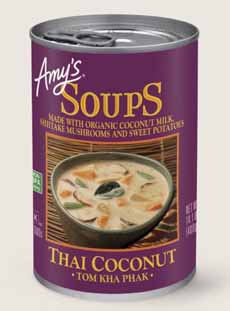
    So, we searched around, and found cans of Amy’s Thai Coconut Soup. It isn’t as chock-full and rich as the restaurant version, but we adapted a recipe from Amy’s Kitchen.

    Add some extra veggies, fresh herbs and protein, and serve with jasmine rice to make a complete meal.

    Since most of us don’t live near an Asian grocer, this recipe with easy-to-find ingredients.
     
     
    RECIPE: THAI COCONUT SOUP, TOM KHA GAI

    Ingredients

  • 3 cans Amy’s Organic Thai Coconut Soup (photo #2)
  • Juice of ½ fresh lime
  • 1 cup organic tofu, cubed (substitute or add chicken or shrimp—see note)
  • 2 tbsp tamari or low-sodium soy sauce
  • ½ cup fresh basil leaves, torn
  • 8 sprigs fresh cilantro, cleaned and chopped
  • 5 shiitake or white mushrooms, sliced (straw mushrooms if you can find them)
  • ½ cup cherry tomatoes, halved
  • 1 cup organic jasmine rice, cooked
  • Optional: 1/2 cup full cream coconut milk (for creaminess—photo #4)
  • Optional: 1 Thai chile (or substitute), finely sliced
  • Garnish: cilantro, finely sliced red chile, fried chiles
  •  
    NOTE: While tofu adds protein to the soup, we like to add more flavorful protein such as chicken or shrimp (scallops, mussels and fish fillets work, too). You can add a little or a lot, including a “mixed grill” of proteins, as you prefer.
     
    Preparation

    1. POUR the soup into a medium saucepan. Add the lime juice and mushrooms.

    2. WARM the soup over medium heat for 20 minutes, reducing the broth to concentrate the flavors. While the soup is warming…

    3. PLACE the tofu and tamari in a small, shallow bowl and toss well. Marinate for 10 minutes. Add the tofu, basil, cilantro, tomatoes and optional coconut milk to the soup.

    4. SERVE immediately with a side of rice.
     
     
    YOUR HOMEWORK

    Take one of your favorite soups and build on it, as we’ve done here. You can add:

  • Additional vegetables, herbs and spices
  • Proteins of choice, including leftovers and sausage
  • Diary for creaminess
  • Heat
  •   Thai Coconut Soup
    [1] This “loaded” bowl of Thai coconut soup added half of the ingredients to a can of soup.

    Amy's Thai Coconut Soup
    [2] It starts with this can of soup (both photos courtesy Amy’s Kitchen).

    Galangal
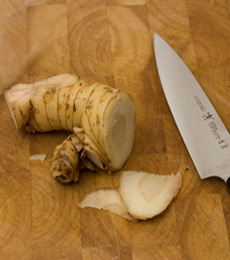
    [3] Galangal, looking similar to its cousin, ginger (photo Wikipedia).

    Thai Kitchen Coconut Milk
    [4] Add unsweetened whole coconut milk for extra creaminess (photo courtesy Thai Kitchen).

     
    *WHAT IS GALANGAL

    Galangal is a rhizome, an underground shoot that is a member of the ginger family (along with turmeric and cardamom). It’s popular in Thai, Indonesian and Malaysian cooking.

    Galangal has an earthy, citrusy, almost piney flavor. It is much stronger than ginger, which is pungent and spicy, with a hint of sweetness.

    Galangal is also known as Thai ginger or Siamese ginger, because it resembles ginger root (photo #3). The skin is smoother and lighter than ginger and the flesh is much harder (so it can’t be grated like ginger).
     
     
    THE DIFFERENT TOM (SOUPS)

    The soups you’re most likely to find at Thai restaurants in the U.S. are:

  • Tom yum is a hot and sour soup, a broth made with with fragrant spices and herbs.
  • Tom kha gai or kai is a spicy and sour hot soup with a coconut milk broth.
  • Tom kha phak is similar to tom kha gai, with the addition of sweet potatoes and green beans.
  •  
    There are many other Thai soups, of course. Scroll down here to see some of them.


    Comments off

    TIP OF THE DAY: Romaine & Other Food Recalls

    Caesar Salad
    [1] The most popular romaine dish: Caesar salad (photo courtesy Safe Eggs).

    Organic Romaine
    [2] Even organic romaine isn’t immune to E. coli. See why below (photo courtesy Good Eggs).


    Recently, Santa Barbara County recalled romaine harvested between November 27th through 30th due to an E. coli outbreak.

    Almost instantly, every leaf of romaine disappeared [hopefully] from store shelves and restaurant menus.

    The public was warned not to purchase or consume romaine lettuce if its growing locale was unknown.

    Into the bin went whole heads, hearts of romaine, and bags of pre-cut lettuce and salad mixes that contain romaine, including baby romaine, spring mix and Caesar salad.

    Further instructions were to wash and sanitize drawers or shelves in refrigerators where romaine was stored. (Here’s how to clean your fridge after a food recall.)
     
     
    WHAT IS E. COLI?

    E. coli (Escherichia coli) are bacteria that live in the intestines of healthy humans and animals. Most varieties are harmless or cause relatively brief diarrhea.

    There are some particularly harmful strains that can cause severe abdominal cramps, bloody diarrhea and vomiting.

    People may be exposed to E. coli from contaminated water or food. Raw vegetables and undercooked ground beef are two of the most impacted foods.

    Healthy adults usually recover from E. coli within a week, but young children and older adults have a greater risk of developing a life-threatening form of kidney failure called hemolytic uremic syndrome.
     
     
    HOW DO PRODUCE & BEEF GET E. COLI?

    Produce and water get E. coli from manure; most typically, from dairy cow manure.

    That’s because in some agricultural areas, dairy farms exist in the same region as produce fields.

     
    E. coli in the manure sinks into the water tables, or blows from dry manure into the growing fields.

    The November outbreak occurred in three identified counties of the Central Coastal growing regions of northern and central California.

    Romaine grown elsewhere was not affected. “Safe” romaine includes the desert growing region near Yuma, Arizona; the California desert growing region near Imperial County and Riverside County; the state of Florida; and Mexico.

    For beef, the problem occurs in the processing plant. Microscopic amounts of E. coli from the intestines of cattle carcasses can come into contact with beef that is then ground.

    When beef is cooked, the heat kills any bacteria on the outsides of the meat. Ground beef is different, in that it has many interior surfaces that may have had exposure to bacteria, but are not exposed to the flame that kills any E. coli.

    That’s we are urged to cook ground beef to medium. It’s also why we should use separate cutting boards and utensils for raw beef and other meats.

    Note: Don’t rinse off meat prior to cooking. It just spreads bacteria over the sink and anything in the sink.
     
     
    HOW TO PROTECT YOURSELF

    We had consumed a romaine salad—one of our typical lunch choices—the day before the November outbreak was announced. It was also announced that our place of residence, the state of New York, was one of the top E. coli locations. Thankfully, we were not affected.

    But after the most recent outbreak, some romaine lettuce products are now labeled with a harvest region. At least then, if an outbreak is called in Santa Barbara, romaine from other areas can be safely consumed.

    We hope that all growers will do this. It will save consumers an unpleasant illness, and will also save millions of dollars of discarded produce.
      

    Comments off


    © Copyright 2005-2026 Lifestyle Direct, Inc. All rights reserved. All images are copyrighted to their respective owners.