THE NIBBLE BLOG: Products, Recipes & Trends In Specialty Foods


Also visit our main website, TheNibble.com.

TOP PICK OF THE WEEK: Edible Utensils

There have been edible utensils before, and edible dishes too (think of the tortilla salad bowl or the rice noodle cups in Thai restaurants).

But the category may be on the verge of a breakthrough:

The Best In Show Winner at this year’s International Restaurant Show was Planeteer, for their edible utensils in different flavors.

An estimated 40 billion plastic utensils are used worldwide annually. Planeteer and other companies that are edging their way into the edible category are ostensibly doing it to help save the planet from plastic spoons and forks—quickly used and tossed at fast-food restaurants, food carts, etc.

While people get into the business for sustainability reasons—and we’re very pro-sustainability—we like edible flatware for food fun and flavor.

Search online and you’ll see edible cups, bowls, plates and more. (The easiest way is to search Google Images.)

They are made by small companies that don’t have economies of scale, although some are more affordable than others. Bocado Edible Spoons are $69 for 100 pieces—69¢ per spoon, which isn’t egregious for a special occasion.

Perhaps Planeteer’s win, in front of the restaurant industry, will help spur economies, so more creative cooks and hosts can use edible tableware.
 
 
PLANETEER’S EDIBLE SPOONS

The company is launching three types of spoons for different culinary needs. All have a choice of flavors to complement the food.
 
Tablespoons

  • Indian Masala
  • Root Power
  • Simply Salted
  • Spinach Power
  •  
    Soup Spoons

  • Indian Masala
  • Peppercorn
  • Simply Salted
  •  
    Dessert Spoons

  • Chocolate
  • Mighty Mint
  •  

    Edible Utensils
    [1] Use these Asian-style soup spoons to serve amuses-bouche (photo courtesy Bocado).

    Edible Utensils
    [2] How about a mint spoon with strawberry sorbet (photo courtesy Bakeys on Kickstarter)?

     
    They’re coming soon to stores, and other brands are currently available online (see photo captions). Keep an eye out!
     
     
    MORE FUN: BAKE YOUR OWN “UTENSILS”

    Here’s a recipe for fork, spoon and knife cookies.

    They’re cookies rather than utensils, but are very fun to serve with ice cream, mousse, panna cotta, etc.

    ________________

    *Amuse-bouche (pronounced ah-MEEZ boosh) is French for “amusing the mouth.” It’s an hors d’oeuvre-size portion plated on a tiny dish, sent as a gift from the chef after the order has been placed but before the food arrives. It is brought after the wine is poured. It is just one bite: A larger portion would constitute an appetizer. Amuses-bouches tend to be complex in both flavors and garniture, and enable the chef to show creativity. They are now very popular for parties and events, to offer from a tray with cocktails.


    Comments off

    TIP OF THE DAY: Ploughman’s Lunch For St. Patrick’s Day

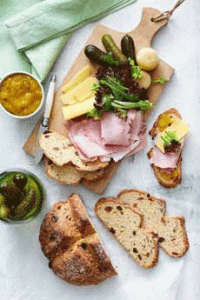
    Ploughman's Lunch
    [1] The Ploughman’s Lunch, a staple lunch in Britain for centuries (photo ©Taste | Australia).

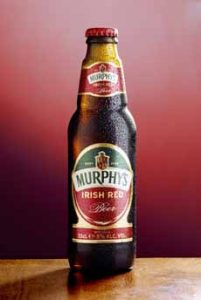
    Murphy's Irish Red
    [2] Have an Irish beer with your lunch (photo © Murphy’s Irish Stout).

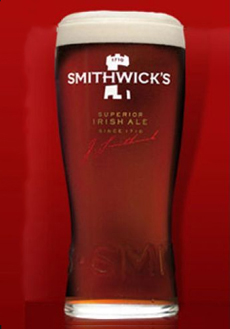
    Irish Red Ale
    [3] Smithwick’s Irish Ale (photo © Smithwick’s).


    For St. Patrick’s Day, how about a Ploughman’s lunch? You can bring it to work or dig in at home.

    Pronounced “plow man,” Ploughman’s, as it’s called for short, is a cold lunch that farmers (the plow men) and other laborers in the British Isles (including Ireland), out for the day, would take with them.

    The lunch included bread and butter, cheese (cheddar, stilton or other local cheese), relish such as a Branston pickle (chutney),* piccalilli* and/or pickled onions.

  • A deluxe version might include ham, hard boiled eggs, a green salad and an apple.
  • The ploughman’s lunch entered pub menus as an inexpensive meal.
  • Today’s ploughman’s lunch at a pub or café can add a green salad, celery sticks, hard-boiled egg, beet salad, pâté, potato chips and sliced apple.
  • At home, you can add caramelized onions, tapenade and/or chutney. We also like to add a chicken-and-apple sausage.
  •  
    The history of the ploughman’s lunch is below.
     
     
    RECIPE: DIJON VINAIGRETTE

    Dress your salad with a Dijon vinaigrette.

    Ingredients

  • 1 cup extra virgin olive oil
  • 1/3 cup white wine vinegar
  • 1 teaspoon Dijon mustard
  • Salt and pepper to taste
  •  
    Whisk in a bowl or shake in a jar to combine.
     
     
    UPGRADE FOR ST. PATRICK’S DAY

    For St. Patrick’s Day, substitute Irish soda bread for everyday bread.

    Add an Irish beer.

    Beyond the well-known Guinness and Fuller’s beers, look for something new.

    There’s a lot to choose from, including:

  • Beamish Irish Stout
  • Harp Lager
  • Kilkenny Irish Cream Ale
  • Murphy’s Irish Red
  • Murphy’s Irish Stout
  • O’Hara’s Celtic Stout
  • O’Hara’s Irish Wheat
  • Porterhouse Brewing Co. Oyster Stout (oyster shells are added to the vat)
  • Smithwick’s Irish Ale
  •  

    THE HISTORY OF THE PLOUGHMAN’S LUNCH

    There’s not much mystery to it: bread and cheese were the basis of a poor person’s diet, and was what rural English labourers carried when they left the house [source].

    A reference as far back as c.1394 mentions the traditional ploughman’s meal of bread, cheese and beer.

    Meat was a luxury, so cheese provided the protein.

  • The cheese, plus butter or lard for the bread, provided fats.
  • Onions and leeks, served as a condiment, when more expensive seasonings and condiments were out of reach.
  •  
    Over the years, the romance of “the rural life” led middle-class people to embrace the Ploughman’s Lunch. See if your local Irish pub offers it.

    ________________

    *Branston pickle is a chutney typically made of carrots, cauliflower, gherkins, onions and rutabaga, pickled in a sauce of vinegar, tomato, apple and dates flavored with chutney spices such as mustard, coriander, garlic, cinnamon, pepper, cloves, nutmeg and cayenne pepper, plus sugar. British piccalilli is similar but tangier, less sweet, and colored bright yellow with turmeric.


    Comments off

    ST. PATRICK’S DAY: Irish Beef Stew With Guinness & Puff Pastry

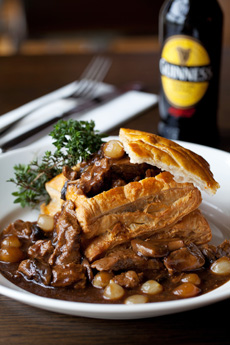
    An everyday beef stew can be turned into a special-occasion dish, merely with the addition of some puff pastry and wine or beer.

    This recipe, Beef & Guinness with Puff Pastry, was created for his St. Patrick’s Day menu by Justin O’Connor, Executive Chef at the Guinness Storehouse in Dublin. Patrick’s Day. The recipe serves four.

    > The history of St. Patrick’s Day.

    > The history of beef.

    > The history of Guinness is below.

    > The history of beer.

    > 35 comforting stew recipes.

    > National Beef Day is April 6th.

    > National Beef Stew Day is December 13th.
     
     
    BEEF & GUINNESS WITH PUFF PASTRY RECIPE

    Ingredients For 4 Servings

  • 7 ounces of Guinness Foreign Extra Stout* (or other variety)
  • 14 ounces stewing beef, diced
  • 4 ounces pearl onions
  • 1 large carrot, diced
  • 4 ounces sliced button mushrooms
  • 2 cloves garlic crushed
  • 16 ounces thick beef stock
  • Sprigs of fresh thyme and rosemary chopped
  • Small sheet of puff pastry
  • Egg
  •  
    Preparation

    1. SLICE the vegetables as desired. In a pot, brown the diced beef all over. Add the vegetables and cooked for 5 minutes. Add the herbs and beef stock. Finally, add the Guinness.

    2. BRING the stew to a slow boil and simmer for 1 to 1¼ hours. If needed, add a bit of water towards the end.

    3. MAKE the egg wash. Beat the egg thoroughly with a fork. Add 2 tablespoons of water or milk and a pinch of salt. Stir until combined. (Milk creates a more browning on the pastry.)

    4. CUT the puff pastry into 8 even pieces. Brush each piece of pastry with a pastry brush. Make four double packets by placing one piece of pastry atop another piece. Score the top of the pastry to give it the effect of a vol au vent.

    5. BAKE at 390°F for 14 minutes. When cool, cut the top of to form a lid. Core some of the top out in the centre of each packet. Spoon the beef stew into each case and serve.
     
     
    MORE GUINNESS RECIPES

  • BBQ Sauce With Guinness
  • Chocolate Mousse With Guinness
  • Chocolate Stout Float With Guinness
  • Corned Beef & Cabbage With Guinness
  • Fish & Chips With Guinness Batter
  • Lamb Kebabs Marinated In Guinness
  • Irish Lamb Stew For St. Patrick’s Day
  • Milkshake With Guinness
  • Roasted Leg Of Lamb With Guinness
  •  
     
    GUINNESS HISTORY


    [1] Add Guinness to beef stew for a hearty St. Patrick’s Day dinner (photo courtesy Guinness).

    Guinness Foreign Extra Stout
    [2] A more-hopped, higher alcohol version of Guinness Extra Stout (photo courtesy Evensi).

    Arthur Guinness
    [3] Brewer Arthur Guinness (photo courtesy Guinness).

     
    Guinness is a brand of Irish dry stout that originated in the brewery of Arthur Guinness, at St. James’s Gate in Dublin.

    Arthur Guinness signed a 9,000 year lease (was there a clause for rent increases??) for an vacant brewery and began to brewing ale in 1759. Guinness was first a domestic product, but began export 10 years later.

    Guinness stout evolved from the porter style of beer that originated in London in the early 18th century.

    A distinctive feature of Guinness is the burnt flavor, which derives from roasted unmalted barley. It has a thick, creamy head, created by the “surging” of bubbles of nitrogen as the beer is poured.

    The brand became wildly popular, even without advertising or discounts. Guinness became a public company in 1886, with average sales of 1.2 million barrels a year.

    By 1914, Guinness was producing 2.6 barrels of beer a year—more than double that of its nearest competitor. In the 1930s, Guinness became the seventh largest company in the world.

    Guinness is brewed in approximately 50 countries and sold in more than 100. [source].

    ________________

    *Guinness Foreign Extra Stout was first brewed in 1801, designed for export; hence the name “Foreign.” It is more heavily hopped than Guinness Draught and Extra Stout, and typically has a higher alcohol content (7.5% ABV). The extra hops were used as a natural preservative for the long journeys the beer would take by ship.


    CHECK OUT WHAT’S HAPPENING ON OUR HOME PAGE, THENIBBLE.COM.


    Comments off


    © Copyright 2005-2026 Lifestyle Direct, Inc. All rights reserved. All images are copyrighted to their respective owners.