THE NIBBLE BLOG: Products, Recipes & Trends In Specialty Foods


Also visit our main website, TheNibble.com.

Italian-Japanese Fusion Food: Chicken Ramen Recipe For National Ramen Day

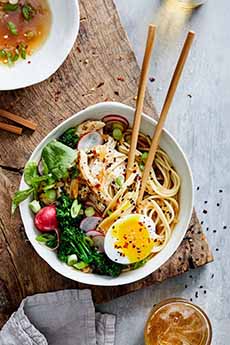
A Bowl Of Ramen Soup With Chicken
[1] Italy meets Japan in this tasty ramen recipe (photos #1 and #4 © DeLallo).

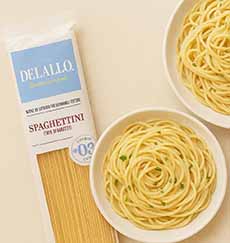
A Box Of DeLallo Spaghettini
[2] Spaghettini, the second-thinnest form of spaghetti (photo DeLallo | ChatGPT 2025-04-04).

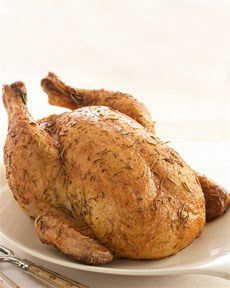
Roasted Chicken
[3] Pick up a rotisserie chicken (photo © McCormick).

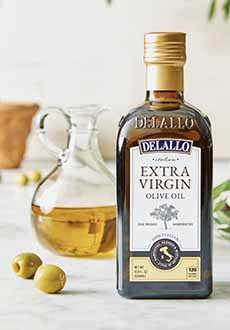
DeLallo Olive Oil Bottle
[4] An Italian starting point: cooking the carrots, celery, onion, and garlic in olive oil.

A Bunch Of Broccolini
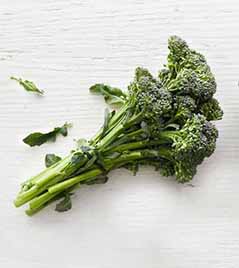
[5] Broccolini. Here’s the difference between broccoli, broccolini, and broccoli rabe (photo © Good Eggs).


There’s more to ramen than dried noodles with seasoning packets. For National Ramen Day, April 4th, how about some fusion food: ramen noodles with an Italian twist?

You’ll note that this recipe uses spaghettini, the second thinnest variety of spaghetti (angel’s hair—capelli d’angelo in Italian—is the thinnest) in place of ramen noodles.

Spaghettini and ramen are not exactly the same, so the taste and texture and taste will differ. But there will be so much other flavor going on, that no one will notice.

You can achieve a similar texture by cooking spaghettini with baking soda in the water. It won’t be a perfect replica of authentic ramen, but there are tricks to “ramenize” it.

> Another ramen holiday: Ramen Day is celebrated every July 11th in Japan.
 
 
THE DIFFERENCE BETWEEN RAMEN & SPAGHETTINI

Both are made with wheat flour. Spaghettini is made from durum wheat flour and water, and has that familiar pasta flavor.

But ramen adds a special alkaline substance*, resulting in a distinct yellow color, chewy texture, and a unique taste.

While you may be able to find fresh ramen noodles or quality dried ones, here’s a trick to “ramenize” spaghettini:

Just add a small amount of baking soda to the pasta cooking water while cooking the pasta. This will create alkaline water* along the lines of that used when making ramen.

> The difference between broccoli, broccolini, and broccoli rabe.

> The history of ramen.

> The history of spaghetti.

> The year’s pasta and noddle holidays.
 
 
RECIPE: ITALIAN STYLE CHICKEN WITH RAMEN

This Italian-style chicken ramen recipe is hearty and full of flavor. It uses a rotisserie chicken, cutting back on prep time.

We also purchased ready-to-eat hard-boiled eggs to save more cooking time.

Prep time is 15 minutes and cook time is 45 minutes.

Thanks to DeLallo for this recipe and the one below.

Ingredients For 4 Servings

  • 2 tablespoons extra virgin olive oil
  • ½ cup celery, diced
  • ½ cup carrots, diced
  • ½ cup onion, diced
  • 2 teaspoons salt
  • 1 teaspoon fresh ground pepper
  • 1 teaspoon red pepper flakes
  • 1 tablespoon chopped garlic
  • 2 anchovy fillets
  • 4 thyme sprigs
  • 2 basil sprigs, plus more for garnish
  • 64 ounces chicken stock
  • 1 package (1-pound) spaghettini
  •  
    For The Toppings

  • 4 large eggs, hard-boiled
  • 1 rotisserie chicken, shredded
  • 1 pound broccolini, blanched
  • ½ pound radishes, thinly sliced
  • 1 bunch scallions, diced white and green parts
  •  
    Preparation

    1. HEAT 2 tablespoons of oil in a 8 quart stock pot over medium heat. Cook the carrots, celery, onion, garlic, salt and pepper until soft and fragrant, about 8 minutes. Add the red pepper flakes, anchovies, thyme and basil and cook 3 minutes more.

    2. REDUCE the heat and add the chicken stock. Simmer for 20 minutes. Remove the thyme and basil before adding noodles to the broth. Cook pasta according to package instructions.

    3. BOIL the eggs. Bring a large pot of salted water to a boil, add the eggs, and cook for 5 minutes. While eggs cook, fill a large bowl with cold water. Using a slotted spoon, transfer the cooked eggs to the cold water and allow to cool for 2 minutes. Peel the eggs and halve them lengthwise.

    4. LADLE the noodles and broth into bowls. Top each with chicken, broccolini, radishes, green onions, and the egg halves.
     
    ________________
     
    *The alkaline substance added to ramen noodles, known as “kansui” or “lye water,” is a solution primarily composed of potassium carbonate and sodium carbonate. It is also used in some types of Chinese noodles, but not with Western noodles.


    CHECK OUT WHAT’S HAPPENING ON OUR HOME PAGE, THENIBBLE.COM.


    Comments off

    Baked Carrot Fries Recipe For International Carrot Day

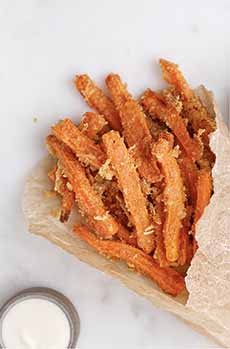
    What’s up, Doc? It’s International Carrot Day and we’re making carrot fries for dinner. They’re baked carrot fries, so much easier than deep frying these days. Not to mention, they’re a healthier alternative (less fat and calories).

    We’re making ours in the air fryer, coating them with Parmesan, and doing a flavored ketchup tasting: bacon, smokey, spicy, and truffle.

    > The history of carrots.

    > More carrot recipes.

    > A year of carrot holidays.
     
     
    RECIPE: CARROT FRIES

    You can serve this recipe with a more elegant dip than ketchup—aïoli, hot honey, peanut sauce, spicy mayo, even hummus or Greek yogurt flavored with herbs and garlic.

    You can peel the carrots or not. See the discussion below.

    This recipe uses standard American seasonings, garlic and onion powders. But you can use anything in your spice cabinet, from cumin and garam masala, or za’atar, to the heat of Cajun seasoning, chipotle, or other ground chile.

    Minced parsley adds brightness to the layers of flavor.
     
    Ingredients

  • 1 pound carrots, peeled (or not) and cut 3/8″ to 1/2″ thick
  • 1/4 cup olive oil
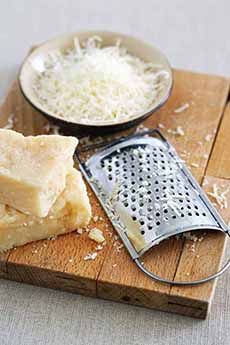
  • 1/3 cup grated Parmesan cheese*
  • 1 tablespoon cornstarch
  • 1 teaspoon onion powder
  • 1 teaspoon garlic powder
  • Salt and pepper
  • Garnish: minced fresh parsley
  • Optional dip: parsley for garnish sauce of choice for dipping
  •  
    Preparation

    1. PREHEAT the oven to 400°F. Line a baking sheet with parchment paper (we use air fryer liners).

    2. COMBINE the olive oil, Parmesan, cornstarch, and seasonings in a bowl and mix well. Add the carrots and toss to coat well.

    3. SPREAD the carrots evenly on the baking sheet in a single layer. Bake for 25-30 minutes until desired crispiness is reached, flipping the carrots halfway with a spatula.

    4. GARNISH with fresh parsley and serve with dipping sauce. Eat ‘em while they’re hot!
     
     
    FOR CRISPIER CARROT FRIES

    Carrots don’t have the starch content potatoes do, which is why we prefer the air fryers to the oven (but either is fine).

    For crispier carrot fries, toss the carrot sticks in olive oil and then in corn starch or arrowroot powder.
     
     
    TO PEEL, OR NOT TO PEEL?

    If you choose not to peel the carrots, the benefits are extra nutrients like vitamin C, beta-carotene, and niacin. You also reduce food waste, and can use the peels for carrot peel chips, pesto, candied carrot peels, or in smoothies, soup, or stock.

    The argument for peeling is that baked peel has a slightly earthy taste and texture of the skin. Some people find them more aesthetic.

    But we enjoy fries with the peel on, so we often keep it on other vegetable fries.
     
     
    ________________
     
    *For a dairy/free vegan substitute, use a blend of nutritional yeast and cornstarch or tapioca starch.


    CHECK OUT WHAT’S HAPPENING ON OUR HOME PAGE, THENIBBLE.COM.


    Carrot Fries
    [1] Carrot fries with aïoli, garlic mayonnaise (the recipe). Make them in the oven or air fryer (photo © Get Flavor).

    Grated Parmesan Cheese
    [2] Grated Parmesan gives the fries a bit of cheesiness and flavor (photo © London Deposit | Panther Media).


    [3] Minced parsley adds brightness to the finished fries (photo © Good Eggs).

    Bugs Bunny
    [4] Bugs Bunny just might trade his carrot for a plate of these fries (photo © Warner Brothers).


    Comments off

    Rainbow Foods & Rainbow History For National Find A Rainbow Day

    Rainbow Tacos
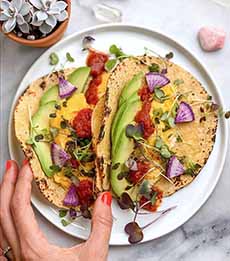
    [1] Rainbow tacos. Pick your veggie colors from this list (photo © Maria And Ricardo’s).

    Colorful Salad
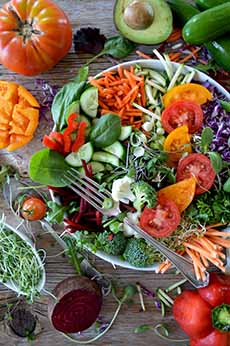
    [2] We also made a rainbow salad for lunch (photo © Nadine Primeau | Unsplash).

    A Bowl Of Rainbow Pasta
    [3] Rainbow pasta. Here’s the recipe (photo © Cool Mom Eats).

    Rainbow Spring Rolls
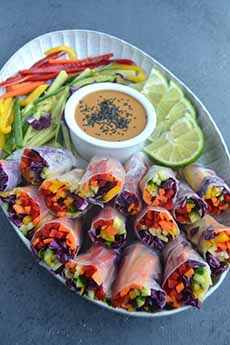
    [4] Rainbow spring rolls. Here’s the recipe (photo © Nutritionist Reviews).

    Cone Of Rainbow Sherbet
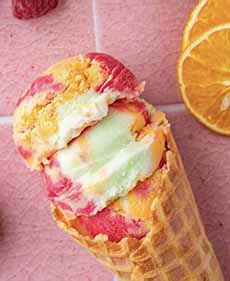
    [5] Time for dessert: rainbow sherbet. Here’s the recipe (photo © Dinner Then Dessert).

    Rainbow Fruit Tart
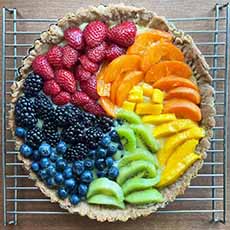
    [6] Or if you prefer, a rainbow fruit tart. Here’s the recipe (photo © Ugly Duckling Bakery).


    We did not find a rainbow today, National Find A Rainbow Day. It was a dry, cloudy day, lacking the water vapor/droplets and sunlight required to create a rainbow.

    But we did have a rainbow breakfast taco (photo #1), thanks to Maria and Ricardo, two cousins from Mexico who brought tortillas to Boston in the 1980s.

    We found the idea on their Instagram page.

    Since we first saw their rainbow tacos, we’ve been making them regularly. Today, National Rainbow Day, is certainly one of those days.

    It’s easy to decide what rainbow colors to put in the taco (or burrito or sandwich).

    We just head to our article, Eat The Rainbow, which lists every veggie and fruit by color group: green, orange, purple, blue, yellow, and white.

    We included scrambled eggs, which counted as the yellow color.

    There are many more rainbow dishes to make, from pizza to sushi to desserts galore. And more rainbow holidays to celebrate, below.

    If you want to find a rainbow in a hurry, head to Hawaii, “The Rainbow Capitol of the World.” Here’s more about it.
     
     
    THE “HISTORY” OF THE RAINBOW

    We learned in 8th grade science class that the colors of the rainbow were, in order of their place on the spectrum, red, orange, yellow, green, blue, indigo and violet (ROYGBIV). The colors are the result of light being split into different wavelengths. Red is the longest, violet the shortest.

    These were the original colors described by Sir Isaac Newton. There are far more, because a rainbow is actually made up of a myriad of individual spectral colors that overlap and mix.

    Modern scientists who study the phenomena of rainbows—the meteorologists, atmospheric physicists, optical physicists, and spectroscopists—have dropped the “I,” combining indigo with the blue and violet spectra.

    But at the beginning, there were the philosophers†.

    In fact, the first writings about rainbows come from the Greek philosopher Aristotle, who mused about their colors as far back as 350 B.C.E. He recognized that rainbows involved the reflection of light in water droplets.

  • 350-330 B.C.E.: Aristotle writes about rainbows in his treatise “Meteorologica” (Meteorology). He discusses the physical nature of rainbows, their shape and formation, the colors visible in rainbows and their order, and the conditions needed for rainbows to appear.
  • 65 C.E., The Roman philosopher Seneca the Younger picked up on Aristotle’s ideas and added his own in his book, Naturales Quaestiones. He predicted the prism effect that was established by Sir Isaac Newton centuries later.
  • 1304: Theodoric of Freiberg demonstrated how light is refracted and reflected inside raindrops using glass spheres filled with water.
  • 1637: René Descartes calculated the path of light through a raindrop and explained the primary rainbow.
  • 1666*: Isaac Newton discovered through his prism experiments that white light contains all colors of the spectrum. This finally explained how rainbows were created.
  • 1800s: Scientists discovered ultraviolet and infrared light beyond the visible spectrum.
  •  
    Modern physics now explains rainbows as the result of light being refracted, reflected, and dispersed within water droplets, creating its arc of colors.

    In the process, modern definitions of the spectrum of visible light have come to exclude indigo as a primary spectral color, merging it into the ranges of shades of blue and violet.

    Thus, most modern physics textbooks, scientific literature, and educational materials now use the six-color model (ROYGBV).

    A Rainbow Over Mountains
    [7] Contemplation of rainbows began with Aristotle, who was the first to write about them in a scientific manner (photo © Look Up Look Down Photography | Unsplash).


    RAINBOW HOLIDAYS

  • April 3: National Find a Rainbow Day (celebrate their beauty and the science behind rainbows)
  • June: Pride Month (coincides with the anniversary of the 1969 Stonewall riots)
  • June 28: Christopher Street Day (commemorates the Stonewall Riots)
  • August 28: Rainbow Bridge Remembrance Day (remembers beloved pets who have passed away)
  • October 22: National Color Day (focuses on the impact color has on each of us)
  •  
    ________________
     
    *When Newton first published his work on the spectrum in 1672 in the Philosophical Transactions of the Royal Society—six years after his discovery in 1666—he initially distinguished five primary colors: red, yellow, green, blue, and violet (or purple). However, when he published his comprehensive work “Opticks” in 1704—another 22 years later—he had expanded his model to seven colors: red, orange, yellow, green, blue, indigo, and violet (the familiar ROYGBIV).

    †Science did not appear as a separate field until the Scientific Revolution, 1500-1700.


    CHECK OUT WHAT’S HAPPENING ON OUR HOME PAGE, THENIBBLE.COM.


    Comments off


    © Copyright 2005-2026 Lifestyle Direct, Inc. All rights reserved. All images are copyrighted to their respective owners.