|
July 27th is National Scotch Day. You know how to drink it. How about cooking with it?
Although it is much more common to use wine or brandy in cooking, Scotch can offer complex character to everything from appetizers through dessert.
Cooking lets you appreciate Scotch—or other whiskey—in new ways.
You don’t have to use a “grand cru” Scotch, but don’t cook with the cheapest brand either. You don’t need that much whiskey in any particular recipe, so go for the best flavor.
You can put together an entire meal infused with Scotch. If you’re not already aware, most of the alcohol evaporates in the heat of cooking. Recipes that aren’t cooked, such as mousse, need much less alcohol.
You also can serve a different Scotch with each course. If you don’t have all that you need, invite guests to bring their favorites.
If you prefer a different type of whiskey, use that instead.
COOKING WITH WHISKEY TIPS
Omaha Steaks advises:
Replace some of the water, broth, or other liquid in a recipe with a few tablespoons to 1/4 cup of whiskey.
Create a pan sauce by deglazing the pan with whiskey.
Add some to a cream sauce for just about anything.
Try to match flavors to dishes; a whiskey with herbal notes to a chicken dish with lemon and herbs, for example.
Use darker whiskey with darker meats—beef and pork, for example; and lighter whiskeys with white meats or seafood.
Mix it into any batter or dessert. Brownies, cakes, cookies, pancakes, puddings. The fillings of apple pies, tarts and crumbles just beg for a splash.
COOKING WITH SCOTCH
You can find many recipes with Scotch and other whiskies online, but here’s a menu to start you off.
Breakfast: Mix into maple syrup.
Lunch: (Blue cheese burger ), a splash in salad dressing or soup.
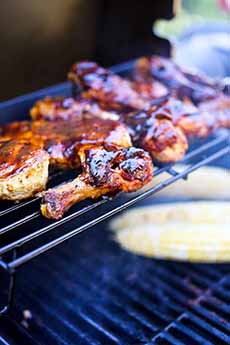
Main Course: BBQ chicken, brisket, marinated proteins, anything with a cream sauce (fish/seafood, pasta, etc.)
Side: Cranberry sauce (photo #5), glazed or mashed sweet potatoes.
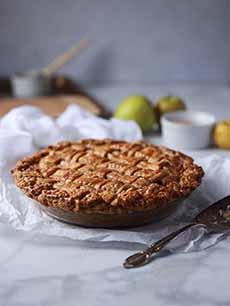
Dessert: Apple tarts or pie (photo #6), pudding, mousse; stir into chocolate, caramel or other dessert sauce, frostings and fillings, whipped cream.
Snack: Blondies and brownies, caramel apples, whiskey caramel corn.
THE DIFFERENCE BETWEEN WHISKEY & WHISKY
Whisky is the Scottish spelling of whiskey, chosen to differentiate its product from Irish whiskey. The spelling is used by Canada, Japan and Wales as well.
In the U.S., a 1968 directive of the Bureau of Alcohol, Tobacco and Firearms specifies “whisky” as the official U.S. spelling, but allows the alternative spelling, “whiskey,” which most U.S. producers prefer.
The differences predate modern English, to the sixth century when distillation began in what is now the U.K. Here’s how it began:
> Irish Uisge Baugh Became Whiskey
The Irish are believed to have been the first Europeans to distill whiskey. In Gaelic, the language of the Irish, the name uisge baugh, pronounced ISH-ka BA-ha, was given by Irish monks to the distillate they produced.
The monks also called the beverage aqua vitae in Latin. Both phrases mean the same: water of life.
> Scottish Uisce Beatha Became Whisky
A slightly different spelling for the same “water of life” in Celtic, the language of the Scots, and a slightly different pronunciation, ISH-ka BYA-ha.
The Gaelic uisge and the Scotch uisce both evolved into usky and then whisky in English.
Scholars can’t determine why the “e” was dropped by the Scots. One theory is that the Irish made whiskey first and pronounced it with a broad “e.” When the Scots began to make it, they dropped the “e” to differentiate their product.*
In addition, the Irish and Scots disagree over whiskey’s origin.
Scots claim that whiskey originated in Scotland and attribute the monk John Cor with the first variation of the drink there from barley malt in 1294 C.E.
There is also an argument that Irish monks who had traveled to the Near East brought back the technique and applied it to a different medium: the ancient Egyptians had been distilling perfume.
A HISTORY OF WHISKEY
Although it was originally considered little more than a distilled beer (which itself dates to before 5000 B.C.E.), whiskey has evolved into a complex beverage made from different types of mash, the fermented combination of grains that give each whiskey its distinctive taste.
Thousands of years later, distillation was discovered in the late 8th century C.E., by an Arab scholar.
Known as the Father of Modern Chemistry, Abu Masa Jabir ibn Hayyam (?-803 C.E.) wondered what would happen if he put wine into an al-ambiq, a round vessel like a tea pot with a tall spout on the top, and boiled it.
The vapors rose through the spout, were collected and condensed, creating the world’s first distilled alcohol.
In fact, since the al-ambiq was often used to boil powdered antimony into a liquid called al-kohl (used to make the cosmetic kohl), the liquid became known as alcohol and the al-ambiq became the alembic still, which remains in use today.
The distillate was originally used as medicine and remained a secret process, ultimately shared with the monks in Spain for medicinal purposes. Some orders created their own distillations—liqueurs such as Benedictine and Chartreuse.
The Secret Becomes Public
Around 1300, Arnald of Villanova, a professor of medicine at one of the first European medical schools, compiled the first hand-written instructions for distillation, calling the alcohol aqua vitae, Latin for “water of life.”
This translates into French eau de vie, Scandinavian akavit (now spelled aquavit) and Celtic uisege beatha and the Gaelic uisge baugh. These latter two evolved to usky and then whisky in English.
While vodka is not a whiskey†, in Russian and Polish the word is vodka (spelled wodka in POlish) for “dear little water,” instead of “water of life.”
Alcohol was believed to prolong life and cure ills. As we now know, whiskey has no curative properties, but it could help people “feel better,” or sleep and forget the pain.
WHISKEY GOES GLOBAL
English and Irish immigrants to the U.S. began to distill their own whiskeys, including the distillation of corn, which was not grown in the British Isles.
Today, whiskey is made around the world, from different grains: barley, corn, rye, and/or wheat.
These grains, along with the oak barrels the spirit is aged in, define the taste and aroma of the whiskey.
Most whiskeys are made with a blend of these grains, to create texture and depth and fully bring out the best flavor of each grain.
Regardless of the type, all whiskey is made from a fermented mash of grain.
Single malt whiskeys, also called straight whiskeys, are bottled from the casks in which they are aged, with water added to reduce their proof.
Blended whiskeys, including Bourbon and Tennessee whiskey, can be made by either using “sweet mash” (fresh yeast) or “sour mash” (starter yeast culture saved from a previous batch).
With the continuing popularity of whiskey, other countries with significant whiskey production, sales and export.Australia, Finland, Germany, India, Taiwan [source].
> The Different Types Of Whiskey
> Scotch & Chocolate Pairings
> Whiskey 101: The Wonders Of Whiskey
|
|
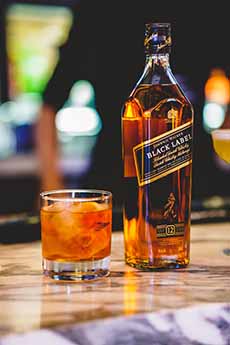
[1] If you like to drink Scotch or other whiskey, you’ll like cooking with it (photo © Brian Jones | Unsplash).

[2] How about whiskey in your burger? This recipe from Half Baked Harvest uses Irish whiskey, but you can substitute Scotch (photo © Half Baked Harvest).
[3] How about BBQ Chicken? This recipe from Feasting At Home combines whiskey, chipotle and honey. You can substitute bourbon or other favorite (photo © Feasting At Home).
[4] Add a splash or two of whiskey to anything: meat, fish, fowl, fruit, vegetables (photo of gravlax © Eataly).
[5] You won’t want to wait until Thanksgiving to make this cranberry sauce with whiskey. Here’s the recipe from Fork In The Road (photo © Fork In The Road).
[6] It’s still “as American as apple pie” if you use an American whiskey, like bourbon, corn, rye or Tennessee. Here’s the recipe for this apple pie with rye and ginger from Pastry And Prose (photo © Pastry And Prose).
[7] Scotch or other whiskey in mousse or pudding—bread pudding, rice pudding, etc.—adds something very special. Here’s a recipe from Sweet Society (photo © Sweet Society). |