THE NIBBLE BLOG: Products, Recipes & Trends In Specialty Foods


Also visit our main website, TheNibble.com.

FOOD FUN: Campbell’s Soup Candles, Tomato Soup & Chicken Noodle

If you’re feeling a winter chill, a can of Campbell’s soup might be just what you need to warm up. What if you could add to that some comforting ambiance, in this case candles scented like your favorite soups?

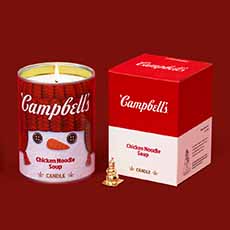
Campbell’s has partnered with CAMP, A Family Experience Company, to release two limited-edition scented candles: Tomato Soup & Grilled Cheese, and Chicken Noodle Soup.

  • Tomato Soup & Grilled Cheese features notes of roasted tomato, peppercorn, and grilled cheese.
  • Chicken Noodle Soup has notes of savory chicken, clove, and buttery crackers.
  •  
    They’re about 50% larger than a can of Campbell’s soup, and have the same pull-tab top.

    The candles-in-a-can tap into the familiar design of Campbell’s limited-time-only, stackable snowman soup cans, which made their debut in 2020 and were inspired by the brand’s snowman commercial, “Snowbuddy.”

    A miniature golden “Snowbuddy” keepsake is revealed as the candle burns (photo #2).

    Start by making your home smell M’m! M’m! Good!® Treat yourself to a candle, or the pair.
     
     
    GET YOUR CAMPBELL’S SOUP CANDLES

    The candles are available online at Camp.com/Campbells or in-person at CAMP stores in New York, New Jersey, Dallas, and Connecticut.

    The candles are $24.99 each while supplies last, with 10% of net proceeds from total candle sales going to Feeding America

    Even if you don’t buy a candle, you can download a free copy of The Winter Warmup Guide, 12 pages of crafts, games, and coloring to delight the Campbell Kids, and yours.
     
     
    > THE HISTORY OF SOUP
     
    > THE DIFFERENT TYPES OF SOUP


    [1] Limited-editional Campbell’s soup-scented candles, in Tomato Soup & Grilled Cheese, and Chicken Noodle © Campbell’s).


    [2] Each candle, beautifully boxed, has a hidden “Snowbuddy” that is revealed as the candle burns.


    CHECK OUT WHAT’S HAPPENING ON OUR HOME PAGE, THENIBBLE.COM.


    Comments off

    Shaker Vinaigrette Recipe: Easy To Make Salad Dressing


    [1] Whether the salad is plain or fancy, we prefer a vinaigrette dressing (photo © Nadine Primeau | Unsplash).

    Shaker Vinaigrette
    [2] Just add the ingredients to a jar and shake your vinaigrette (photo © Colavita).


    It struck us that quite a few people we know don’t know how easy it is to make a shaker vinaigrette. There’s no whisking in a bowl, no blender or food processor to clean. All you need is the vinaigrette ingredients and a jar. And if your goal this January is to eat more healthy salads without the calorie-laden bottled dressing, this is a great tip.

    Thanks to Colavita Extra Virgin Olive Oil for reminding us!

    > Check out more recipes with Colavita Extra Virgin Olive Oil.

    > The history of salad.

    > The history of olive oil.

    > The history of vinegar.

    > May is National Salad Month.

    > National Vinegar Day is November 1st.
     
     
    RECIPE: SHAKER VINAIGRETTE

    This is a fancy vinaigrette, with layers of flavor. But there’s a much shorter version.

    For the quick version, just add oil and vinegar—we recommend balsamic or red wine vinegar—salt and pepper, and a shake or two of your favorite dried herbs.
     
    Ingredients

  • 2 small shallots, minced
  • 1 garlic clove, minced
  • 2 teaspoons Dijon mustard
  • 2 teaspoons honey
  • 5 tablespoons apple cider vinegar
  • 1 tablespoon water
  • Zest and juice of 1 small lemon
  • Pinch of dried oregano
  • Pinch of dried basil
  • Optional: dash of hot sauce
  • ¾ cup extra virgin olive oil
  • 1/4 teaspoon kosher or sea salt
  • ⅛ teaspoon freshly ground black pepper
  •  
    Preparation

    1. COMBINE the shallots, garlic, mustard, honey, vinegar, water, zest, oregano, basil, EVOO, and salt and pepper in a medium-sized jar. Screw the lid on tightly and shake until the dressing is emulsified. That’s it!

    2. STORE unused vinaigrette in the jar in the fridge, for up to 3 weeks. Once stored, the EVOO may solidify. To use, let it warm at room temperature or under warm water.


    CHECK OUT WHAT’S HAPPENING ON OUR HOME PAGE, THENIBBLE.COM.


    Comments off

    It’s Sumo Citrus Season: Gather A Supply Of Sumo Mandarins

    Sumo Citrus has hit the shelves at grocers near you. Available nationwide* annually from January to April. you can easily recognize them by their topknot—reminiscent of the hair of sumo wrestlers. Sumo Citrus is one of the world’s largest and sweetest mandarins, celebrated for its sweet taste and distinct looks. Originally from Japan, Sumo Citrus is now grown in the U.S.

    Compared to the navel and other oranges, Sumo Citrus is easy to peel. It’s seedless, super-sweet, and juicy: a no-mess snack.

    It’s a bit more expensive than other mandarins. According to SumoCitrus.com, Sumo Citrus is the most difficult citrus to grow. It takes four years of constant care before a Sumo Citrus tree produces any fruit.

    Despite its rugged appearance, it’s a delicate fruit that requires far more expertise and gentle handling than any other piece of citrus. Each Sumo Citrus tree is carefully groomed by hand every year and then hand-picked and hand-packed. Even the trailers used to transport Sumo Citrus are designed to give it a smooth (vs. bumpy) ride!

    Here’s more about Sumo Citrus.
     
     
    THE DIFFERENCE BETWEEN MANDARINS & ORANGES

    The term “mandarin orange” is incorrect. Mandarins and oranges are separate species, as you can see from the taxonomy below.

    From a visual perspective:

  • Oranges are medium to large round or ovoid shapes covered with a thick peel that can take time to remove. They are in the genus Citrus, with separate species (e.g. Citrus sinensis, the sweet orange group, includes the common sweet orange, blood orange, and navel orange).
  • Sometimes they’re sweet, and sometimes they aren’t; you don’t know until you buy and try.
  • Mandarins are small and roundish with flatness on the top and bottom, and a loose, easy-to-peel skin. They are in the genus/species Citrus reticulata.
  • The mandarin from California are reliably sweet and usually seedless. That’s why we prefer mandarins like clementines and Sumo Citrus to navel oranges, which are a spin on the sweetness roulette wheel.
  •  
    Are they close relatives?

    From a hybridization perspective, the mandarin is a progenitor of the orange. The orange is a cross between a mandarin and a pomelo, created long ago in China.

    Both are in the genus Citrus; the binomial classification of both mandarins and oranges branches at the species level (we’d call this “cousins”). For food geeks, here’s the entire taxonomy:

  • Kingdom Plantae
  • Clade† Tracheophytes
  • Clade Angiosperms
  • Clade Eudicots
  • Clade Rosids
  • Order Sapindales
  • Family Rutaceae
  • Subfamily Auranntioideae
  • Tribe Citreae
  • Subtribe Citrinae
  • Genus Citrus
  • Species: reticulata (mandarin), citrus X sinensis (orange)
  • Subspecies: there are individual subspecies for both mandarins (e.g. clementine, tangerine) and oranges (e.g. navel, Seville)
  •  
    Hats off to the botanists who painstakingly mapped this out!
     
     
    > THE HISTORY OF MANDARINS
     
     
    > THE HISTORY OF ORANGES


    [1] Sumo Citrus has a topknot, like the sumo wrestlers after which they were named (all photos © Sumo Citrus).


    [2] Sumo Citrus are mandarins, easy to peel.


    [3] Look for them in the produce section from January through April.


    [4] Add segments to green salads (here mesclun and fennel), chicken salads, and to a pan sauce (photo © Shaya Restaurant | New Orleans).

     
    ________________

    Retailers include Albertsons, H‑E‑B, Hy-Vee, Kroger, Osco, Pavilions, Publix, Ralphs, Safeway, Sams Club, Shaws, Sprouts, Target, Vons, Wegmans, and Whole Foods.

    †A clade is a branch that includes a single common ancestor; the group of its descendants is called a clade. A cladogram is an evolutionary tree that diagrams the ancestral relationships among organisms.


    CHECK OUT WHAT’S HAPPENING ON OUR HOME PAGE, THENIBBLE.COM.


    Comments off


    © Copyright 2005-2026 Lifestyle Direct, Inc. All rights reserved. All images are copyrighted to their respective owners.