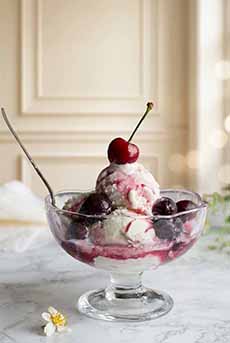
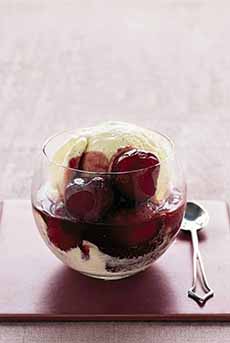
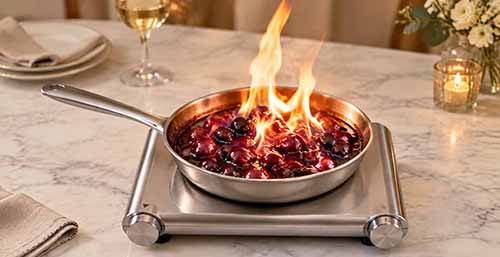
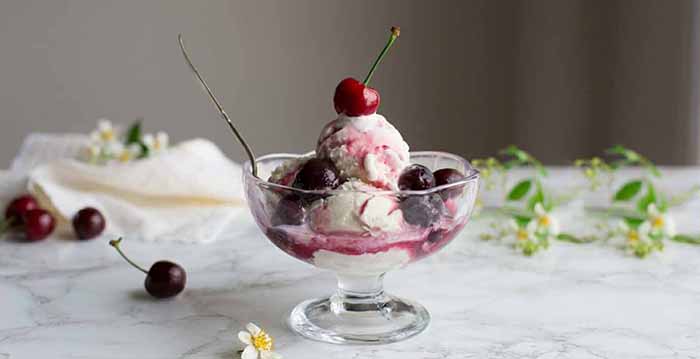
[9] If you have leftover sauce, treat yourself in the days after the dinner party (photo © Stemilt).
3. THE HISTORY OF CHERRIES JUBILEE
In the 1950s, Cherries Jubilee became the rage for home cooks like our mother, the hostess with the mostest. In those postwar years, flambéing was the hallmark of fine dining and home cooks were eager to impress at their dinner parties.
But the recipe was first served in a far more elevated venue than American dining rooms.
The legendary French chef Auguste Escoffier created the dish for Queen Victoria, either her Golden Jubilee of 1887 (the 50th year of a monarch’s reign) or her Diamond Jubilee in 1897 (the 60th year on the throne); sources disagree on which‡.
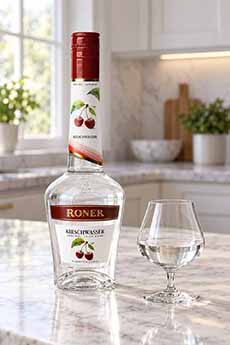
The original spirit used to flambé appears to be Kirschwasser (or kirsch), a clear cherry brandy made from distilled cherries.
The “celebrity chef” was working at the Savoy Hotel in London at the time. Following its debut, Cherries Jubilee was a very fashionable dessert for many decades—far beyond England, including across the pond in the United States.
It immediately joined the menu at restaurants of haute cuisine, where it was prepared tableside with great fanfare.
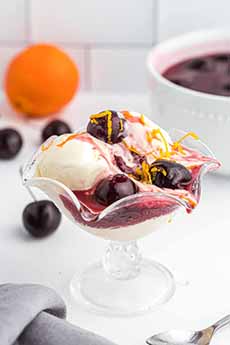
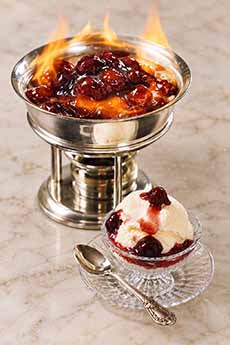
Pitted black cherries were flambéed with kirsch (which is cherry eau de vie, or unaged brandy) or regular brandy, then spooned into a stemmed silver dish of vanilla ice cream.
You don’t need to have a stemmed silver dish—that kind of pomp disappeared in the 1960s.
Over time, cooks have substituted regular brandy and even rum. But it’s worth investing in a bottle of Kirsch: it has many other uses (see them in the *footnote).
Good news for home cooks: You can serve this queenly dish at home, or “jubilee” any other cooked fruit using any 80-proof or overproof spirit. It’s an impressive yet easy to make dessert.
While Escoffier’s team pitted and cooked fresh cherries and made the ice cream from scratch, you can elect to save time with canned cherries. We used Oregon Fruit Pitted Red Tart Cherries in Water, and have also used frozen cherries.
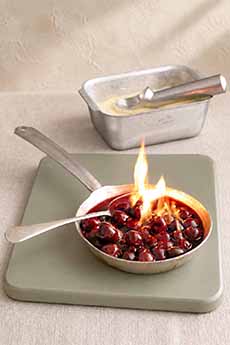
You can elect to flambé the dish or not. Tip: If guests ask to help, put them on flambé duty.
When you serve it to guests, tell them the Escoffier-Queen Victoria story.
We tend to make this recipe every year to celebrate George Washington’s birthday, traditionally a day for cherry desserts.
A recipe served to one head of state is certainly appropriate for another!
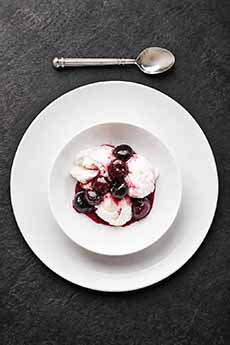
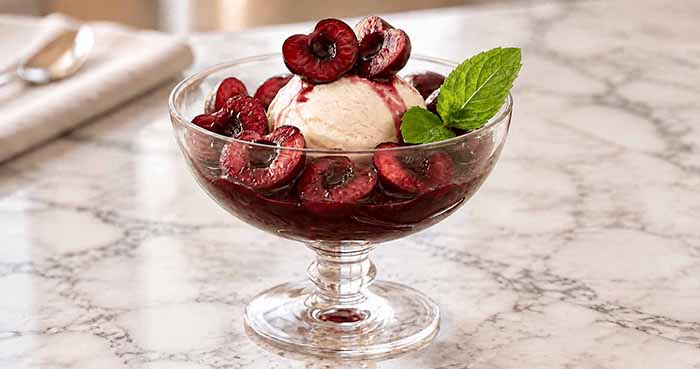
[10] This preparation uses halved cherries instead of whole ones (Abacus photo).
4. THE HISTORY OF FLAMBÉED FOOD
The word flambé comes from the French verb flamber, meaning to flame or singe. While lighting spirits on fire has roots stretching back centuries, the practice of flambéing as an intentional culinary technique and tableside performance emerged primarily in 19th-century Europe.
Pre-19th Century
Long before flambéing became a spectacle at refined restaurants, alcohol was used with fire for preservation, ritual, and theater.
- Medieval and Renaissance Banquets: Medieval feast-masters loved spectacle and illusion food (entremets). Occasionally, spirits like aqua vitae were poured over roasted birds or boar heads and briefly ignited to produce dramatic blue flames as dishes entered the dining hall. At that stage, it was pure showmanship rather than a flavor technique.
- The British Flaming Pudding: In 17th- and 18th-century Britain, the tradition of pouring warmed brandy over rich steamed plum puddings and lighting it at Christmas became widespread. This served a practical purpose (warming the dense pudding and infusing a toasted spirit aroma) as well as a celebratory, seasonal one.
The 19th Century: The Rise of Service au Guéridon
Flambéing in its modern culinary sense was born alongside classical French haute cuisine during the nineteenth century.
- Shift to Tableside Service: In the mid-1800s, European fine dining transitioned from service à la française (all dishes placed on the table at once) to service à la russe (courses served sequentially from carts or side tables, known as guéridons).
- The Role of the Chafing Dish: The invention of portable, spirit-fueled chafing dishes enabled maître d’s and captains to sauté, finish sauces, carve meats, and ignite spirits directly in front of diners. The flame provided ambient lighting, warmth, and an intimate theatrical experience.
Several classic flambé dishes emerged during the late 19th and early 20th centuries, many with famous backstories:
- Crêpes Suzette (c. 1895): The most famous legend credits Henri Charpentier, then an apprentice waiter at the Café de Paris in Monte Carlo. As Charpentier later told it, he accidentally set a pan of cordial-infused crêpes ablaze while preparing them for Edward VII (then Prince of Wales). Tasting the sauce, he realized the burnt-off alcohol left behind a smooth, caramelized citrus glaze. The prince loved it and suggested naming it after a young French girl in his entourage named Suzette. While culinary historians dispute Charpentier’s sole claim (Auguste Escoffier and other chefs had similar recipes recorded), the dessert solidified flambéing as an international luxury sensation.
- Cherries Jubilee (1887 or 1897‡): Master chef Auguste Escoffier created this dish to celebrate Queen Victoria’s Diamond Jubilee. Originally known simply as Cerises Jubilé, Escoffier poached sweet cherries in syrup, thickened them with arrowroot, and doused them in warm Kirschwasser before lighting the spirit at the table.
- Steak Diane (1930s–1950s): Named after the Roman goddess of the hunt, Steak Diane featured thinly pounded tenderloin steaks cooked tableside with shallots, mustard, Worcestershire, and butter, flambéed with cognac, and finished with cream. It gained prominence in luxury hotel dining rooms in London and New York, including the Drake Hotel and The Sherry-Netherland.
- Bananas Foster (1951): Created at Brennan’s restaurant in New Orleans by chef Paul Blangé and owner Owen Brennan. Facing a surplus of bananas entering the city’s busy port, they paired sautéed bananas and brown sugar with dark rum and banana liqueur, lighting it tableside over vanilla ice cream. It remains one of America’s most recognizable flambéed desserts.
The Mid-Century Golden Era (1950s–1970s)
By the mid-20th century, tableside flambé was the ultimate hallmark of cosmopolitan dining. Steak houses, continental dining rooms, and supper clubs across North America and Europe routinely rolled out copper-plated guéridon carts to prepare:
- Bananas Foster and Crêpes Suzette for dessert.
- Duck à l’orange flamed with Grand Marnier.
- Coq au Vin ignited with Cognac.
- Flaming Polynesian tiki cocktails (such as bowls ignited with overproof rum in carved-out coconut shells).
The Decline and Modern Resurgence Of Flambéed Foods
By the 1980s and 1990s, the rise of nouvelle cuisine shifted focus away from theatrical dining-room finishing toward kitchen-plated artistry, lighter sauces, and seasonal ingredients. Tableside service came to be viewed by some critics as dated, kitschy, or an unnecessary fire hazard.
Today, flambéing is appreciated for both its science and its nostalgic drama. The culinary chemistry:
- Chefs recognize that burning off ethanol rapidly reduces harsh alcohol vapors while caramelizing sugars.
- It also creates distinctive aromatic compounds that gentle simmering alone cannot replicate.
These days, high-end cocktail bars frequently use flambéed citrus oils or ignited overproof rinses, while classic restaurants and modern steakhouses have revitalized tableside cart service as an experiential counterpoint to casual dining.
*5. More uses for Kirschwasser: There are numerous cherry cocktails, but our favorite is the easiest: Add a splash to Champagne or other sparkling wine. Plus:
Desserts: Black Forest Cake, chocolate fondue, fruit salads (especially with stone fruits and berries), ice cream (drizzle over chocolate, vanilla, and of course cherry, plus sorbets), and poached pears or fruit compote. Add to any chocolate dessert recipe, and to fruit tarts.
Cheese pairings: While cheese fondue is the classic, you can also serve a small glass with aged cheeses like Gruyère or Emmental.
Other recipes: Add to fruit preserves (even store-bought: just mix some into the jar) and sauces for duck, pork, or game—it’s one of our favorite ways to deglaze a pan for a pan sauce.
†A chafing dish is a serving pan designed to keep prepared food warm for an extended period. It typically consists of a water pan (bain-marie) that provides gentle, even heat; a food pan placed above the water; a lid to retain heat and moisture; a stand or frame it rests upon; and a heat source, traditionally a small fuel canister or candle (some modern versions use electricity).
Raw food is not usually cooked in a chafing dish. Instead, it is cooked beforehand and kept warm in the chafing dish. You’ve no doubt seen them at buffets. Copper-clad dishes are traditionally associated with fine dining, with silver-plate considered an even higher level. Stainless steel or nickel silver (an alloy of copper, nickel, and zinc that resembles silver but contains none) makes a fine presentation. On the low end, aluminum is an efficient heat conductor and more lightweight than the others.
‡Which jubilee: 1887 or 1897? While the year hasn’t been definitely established by culinary historians, here are some facts for you to consider. We know that the dish was created by Escoffier for one of Queen Victoria’s jubilees. Since he didn’t more to London to the Savoy Hotel until 1890, he wouldn’t have been in residence for the 1887 jubilee. This does rule out the specific claim that Escoffier created the dish at the Savoy for the 1887 Golden Jubilee.
However, Escoffier was already a prominent and highly respected chef in elite European culinary circles. So he theoretically could have created a Golden Jubilee (1887) dish elsewhere. Points to ponder:
> Escoffier + Savoy Hotel + Queen Victoria’s Jubilee points logically to the 1897 Diamond Jubilee.
> Escoffier + 1887 Golden Jubilee remains chronologically possible only if the dish was created somewhere other than the Savoy.
> The earliest cited published Escoffier recipe appears in the 1903 Le Guide Culinaire, so that recipe does not conclusively establish where or precisely when he first served it.
CHECK OUT WHAT’S HAPPENING ON OUR HOME PAGE, THENIBBLE.COM.
|