|
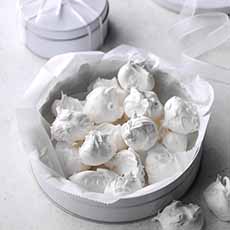
For National Nougat Day, March 26th, we’re taking a slight turn to highlight a member of the nougat family: divinity. This creamy, smooth confection is made with egg whites, sugar, water, corn syrup, vanilla extract, and pecans—although you can substitute the nuts and otherwise play with the recipe, adding flavors. The recipe for divinity is below.
A comment from our colleague, Hannah Kaminsky: “Said to taste so heavenly that one bite could make the angels sing, divinity is an ethereal confection that looks the part, too. Fluffy billowing masses with crisp exteriors, it wouldn’t be entirely surprising if the entire platter were to float away.”
Somewhat of a cross between nougat, marshmallows, and meringue, divinity is a specialty of the southern U.S., often made for the holiday season. (See how Martha Stewart makes it Christmassy in photo # 4).
Like marshmallows and meringue, and to a certain extent nougat, divinity can be flavored in as many ways as there are flavors, from cranberry and peppermint for the holidays to citrus to fruit for spring and summer.
> Divinity contains egg whites, but here’s a recipe for vegan divinity (photo #5).
> The history of candy.
IS DIVINITY NOUGAT?
Not exactly, but it’s nougat-like. It has the same ingredients: egg whites, corn syrup, sugar, and flavoring (most often vanilla but almond, cherry (photo #6) orange, peppermint, and other flavors work).
It’s made by cooking sugar syrup to the firm or hard-ball stage and then beating it into whisked egg whites. Nougat has a similar, but more complex, blending process.
Chopped dried fruit and/or chopped nuts are typically added to both. So what’s the difference? The complexity of the blending technique, which impacts the texture, makes nougat a more dense confection.
As one cook describes it: “The only difference between making divinity and making nougat is that nougat requires that after blending beaten egg whites with half of your hard-ball-stage syrup, you heat the rest to near [the] hard-crack [stage] before blending it in.
“So the divinity process is basically an easier version of the nougat process [source].
Thus, nougat is more complicated to make. That’s why, on National Nougat Day, you may prefer to make divinity instead.
Replacing the sugar in divinity with brown sugar results in a darker confection called sea foam [source].
You can also replace the corn syrup with maple syrup or honey.
Don’t eat nuts? Substitute coconut flakes.
Divinity’s Close Relatives
Divinity is closely related to:
Fudge: sugar, butter, milk, flavoring, heated it to the soft-ball stage (240°F), then beaten while it cools so that it acquires a smooth, creamy consistency.
Marshmallow: sugar, water, gelatin, and flavoring whipped to a solid-but-soft consistency (whipping aerates the mixture).
Meringue: sugar, egg whites, cream of tartar or other acid.
THE HISTORY OF DIVINITY
Divinity (also called divinity fudge [inaccurately]* and divinity candy) originated in the early 20th century U.S. It has roots in Turkish delight and European treats from the 17th and 18th centuries.
At the beginning of the 20th century in the U.S., corn syrup was starting to be used as a less expensive sugar substitute. Many new recipes featuring corn syrup were developed by home economists working for the major manufacturers.
The type of divinity widely made today first appeared in a recipe from 1915. However, an earlier version including milk debuted in 1907. Divinity’s emergence largely coincided with the rise in popularity of corn syrup, which was also occurring in the early 1900s.
A 1905 recipe boiled “one pint golden drip syrup, one pint sweet milk, one cup granulated sugar, butter size of a walnut,” then whipped it and poured it over “one-half pound of shelled California English walnuts.”
That’s not today’s recipe of egg whites, sugar, and corn syrup.
A 1910 recipe for “Divinity Fudge” is more on target, with egg whites, sugar, corn syrup, vanilla, and walnuts. [You can find these recipes here.]
A trend to divinity-making owes to a recipe from Karo brand corn syrup, which was introduced in 1902. Early Karo cooking brochures contain recipes for divinity.
The use of pecans in the recipe led to an association with the American South, although it was featured in recipe books throughout the country [source].
The source of the name “divinity” has never been found, but the general consensus is that someone thought it tasted “divine.”
RECIPE: DIVINITY
Thanks to Taste Of Home for this recipe. You may want to check the tips on the bottom of their page. The most noteworthy tip: Don’t make divinity on a humid day!
Similarly, the recipe needs to be altered for high-altitude areas (more than 3500 feet).
Prep time is 5 minutes, cook time is 40 minutes plus standing time.
But wait! There’s also a microwave recipe (photo #7)!
Ingredients For 60 Pieces (1-1/2 Pounds)
2 large egg whites
3 cups sugar
2/3 cup water
1/2 cup light corn syrup
1 teaspoon vanilla extract
1 cup chopped pecans
Preparation
1. PLACE the egg whites in the bowl of a stand mixer; let stand at room temperature for 30 minutes. Meanwhile, line three 15 x 10 x 1-inch pans with waxed paper.
2. COMBINE the sugar, water, and corn syrup in a large heavy saucepan. Bring to a boil, stirring constantly to dissolve the sugar. Cook, without stirring, over medium heat until a candy thermometer reads 252°F (hard-ball stage). Just before the temperature is reached, beat the egg whites on medium speed until stiff peaks form.
3. SLOWLY ADD the hot sugar mixture in a thin stream over egg whites, beating constantly and scraping the sides of the bowl occasionally. Add the vanilla. Beat until the candy holds its shape, 5-6 minutes. (Do not overmix or the candy will get stiff and crumbly.) Immediately fold in pecans.
4. QUICKLY drop by heaping teaspoonfuls onto the prepared pans. Let the candy stand at room temperature until it’s dry to the touch. Store between sheets of waxed paper in an airtight container at room temperature.
________________
*Fudge contains milk, divinity does not. So “divinity fudge” is a misnomer.
|
|

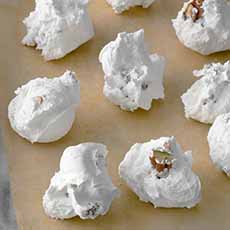
[1] Homemade, fluffy divinity. The recipe is below (photo © Taste Of Home).
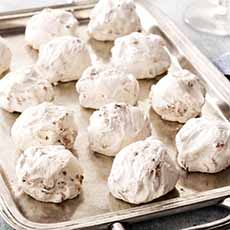
[2] These airy delights are made by a pecan producer. You can get them here (photo © Priester’s Pecans).
[3] For festive holiday divinity, Martha Stewart added candied cherries and citron along with the pecans Here’s the recipe. You can also make this holiday version with crushed peppermint candies (photo © Alpha Smoot | Martha Stewart).
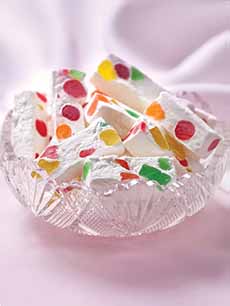
[4] This is a fun version of divinity, with added Jujube candies. Get it at the Vermont Country Store (photo © Vermont Country Store).
[5] This vegan divinity recipe is made with maple syrup instead of sugar (photo © Hannah Kaminsky | Bittersweet Blog).
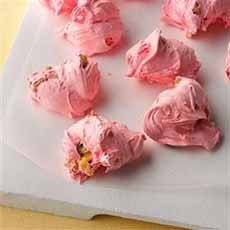
[6] Cherry divinity. Here’s the recipe (photos #7 and #8 ©Taste Of Home).
[7] This batch was made in the microwave. Here’s the recipe.
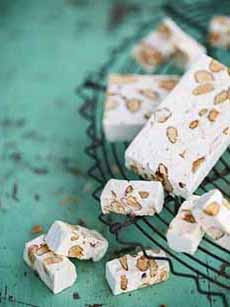
[8] Lastly, an actual piece of nougat (photo © Marmiton)!
|