|
March 13th, National Coconut Torte Day, begs the question: What is a torte? Is it just a pretentious word for cake, something to make you think the torte is more special than an everyday cake?
Nein, mein freund. While torte is the German word for what the British (and Americans) call cake and the French call gâteau, they don’t refer to identical confections.
Below:
> Baking by country.
> Tort vs. tart: the difference.
> The different meanings of “cake.”
Elsewhere on The Nibble:
> The history of cake.
> The different types of cakes: a photo glossaty.
> The year’s 55+ cake holidays.
BAKING BY COUNTRY
Different cooking traditions led to different styles of baking. Baking cookbooks that focus on particular countries show the extent of the differences. They’re different, equal, and equally delicious.
To look at just three nations’ traditions:
British cakes, German tortes and Italian tortas are generally hardier creations than delicate French gâteaux.
The French, those keen culinarians, went for light, rich, layered affairs stuffed with custard, whipped cream or butter cream, frosted, and decorated with fresh fruit—oh la la, but very perishable.
While British culinary tradition created sturdier, longer-lasting pound cakes and fruit cakes, tortes are rich, dense cakes made with many eggs and little or no flour, using ground nuts (and sometimes breadcrumbs) for texture.
A torte is thus easily recognizable because it’s one layer that’s shorter than a typical cake layer, often no more than 2-1/2 inches high because there’s not much, if any, flour to rise. Flourless cakes are tortes. The crumb is denser than the airy crumb of a layer cake; it’s similar to the density of a Bundt cake.
And a torte is wider than a cake—usually 10 to 12 inches in diameter compared to the typical 8-to-9-inch cake. That’s to compensate for the shorter height, so each short wedge will be a good portion.
KNOW YOUR TORTES
Alas, many people, including some bakers, use terms incorrectly. The following may be called “torte” by their makers and/or sellers, but are not tortes:
Bundt cakes
Layer cakes
Sheet cakes
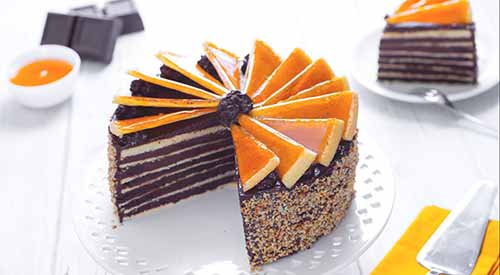
[ ] Dobos Torte, the famed Hungarian multi-layer chocolate caramel cake. Here’s the recipe (photo © Giallo Zafferano).
THE CONFUSION OVER TORTES
Why do we see so many layer cake recipes called tortes? Torte is a sub-category of cake with particular criteria.
The confusion stems from the fact that torte is the German/Central European word for cake, and many such tortes are dense, one-layer cakes. However, in the pastry world, a torte is defined by its ingredients and construction rather than just its height or density.
Ingredients: Flour vs. Crumbs/Nuts
Cake: The most traditional distinction is that a cake is made primarily with wheat flour, the crumb is light and airy, and usually topped with thick frosting.
Torte: A torte replaces most or all of the flour with ground nuts (like almonds, hazelnuts, or walnuts) or breadcrumbs. The nuts are what gives a torte its characteristic heavy, tight, and dense crumb, compared to the airy, spongy texture of a typical American layer cake. A torte can be unfrosted, or garnished with nuts or a glaze.
The Number Of Layers
While Americans familiar with the German Linzer torte and Sacher torte* can easily think of tortes as being one layer (as are flourless chocolate cakes, which are tortes, and sheet cakes, which are not tortes), there are multi-layer classic European tortes like the Dobos Torte (Hungarian, five to seven thin layers of sponge cake sandwich, photo #__) or the Prinzregententorte (Bavarian, 6 to 8 thin layers of genoise sponge cake, photo #__)—are famous for having many thin layers (often 6 to 12).
The confusion between cake and torte is in the way the layers are made:
Layer Cake: 2 or 3 thick layers are filled and stacked (you can find four layers, too).
Single-Layer Torte: The nut-dense crumb can actually be a single layer, or can be sliced in half but short enough to resemble a single layer (short) cake.
Multi-Layer Torte: Tortes with numerous (five or more) paper-thin layer of nut-heavy batter are stacked with thin layers of buttercream, ganache, or jam.
Flourless Torte (a.k.a. Cake): Short and dense these one-layer cakes, they are rarely stacked into multiple layers.
What About Tarts?
Tart and torte are not related except broadly: both are filled baked goods that can be sweet or savory.
A torte is a type of cake. The cake layers are baked in a tin with smooth edges. It does not have a bottom crust, as do tarts and pies.
A tart is related to a pie: a filled crust. A tart has no top crust but it may have a lattice. A pie can have a top crust, no top crust, or a lattice. A tart is baked in a special tin with crimped edges (more difference between tarts and pies).
There are also polenta or grits cakes: cooked cornmeal spread into a pan and allowed to cool and solidify into a “cake” which is then sliced and seared until crispy on the outside.
In some regions or historical contexts, “cake” refers to thin, flat batters cooked on a griddle, e.g., pancakes.
Asian “Cakes”
In Asian cuisines:
Chinese Turnip Cake (Lo Bak Go): A staple of Cantonese Dim Sum, these are made from shredded radish and rice flour, often flavored with dried shrimp or Chinese sausage, then steamed and pan-fried.
Japanese Savory Pancakes (Okonomiyaki): Also called cabbage cake, this griddled dish contains a variety of ingredients in a wheat-flour-based batter. Cabbage, meat, and seafood are dipped in batter, cooked on a griddle (teppan), and topped with a special sauce, mayonnaise, seaweed flakes (aonori), and bonito flakes (katsuobushi).
Korean Rice Cakes (Tteok): Chewy, savory cakes made from steamed rice flour, often used in spicy stews or stir-fries.
Non-Food References To Cake
A Solid Block: A shaped or compressed mass of a specific substance, such as a cake of soap, a cake of ice, or oil cake (the solid residue left after pressing seeds for oil).
An Encrusted Layer: Something that has hardened or dried onto a surface, such as a cake of mud on a boot or a cake of rust on metal.
Religious: Small, often unleavened wafers or breads used in various religious rites are sometimes referred to as cakes.
|
|
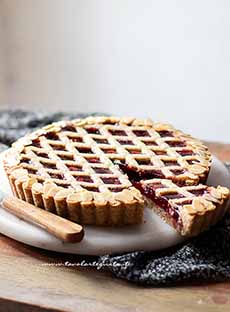
[1] A Linzer torte, a type most familiar to Americans, is just one layer. Here’s the recipe and the history of the Linzer torte (photo © Tavolartegusto). plain coconut torte from SweetSmarts.com; it’s also sugar-free.
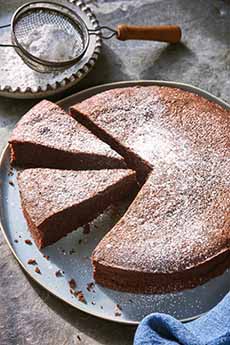
[2] Torta Caprese is a single-layer flourless chocolate cake replacing flour with ground almonds. Here’s the recipe (photo © The Clever Carrot).
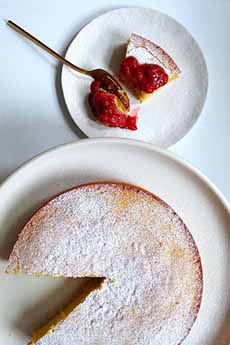
[3] A single-layer flourless almond and coconut torte. Here’s the recipe from Food 52.
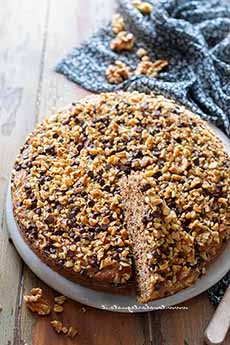
[4] A single-layer mixed nut torte. Here’s the recipe (photo © Tavolartegusto).
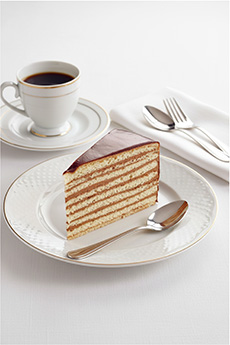
[5] The multi=layer Prince Regent Torte, Prinzregententorte, was created in the late 19th century by Heinrich Georg Erbshäuser in honor of Prince Regent Luitpold of Bavaria. Seven thin genoise sponge layers are separated by chocolate buttercream, covered in a dark chocolate glaze. The seven layers represent the seven regions of the state of Bavaria: Oberfranken, Mittelfranken, Unterfranken, Schwaben, Oberpfalz, Oberbayern, and Niederbayern. Historic note: It used be an eight-layer cake until Rheinpfalz exited Bavaria to join the Rheinland post World War II, creating the state of Rheinland-Pfalz. Sorry guys: No cake for you. Here’s the recipe (photo © The Cottage Loaf).
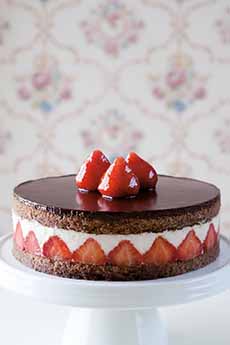
[6] Is it a torte? The dense sponge layers with a nut-like texture say so, even when there are no nuts. But the mousse-like filling (here. coconut crème) and the fresh strawberry perimeter are a classic French fraisier‑style gâteau technique. Is it a fair call to say it’s a hybrid? Here’s the recipe (photo © Lindt, but recipe is no longer on their website).
|



