|
Is there anything more wonderful than a favorite comfort food in the hands of a great chef?
We worshipped Parisian pâtissier Pierre Hermé, a fourth generation pastry chef from Alsace, even before we saw these ice cream sandwiches. As his Star Chefs bio says, “Pierre Hermé didn’t just carry on the family tradition; he rocketed it into the stratosphere.”
Hermé began his career at age 14 as an apprentice to Gaston Lenôtre, was a full-fledged pastry chef by 20 at Fauchon, and established Pierre Hermé Paris since 1996.
Unable to get to Paris, we set to work recreating the ice cream sandwiches.
Hermé, the master of macarons, makes rectangular meringue cookies to sandwich his ice cream sandwiches. By all means, try it if you’re up to the challenge. Unschooled in the technique, we couldn’t get ours out of the pan and evenly sliced without a lot of breakage; but the pieces tasted fine.
Otherwise, you can use any base, from cookies to cake slices. We really liked pound cake, pre-toasted and cooled before the ice cream was added.
|
|
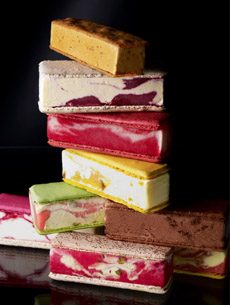
The prettiest ice cream sandwiches, on meringues. Photo courtesy Pierre Hermé. |
|
PIERRE HERMÉ ICE CREAM SANDWICHES
Ingredients
2 complementary flavors of ice cream and/or sorbet
Optional inclusions: berries, chips, nuts, etc.
Sandwich base of choice (cookies, cake)
While all combinations we tried were delicious, we especially loved vanilla ice cream with raspberry sorbet or passionfruit sorbet.
|