|
Updated August 2026
August 29th is National Lemon Juice Day, a good nudge to us to highlight the versatility of this sunny fruit, well beyond standard recipes.
We begin in defense of lemons: Why is a defective car called a “lemon?”
- In the 1906-1909 time frame, the phrase “to hand someone a lemon,” meaning to pass off a substandard or fake item as a good one, arose in British and American slang—possibly because biting into one leaves a sour, unpleasant taste in one’s mouth.
- As automobiles grew widely popular in the 1920s, buyers frequently ran into unscrupulous used-car salesmen who knowingly sold broken-down vehicles. Consumers applied the word “lemon” to automobiles that didn’t run properly, leaving buyers just as soured on the deal.
Here, we defend the juice of this vilified fruit.
Below:
> Lemony tips, including how to squeeze the last drop of juice.
> Beyond recipes: ways to use lemon juice.
> Using lemon juice to cut back on salt.
> Uses for lemon zest.
> Ready-to-use Volcano Burst lemon juice (tastes almost like fresh-squeezed).
> Can you name the parts of a lemon?
Elsewhere on The Nibble:
> The different types of lemons: a photo glossary.
> The history of lemons.
> The year’s 40+ citrus holidays.
1. LEMONY TIPS
Buying Lemons
Choose heavy, smooth-skinned fruit. Thin-skinned lemons with smooth, glossy rinds yield substantially more juice than thick, pebbled-rind varieties, which reserve more volume for the pith. Compare same-size lemons in your hand and select those that are heavier.
Storing Lemons
Whole lemons stored loose in the fridge will stay juicy for about two weeks. Sealing them in an airtight plastic bag or container with a splash of water keeps them plump for up to a month.
Once a lemon is cut, its exposed flesh will dry out, shrivel, and absorb odors quickly in the fridge if the cut edge is left uncovered.
Never leave a cut lemon on the counter. It dries out within hours and loses acidity. In a day or two, it becomes a breeding ground for mold and bacteria.
Juicing Lemons
Bring lemons to room temperature before juicing. Cold lemons straight from the fridge have rigid, contracted cell walls that yield less juice. If you plan to use them in the next few days, just leave them on the counter.
There are roughly 2 to 3 tablespoons of juice in a lemon. To get every last drop of it, whether you’re using a manual juicer, an electric juicer, or hand-squeezing, try one of these options:
- Roll the lemons on the counter before squeezing, or microwave them for 10 to 20 seconds (pierce the skin once with a fork tine or a cake tester).
- You can also submerge firm lemons in a bowl of hot tap water for 5–10 minutes before squeezing. This softens the outer rind and loosens the internal juice sacs.
Slicing & Extraction Techniques
- Cut lengthwise, not crosswise. Slice the lemon from pole to pole (stem to blossom end) rather than across the equator. This exposes more of the juice-containing segment membranes to direct pressure, significantly increasing manual yield.
- Try the “X cut” (quadrant slicing). Cut around the center core by slicing off four outside cheeks, leaving a square central core. Squeeze the four outer pieces individually, then twist the core. This yields noticeably more liquid than a simple halve-and-squeeze.
- Skewer-and-squeeze method (the No-Cut Technique). Pierce the blossom end of an uncut lemon with a clean metal skewer, toothpick, or chopstick, working it into the center. Squeeze the whole fruit over a bowl to extract a controlled stream of juice without exposing seeds or drying out unused portions.
2. BEYOND RECIPES: WAYS TO USE LEMON JUICE
You may know a lot of these but here’s a refresher:
Culinary & Prep Hacks
- Prevent enzymatic browning. A quick brush or toss of lemon juice keeps sliced apples, pears, avocados, and raw potatoes from oxidizing. Instead of brushing, you can make acidulated water—a bowl of water with 1 tablespoon of lemon juice for every 2 cups of cold water—to keep peeled and sliced potatoes until you’re ready to use them.
- Rescue over-salted dishes. Adding a splash of acid cuts excessive saltiness or heavy fat in soups and sauces, without changing the base flavor profile.
- Make buttermilk. Demonstrate simple kitchen chemistry—adding one tablespoon of lemon juice per cup of milk creates an instant buttermilk substitute for baking.
- Cure raw seafood. Lemon juice sets protein structures instantly, as in ceviche—raw fish, scallops, or shrimp, for starters.
- Take the bite out of onions. If you have an onion that’s too pungent to eat raw, soak the slices in straight lemon (or lime) juice for 15 to 30 minutes to tame the bite. If you soak red onions, they’ll turn bright pink!
Kitchen Cleaning
- Deodorize and sanitize kitchen surfaces. Lemon juice is a natural alternative to harsh cleaners. Rubbing lemon juice mixed with coarse salt on wooden cutting boards lifts stains and neutralizes garlic/onion odors.
- Remove mineral stains and hard water stains. Show how the natural citric acid dissolves limescale and water spots on chrome faucets, glass shower doors, and tea kettles.
- Steam clean the microwave. Heat a bowl of lemon juice and water for three minutes to loosen baked-on splatters and eliminate stale food smells (including burnt popcorn and biscuits).
3. USE LEMON JUICE TO CUT BACK ON SALT
The average American consumes twice the amount of recommended sodium daily. Uh oh.
Even if you’re in great shape now, as you hit middle age, the excess sodium can create serious problems.
While much of the salt we consume is in prepared and processed foods, you can reduce the salt in recipes—including proteins, grains, soups, salads, rubs and seasoning mixes—up to 75% without compromising flavor.
Lemon juice is an excellent substitute for salt.
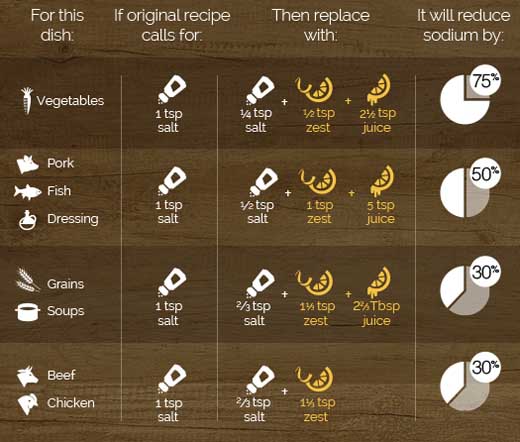
- In everyday cooking, instead of a teaspoon of salt, use 1/4 teaspoon salt and 1/2 teaspoon lemon zest before/during cooking.
- Finish cooked food with 2-1/2 teaspoons lemon juice instead of salt.
Your Daily Sodium Limit
Dietary Guidelines from the USDA Center For Nutrition Policy And Promotion recommend that Americans consume less than:
- 2,300 mg of sodium per day for healthy individuals age 14 and up.
- 1,500 mg of sodium per day for individuals with hypertension or elevated risk.
How much sodium is in your daily diet? You’d be shocked.
For just one day, write down everything you eat. Packaged foods will have the sodium on the nutrition label; you can look up other foods.
|
|

[1] Ready to juice (photo © Dominika Roseclay | Pexels)!
[2] For the most yield, lemons should be at room temperature before juicing (photo © Jeff Siepman | Wesual | Unsplash).
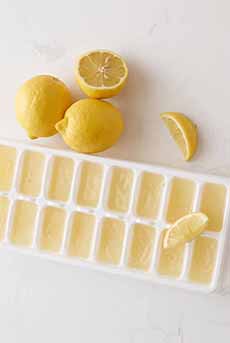
[3] Freeze lemon juice in ice cube trays. You’ll always have lemon juice at the ready (photo © Food Network).
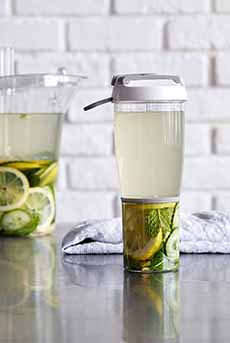
[4] Make spa water with lemon juice, lemon slices, cucumbers, ginger…whatever you have on hand. Here’s the recipe (photo © Pampered Chef).
[5] Use more lemon juice, less salt (photo courtesy Cooking San Francisco).
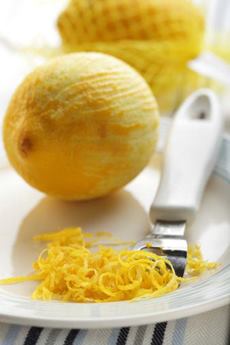
[6] Before you juice the lemon, zest it. There are many uses for the zest, and you can freeze it until you need it (photo © Sunkist).
[7] We keep a “bottle” of Volcano Burst in the fridge for when we’re out of lemons, or we just need a teaspoon or two (photo © The Nibble).
|
Excessive sodium intake has been linked to health problems such as high blood pressure, cancer, and osteoporosis. According to a study from the University of California (UCSF) Action Research Center for Health at Zuckerberg San Francisco General Hospital and Trauma Center in San Francisco:
- If every American reduced his or her daily sodium intake by 400 milligrams, 32,000 heart attacks, 20,000 strokes, and 28,000 deaths could be prevented each year.
- This is not just a guideline for adults: The habits kids develop stay with them for life.
[8] Thanks to Sunkist for this chart.
4. USES FOR LEMON ZEST
Before you juice that lemon, zest it! You can freeze the zest and add it directly to your recipes without thawing it first.
Add zest to:
- Vinaigrette. Add zest to vinaigrettes and other salad dressings.
- Compound butter. Mix the zest into softened butter to melt over grilled fish, pasta, or vegetables.
- Dipping oil. Flavor your EVOO (extra virgin olive oil).
- Lemon salt. Mix the zest with coarse sea salt. Let it dry, then use it to season roasted vegetables, chicken, or fish.
- Lemon sugar. Rub the fresh zest into regular granulated sugar with your fingers. The natural oils infuse the sugar, which you can use for baking cookies or sweetening tea.
5. READY-TO-USE VOLCANO BURST LEMON JUICE
This is our go-to when we’re out of lemons (photo #7).
Unlike American brands of reconstituted lemon juice made from concentrate, all-natural Volcano Burst lemon juice from Italy tastes almost like the real thing.
It’s 100% lemon juice from freshly squeezed lemons. The trick is in the cap, which holds lemon oil extracted from the rind. When you squeeze out the juice, some oil comes with it, making it taste close to fresh-squeezed.
6. CAN YOU NAME THE PARTS OF A LEMON?
[9] Know your lemon parts (photo © The Lemon Age | The European Commission).
CHECK OUT WHAT’S HAPPENING ON OUR HOME PAGE, THENIBBLE.COM.
|