THE NIBBLE BLOG: Products, Recipes & Trends In Specialty Foods


Also visit our main website, TheNibble.com.

Frozen Hot Chocolate Recipe For A Chocolate Chill-Down

What’s a Frozen Hot Chocolate? It’s an icy cold version of hot chocolate, of course. Depending on how you make it, it’s a chocolate milkshake with added cocoa powder. There are many variations of the recipe.

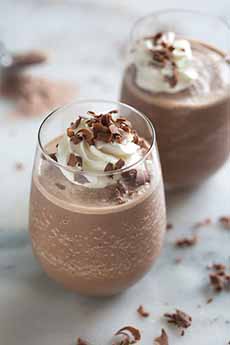
Some recipes start by blending melted chocolate with hot cocoa powder, milk, and ice, and garnished with whipped cream (like this recipe).

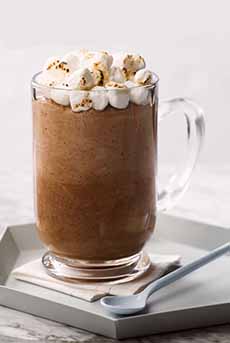
Others are minimalist, blending ice with cocoa powder, sugar, powdered non-dairy creamer, and milk (like this Hershey’s recipe).

The original Frrrozen Hot Chocolate [not a typo] from Serendipity 3 in New York City uses a recipe similar to the one below but with chocolate ice cream, sprinkles, and a maraschino cherry (the recipe).

The following recipe is our go-to.

It uses a packet of hot cocoa mix, milk, and ice, plus the added richness of vanilla ice cream.

> National Hot Chocolate Day is January 31st.

> National Milkshake Day is September 12th.

> The history of hot chocolate.

> The history of frozen hot chocolate is below.
 
 
RECIPE: FROZEN HOT CHOCOLATE

You can opt to make this recipe with a no-sugar-added cocoa mix and no-sugar-added ice cream.

In our opinion, if you want to shave calories, it’s better to lose the sugar than the richness of whole milk.

If you use mini marshmallows, use your kitchen torch to brûlée them as in photo #3.
 
Ingredients Per Drink

  • 1/2 cup whole or 2% milk
  • 1 heaping cup ice cubes or crushed ice
  • 1 cup vanilla or chocolate ice cream
  • 1 packet/1.5 ounces hot cocoa mix of choice (regular, Mexican, mint)
  • Garnish: marshmallows or whipped cream topped with chocolate curls/shavings, mini chips, sprinkles
  •  
    Preparation

    1. COMBINE the milk and ice in a blender and process just until the ice is crushed.

    2. ADD the hot cocoa mix and ice cream. Blend until ice cream is combined into a milkshake consistency.

    3. GARNISH as desired.
     
     
    THE HISTORY OF FROZEN HOT CHOCOLATE

    Frrrozen Hot Chocolate has long been on the menu at Serendipity 3 in New York City (founded 1954). Back in the 1960s when we met the owner, Stephen Bruce, he told us that he invented it.

    As noted earlier, he (or his chef) added cocoa powder to chocolate milkshake ingredients.

    Today the restaurant serves 13 different flavors of Frrrozen Hot Chocolate, including Birthday Cake, Peanut Butter, and Salted Caramel.

    While many celebrities have graced Serendipity’s tables, one, Selena Gomez, became a partner and investor in 2021 (which should make it Serendipity 4*).

    If anyone knows a different origin, speak now or forever hold your peace.

    We have seen references that:

  • Frozen hot chocolate “is believed to have originated in the United States in the early 1900s” [source]. But the blender wasn’t invented until 1922, and not mass-produced until to make it until 1933, so we don’t know what blades would have ground up the ice cubes.
  • Another source places the invention of frozen hot chocolate to the 1970s, where Steve Herrell, owner of the eponymous Herrell’s Ice Cream in Northampton, Massachusetts (it’s still there!) [source].
  •  
    While Herrell may have had Frozen Hot Chocolate on the menu, Bruce beat him to it by a decade or more.
     
     
    ________________

    *The Serendipity 3 founding partners were Stephen Bruce, Patch Caradine, and Calvin Holt. The “desirable discoveries made by accident” include not just frozen hot chocolate, but a foot-long hot dog and a caviar omelet (the latter created by chef James Beard).


    Serendipity Restaurant's Frozen Hot Chocolate
    [1] The original Frrrozen Hot Chocolate. Here’s the recipe from Chef Joe Calderone (photo © Serendipity 3).

    Serendipity Restaurant Frozen Hot Chocolate
    [2] This version doesn’t use ice cream but does use high-quality melted chocolate. Here’s the recipe (photo © Lauren Allen | Tastes Better From Scratch).

    Glass Mug Of Frozen Hot Chocolate With Mini Marshmallows On Top
    [3] Surprisingly, Hershey’s version is the most spare: no ice cream, but powdered dairy creamer. Here’s the recipe (photo © The Hershey Company).

    Peanut Butter Frozen Hot Chocolate Garnished With Mini Peanut Butter Cups
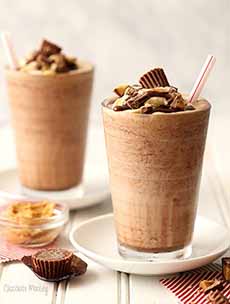
    [4] How about a Peanut Butter Frozen Hot Chocolate? Here’s the recipe (photo © Chocolate Moosey).


    CHECK OUT WHAT’S HAPPENING ON OUR HOME PAGE, THENIBBLE.COM.


    Comments off

    Recipes With Pineapple Juice For National Pineapple Juice Day

    Glass & Bottle of Pineapple Juice
    [1] Serve pineapple juice on the rocks with a wedge of fresh pineapple (photo © Denys Gromov | Pexels).

    Pineapple Cheesecake
    [2] Make a no-bake pineapple cheesecake. Here’s the recipe (photo © Kraft Recipes).

    Spiced Pineapple Rum Punch
    [3] Spiced Pineapple Rum Punch. Here’s the recipe (photo © Koloa Rum).

    Pineapple Pound Cake
    [4] Pineapple Pound Cake. Here’s the recipe (photo © Hannah Kaminsky | Bittersweet Blog).

    Can Of Dole Pineapple Juice
    [5] Canned pineapple juice from Dole enabled people in the U.S., Europe, and elsewhere to experience it (photo © Dole Food Company).


    August 14th is National Pineapple Juice Day. While we don’t think we’ve had a glass of pineapple juice in our adult life, we have had it in cocktails, desserts, glazes, marinades, and other recipes.

    Here are some of them. We’ve also included a few that include pineapple chunks or slices but no added juice.

    > The history of pineapple.

    > The history of pineapple juice is below.
     
     
    DRINKS WITH PINEAPPLE JUICE

  • Basic Fruit Punch
  • Beer Piña Colada
  • Fish Bowl Punch
  • Flavored Ice Cubes
  • Golden Piña Colada
  • Golf Cocktail
  • Le Baiser de Noilly: Gin, Grenadine, Pineapple Juice, Vermouth
  • Piña Colada Jell-O Shots
  • Pineapple Ice Cubes
  • Pineapple Juice Cocktails In Team Colors
  • Pineapple Pisco Punch
  • Rum Cocktails With Pineapple Juice
  • Spiced Pineapple Rum Punch
  • Spicy Grilled Pineapple Cocktail
  • 3 Mojito Recipes
  •  
     
    DESSERTS WITH PINEAPPLE JUICE

  • No-Bake Frozen Pineapple Cheesecake
  • Piña Colada Cheesecake
  • Pineapple Pound Cake
  •  
     
    USES FOR LEFTOVER PINEAPPLE JUICE

  • Anti-browning: As with lemon juice, toss it with cut fruit.
  • Baking: Substitute for water in a boxed cake mix, for oil in quick bread.
  • Condiments: Add to barbecue sauce, homemade ketchup (recipe).
  • Cook with it: in brines, marinades, sweet sauces, substitute for water in pancake batter
  • Drink it: straight, in cocktails, in smoothies, in a spritz.
  • Freeze it: into ice pops, granita, or pineapple sorbet.
  • Dole Whip: Here are 8 recipes.
  • Salad: Add to vinaigrettes.
  •  
     
    PINEAPPLE JUICE TRIVIA

    Pineapple juice is rich in nutrients, particularly copper, manganese, and vitamins B6 and C. These nutrients play an important role in bone health, immunity, wound healing, energy production, and tissue synthesis.

    Some research suggests that pineapple juice may contribute to a stronger immune system.

    In 1932, the Hawaiian Pineapple Company successfully developed a process of clarifying the juice, while capturing the aroma and flavor of the fruit.

    Countries consuming the most pineapple juice:

  • In 2017 Thailand, Indonesia, and the Philippines had a combined consumption of 47% of the world total.
  • In 2019, the countries that consumed the most pineapple juice were Spain, France, and Germany, consuming about half of the world total.
  • Spain was the largest producer of pineapple juice in Europe, with France and Italy as secondary producers [source].
  •  
    Pineapple juice can be used as a meat tenderizer.

    Pineapple juice powder can be used in baked goods (cakes, muffins, pies, scones), candies, condiments (barbecue and chili sauces, chutneys, jams), and savory recipes like sauces and stews.

    Pineapple juice powder can also be used in marinades for chicken and fish.
     
     
    THE HISTORY OF PINEAPPLE JUICE

    The pineapple Ananas comosus var. comosus) originated in South America, thousands of years ago. It is believed to have originated in what is now southern Brazil and Paraguay.

    The natives of those regions carried it throughout South America via trade. It eventually reached the Caribbean, Central America, and Mexico, where it was cultivated by the Mayas and the Aztecs.

    The first Europeans to see pineapples were Christopher Columbus and his crew, on the Caribbean island of Guadeloupe, in 1493. Columbus called them piña de Indes, “pine of the Indians,” because their shape was reminiscent of Europe’s pine cones.

    He brought them back to King Ferdinand in Spain, and the exotic fruit was an instant hit in the royal court.

     
    The Portuguese, who colonized Brazil, had brought the fruit from Brazil to India by 1550.

    It was brought to northern Europe by the Dutch, from their colony in Surinam.

    Spanish traders introduced the pineapple to Guam, Hawaii, The Philippines, and Zimbabwe.

    There is no record of the date when pineapples arrived in Hawaii. The fruit may have arrived with the Spanish years before the arrival of Captain James Cook in 1778. Conceivably, it could have washed ashore from a Spanish or Portuguese shipwreck or brought ashore by sailors [source].

    However, the presence of pineapples was first recorded in 1813. A Spanish horticulturist, Don Francisco de Paula Marin, described pineapple planting in his journals in 1813.

    When American missionaries first arrived in Hawaii in 1820, pineapples were found growing wild and in small gardens.

    The pineapple canning industry began in Baltimore in the mid-1860s using fruit imported from the Caribbean. The export-based Hawaiian pineapple industry was developed by a group of Californians who arrived in Hawaii in 1898, and the well-connected James D. Dole who arrived in 1899.

    The first profitable lot of canned pineapples was produced by Dole’s Hawaiian Pineapple Company in 1903 and the industry grew rapidly from there [source].

    Pineapple juice is manufactured from ripe pineapples. It contributed to the success of Hawaii’s pineapple industry in the 1930s.

    In 1932, the Hawaiian Pineapple Company successfully developed a process of clarifying the juice, while capturing the aroma and flavor of the fruit.

    This led to the large-scale cultivation of pineapples and the canning of both the juice and the fruit (slices, chunks, crushed).

    This enabled many Americans, Europeans, and consumers in other parts of the world to experience pineapple for the first time. Fresh pineapples were very costly, due to the need to pick them when ripe. and then transport them across the seas.

    Most of America’s pineapple juice consumption goes into cocktails.

    Otherwise, the average American drinks pineapple juice 1.4 times per year [source].

    The global pineapple juice market size was valued at $2.37 billion in 2021 and is expected to expand at a compound annual growth rate (CAGR) of 8.1% from 2022 to 2028 [source].


    CHECK OUT WHAT’S HAPPENING ON OUR HOME PAGE, THENIBBLE.COM.


    Comments off

    Maury’s Hive Tea Bags Are Sweetened With Honey

    Maury Pittman, a fitness trainer and wellness professional, has reinvented the tea bag. He’s infused it with honey.

    You add boiling water, steep, and sip: The sweetness of honey pleases your palate to the end. Yummy honey with no sticky mess.

    How does he do it?

    Maury’s tea bags include premium robust black or green tea and premium, granulated honey.

    The result is both delightful and invigorating.

    With 10 years in business under his belt, Maury is still making his uniquely blended tea bags, each filled with a perfect combination of whole-leaf tea and sweet granulated honey.

    It’s a tea-riffic combination, says Maury, who continues to use only the best, highest-quality teas and granulated honey.

    So: Steep, sip, and enjoy a cup of hot or iced tea infused with honey (and lots of love from Maury).

    > The different types of honey: a photo glossary.

    > The history of honey.

    > The year’s honey holidays are below.


    MEET THE TEAS

    Maury’s offers two premium teas, black and green, both available in regular and decaf, both all-natural.

    The specialized formula works great in both hot and cold water.

    All you have to do is heat the water and allow the bag to steep. The longer it steeps, the sweeter it gets.

    Maury’s Black Buzz

    Maury’s Black Buzz tea bags are whole-leaf black tea uniquely blended with sweet granulated honey.

    Maury’s Green Glory

    Maury’s Green Glory tea bags are whole green leaf tea uniquely blended with sweet granulated honey.

    Black or green, caf or decaf, every cup is pure deliciousness.
     
    So, whether you’re snuggling on the couch with a hot cup of tea, or on the patio with a tall glass of iced tea, experience the delights of Maury’s Hive Tea.

    Sip, sip, hooray!
     
     
    GET YOUR MAURY’S HIVE TEA

    A box of 15 tea bags is $9.99, with shipping and taxes included.

    A box of 30 tea bags is $18.99, with shipping and taxes included.

    Subscribe & Save: 30 bags delivered every 30 days is $16.99 per month.

    Are you ready to join the hive?

    Head to MaurysHiveTea.com.
     
     
    TAKE A SIP OF THIS TEA INFO

    > The different types of tea.

    > The different types of honey.

    > The history of tea.

    > The history of iced tea.

    > The history of tea bags.

    > The history of afternoon tea.

    > The history of honey.

    > A year of world and national tea holidays.
     
     
    HONEY HOLIDAYS

    World Honey Bee Day is celebrated every third Saturday in August (upcoming: August 19, 2023, August 17, 2024).

    National Honey Month is September.


    CHECK OUT WHAT’S HAPPENING ON OUR HOME PAGE, THENIBBLE.COM.


    Cup Of Black Tea On A Wood Tabletop
    [1] What’s missing from this picture? The sweetener! That’s because honey granules are in the tea bag (photo © Mark T. Wendell Tea Company | Facebook).

    Box Of Maury's Hive Tea Black Tea Bags. The tea bags are sweetened with granulated honey blended with the tea leaves.
    [2] A box of Maury’s Black Buzz (photos #2 and #3 © Maury’s Hive Tea).

    Box of Maury's Hive Tea Green Tea Bags. The tea is blended with granulated honey, so there's no need to add sweetener.
    [3] A box of Maury’s Green Glory.

    Jar Of Honey With Drizzler
    [4] With Maury’s, there’s no need to drizzle honey, or clean up dripped honey (photo © National Honey Board | Facebook).

    Granulated Honey
    [5] Instead, there are honey granules in each tea bag. You can also use it in brines, marinades, sauces, vinaigrettes, and drizzled on frosting. You can find granulated honey online (photo © Spice Jungle).


    Comments off


    © Copyright 2005-2026 Lifestyle Direct, Inc. All rights reserved. All images are copyrighted to their respective owners.