THE NIBBLE BLOG: Products, Recipes & Trends In Specialty Foods


Also visit our main website, TheNibble.com.

TIP OF THE DAY: Christmas Fondue

In supermarkets, displays are currently piled high with panettone and pandoro, Italian holiday breads that are traditionally served and gifted during the Christmas and New Year season.

The origins of sweet leavened breads date back to Roman times. By Medieval times, different regions of Italy had created signature holiday breads. Best-known, and available in the U.S., are:

  • Pandoro, the star-shaped “golden bread” from Venice, has no inclusions but is sprinkled with confectioners’ sugar. This modern version first appeared in late 19th-century Verona. In the Renaissance, cone-shaped cakes for the wealthy were dusted with gold leaf.
  • Panettone, from Milan, has origins in a medieval Christmas yeast bread, filled with candied fruits and raisins. It is tall, dome-shaped and airy. While the recipe has been around for centuries, the first known use of the word “panettone” with Christmas is found in the 18th century writings of Pietro Verri, who refers to it as “pane di tono,” “large loaf.”
  • Panforte is short and dense, almost like fruitcake. It dates to 13th-century Siena, in Tuscany. Like fruitcake, it is served in thin slices.
  •    
    milk-chocolate-fondue-zabars-230

    Dip panettone cubes into chocolate fondue. Photo courtesy Zabars.


    PANETTONE DESSERT

    Most panettone is accented with raisins, candied orange peel, citron and lemon zest. Some modern versions add chocolate, which was not available when the recipe originated; others are plain, like pandoro.

    For a dessert or a snack, the classic panettone accompaniment is a sweet hot beverage or a sweet wine such as spumante or moscato (any dessert wine will do). Some Italians add a side of crema di mascarpone, a cream made from mascarpone cheese, eggs, and amaretto (or you can substitute zabaglione, a sherry-flavored custard sauce).

    But you can Americanize it into chocolate fondue with seasonal dippers. Here are recipes for chocolate and white chocolate fondues. Consider a white chocolate version with panettone and green and red fruit dippers—very Christmassy.

    You can also slice the panettone into layers and fill them with whipped cream (how about bourbon or rum whipped cream); then top with berries.


    pandoro-monkey-chef.blogspot-230
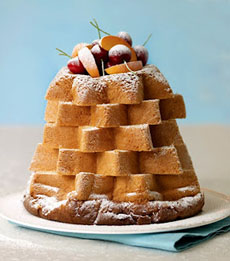
    A pandoro, baked in the shape of a star, with staggered slices emulating a Christmas tree. Photo courtesy Monkey-chef.blogspot.com.
      FONDUE DIPPERS

    Cakes, Cookies & Candies

  • Amaretti
  • Biscotti: cranberry, ginger, pumpkin
  • Crystallized ginger
  • Fruit cake cubes
  • Mini meringues
  • Gingersnaps or mini gingerbread men
  • Panettone cubes
  •  
    Fruits

  • Figs
  • Kiwi
  • Lady apples
  • Red grapes
  • Clementine/orange/mandarin segments
  • Pear slices
  • Strawberries and raspberries
  •  
    MORE PANETTONE DESSERT RECIPES

  • Try this Panettone Bread Pudding recipe.
  • With this Panettone French Toast recipe, you can serve the slices like dessert crêpes, topped with some whipped cream or ice cream.
  •  
    PANDORO DESSERT

    The star shape of a pandoro enables creative cooks to cut the cake into horizontal layers, then stack them in a offset layers to create a Christmas tree effect (see the photo above). You can decorated the tree with red and green candied cherries, or raspberries and and mint leaves.

    Alternatively, layers can be sandwiched with whipped cream or zabaglione. Whipped cream flavored with amaretto, Irish cream liqueur or chocolate liqueur is especially festive. Follow this recipe for Bourbon whipped cream (there’s also a recipe for salted caramel whipped cream).

    Find more pandoro recipes at BauliUSA.com.


    Comments off

    STOCKING STUFFER: Wine-Infused Chocolates

    pod_vine-wine-chocolate-gearharts-230
    Delicious wine-infused chocolates. Photo by
    Elvira Kalviste | THE NIBBLE.
      Virginia-based Gearharts chocolates Fine chocolates has some irresistible treats for stocking stuffers, party favors or anytime indulgence.

    For wine lovers, an excellent stocking stuffer is Pod and Vine, a box of four bonbons. The pod refers to the cacao; the vine is the wine that infuses the ganache.

    It’s not just any wine: It’s Cabernet Franc from Virginia’s highly regarded Barboursville Vineyards.

    Four boxed bonbons are $8.00 at GearhartsChocolates.com; nine pieces are $20.00.

    We’re also fond of the Pistachio Toffee, eight pieces of buttery toffee with roasted pistachios, enrobed in bittersweet chocolate ($8.00).

    For a full-size gift, another great gift is a Top Pick From Last Year, Chocolate Peanut Butter Pups. That’s pups, not cups: The pieces are decorated to look like dog heads.

    The milk chocolate bonbons are filled with silky chocolate ganache, which is lightly infused with handmade peanut butter.


    And they’re guilt-free: Five percent of sales of Peanut Butter Pups is donated to Companions for Heroes, a not-for-profit organization that matches rescue pets as companion animals to our nation’s wounded veterans.
    A box of nine pieces is $22.00 at Gearharts’ online store.


    Comments off

    BOOK: Red Velvet Lover’s Cookbook

    It’s the best-selling flavor at New York’s Magnolia Bakery, L.A.’s Sprinkles Cupcakes, London’s Hummingbird Bakery and other cake emporia. Since 2005, its inclusion on restaurant menus has grown by more than 500%. It has been used to flavor coffee, tea, waffles, doughnuts, even fried chicken. It’s easy to find red velvet truffles, butter cookies, and even hot chocolate.

    Red Velvet is the flavor that came from—where, exactly?—to grab the spotlight.
     
     
    WHERE DID RED VELVET COME FROM?

    “The history of red velvet is not black and white,” says Deborah Harroun, author of the recently published Red Velvet Lover’s Cookbook.

    Stories detail its discovery in the 1870s in Canada and in the 1950s in Pennsylvania. Some give credit to the Deep South, where red velvet cake is topped with cream cheese frosting.


    red-velvet-lovers-cookbook-230

    A gift book for red velvet fans. Send it from Amazon.com (photo © Harvard Common Press).

     
    One claim is that the Waldorf-Astoria’s restaurant in New York City was the first to serve red velvet cake as we know it today. Harroun writes:

    “According to legend, a woman visited the Waldorf-Astoria, tried the cake, and fell in love. She wrote a letter to the hotel, asking if the chef would send her the recipe. The hotel did send her the recipe—along with a bill for $350. In retaliation, she made copies of the recipe and distributed them high and low.”

    That does sound like a legend; and the truth is, we don’t know where red velvet cake originated.
     
     
    SHOULD RED VELVET HAVE CHOCOLATE FLAVOR?

    Before we read the book, we were under the impression that red velvet cake should be a type of chocolate cake with red food coloring. Our mom has baked a recipe called Red Devil’s Food Cake since the 1950s.

    Think again, says Deborah: “The cocoa taste actually appears as just a hint when done correctly. I say that a red velvet cake or cupcakes taste like butter cake with just a hint of cocoa. It may be a hard flavor to describe, but once you’ve had it, you probably won’t forget it!”

    And while many committed bakers deride red velvet for its use of “fake” red food coloring, there are natural ingredients that can be used to achieve the same red hue: cranberries, other red berries, pomegranates. Mom used beets in her Red Devil’s Food Cake.


    red-velvet-cheesecake-230
    Red velvet cheesecake. Here’s the recipe (photo © McCormick).
      A CORNUCOPIA OF RED VELVET RECIPES

    What initially appeared to us as a gimmick has become a bakery staple, like another arrival of the same time, the cake pop. (Their offspring: the red velvet cake pop.)

    In the book, Deborah presents the classics as well as a host of new, inventive uses for red velvet: red velvet biscuits, donuts, cheesecakes, icebox cakes, molten lava cakes, muffins, mug cakes, pancakes and even waffles.

    There are a dozen recipes for bars, brownies and cookies, plus red velvet rolls and breads. Don’t stop there: Make red velvet cannoli, churros, éclairs, snowballs and truffles.

    Even if your favorite red velvet lover doesn’t like to bake, he or she will be entertained just by the recipes and the photos.

    Order yours at Amazon.com.
     
     
    > THE HISTORY OF CAKE

    > THE DIFFERENT TYPES OF CAKE


    Comments off


    © Copyright 2005-2026 Lifestyle Direct, Inc. All rights reserved. All images are copyrighted to their respective owners.