THE NIBBLE BLOG: Products, Recipes & Trends In Specialty Foods


Also visit our main website, TheNibble.com.

TIP OF THE DAY: Make Hot Mulled Wine For The Holidays


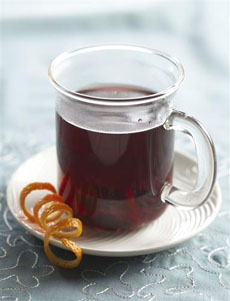
You can serve mulled wine in a mug, brandy snifter, wine glass or other vessel of choice. Photo courtesy Spice Islands.

  Mulled wine, a traditional winter drink in northern Europe, is hearty red wine that’s warmed, sweetened and spiced.

It’s a popular holiday drink. The word mulled means heated, sweetened and spiced. The expression “cup of good cheer” that comes to us from Merrie Olde England refers to hot mulled cider and wine.

Glögg is the Swedish form of mulled wine, Glühwein is the German variation, vin fieri (“boiled wine”) is Romanian, and so forth. Hot buttered rum (also called rum toddy), the Colonial favorite, uses similar spices and brown sugar (both rum and sugar came from the Caribbean).

Different countries use different spices (cloves and black pepper versus cinnamon and star anise, e.g.) and sweeteners (sugar, brown sugar, honey, molasses). But the end result is the same: fragrant, warm, sweet and comforting.

While delicious and festive, recipes originated not as party fare but as a way to save wine that had turned (throw in enough sugar and spice and anything tastes good). Ale was/is also mulled.

 
You can buy pouches of pre-mixed mulling spices, but it’s just as easy to pull out the cinnamon sticks, measure out a little allspice, mix in some dried orange peel and drop in a few whole cloves.

You can cook up the ingredients and keep them in the fridge, reheating when friends and family stop by.

Check out our article on mulled wine, cider and glogg and enjoy a cup of good cheer.

Tomorrow: how to make a wassail bowl.


HOT MULLED WINE RECIPE

There are as many mulled wine recipes as there are people who make them. This recipe, from Estancia Winery, mixes Estancia’s Pinot Noir with apple cider.

Ingredients

  • 1 bottle pinot noir
  • 2 cups apple cider
  • ½ cup honey or sugar (or more to taste)
  • 2 cinnamon sticks
  • 1 large orange (and the juice)
  • 1 lemon
  • 1 lime
  • 4 whole cloves
  • 2 bay leaves
  • 2 star anise pods
  • 1 whole vanilla pod, cut lengthwise
  • Whole nutmeg for grating
  •  

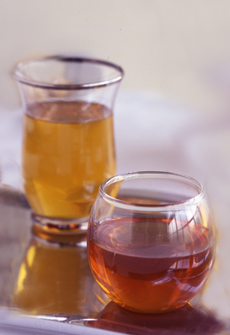
    Hot buttered rum at left, flanked by a Scotch toddy (substitute Scotch for the rum). Photo courtesy National Honey Board.

     
    PREPARATION

    1. PEEL long strips of rind from the orange, lemon and lime and place in a saucepan along with the sugar/honey and the juice of the orange.

    2. ADD the cloves, cinnamon sticks, 3 gratings of nutmeg, zest of orange, bay leaves and sliced vanilla pod.

    3. POUR enough wine and cider to cover the sugar and place over medium heat. Stir frequently until the mixture boils and thickens slightly (roughly 5 minutes).

    4. POUR in the rest of the wine and cider and turn the heat down to low.

    5. ADD the star anise and leave the mixture to heat through for about 10 minutes without boiling. Make sure to leave the spices and zest in the pan.

    6. LADLE into glasses or mugs and garnish with slices of orange, nutmeg or cinnamon sticks and enjoy!
     
    FOOD TRIVIA

    Some American food holidays are on dates that make no sense:

  • Fruits are out of season (National Apricot Day on January 9th, National Strawberry Day on February 27th, National Peach Cobbler Day on April 13th, etc.)
  • National Plum Pudding Day om February 12 (plum pudding is a Christmas tradition)
  • And so forth
  •   

    Comments off

    GIFT: Kuhn Rikon Knives In Zebra Prints & More


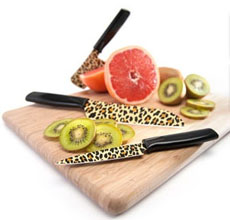
    Inspire someone to cook with these fun knife
    designs. Photo courtesy Kuhn Rikon.

      Over the past few years, Swiss kitchenware manufacture Kuhn Rikon has produced some stylin’ knives. Blades are coated with everything from polka dots to pineapples; or have cut outs ranging from baguettes (for the baguette knife) to watermelon seeds (for the watermelon slicer).

    To encourage teens and other untamed potential chefs to roam free in the kitchen, how about a gift of a Kuhn Rikon Safari Colori Knife Set? There’s a 6-1/2-inch chef’s knife and a 3-inch nakiri knife that slices, dices and juliennes.

    The nonstick coating not only bears the design; it ensures that food doesn’t stick to the blades. Each knife has a matching protective sheath. Sets range from $25.00 to $37.00; some are available with a paring knife as well. Designs include:

  • Cheetah
  • Giraffe
  • Zebra
  •  
    KNIFE TRIVIA

    The chef’s knife, also known as a French knife or a cook’s knife, was originally designed to slice and disjoint large cuts of beef. Today it is the primary all-purpose knife in most Western kitchens.

    Japanese nakiri knives are the opposite: thin bladed and not suitable for chopping through bones or other solid items like frozen foods. However, like a Chinese cleaver in mineature, they require very little effort to wield.


    Comments off

    TIP OF THE DAY: Make Dumplings Or Ravioli From Thanksgiving Leftovers

    If you still have Thanksgiving leftovers, this tip from Chef Johnny Gnall shows how to turn them into favorite comfort foods: dumplings or ravioli. If you have questions or suggestions for tips, email Chef Johnny.

    At Thanksgiving, just about every content source offers you a new take on what to do with leftovers. Here’s my take: Use them to stuff dumplings! It gives you the chance to practice your dumpling- or ravioli-making skills and produces some delicious pasta.

    Dumplings are a stuffed pasta similar to ravioli or tortellini, but with a thicker dough. If you have a pasta machine to press out thin dough, go for the ravioli!

    All the Ziploc bags and Tupperware in my fridge, crammed full of leftover Thanksgiving goodness, were soon transformed into dumpling goodness (and you can freeze any extra dumplings).

    So impress your family and friends with fresh, handmade pasta that lights up their taste buds and reminds them of that most special of eating holidays: Thanksgiving! I guarantee you they will GOBBLE it up, and may well demand that it become an annual event.


    You can use up the remaining leftovers in a sandwich…or you can make “Thanksgiving Ravioli.” Photo courtesy McCormick.com.


    HOW TO MAKE “THANKSGIVING DUMPLINGS” OR RAVIOLI

    First, make a simple pasta dough by mixing 1 egg, 1 cup of sifted flour and 2 or 3 tablespoons of room temperature water. Professionals will do this on any clean, floured surface; but use a large bowl if you want to keep things contained and neat.

  • Combine the ingredients. Use your hands to gently bring the flour, egg and water together. If you find things getting dry and caking, add another tablespoon of water or two. If it’s too wet, add some flour.
  • Work the dough very gently. The more you handle it, the tougher any dough gets. So knead it softly and form it into a smooth ball. Don’t get frustrated if your first attempt doesn’t come together just as you’d expect. Feel free to scrap it and start over if you’d like—it’s only an egg and some flour. Don’t aim for perfect on your first few tries.
  • Roll out the dough. You can use a wine bottle if you don’t have a rolling pin. Try to get the thickness to about 1/8 of an inch, and keep your surfaces well floured, flipping the dough a few times to keep it from sticking as you roll it. Take a ring cutter with a width of 3-4 inches (the rim of a drinking glass or cup works in a pinch) and cut out as many circles as you can. Re-knead the scraps and roll out the dough to coax out a few more pasta circles.
  • Fill. Lightly brush the edges of one pasta circle with a diluted egg wash (1:1 ratio of egg to water) and spoon filling into the center, compacting it as much as you can without pressing on the dough.
  • Press on. Take another dough circle, brush one side with egg wash and place it, wet side down, onto the bottom circle. Gently press the edges of the two circles together (pressing too hard may cause it to stick to the surface). Once you’ve connected it all the way around, pick up your dumpling or raviolo (the singular form of ravioli) and now, more firmly, press its edges together.
  • Overstuffed? If you find you’ve overstuffed your little guy and filling comes out, wipe it off and use some flour on your fingers to absorb moisture. It’s important to create a dry, secure seal all the way around or the ravioli will open up in the water, spilling their contents like pasta piñatas.
  • Go for function over form. Do your best to center your filling and make your edges pretty, but put your focus on function over form. A well built, slightly less attractive dumpling or ravioli can be called “rustic” and still be successful, as long as it’s tasty. A poorly built pasta, on the other hand, can’t be called anything if it falls apart and doesn’t make it to the plate.
  •  


    Ravioli stuffed with leftover turkey and
    butternut squash. We even used up the last
    of the peas and the sage. Photo courtesy
    McCormick.com.
     
  • Filling trick. If you find, after cutting your pasta circles, that your dough is on the thicker side, you can make tortolloni—large tortollini. Place your filling slightly off center and fold the circle over on itself, almost like a semi-circular taco. Lightly brush the edges with the 1:1 egg wash before you fold, and keep your fillings compact and your seal tight.
  • How to make tortelloni. Once you have taco-like half circles, pull the two corners slightly downward and in toward one another to form tortelloni. It takes a gentle hand a little practice to get them nice looking, so put on your favorite holiday tunes and take your time.
  • Don’t spare the flour and water. As always, if things get sticky, dust with a little flour; if the dough feels dry, put a few drops of water on your hands. Keep any dough that needs to sit for a while (as you work on other dough) under a slightly damp paper towel or two. With doughs, you have to roll with the punches to get things just right.
  • Ready to cook! Cook the pasta in gently boiling salted water for five to seven minutes or until tender and al dente (how to cook fresh pasta). Pull out a “tester” and taste to make sure they are just right.
  •  

    RAVIOLI FILLING IDEAS

    Here are five delicious fillings I made for my own pastas, all from fully cooked leftovers straight out of the fridge:

  • Brussels Sprouts, Glazed Ham, & Pomegranate: Thinly slice the ham and Brussels sprouts; toss in a few pomegranate seeds per piece.
  • Classic Turkey & Cranberry: Mix shredded dark meat with a dot of turkey drippings, stock or gravy and a bit of leftover cranberry sauce. Bonus: If you can get a bit of turkey fat or gelatin to mix in with the meat, your pasta may approach Asian soup dumpling moisture consistency as it cooks and the filling liquefies. This could be one of the tastiest and most satisfying items you have ever enjoyed. Just make sure your filling holds together well enough to allow for successful pasta construction.
  • Turkey & Mascarpone: Substitute the tart cranberry sauce in the previous bullet for a dash of creamy mascarpone cheese and a tiny pinch of nutmeg. If you don’t have mascarpone you can use sour cream, or simply whip a tablespoon of heavy cream to soft peaks. The nutmeg is a really nice offset to the rich cream.
  • Maple Squash: Take a few pieces of roasted squash, pumpkin or potato and mash with a fork along with a teaspoon or two of cream, or sour cream or mascarpone (or Brie, fromage blanc, crème fraîche or cream cheese—get creative). Get the mixture smooth and creamy, taste and adjust for seasoning, then go in for the kill: a generous drizzle of maple syrup stirred. The maple takes the whole recipe to holiday heaven. If you really have a sweet tooth (or a nostalgia tooth, for that matter), finish with a shake of pumpkin pie spice.
  • Stuffing: Toss in the stuffing with any leftover fresh herbs, carrots and peas, even cranberry sauce.
  •  
    How to serve the dumplings? In broth, as a side or with a sauce of your choice. We like a white sauce, or try mixing tomato sauce or olive oil with some cranberry sauce.

    Use these ideas as a jumping-off point, but remember that the point is to eat up the leftovers in a fun and delicious way, whether they’re from Thanksgiving, Christmas, Chanukah or last Thursday.

    Review my tip on “Guerilla Cooking”, then head to your fridge, grab all leftovers you can carry and begin to perfect your handmade pasta technique!


    Comments off

    TIP OF THE DAY: Hey Shuga! Organic Sugar Cane Syrup & Stevia Syrup

    What if there were a sweetener that was all natural, organic and delicious? Lower in calories? Better for you? And as a bonus, packaged in a fun enough way to be giftable?

    Refined sugars (such as table sugar) are stripped of nutrients; most noncaloric sweeteners are artificial. Sugar isn’t all that convenient when you’re trying to get it to dissolve in iced coffee, iced tea or lemonade.

    One solution: liquid cane sugar and liquid stevia dissolve easily and are available in natural food stores. But one family business is treating them with imagination and sass. We bought quite a few bottles for ourselves and for holiday gifts.

    The Hey Shuga! line of all natural, organic liquid sweeteners dissolve instantly in cold beverages and cocktails, and are equally delicious in hot beverages, as topping for cereal and fruit, in baking and glazing.

    The two initial products are:

     
    Lil’ Shuga liquid stevia-cane sugar blend and Hey Shuga! liquid cane sugar. Photo courtesy Hey Shuga!
     

  • Hey Shuga! is a flavorful organic sugar cane syrup, 20 calories per teaspoon.
  • Lil’ Shuga! cuts calories by blending sugar with noncaloric stevia, 15 calories per teaspoon. However, since stevia makes the blend much sweeter than sugar, you use 1/3 as much: 5 calories’ worth.
  •  
    Both are alternatives to agave. corn syrup/golden syrup, honey, maple syrup, refined white sugar and conventional stevia. Lil’ Suga! has so few calories, you can use it instead of noncaloric sweeteners.

    Both have a delicious cane sugar taste, nothing artificial and are USDA organic certified, GMO free, gluten free and kosher certified by SKS.

    The line expects to expand next year to all-natural Hazelnut, Irish Cream, Maple and Vanilla flavors.
    You can purchase them on Amazon or on the HeyShuga.com website, which sells:

  • Hey Shuga! 12-ounce bottle, $7.99; case of 12, $80.000 ($6.66/bottle)
  • Lil’ Shuga! 8.5-ounce bottle, $9.99; case of 12, $94.00 ($7.83/bottle)
  •  
    There are also tall bottles, glamorous for gifting:

  • Hey Shuga! 33.8-ounce bottle, $20.00
  • Lil’ Shuga! 23.7-ounce bottle, $24.00
  •  

    Check out all the different types of sugar in our Sugar Glossary.
      

    Comments off

    PRODUCT: Softsoap Scentsations For Holiday Handwashing


    Deck the sinks with holiday-scented hand
    soap.


    With everything getting the holiday treatment, why not your hand soap?

    Softsoap Scentsations Limited Edition Holiday Liquid Hand Soaps offers three holiday scents: Enchanting Sugar Plum, Spiced Berry Bliss and Wintermint Wonderland. We installed bottles at the kitchen and bathroom sinks.

  • Enchanting Sugar Plum reminds us of sugar cookies.
  • Spiced Berry Bliss is cinnamon-laden.
  • Wintermint Wonderland evokes candy canes.
  •  
    Softsoap Scentsations Holiday Liquid Hand Soaps are available at Walmart. The suggested retail price is $2.29.

    They may get the family to wash their hands more often! And in our germophobic crowd, they make good party favors.


    There’s no information at the Softsoap website, but what more do you need to know?

    ARE YOU A GERMOPHOBE OR A MYSOPHOBE?

    Germophobia/germaphobia means “fear of germs,” coined in modern times. But back in 1897, the term mysophobia was coined by Dr. William Alexander Hammond, who served as Surgeon General of the United States Army during the Civil War. The word combines the Greek musos, “uncleanness” and phobos, “fear.”

    Other medical terms, such as bacillophobia, bacteriophobia, molysmophobia/molysomophobia, rhypophobia, rupophobia and spermophobia, indicate a pathological fear of contamination and germs or the need to compulsively wash one’s hands.

    Of course, you don’t need a phobia to keep those hands clean!


    Comments off

    The Nibble Webzine Of Food Adventures
    RSS
    Follow by Email


    © Copyright 2005-2026 Lifestyle Direct, Inc. All rights reserved. All images are copyrighted to their respective owners.