THE NIBBLE BLOG: Products, Recipes & Trends In Specialty Foods


Also visit our main website, TheNibble.com.

TIP OF THE DAY: Asian Pears

Today’s tip is to try Asian pears. But don’t expect a creamy European pear texture or even a juicy apple texture, from the fruit that is also known as “apple pear” and “Korean pear,” among other names.*

“Asian pear” is the generic name for more than 25 different varieties† that originated in Asia. In ancient times the fruit was cultivated in what are now China, Japan and Korea.

Asian pear is not a cross between apples and pears, as a name like “apple pear” suggests. That name was conferred because its shape and crisp texture are reminiscent of some varieties of apples. Don’t expect any apple flavor, either: The Asian pear is a true pear, of the genus Pyrus.


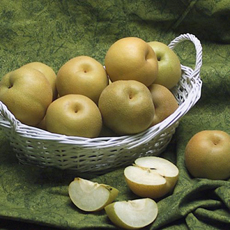
Asian pears. Photo courtesy Baldor Foods.

 
Depending on the variety, Asian Pears may be considerably large or somewhat small. Their color may vary from yellow to brown, and their skin may be smooth or speckled.
Although the outside appearance of each variety will differ, all Asian pears are crunchy and moderately sweet. Thought to have originally come to the U.S. via Chinese immigrants, Asian pears are now grown in California, Oregon and Washington, in addition to orchards worldwide.† Some of the most popular varieties grown in the U.S. include Hosui (Golden Russet Brown), Kosui (Golden Russet), Nijiseiki or Twentieth Century (Yellow-Green), Shinseiki (Yellow) and Shinsui (Russet Brown).

*Names include apple pear, Asian pear, bae (Korean), Japanese pear, Korean pear, li (Chinese), nashi (Japanese; also nashi pear, nashipati or nashpati), sand pear and Taiwan pear. Asian pears are cultivated throughout East Asia, as well as in Australia, New Zealand and other countries.

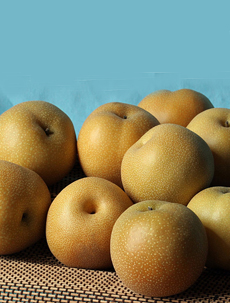
†The species include Pyrus pyrifolia, Pyrus ussuriensis, P. × bretschneideri, P. × sinkiangensis and P. pashia. Unlike the creamy flesh of Western pear varieties,


Asian pear varieties grown in the U.S. often
have a yellow-brown hue with a tinge of
green. Photo courtesy The Fruit Company.
  Chilled or cooked, Asian pears can add interest to any meal. The Asian pear is not baked into pies or made into chutney because it has a high water content and a signature grainy texture. It is commonly served raw and peeled, but we also enjoy them:

  • Diced and added for crunch to a fruit, vegetable or protein salad (chicken, tuna, egg, shrimp, etc.) salad
  • Sliced or diced as a garnish
  • Pickled and served with meat and poultry
  •  
    THE HISTORY OF PEARS

    The pear genus is believed to have originated in present-day western China, in the foothills of the Tian Shan mountain range. It evolved into a diverse group of more than 20 widely primary species in Asia, and spread along mountain ranges in prehistoric times to the Middle East and then to Europe.


    There is firm evidence of prehistoric cultivation of pear trees in the Stone Age (beginning around 9500 B.C.E.), the period that begins with the rise of farming with stone tools and ending when metal tools engendered the Bronze Age (approximately 3500 B.C.E. to 2000 B.C.E.).

    As far back as 5000 B.C.E., Feng Li, a Chinese diplomat, became engrossed in grafting pears and other fruits as a commercial venture and switched careers.

    Early colonists brought the first pear trees to America’s eastern settlements, where they thrived until crop blights proved too severe to sustain widespread cultivation. Fortunately, the pear trees brought west to Oregon and Washington by pioneers in the 1800s thrived in the unique agricultural conditions found in the Pacific Northwest.

    Here‘s more on the history of pears from the Pear Bureau Northwest.
      

    Comments off

    PRODUCT: SeaPak Shrimp Spring Rolls

    In 1948, SeaPak opened shop on St. Simons Island, Georgia, a beautiful barrier island. The waters were rich in shrimp, and the company went to work developing enjoyable products to bake, fry and sauté.

    Today SeaPak has a large lineup of tasty, easy-to-prepare frozen seafood products, from jumbo butterfly shrimp and popcorn shrimp to non-shrimp favorites such as crab cakes and salmon burgers (see the full product range on the company website).

    The newest item, SeaPak Spring Rolls, recently launched nationwide in grocery and club stores. Handmade with shrimp and crispy vegetables and tucked into crunchy wrappers, Shrimp Spring Rolls are simple to heat-and-eat in the oven, and are ready in less than 15 minutes. Or, for a more traditional restaurant taste, get out the deep fryer.

    Sweet Thai chili dipping sauce is included in each package. According to the package, three shrimp spring rolls—a nice portion size—contains only 170 calories and 9 grams of fat.


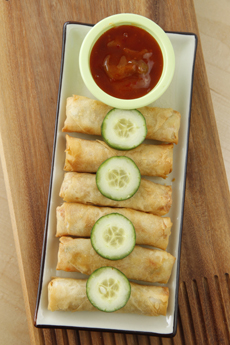
    SeaPak’s shrimp rolls are better than most we‘ve had at restaurants. Photo by Elvira Kalviste | THE NIBBLE.

     
    EASY TO PREPARE
    We preheated the oven, quickly baked up a box in THE NIBBLE kitchen and served them as a snack. The general comment was that SeaPak’s shrimp rolls were better than what is served at most Chinese restaurants. And that was without the added flavor of deep frying!

    Serve them as an appetizer or snack, and keep a box in the freezer for when friends drop by for a beer or a glass of wine.
    SeaPak Shrimp Spring Rolls are available nationwide for a suggested retail price of $9.99 for a 20-ounce package containing 16 shrimp spring rolls. You can find a product locator on SeaPak’s website.

    SUSTAINABLE SEAFOOD
    Another thing we liked: The company has strict sustainability standards, including a commitment to source only from suppliers whose practices limit negative environmental impact. Suppliers follow the most environmentally responsible harvesting practices, and SeaPak exercises strict oversight of every aspect of product procurement and processing.

    Fifty percent of the seafood is wild-caught rather than farmed. Why only 50%? Demand is so great that the oceans cannot satisfy even half of the consumer need.


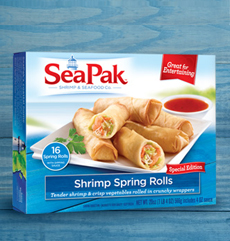
    Frozen and ready to bake or fry. Photo
    courtesy SeaPak.
     

    SHRIMP 101

    SeaPak answers some commonly-asked questions and busts some myths:

  • What’s with the veins? Veins in shrimp are not bad for you. In fact, some smaller shrimp are not deveined and experts agree this doesn’t affect the taste or healthfulness.
  • How about the mercury? Nearly all fish and shellfish contain traces of methyl mercury. However, larger fish that have lived longer—king mackerel, shark, swordfish and tilefish and tuna—have the highest levels of methyl mercury because they’ve had more time to accumulate it, and thus pose the greatest risk. Other types of fish and shellfish may be eaten in the amounts recommended by FDA and EPA.
  • Does shrimp count as “fish?” The American Heart Association recommends eating fish at least two times a week, and shrimp definitely counts toward meeting that goal.
  •  
    THE DIFFERENCE BETWEEN EGG ROLLS, SPRING ROLLS & SUMMER ROLLS

    While some countries, including China, serve fried spring rolls, the term “spring roll” is not synonymous with “egg roll,” a food that is fried. An egg roll has a heavier pastry wrapper that can be sliced into sections; a fried spring roll is very fragile and can shatter like phyllo.

  • Egg rolls are deep fried; the wrappers are thicker, making egg rolls more of a filled pastry (most are vegetable, egg and/or meat or seafood filling). Spring roll wrappers are thinner, the shape is narrower and when fried the rolls are more finger-like.
  • Spring rolls are an Asian appetizer, eaten either Vietnamese-style, in an uncooked rice noodle wrapper, or fried. They are traditionally eaten during the Spring Festival in China, hence the name; but also are popular in Cambodia and Indonesia. Vietnamese spring rolls use rice paper wrappers, which can be found in Asian markets. The dry hard wrappers are moistened into pliancy and translucency, and filled with seafood; red lettuce or Boston lettuce leaves; fresh mint, basil and cilantro leaves and shredded carrot. They are served with a chili dipping sauce.
  • Summer rolls are made in the style of spring rolls, but with more seasonal ingredients. They are not fried. The ingredients show through the translucent wrapper.
  •   

    Comments off

    FOOD HOLIDAY: National Licorice Day & Licorice History

    April 12th is National Licorice Day. We’ll let others debate the merits of Red Vines versus Twizzlers; our heart belongs to Australian licorice, which is spelled liquorice there and in other parts of the former British Empire.

    In 2011, the last year for which we could find figures, U.S. licorice sales topped $359 million, a 6.56% increase over the prior year and proof that not everyone is dying for chocolate (the non-chocolate candy market had total sales of $6.87 billion).

    Licorice extract is made from the root of the licorice plant, Glycyrrhiza glabra. It derives its botanical name from Greek words meaning “sweet root.” The sap of the root is 50 times sweeter than sugar!

    A member of the pea family that is native to southeastern Europe, licorice grows about four feet high. Its pretty bluish purple and white flowers that resemble sweet pea blossoms.

    Although they have similar flavor notes, licorice is not related to the spices anise and star anise, the vegetable fennel or the spice tarragon. The relation is that all of these plants and spices contain anethole, an aromatic and sweet-tasting ether compound.

     
    Licorice “shooters” from Kookaburra, one of our favorites. Photo by Katharine Pollak | THE NIBBLE.
     
    Our favorite licorice: Kookaburra, from Australia. You can buy it online. We love all the varieties, but especially the Allsorts (assorted licorice).

    LICORCE HISTORY

    We know licorice as moderately firm, semi-firm gelled candy. But for thousands of years in ancient China, Egypt and Greece, it was a cure for stomach and respiratory ills, as well as a thirst remedy for travelers and soldiers. It soothes irritated membranes and loosens congestion in the upper respiratory tract. It helps as an anti-inflammatory effects, with allergies and with the liver.

    Medicinal use of licorice has been documented for 3,000 years. Ancient Egyptians created a drink from it (a popular version of the drink, called mai sus, is still enjoyed in Egypt). Large quantities of licorice root were found in the tomb of King Tut (1356 to 1339 B.C.E.)

    The troops of Alexander the Great and the Roman legions used licorice. The Caesars advocated licorice as a health remedy. Some 1800 years later, Napoleon Bonaparte chewed licorice for his ongoing digestive problems. Over time, his teeth turned black from the concentration of licorice juice. You can chew on a piece of licorice root if you want the experience, or are headed to a Halloween party.
      

    Comments off

    FOOD FUN: Sashimi Tacos Recipe & The History Of Sashimi


    [1] Sashimi tacos at Haru restaurant in New York City (photo © Haru/RA Sushi).

    Spicy Tuna For Sushi
    [2] Fill your taco shells with spicy tuna and/or spicy salmon. Here’s the recipe (photo © No Spoon Necessary).

    Fancy Sushi Hand Rolls - Temaki
    [3] Here, crisp sheets of nori are used instead of taco shells. Are they “open hand rolls,” “sashimi tacos,” or both (photo © LT Bar & Grill | Hackensack, New Jersey).

    Deluxe sashimi on a bed of ice.
    [4] A bit of “fusion” on this plate of sashimi: The soy sauce is given some heat with Mexican jalapeño instead of Japanese wasabi (photo © The Fulton | NYC).

    Salmon and avocado sushi burrito.
    [5] More fusion: a sushi burrito, with salmon and avocado (photo © Genji Sushi | Facebook).

    Sushi  burger with raw tuna.
    [6] Yes, there’s even a sushi burger (photo © Redeye Grill | NYC).

      Given our love of fusion food, we were delighted to discover these sashimi tacos at Haru restaurant in New York City.

    You can make them full size or in miniature for appetizers and hors d’oeuvre. At Haru, the sashimi tacos are available in:

  • Salmon and/or Spicy Salmon
  • Tuna and/or Spicy Tuna
  • Yellowtail
  •  
    Of course, you can make “California roll” tacos with avocado, cucumber, and crab stick or your other favorite sashimi.

    We made delicious tacos with bay scallops and seaweed salad. With a standard taco size, some “salad” helps to fill out the base.

    If you can’t find seaweed salad, a mix of shredded daikon and carrot is equally delicious; and shredded lettuce always works!

    > The history of tacos.

    > The history of sushi. The history of sashimi is below.
     
     
    HOW TO MAKE SASHIMI TACOS

    Ingredients

  • Fish or seafood of choice
  • Sesame oil
  • Rice vinegar
  • Wasabi powder
  • Soy sauce
  • Optional filling: shredded carrots and/or daikon, seaweed salad
  • Taco shells or wonton wrappers
  • Garnish: snipped chives, thin-sliced green onion (scallion), lemon or lime zest, lemon or lime zest and grated ginger mix, toasted sesame seeds, tobiko (flying fish roe) or salmon caviar
  • Lime wedges
  •  
    Preparation

    1. BUY sushi-quality fish and dice it into 1/4″ to 1/2″ cubes.

    2. MOISTEN/TOSS with sesame oil, rice vinegar, and a bit of wasabi powder. Taste and add soy sauce if the mixture needs a hit of salt. You can also use the spicy tuna recipe in photo #2.

    3. PREPARE and fill taco shells. Here’s how Guy Fieri makes shells from wonton wrappers for his tuna taco recipe.

    4. GARNISH as desired.
     
     
    DO YOU KNOW YOUR SASHIMI?

    Check out the different types of sashimi in our Sushi & Sashimi Glossary.
     
     
    THE HISTORY OF SASHIMI

    Sashimi is a dish consisting of fresh raw fish or meat (especially beef) sliced into thin pieces and often eaten with soy sauce, wasabi, and gari or shoga (both are pickled ginger—pink-hued shoga is pickled in red plum vinegar and gari, beige in color, is pickled in sweet vinegar).

    The word “sashimi” means “pierced body” (sashi = pierced or stuck, mi = body or meat). It dates from the Muromachi period in Japan (1336-1573) and there are different origin stories.

    The most colorful one concerns the practice of sticking the fish’s tail and fin to the slices for the purpose of identifying the fish being served.

    Sashimi is often the first course in a formal Japanese meal, but it can also be the main course, served with rice and miso soup.

    In a multicourse meal, it should be eaten first so that its delicate flavors can be savored before stronger-flavored food affects the palate [source].

    Sashimi is sliced thicker than the fish used for sushi, since the latter has more substance served atop or rolled with vinegared rice.

    The typical garnish for sashimi is the Asian white radish, daikon, which is shredded into long thin strands, or individual leaves of the herb shiso, a.k.a. perilla (plastic leaves are substituted in lesser establishments).

    (If you usually leave the daikon on the plate, you’re missing out on great fiber. You can dip it in soy sauce if you want more flavor. As for shiso leaf: It’s a delicacy that’s also often left behind. A member of the mint family, it tastes a bit like basil. We wrap the leaf around a slice of fish.)
     
    How Old Is Sashimi?

    While we know the origin of sashimi, the origin of sashimi is less certain.

    In the days before refrigeration, raw fish (for both sashimi and sushi) many fish varieties could only be enjoyed raw along the coastals of Japan. But since Japan consists of hundreds of islands, fresh seafood was available in many locations.

    Inhabitants of the interior of the country could have enjoyed lake or river fish.

    One origin theory suggests that modern sashimi descends from a dish of thinly sliced raw fish marinated in seasoned rice vinegar called namasu, which was a favorite in Japan during the Heian period (794-1185). The dish is still served today.*

    Scholars agree that sashimi became popular in Japan during the Edo period (1600-1867). Nigiri sushi, slices of fish set atop patties of vinegared rice, appeared before the start of the 19th century [source].

    In 1965, the landmark Immigration and Nationality Act enabled more Asians to emigrate to the U.S. They brought with them the Asian cuisines we enjoy today. The first sushi restaurant in the U.S. opened in Little Tokyo in Los Angeles in the 1960s.

    As sushi has grown in popularity, its preparation has evolved from the traditional to the modern.

    From the use of ingredients not native to Japan (avocado for California rolls, cream cheese and smoked salmon for Philadelphia rolls, mango for numerous rolls) to new formats (sushi burritos—photo #5, sushi burgers—photo #6), Japanese sushi has become treasured American fare.
     
    ________________

    *Namasu is made from raw, thinly sliced vegetables and seafood, marinated in rice vinegar for several hours, which pickles them slightly. Namasu was brought to Japan from China during the Nara period (710-784). Sunomono and other vinegared salads are related to namasu [source].


    CHECK OUT WHAT’S HAPPENING ON OUR HOME PAGE, THENIBBLE.COM.


    Comments off

    PRODUCT: Applegate Naturals Reduced Sodium Bacon

    If you haven’t yet had Applegate organic and natural meats, you’re in for a treat. The quality is superb, and Applegate franks are our app-solute favorites.

    Another product on our “special indulgences” list is Applegate’s Natural Sunday Bacon: packed with old fashioned country bacon flavor but without added nitrites or chemical preservatives.

    Made from select cuts of antibiotic-free pork and seasoned with natural ingredients like sea salt, Applegate bacon is smoked for hours over hardwood.

    And now, there’s an even healthier version of Applegate’s Natural Sunday Bacon: Reduced Sunday Bacon, which delivers the same great taste with 25% less sodium.


    New, delicious and 25% lower in sodium. Photo courtesy Applegate.com.

    Learn more about Applegate products at Applegate.com.

    Then, whip up some BLTs or make this tasty salad:

    RECIPE: BLT SALAD WITH AVOCADO & BUTTERMILK DRESSING

    This pretty composed salad is like an avocado BLT without the toast. Homemade buttermilk dressing is a creamy treat.

    The recipe serves 4 to 6.


    An avocado “BLT” salad. Photo courtesy
    Applegate.com.


    Ingredients

    Dressing Ingredients

  • 2/3 cup well-shaken buttermilk
  • 1/3 cup extra-virgin olive oil
  • 2 tablespoons chopped chives
  • 1 tablespoon apple cider vinegar
  • 2 teaspoons Dijon mustard
  • Salt and pepper
  •  
    Salad Ingredients

  • 1 package (8 ounces) Applegate Sunday Bacon
  • 1 head iceberg lettuce, cored and cut into 6 wedges
  • 3 avocados, pitted, peeled, and cut into thick wedges
  • 1 cup cherry or grape tomatoes, halved
  • 2 tablespoons chopped chives
  •  
    Preparation

    1. COOK the bacon until crisp, according to package instructions. Remove from heat, drain briefly on paper towels, then chop into 1- to 2-inch pieces.

    2. PREPARE dressing. Place the buttermilk, olive oil, chives, vinegar and mustard in a large jar; seal tightly and shake well to combine. Season to taste with salt and pepper and shake again to combine.

    3. ASSEMBLE salad: Arrange the lettuce, avocado, tomatoes and bacon on a large serving platter or individual plates. Shake the dressing well and spoon some over the salad, saving some for people to add more if they like. Garnish the salad with the remaining chopped chives.
    Find more recipes at Applegate.com.


    Comments off

    The Nibble Webzine Of Food Adventures
    RSS
    Follow by Email


    © Copyright 2005-2026 Lifestyle Direct, Inc. All rights reserved. All images are copyrighted to their respective owners.