THE NIBBLE BLOG: Products, Recipes & Trends In Specialty Foods


Also visit our main website, TheNibble.com.

TIP OF THE DAY: Purslane

Many of the greens we enjoy today began life as weeds. They showed up, uninvited, in gardens and fields. Given the scarcity of food, they were gathered and brought to the kitchen.

While some of these intruders were distasteful (or even poisonous), others were welcome, including dandelion greens and mache (lamb’s quarters), which has become a “gourmet lettuce.”

Perhaps the weed we eat the most is watercress, which grows wild alongside streams and riverbanks.

Other weeds, like red clover, were turned into homeopathetic remedies.

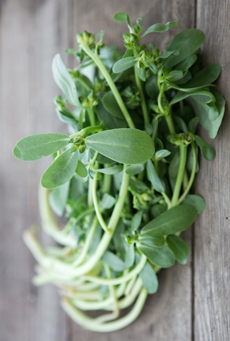
Such is the case of purslane (PURSE-lane, Portulaca oleracea), a low, trailing plant with yellow flowers that’s used for food and homeopathy. It looks like a baby jade plant (see photo) and tastes like a cousin of spinach or watercress.

Purslane is not well known in the U.S., where most people see it as a common garden weed. But for those who decide to eat it rather than weed it, it is a delicious salad ingredient and potherb*.


wild-purslane-goodeggs-230

Wild purslane. Photo courtesy GoodEggs.com.

 
Purslane, native to India and Persia, has spread throughout the world. Ancient Greeks and Aztecs ate it. Many modern cultures embrace it. Russians dry and can it for the winter. Mexicans (who call it verdolaga) enjoy it as a comfort food, in omelets, as a side dish, rolled in tortillas, in soups and stews. Europeans and Americans in-the-know use it in salads and stews.

*Potherb refers to any plant prepared as food by cooking in a pot—spinach, for example—or any herb added as seasoning. It includes any part of the plant: flowers, leaves or stems. The seeds of a plant become…spices!

Two tablespoons of olive oil per day have been shown in clinical studies to have a beneficial effect in reducing coronary disease. The claim has been approved by the FDA.


A Mediterranean salad with purslane. Recipe
and photo from Kalyn’s Kitchen.
  Think of purslane as a weed, says a CSA that gathers it for customers, and you’ll be missing out on one of the most nutritious greens on the planet.

  • Purslane has more beta-carotene than spinach.
  • It’s a good source of alpha-linolenic acid, the compound also found in olive oil that has heart-healthy benefits†. This omega-3 fatty acid. lowers blood pressure and cholesterol levels, and makes the blood less likely to form clots.
  • Purslane has high levels of magnesium and potassium—so much so that it has historically been used as a homeopathic remedy for arthritis and inflammation by European cultures. Chinese herbalists use it to aid respiratory and circulatory functions.
  • And, purslane has only 15 calories per 100 grams (about a half cup).
  •  

    Purslane loves prefer to eat the young plants, especially young leaves and tender stem tips.

  • Substitute it for spinach or watercress, raw or cooked.
  • Use purslane in salads or on sandwiches instead of lettuce.
  • Try it steamed, stir-fried or puréed (but don’t overcook it if you don‘t like an okra-like sliminess).
  • Add it to cucumber-yogurt salad, potato salad, pasta, quiche/savory tarts and many other everyday dishes.
  •  
    So don’t banish purslane from your garden: Invite it to dinner!

    Check out purslane recipes at PrairielandCSA.org.


    Comments off

    FOOD FUN: Pizza Ravioli

    We had fun eating the “pizza ravioli” from Giovanni Rana restaurant and pasticceria in New York City’s Chelsea Market.

    Jumbo cheese ravioli are deep fried and topped with a fresh tomato and basil sauce, then garnished with more of the fresh basil. You’ve got a crisp “crust,” cheese, tomato sauce and basil: a fun first course.

    You can buy jumbo ravioli at shops that specialize in fresh pasta.

    But that’s not the end of the fun.

    Now, think of the opposite approach: ravioli pizza. Top a Margherita pizza, homemade or take-out, with miniature ravioli, boiled the conventional way or fried.


    Pizza ravioli: all the flavors of pizza in crisp ravioli. Photo courtesy Giovanni Rana Restaurant | NYC.


    You can use standard ravioli, but look for miniature ravioli—they’re easier to eat as a topping. Then, make a fun pasta salad with the extra miniature ravioli. Here’s a recipe from PeanutButterAndPeppers.com.


    Mini ravioli make a fun Mediterranean pasta
    salad. Photo courtesy Peanut Butter and
    Peppers.
     

    EVEN MORE FOOD FUN

  • Bacon Cake (recipe)
  • Chocolate Ravioli (recipe)
  • Dough Dogs (recipe)
  • Fork, Knife & Spoon Cookies (recipe)
  • Hamburger Cupcake (recipe)
  • Fried Egg Cupcake (recipe)
  • Heirloom Potatoes (recipe)
  • Hot Dog Sculpture (recipe)
  • Ice Cream Sandwich On A Roll (recipe)
  • Macarons On A Stick (recipe)
  • Peanut Butter Sushi Rolls (recipe)
  • Radicchio Bowl (recipe)
  •  
      

    Comments off

    The History Of The Cobb Salad & A Cobb Sandwich Recipe

    The Cobb Salad endures on restaurant menus, decades after once-popular luncheon salads such as Allerton Salad, aspics, Russian Salad, spinach salad (with mushrooms and bacon), stuffed tomatoes and Waldorf Salad have faded into obscurity.

    And thank goodness it’s still here, because it’s one of our favorites.

    > The history of salad.

    > The 40+ salad holidays.
     
     
    THE HISTORY OF THE COBB SALAD

    Late one evening in 1937, Bob Cobb, owner of The Brown Derby restaurant in Hollywood, was scrounging in the kitchen’s refrigerator for a snack.

    He grabbed a head of iceberg lettuce, an avocado, some romaine, watercress, tomatoes, a cold breast of chicken, a hard-cooked egg, chives, blue cheese and some old-fashioned French dressing*. He took some crisp bacon from one of the chefs and started chopping.

    He laid each ingredient in a row, in a bowl.

    Cobb shared the salad with his friend Sid Grauman, proprietor of Grauman’s Chinese Theatre, who came back and asked for a “Cobb Salad” the next day.

    It was put on the menu and became an overnight sensation. Customers like movie mogul Jack Warner regularly dispatched his chauffeur to pick one up.

    Since then, the salad has often been served with the ingredients laid out on the plate in rows, rather than tossed or with the other ingredients layered atop the greens, like a chef salad.

    Over time, people have added an extra ingredient, like the ham in photo #1 and the corn in photo #2, celery, bell pepper, scallions, croutons, and so on.

    People who don’t like blue cheese substitute Cheddar. People who don’t like tomatoes substitute red pepper. People who don’t eat bacon substitute kidney beans.

    There have been variations like Wolfgang Puck’s Lobster Cobb Salad. And now, here’s the Cobb Sandwich.

    There’s also a recipe for Asian Cobb Salad below.

    > The history of the chopped salad.
     
     
    RECIPE #1: COBB SANDWICH

    Ingredients For 4 Servings

    Blue Cheese Mayonnaise

  • 1/4 cup blue cheese
  • 1/4 cup mayonnaise
  •  
    Avocado Purée

  • 1 cup puréed avocado
  • 1/4 teaspoon lemon juice
  • Salt and pepper to taste
  •  
    Sandwich

  • 8 slices sourdough bread
  • 2 ounces mixed greens
  • 8 slices tomato
  • 8 ounces smoked chicken or turkey, sliced (we substituted chunky chicken salad: chunks of chicken lightly dressed with tarragon mayonnaise
  • 8 strips bacon, fried crisp
  •  

    Cobb Salad On A Platter
    [1] Cobb Salads are typically served with the ingredients in rows (photo © eMeals weekly meal plans).


    [2] In the chips? Trade the chicken and ham for a Lobster Club Salad. Here’s the recipe from Skinnytaste (photo © Skinnytaste).


    [3] A Cobb Wedge Salad: the Cobb toppings used as a toppings for a wedge of iceberg lettuce (photo © Sid Wainer).


    [4] The evolution of the Cobb Salad: the Cobb Sandwich (photo © Wisconsin Milk Marketing Board).


    [5] Asian Cobb Salad, with bean sprouts, napa cabbage, seaweed salad and an Asian vinaigrette (photo © East & West Yotel | New York City).


    [6] You can vary the ingredients to reflect different cuisines. This Italian Cobb Salad has speck and sundried tomatoes. We’d add some shaved provolone cheese (photo © Uncommon Flavors Of Europe).

      Preparation

    1. COMBINE blue cheese and mayonnaise in a small bowl; mix well and set aside.

    2. MIX the avocado purée, lemon juice, salt and pepper until well blended.

    3. ASSEMBLE: Spread one bread slice with 1 to 2 tablespoons of the blue cheese mayonnaise. Layer the mixed greens, 2 tomato slices, 2 ounces smoked turkey and 2 bacon strips on the bread. Spread another slice of bread with the avocado purée, and top the other half of the sandwich. Repeat to make three more sandwiches.
     

    RECIPE #2: ASIAN COBB SALAD

    Can you call something a Cobb Salad variation when the only ingredients it shares with the original are lettuce and chicken—ingredients common to more than a few salads? We’d say no, but we like this salad with a more appropriate name, like Asian Chicken Salad.
     
    Ingredients For 8 Servings

    For The Dressing

  • 2 tablespoons sesame oil
  • 2 tablespoons olive oil
  • 1 tablespoon rice wine vinegar
  • 1 tablespoon soy sauce
  • 1 teaspoon chili flakes
  • 1 tablespoon brown sugar
  • 1 teaspoon minced garlic
  • Salt and pepper to taste
  •  
    For The Salad

  • 3 cups chopped lettuce (iceberg or romaine)
  • 3 cups napa cabbage, shredded
  • 6 to 8 grilled chicken breasts cut into bite-size pieces
  • 4 avocados, peeled and diced
  • 3 carrots, peeled and julienned
  • 1-1/2 cup mushrooms, sliced
  • 1/2 cup bean sprouts
  • 1 cup snow peas or sugar snap peas, halved
  • 3 tablespoons green onions, sliced
  • 3 to 4 tablespoons fresh parsley, coarsely chopped
  • 1 cup rice noodles
  • 1/2 cup toasted almonds
  •  
    Preparation

    1. COMBINE the dressing ingredients in a jar with a lid. Cover and shake to combine. Set aside.

    2. MIX the lettuce, cabbage, snow/snap peas, bean sprouts and parsley in large serving bowl; toss to combine. Arrange the chicken, avocados, carrots, green onions and mushrooms on top.

    3. SPRINKLE the rice noodles and almonds on top. Drizzle the dressing over the salad and serve immediately.

     
    _____________________

    *The French use vinaigrette—oil and vinegar—as a salad dressing. Originally, “French dressing” was synonymous with vinaigrette. Over time, a sweet, decidedly non-French, orange-colored vinaigrette (from ketchup, not a very French condiment) appeared in the U.S. and Canada. It’s what “French dressing” is today. To make it, combine 1/4 cup white wine vinegar, 1/3 cup olive oil, 1/4 cup ketchup, 1 tablespoon sugar, 2 teaspoons paprika, 1 teaspoon Worcestershire sauce, a pinch of salt. Our mother halved the sugar and threw in a clove of garlic.


    CHECK OUT WHAT’S HAPPENING ON OUR HOME PAGE, THENIBBLE.COM.


    Comments off

    TIP OF THE DAY: Five Minute Marinating Tips

    Whether you decide to grill, roast, or sauté meats and other foods, marinating will make them tastier.

    A marinade is a savory, acidic sauce comprised of an acid, oil and seasonings. The food—fish, meat, vegetables—is bathed in the marinade to enrich its flavor and/or to tenderize it. The breaking down of the tissue also causes meat and poultry to hold more liquid, making it juicier.

    The marinade should be relatively thin in consistency, in order to penetrate the food. The acidic ingredient can be buttermilk, lemon juice, wine/beer, or yogurt, seasoned with herbs and/or spices. Sometimes oil is eliminated from red meat marinades, because meat generally contains enough fat.
     
    EASY MARINADE RECIPE

    1. MIX any good cooking oil with an acid (lemon juice, vinegar, wine).


    Old-school marinating: in a glass or plastic dish. Photo courtesy 12Tomatoes.com.

     
    2. CHOP up some fresh herbs and garlic cloves or add herbs and/or spices from your pantry. For an Asian marinade, mix soy sauce with oil, chopped onions and garlic.

    Thanks to Linda Stadley of What‘s Cooking America and FoodSafety.gov for some of these tips:

  • RATIO: A general rule of marinade-to-meat ration is 1/2 cup of marinade per pound of meat. If you use a little more marinade, it will be OK.
  • FRIDGE: Always marinate in the refrigerator, never marinate at room temperature or outdoors when barbecuing. Bacteria can quickly multiply on warm, raw meat. If the recipe says to marinate at room temperature, ignore it.
  • TIME: Marinades that contain no salt, acid, or alcohol can be marinated overnight or, in some cases, longer.
  • TIME: Marinades that contain acid, alcohol or salt should not be used for longer than four hours, because those ingredients will chemically “cook” or denature the food, the way raw seafood is cured by citrus juice to create ceviche.
  • TIME: Marinades that contain citrus juices, especially lemon or lime juice, should be used for only 2 hours or less. Mind the time: foods left too long in these blends can change color and texture. Fish fillets, for example, can change in a matter of minutes.
  • TIME: You can store marinated poultry in your refrigerator for two days. Beef, veal, pork, and lamb may be marinated up to 5 days.
  • SAFETY: Be sure to use a food thermometer and cook the meat to a safe minimum internal temperature. Here’s a temperature chart.
  •  


    The best way to marinate: in a resealable
    plastic bag. Photo courtesy McCormick.
     
  • NO METAL: Do NOT marinate in a metal container: The acidic mixture can react with the metal. Marinate only in a sealable plastic bag, plastic container or glass container. Turn the food occasionally so that all sides are coated evenly with the marinade.
  • COVER: If you marinate in container (as opposed to a plastic bag), cover it.
  • DON’T REUSE: Never reuse marinade unless you’ve boiled it to destroy harmful bacteria, according to the U.S. Department of Health & Human Services. If you plan to use some of the marinade as sauce for the cooked food, reserve that portion apart from what you are using to marinate.
  • BOTTLED DRESSING: A common tip is to marinate in bottled Italian dressing, a ready-mixed combination of acid, oil and seasonings. But why pay several dollars for bottled dressing when you can use your own oil, and vinegar and garlic for pennies?
  •  

    EASIEST MARINATING: PLASTIC BAG

    The easiest and least messy way to marinate food is to use a resealable plastic bag. When all of the air is pressed out before the bag is sealed, the marinade completely surrounds the meat.

    This dramatically reduces the amount of marinade necessary, and also affords even marination, allowing maximum penetration of the marinade from all sides.

    Here are tips from McCormick for five-minute marinating. If your recipe calls for a longer time, follow the instructions.

    1. PLACE the food and the marinade in a resealable plastic bag.

    2. PUSH the air out of the bag and seal tightly.

    3. MASSAGE the food for five minutes, turning the bag often so it absorbs most of the marinade. (this is easy to do with meat and seafood; vegetables should just be squished around in the bag).

    4. REMOVE the food and cook. Discard the bag with the remaining marinade.


    Comments off

    Homemade Greek Salad Recipe

    Everyone we lunch with seems to order a Greek salad or a Cobb salad. And they admit that they never make it at home!

    So today’s tip is: Enjoy a Greek salad at home, regularly. When you make your own, you can add as much feta, olives, pepperoncini, and other favorite ingredients as you like.

  • You can buy top-quality feta at a cheese store.
  • You can substitute romaine for the iceberg lettuce normally used in restaurants.
  • You can use the beautiful tomatoes that are now in season.
  • And if you don’t like red wine vinegar, the classic dressing in America, you can substitute balsamic vinegar or lemon juice.
  •  
    Serve your Greek salad as a main meal, a smaller salad course, or as a soup-and-salad or sandwich-and-salad combo for lunch.

    FOOD TRIVIA: In Greece, the feta-cucumber-onion-plus salad is referred to as horiatiki, which translates to country/village/peasant salad. It is a common part of a traditional Greek meal. Horiatiki doesn’t contain lettuce—that’s an American preference. In Greece, you’ll only see lettuce used at restaurants that cater to tourists.


    A cute Greek salad preparation from Stix
    Mediterranean Grill
    in New York City. What’s missing? The lettuce, which is not part of authentic recipes.

     
    An authentic horiatiki is a combination of all or some of the following: anchovies, bell pepper, capers, cucumber, feta cheese, Kalamata olives, onion, sardines, and tomato. It is dressed with olive oil only—no vinegar—plus oregano, salt, and pepper.

    The recipe below is from Molyvos, one of the finest Greek restaurants in New York City. Executive Chef Jim Botsacos. He serves an American-style Greek salad, but check out the preparation: He uses the techniques of a top chef.
     
     
    RECIPE #1: GREEK SALAD

    Ingredients For 6 Side Servings

  • 3 beefsteak tomatoes*
  • 1 cucumber, scored, quartered lengthwise, and cut crosswise ¼ inch thick
  • 1 small red onion
  • 20 kalamata olives, pitted and thinly sliced crosswise
  • 1 cup feta cheese, diced
  • 1 tablespoon capers, well drained
  • Red wine vinaigrette (recipe below)
  • 1 teaspoon dried oregano
  • Sea salt and freshly ground pepper
  • 2 cups shredded iceberg or romaine lettuce
  • Optional: anchovies, bell pepper, pepperoncini, sardines
  •  
    ______________

    *When beefsteak or heirloom tomatoes are not in season, use halved cherry tomatoes.


    A classic Greek salad. Photo courtesy Stix Mediterranean Grill | New York City.
     

    Preparation

    1. CORE the tomatoes. Cut each tomato in half crosswise, then cut each half into 6 pieces. Place the pieces in a mixing bowl. Add the cucumber.

    2. CUT the onion in half lengthwise and then slice each half lengthwise into thin julienne. Add the onion to the bowl. Add the olives, cheese, and capers. If using pepperoncini, slice into circles and add; or use whole as a garnish.

    3. ADD the vinaigrette and toss to coat. Taste and season with oregano and salt and pepper to taste.

    4. PLACE an equal portion of the lettuce on each of the 6 salad plates or bowls. Top with an equal portion of the tomato mixture, and sprinkle lightly with oregano. Serve immediately.
     
     
    RECIPE #2: RED WINE VINAIGRETTE

    Ingredients

  • ¼ cup red wine vinegar
  • 1 garlic clove, peeled and smashed
  • 1 tsp dried oregano
  • 1 cup extra virgin olive oil
  • Sea salt and freshly ground pepper
  •  
    Preparation

    1. COMBINE the vinegar with the garlic and oregano in a small mixing bowl. Using a wire whisk, whisking constantly. add the olive oil in a slow, steady stream until all the oil is incorporated.

    2. SEASON with salt and pepper to taste and set aside until ready to use. Whisk briefly before using.


    CHECK OUT WHAT’S HAPPENING ON OUR HOME PAGE, THENIBBLE.COM.


    Comments off

    The Nibble Webzine Of Food Adventures
    RSS
    Follow by Email


    © Copyright 2005-2026 Lifestyle Direct, Inc. All rights reserved. All images are copyrighted to their respective owners.