|
Updated August 2026
While the Belgians may or may not have invented what we call French fries (see the history below), they do consume the most French fries per capita of any country in Europe.
Call them French fries or simply fries in America, chips in the U.K. or American fries in many parts of the non-European world: It’s hard to find anyone who doesn’t like julienned, fried potatoes and the other shapes that evolved from them: crinkle fries, curly fries, shoestring fries, steak fries, waffle fries, wedges, etc.
And then, there are French fry toppings that create new dishes, from chili cheese fries to the beloved Canadian dish, poutine: brown gravy and cheese curds atop fries.
Your culinary challenge of the week is to come up with your own own signature topping for fries. Here are some categories to choose from and some examples in each.
Below:
> Additions to plain fries for your “signature.”
> The best potatoes to use for fries.
> Belgian vs. American style.
> French fry trivia.
Elsewhere On The Nibble:
> The history of French fries.
> The different types of fries: more than 40!
> Top 10 favorite dips for fries.
> How to make the best French fries.
> French fry styles around the world.
> Non-ketchup dips for fries.
> The history of potatoes.
> The different types of potatoes: a photo glossary.
> The year’s 30 potato holidays.
> The year’s 24 fried food holidays.
> Food fun: The world’s largest French fry.
ADDITIONS THAT CREATE “SIGNATURE” POTATOES
There are bountiful ingredients from which to choose. Experiment with different combinations to pick the winner(s).
Cheese: Consider blue, cheddar, feta, goat, Parmesan, truffle cheese and other options.
Condiments: We like aïoli (garlic mayonnaise) or other flavored mayo (curry, dill, horseradish, parsley, etc.). Other choices: barbecue sauce, chutney, Dijon or honey mustard, flavored ketchup, hot sauce, seasoned salt, sour cream, tartar sauce
Fresh herbs & spices: Capers, chili flakes, cracked pepper, curry, dill, oregano, parsley, scallions or other favorite
Potato shapes: coins, curly fries, crinkle fries, and waffles fries, for starters.
Potato varieties: Beyond white russet potatoes, sweet potatoes, and purple Peruvian potatoes, there other options. See the next section.
Proteins: Bacon, chili, cooked chopped beef with onions, fried/poached egg, pulled chicken or pork
Sauces & oils: Flavored olive oil (we love truffle oil), gravy, malt vinegar or vinaigrette, salad dressing (blue cheese, ranch, thousand island), salsa, tomato sauce, yogurt sauce (like this tzatziki recipe)
THE BEST POTATO POTATO TYPES FOR FRIES
Beyond the well-known russet and sweet potatoes, and purple Peruvian potatoes, there are other varieties that could become your “signature potato.”
The following are all suitable for fries, but some of them are not readily available in the U.S. We’ve split them up.
Varieties Easily Found In The U.S.
Blue or Purple: In addition toi a unique vibrant color and flavor, their dense, firm texture crisps up nicely when baked or fried.
Kennebec: This excellent all-purpose frying potato produces crisp, flavorful fries. It’s widely used by restaurants and fry producers.
Red potatoes: These are an option, but their waxier texture produces denser, less fluffy fries. They work best as thicker steak fries or rustic wedges.
Sweet & Japanese Sweet Potatoes: Their natural sugar creates a tasty, caramelized outer crust while the flesh adds another touch of sweetness.
Yukon Gold: These highly-regarded potatoes produce fries with a reamy interior, buttery flavor, and a golden crust. They’re slightly less crisp and more tender than russet fries.
Varieties Found In Europe
Agria. A high-starch variety commonly used for fries, especially in Europe; fries well and holds its shape.
Bintje. An older European variety traditionally prized for chips and French fries.
Shepody. The fries will be light-colored with fluffy insides and a good outer crispness.
Maris Piper. This popular British frying potato produces fries with a fluffy center and crisp exterior.
Why Do Only Some Types Of Potatoes Make Good Fries?
You need a floury/starchy potato variety, which is lower in moisture (drier). Examples include russet and the Kennebec.
“Russet” is a broad type or market name. A russet potato generally has:
Rough, brown, netted skin.
A relatively high starch and dry-matter content.
A fluffy, mealy flesh when baked.
There are numerous cultivars of russet potatoes. In a grocery store, the “russet potatoes” may refer to several the Russet Burbank, Russet Norkotah, Ranger Russet, Umatilla Russet, or other regionally grown varieties.
|
|
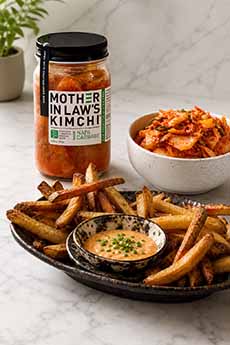
[1] Korean accents on one of our own signature dishes: a kimchi dip with a side of kimchi (photo © The Nibble).
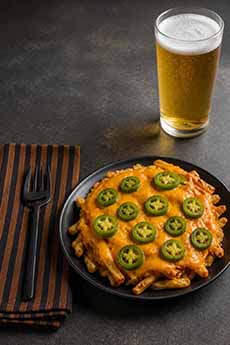
[2] Cheddar fries are common enough, but top yours with jalapenos—raw or pickled—or an assortment of fresh red and green chile peppers. Check out the different types of chiles (photo © The Nibble).
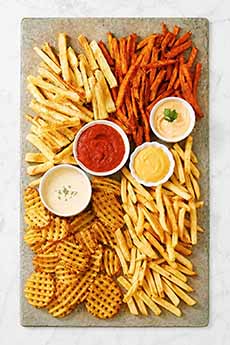
[3] Perhaps your signature is an assortment of shapes (photo © Stonewall Kitchen).
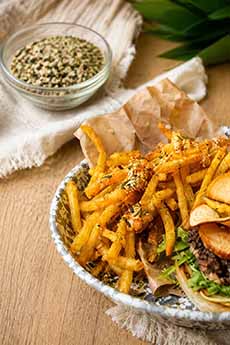
[4] Japan’s furikake spice blend is another way to fuse East and West. Here’s the recipe. Perhaps your signature is Asian fries, each time with a different country’s signature spices tossed with the cooked fries and blended into a dip. We did that in photo #1, but China, Indonesia, India, Thailand, Vietnam, and others await (photo © Girl Carnivore).
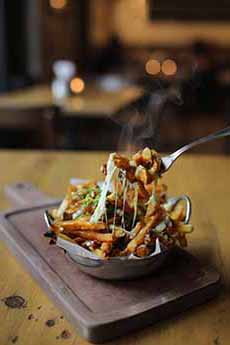
[5] Your “house fries” could be poutine, Canada’s comfort food. Fries are topped with fresh cheese curds that soften under hot gravy (photo © La Poutine Week | Facebook).
|
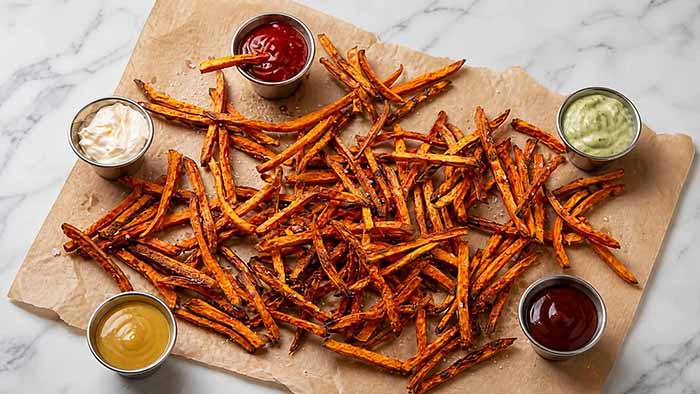
[6] Our personal favorite: sweet potato fries with homemade dips that go beyond the ketchup of restaurant fries. Clockwise from the top: chipotle ketchup, Green Goddess dressing/dip, barbecue sauce, hot honey mustard, and aïoli— garlic mayonnaise (photo © The Nibble).
Russet Burbank is excellent for fries. Its long shape produces long fries and it has a relatively low tendency to absorb oil. Not all cultivars of russet have the same characteristics.
What About The Idaho Potato?
The “Idaho potato” is an Idaho-branded Russet Burbank potato. That it is grown in the Idaho terroir (soil, weather, climate, etc.) does not automatically give it a dramatically superior flavor or texture (but we give the Idaho Potato Commission props for such great branding).
According to the Idaho Potato Commission, the Russet Burbank once accounted for more than 95% of Idaho’s potato crop, but now represents approximately half of the crop. Today, the Russet Norkotah is one of the more popular varieties sold fresh at retail for baked potatoes and other recipes. It can be used for home-cooked fries, although since it has slightly lower starch and more moisture than the Russet Burbank, the fries can turn dark or burn faster if the oil is too hot.
Check out the different types of potatoes in our Potato Glossary.
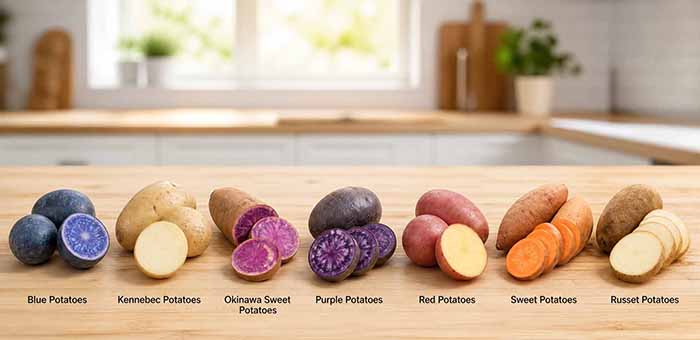
[7] You can make fries with all of these (photo © The Nibble).
BELGIAN VS. AMERICAN STYLE
The average American consumes roughly 29 to 30 pounds of French fries per year, according to USDA and agricultural industry figures. The average Belgian consumes approximately 38 to 40+ pounds, roughly one-third more than Americans.
In Belgium, French fries are commonly called frites in French and frieten or frietjes in Dutch, particularly in Flanders. Frietjes is the diminutive Dutch form, roughly meaning “little fries.” You may also hear patat in some Dutch-speaking areas, particularly in informal usage.
However frites is commonly understood throughout the country.
Belgian menus and fry shops may use the term frites maison, “house-made fries” or friterie for a shop specializing in fries.
But there’s more than language that separates Belgian fry-eaters from Americans.
In the U.S., fries are a side dish, play a supporting role to a burger or other food.
In Belgium, fries can be the main meal—an independent, standalone meal, as well as a snack.
In the U.S., the majority of fries are sold at multinational fast-food burger chains (Burger King, McDonald’s, Wendy’s, etc.) utilizing standardized, mass-frozen pre-cut potatoes.
Belgium, fries are sold at an estimated 5,000 fritkots/friteries)—dedicated street-side fry shacks, kiosks, and storefronts. They serve a population of roughly 11.5 million people compared to 342.6 million Americans. That equates to roughly one dedicated fry vendor for every 2,300 residents, a retail concentration that far surpasses the density of fast-food chains in America.In fact, Belgian frietkot culture has been officially recognized as national intangible cultural heritage.
The condiment of choice in the U.S. is ketchup, although ranch dressing is in second place. In Belgium, it’s mayonnaise. (And in England, it’s malt vinegar, but that’s for another article).
This chart sums it up:
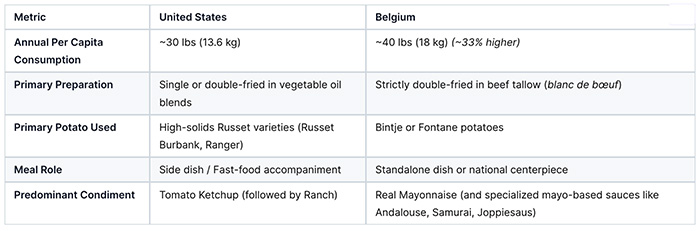
[8] Abacus chart.
FRENCH FRY TRIVIA
What’s in a name? The word “potato” comes from the Haitian word “batata,” which is their name for the sweet potato. It entered Spanish as “patata” and eventually into English as “potato.”
Why a spud? The slang term for potato, “spud,” comes from a spade-like tool used to harvest potatoes in earlier times.
Condiments. In the U.S., ketchup is typically the condiment of choice. In the U.K., it’s malt vinegar. In much of Europe, it’s mayonnaise. But the French typically enjoy their fries without condiments.
Belgian-style fries. In Belgium, a raw egg is sometimes cracked over French fries hot from the fryer. The heat cooks the egg, leaving a runny the yoke as a dip for the fries.
CHECK OUT WHAT’S HAPPENING ON OUR HOME PAGE, THENIBBLE.COM.
|

