|
Updated August 2026
National Deviled Egg Day isn’t until November 2nd, and there’s no Bacon & Eggs Day. There are other holidays, of course, for both eggs and for bacon—conveniently listed below.
But Easter is coming, and according to McCormick, nearly 2/3 of Americans—61%—plan to make and/or eat deviled eggs this Easter [source].
You can serve them as hors d’oeuvres or appetizers (see the difference below) not only for Easter, but for meals throughout the year.
Deviled eggs are especially popular food for parties and other gatherings, especially barbecues, picnics, holiday gatherings, potlucks, and showers.
They’re less an everyday staple than a highly recognizable celebration and party food.
Below:
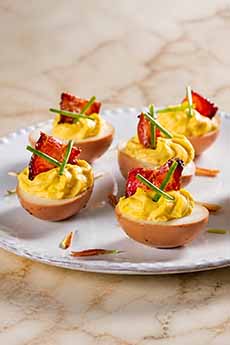
> The bacon and egg deviled eggs recipe.
> The classic deviled eggs recipe.
> More deviled egg recipes.
> The year’s 11 bacon holidays.
> The year’s 10 egg holidays.
> The difference between hors d’oeuvre and appetizers.
> The history of aperitifs and hors d’oeuvres.
Elsewhere on The Nibble:
> How to make perfect hard-boiled eggs.
> The history of deviled eggs.
> The different types of eggs: a photo glossary.

[9] Bacon deviled eggs with a bottle of white, a bottle of red (photo © The Nibble).
RECIPE: BACON & EGGS DEVILED EGGS
If you don’t have a recipe, we’ve our Nana’s classic recipe follows this one.
Ingredients
Deviled eggs, peeled
Bacon, crispy and cut into 2″ long pieces
Optional layer: bacon jam
Optional garnish: microgreens
Preparation
1. HALVE the boiled eggs lengthwise and remove the yolks. Set the hollowed egg-white halves aside.
2. PREPARE the filling and spoon it into the egg white halves.
3. TOP with a dab if bacon jam and crown with a piece piece of bacon placed lengthwise across the egg halves.
Variation
Create a deviled egg “surprise” by placing a layer of bacon jam in the egg half before adding the filling.
RECIPE: CLASSIC DEVILED EGGS
Ingredients For 6 Eggs/12 Halves
6 large or jumbo eggs
1/4 cup mayonnaise
1 teaspoon white wine vinegar
1 teaspoon Dijon mustard
1/8 teaspoon salt
Freshly ground black pepper
Garnish: paprika is classic, but we prefer snipped chives)
Preparation
1. HARD-BOIL the eggs. Place the eggs in a single layer in a saucepan and cover with water to cover by 1-1/2 inches. Heat on high until the water begins to boil. Cover the pan, turn the heat to low, and cook for 1 minute. Remove the pan from heat and leave covered for 14 minutes. Then, drain the hot water and rinse the eggs under cold water continuously for 1 minute. (We place the eggs in a sieve for this.)
2. PEEL the eggs. Crack the egg shells and carefully peel them under cool running water. Gently pat the peeled eggs dry with paper towels.
3. SLICE the eggs in half lengthwise. Remove the yolks to a medium bowl, being very careful not to tear the whites. Place the whites on a plate or serving platter.
4. MASH the yolks finely with a fork. Add the mayonnaise, vinegar, mustard, salt, and pepper. Mix well.
5. EVENLY fill the egg whites with heaping teaspoons of the yolk mixture. Garnish and serve.
MORE DEVILED EGG RECIPES
Bacon & Cheddar Deviled Eggs
Barbecue Deviled Eggs
Beet-ing Heart Deviled Eggs
California Roll Deviled Eggs
Crabmeat, Sturgeon & Smoked Salmon Deviled Eggs With Caviar Caps
Curried Deviled Eggs
Deviled Egg Chicks On Wheatgrass
Deviled Egg Party Bar
Deviled Eggs With Bacon & Cheddar
Deviled Egg & Ham Salad
Deviled Eggs With Smoked Okra
Gourmet Deviled Eggs
Green Deviled Eggs For Spring & St. Patrick’s Day
Green Goddess Pesto Deviled Eggs
Halloween Eyeball Deviled Eggs
Luxury Deviled Eggs With Caviar, Smoked Salmon & Sturgeon
Mix & Match Deviled Egg Stuffings
Pink, White & Green Deviled Eggs For Easter
Smoky Deviled Eggs
Spider Deviled Eggs For Halloween
Sweet Pea Deviled Eggs For Spring
35 Garnishes For Deviled Eggs
THE YEAR’S 11 BACON HOLIDAYS
February 27: The Big Breakfast Day
March 3: Canadian Bacon Day
April: National BLT Sandwich Month
April 6: National Carbonara Day
May 20: National Quiche Lorraine Day
June 29: National Bacon Burnt Ends Day
July 8: Kevin Bacon’s Birthday (LOL)
August 20: National Bacon Lovers Day
August or September, Saturday before Labor Day: International Bacon Day
September: Better Breakfast Month
December 30: National Bacon Day
THE YEAR’S 10 EGG HOLIDAYS
April: Easter
April 16: National Eggs Benedict Day
June 3: National Egg Day
July 9: National Don’t Put All Your Eggs In One Omelet Day
September: Better Breakfast Month
September 26: Better Breakfast Day
October, Second Friday: World Egg Day
November 2: National Deviled Egg Day
November 6: Jalapeño Bacon Egg Bake Day
December 24: National Eggnog Day
|
|
[1] They might look like potatoes, but they’re pickled deviled eggs. Here’s the recipe. Adding deviled egg filling to small potatoes is a thought, though (photo © Flavor & The Menu | Carlos Garcia).
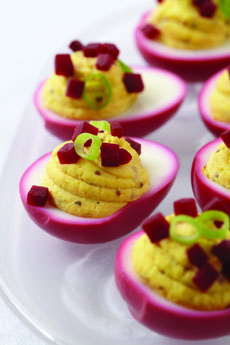
[2] Pink deviled eggs (here’s the recipe) can be combined with green and white deviled eggs (the recipe) for Easter (photo © Andrews McNeel Publishing).
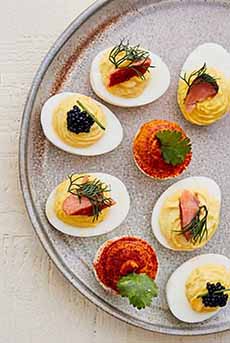
[3] An elevated approach: Top the deviled eggs with an assortment of garnishes (photo © California Wine Institute).
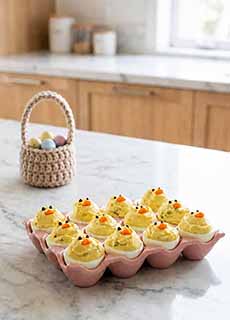
[4] For a fun Easter approach, garnish your favorite deviled egg recipe to look like chicks. Mound the egg mixture to create a head shape, use black sesame seeds for the eyes, and 2 tiny carrot triangles for each beak. Here’s a recipe (photo © The Nibble).
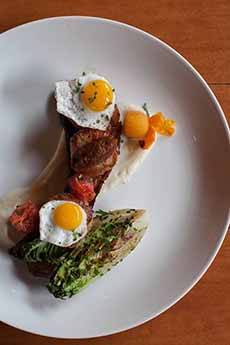
[5] Seared scallops with bacon and eggs (photo © Chef David Burke).

[6] These deviled eggs are garnished with a Mediterranean theme Here’s the recipe (photo © Smithfield Foods).
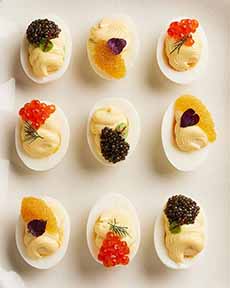
[7] If you’re in the chips, your theme could be different caviars (photo © Petrossian).
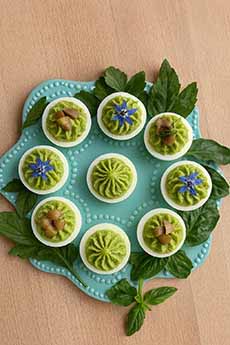
[8] Spring? Summer? St. Patrick’s Day? Here’s the recipe (photo © Woodhouse Chocolate).
|
THE DIFFERENCE BETWEEN HORS D’OEUVRES & APPETIZERS
The difference between hors d’oeuvres and appetizers is twofold.
When They’re Served
Hors d’oeuvres are typically served before the meal begins, with an apéritif or other beverage—or when there is no meal at all, such as at a cocktail party.
In fact, the French word hors-d’oeuvre (or-DURV) literally means “outside the work,” i.e., not part of the meal.
When there is a meal of more than a main course, appetizers are the first course. More recently, restaurants have renamed them “starters.” They are the first course of the meal.
While hors d’oeuvres are not considered to be part of the meal, appetizers are. They are usually chosen to complement the main course (or the next course, in a meal with more courses, e.g. soup, salad, fish course, meat course, cheese course, dessert).
While the deviled eggs featured above are usually hors d’oeuvres, you can serve them as an appetizer by adding them to a plate of salad, etc.
Portion Size
Hors d’oeuvre are typically finger foods that can be consumed in one or two bites.
Appetizer portions are larger and consumed with utensils.
THE HISTORY OF APÉRITIFS & HORS D’OEUVRE*
Apéritifs
While the first mention of an apéritif dates to 5th century Greece [source]. But the custom did not survive.
The custom of the modern apéritif was created in Turin in 1786 with the precursor of modern vermouth [source]. By the 19th century, it had become popular in the major cities of Italy and began to spread to other European countries.
Dubonnet, created in France in 1846 as a palatable means of delivering malaria-fighting quinine, was served to French Foreign Legion soldiers in mosquito-infested Northern Africa. Back in France, Dubonnet’s wife was so fond of the drink that she served it to her friends, and its popularity as an apéritif spread [source].
Hors D’Oeuvre
In Europe, appetizers/first courses have long been part of the afternoon and/or evening meal for more affluent people).
Towards the end of the 19th century, having an apéritif prior to dinner became a trend in France. An apéritif is defined as an alcoholic drink taken before a meal to stimulate the appetite [source].
In the 17th century, smaller dishes began to be served by being placed “outside the main work” of the formally placed dishes. These were known as hors d’oeuvre: originally canapés of small toasted bread with a savory topping served with alcohol before a meal [source].
The first mention of hors d’oeuvre is in François Massialot’s 1691 cookbook: Le cuisinier royal et bourgeois (The Royal and Bourgeois Cook).
In the cuisine of other regions worldwide, small bites before the main meal. But we’ll end here with Europe.
________________
*In French, the singular and plural are the same: hors d’oeuvre. In English, an “s” is added to create the plural, hors d’oeuvre.
CHECK OUT WHAT’S HAPPENING ON OUR HOME PAGE, THENIBBLE.COM.
|

