Homemade Animal Crackers Recipe & History Of Animal Crackers
|
National Animal Crackers Day is celebrated on April 18th. You could buy a box…but how about homemade animal crackers?
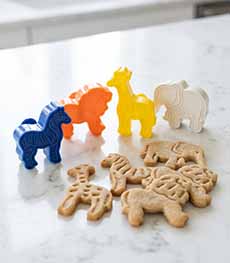
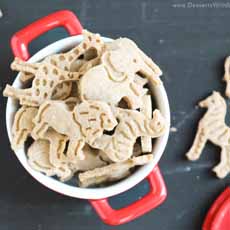
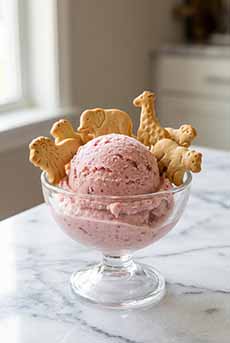
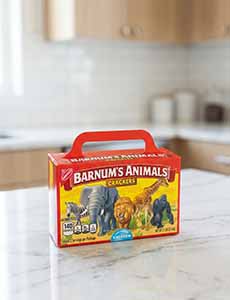
You’re never too adult to enjoy animal crackers..and since your palate is likely much evolved since childhood, to taste the superiority of homemade versions. Any adult will smile at a plate of cookie nostalgia with a cup of coffee or tea (and listen to six-year-old Shirley Temple sing “Animal Crackers In My Soup”). The standard-bearer, Barnum’s Animal Crackers (photo #5), has far less sugar than other cookies. In fact, they’re barely sweet enough to be called a cookie. So why are they called crackers? Because they are made with a layered dough like crackers. Below: > The history of animal crackers. > The history of all crackers. > Recipe: homemade animal crackers. > Uses for crackers beyond the conventional. Elsewhere on The Nibble: > The history of cookies and crackers. > The 10 different styles of cookies. > The different varieties of cookies: a photo glossary. > The year’s 44 cookie holidays. > The year’s 90 snack holidays. > Bonus: Shirley Temple singing “Animal Crackers In My Soup.” Animal crackers originated in Britain in 1889, capitalizing on the time when P.T. Barnum toured there with his circus. The first boxes were labeled Barnum’s Animals (presumably by license). In the U.K. they were called animal biscuits, biscuits being the British word for cookies. The crackers were exported to the U.S. When American manufacturers made their own versions, they changed the word biscuit to cracker instead of cookie (we opine, because consumers would expect cookies to be sweeter). There had been earlier animal crackers in the U.S. In 1883, when the earliest known recipe for “animals” was printed in Secretes of the Bakers and Confectioners’ Trade, written by J.D. Hounihan. Prior to Nabisco, at least two companies, Dozier-Weyl Cracker Company and the Holmes and Coutts Company, had been making them [source]. But the National Biscuit Company won the day with their bright red and yellow “circus car” box, introduced during the holiday season of 1902 with a string attached to hang the box from the Christmas tree. Today, brands like Annie’s and Best Choice call their products animal cookies…and add more sugar to the recipe. > Here’s more of the history of animal crackers. The following recipe, from King Arthur Flour, uses small (2” to 2¼”) spring-loaded plunger cutters (photo #2). You can buy a set of four for $9.95: elephant, giraffe, lion and zebra. You plunge down, then pop the dough right out. If you don’t want to buy the cutters, use whatever animal cookie cutters you have—even large ones. There’s no law that animal crackers have to be small. Also check out these 3-D animal crackers. This recipe, from King Arthur Flour, makes sweet, buttery cookies. It uses Princess Cake & Cookie Flavor, an extract that combines vanilla and lemon and emulates the flavor profile and aroma of Barnum’s Animal Crackers. If you don’t want to purchase a bottle, you can substitute: only vanilla extract, 3/4 teaspoon vanilla extract and 1/4 teaspoon lemon extract, almond extract, anise extract, or another flavor of choice. Another idea: Some brands add nutmeg or cinnamon. Prep time is 15 to 20 minutes; bake time is 8 to 10 minutes per sheet. Ingredients For About 5 Dozen Cookies 1. BEAT together the butter, sugar, honey, salt, baking soda, and flavor until well combined. Add the flour and oat flour, mixing to combine. 2. DIVIDE the dough in half, flattening each half slightly to make a disk; then wrap in plastic. Refrigerate for at least 1 hour. 3. PREHEAT the oven to 350°F. Lightly grease several baking sheets, or line them with parchment. 4. TAKE one piece of dough from the refrigerator and turn it out onto a lightly floured surface. Roll the dough 1/4″ thick. |
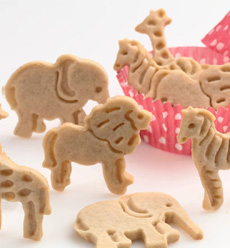 [1] Homemade animal cookies (photos #1 and #2 © King Arthur Flour).
|
|
|
5. DIP the animal cookie cutters in flour (each time you cut), then use them to cut the dough. Using the cutters may take a little practice, not to mention patience in making so many small cookies. Press the cutter down by the outside edges first, then use the plunger to emboss before picking up; and push the plunger again to release the cookie over the baking sheet.
6. TRANSFER the cookies to the prepared baking sheets and freeze for 15 minutes. This helps the cookies retain their shape and imprint. 7. BAKE the cookies for 8 to 10 minutes, until lightly browned around the edges (do not let the cookies brown). Remove the cookies from the oven, and let them cool on the baking sheet for several minutes, or until set. Then transfer the cookies on parchment to a rack to cool completely. Repeat with the remaining dough. Flat, dry, crispy crackers were created as a solution to a very real problem: how to preserve food, for home and travel alike. The earliest crackers were created by ancient civilizations. The Romans made a hard, salty, dry biscuit ration called buccellatum, which soldiers carried because it lasted a long time without spoiling. Twice-baked to remove the moisture (which prevents mold), they are the ancestor of modern biscotti—although more functional than delicious. In fact, buccellatum were rock-hard, practically indestructible, and had to be soaked in water, wine, or soup to be edible. (The modern biscotti di Prato from Tuscany didn’t emerge until the 14th century, adding sugar, honey, and almonds to create a delicacy rather than a military ration.) Many civilizations made cracker-like foods (i.e., dry, shelf-stable) for portability, preservation, or convenience, rather than for pleasurable eating as we enjoy crackers today. Some other examples: By the Middle Ages, cracker-like foods similar to those of Ancient Greece and Rome existed across Europe.
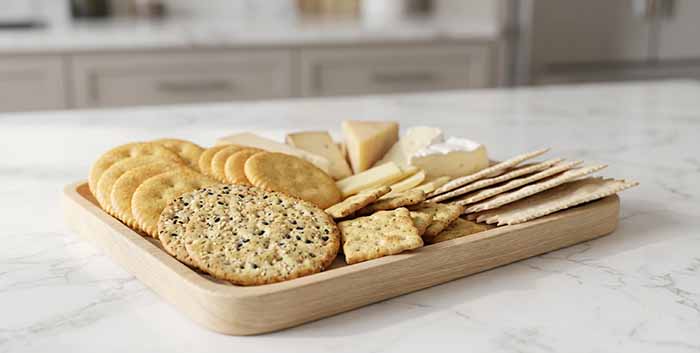
The modern cracker as we know it took shape in the early 1800s. In 1801, a baker in Massachusetts named Josiah Bent made a baked biscuit that “cracked” when it broke—hence the name “cracker.” These were still simple to make and easy to transport, but more palatable than hardtack. Later in the 19th century, companies began to refine the cracker into lighter, tastier versions. Today’s crackers range from basic water crackers to gourmet, seeded, or sweet varieties. No longer a survival food, they’re a staple for appetizers, cheese boards, and snacks, and as a traditional accompaniment to a bowl of soup. CHECK OUT WHAT’S HAPPENING ON OUR HOME PAGE, THENIBBLE.COM.
|
||