THE NIBBLE BLOG: Products, Recipes & Trends In Specialty Foods


Also visit our main website, TheNibble.com.

Cakes, Gateaux, Tortes, Tortas, & Tarts: The Difference

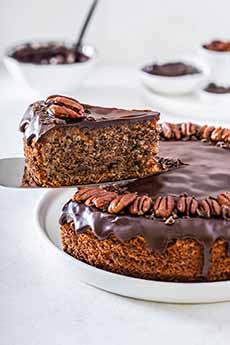
Chocolate Pecan Torte
[1] A torte is often a short, dense, single-layer cake. Here’s the recipe for this beauty, a chocolate-pecan torte, which even has its own food-holiday observance: August 22nd (photo © All We Eat).

Coconut Torte
[2] An almond coconut cake: one dense layer. While the recipe developer titled this a cake, its dense, nut-based structure gives it classic torte characteristics (photo © Food52).

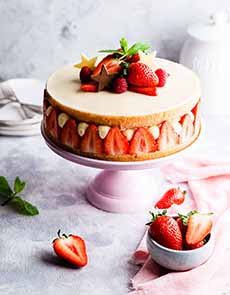
Gâteau Fraisier, a fancy French cake with strawberries
[3] This beauty is a gâteau, specifically, a fraisier (named after the French strawberry plant). Here’s the recipe (photo © Anna Banana).

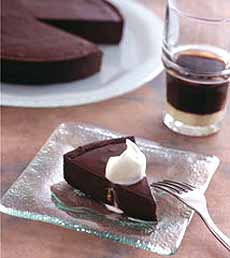
Chocolate Tart
[4] A chocolate tart. Notice the chocolate crust around the perimeter. Here’s the recipe (photo © Pichet Ong).

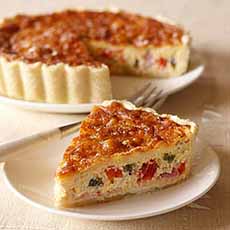
Vegetable Quiche
[5] Quiche is example of a savory custard tart, baked in a tart ring or fluted tart pan with straight sides and a firm pastry crust, pâte brisée (photo © Umami Information Center).


Updated August 2026

Doesn’t this pecan torte look irresistible (photo #1)? We baked it for National Pecan Torte Day, August 22nd. If there hadn’t been such a food holiday, we’d never have looked for a recipe and found this one.

What makes it a torte instead of a cake?

That’s the focus of this article: the differences between cakes, tortes, gâteaux, tortas, and tarts.

Let’s drill down.

Below:

> Cakes, tortes, tortas, and tarts: the differences.

Elsewhere on The Nibble:

> The history of cake.

> The different types of cake and cake terminology: a photo glossary.

> The year’s 55 cake holidays.
 

A BRIEF OVERVIEW

Different baking traditions in centuries past led to different names and styles of desserts, including today’ focus: cakes, tortes, gâteaux, and tarts.

The terms overlap, and usage varies by country, language, and recipe author.

Thus, these are useful guidelines, not rigid rules.

Cakes, tortes, and gâteaux are made from cake batter or cake layers†, with fillings and frostings as desired. There is no pastry crust.

We may be stating the obvious, but tortas, tarts, and pies, do have pastry crusts.

We were inspired to write this article because many people, including recipe authors and food writers, use the term “torte” loosely or incorrectly. We often see it ascribed indiscriminately to fancy layer cakes.

So to the best of our ability to iron things out, here’s the scoop.


CAKES, TORTES, TORTAS & TARTS: THE DIFFERENCE

While everyday usage can vary across regions, these are the general culinary distinctions:

• Cake: The broad English-language term for sweet, baked desserts made from flour, sugar, eggs, and fat. Cakes range from light, airy sponges and chiffon cakes to rich butter cakes, pound cakes, cheesecakes, and layered celebration cakes.

• Torte: A German-derived term for a rich, dense cake (photos #1 and #2). In English-language culinary tradition, a torte is often a short, single-layer cake made with little to no wheat flour, relying instead on ground nuts, breadcrumbs, chocolate, and eggs. Because they lack heavy flour structure, they tend to be lower and denser than conventional cakes.

While many are simply dusted with confectioners’ sugar, classic European tortes (like the Austrian Sachertorte) can also be split, filled, or glazed. Unlike light, towering layer cakes, tortes are celebrated for their rich, concentrated texture. For instance, the chocolate-pecan torte in photo #1 is baked in a round springform pan, yielding a dense, decadent single layer that lets the nuts and chocolate shine.

• Torta: The Italian and Spanish word for cake or tart. In Italian baking, it can refer to anything from a simple rustic breakfast cake to a filled tart or savory baked dish.

• Gâteau: The French word for cake (photo #3). In English-language pastry writing, the term typically refers to an elaborate, multi-layered French-style cake filled with cream, mousse, custard, or fruit.

• Tart: A baked pastry dish consisting of a firm pastry crust filled with sweet or savory ingredients (photo #4). Unlike cakes or tortes, tarts are built in a pastry shell—typically shallow with straight, fluted sides and a removable bottom—so the finished tart can be unmolded before serving.

• Pie: A baked dish featuring a pastry crust and filling. Pies typically have sloping sides and are served straight from the pan, and they may have a bottom crust only, a full top crust, a lattice, or a crumb topping.


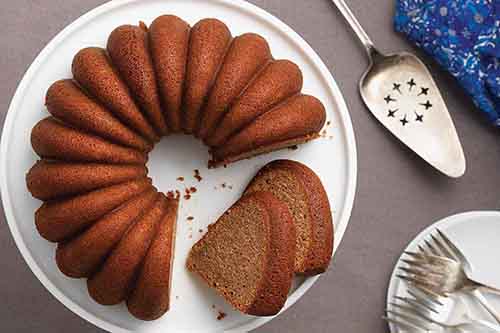
Chai-Spice Bundt Pound Cake
[6] “Cake” is an umbrella category with many sub-categories. The easy-to-make Bundt, an adaptation of a German Kugelhopf, became popular in 1950s America. Here’s the recipe for this chai-spiced pound cake Bundt and the history of the Bundt cake (photo © King Arthur Baking).

 
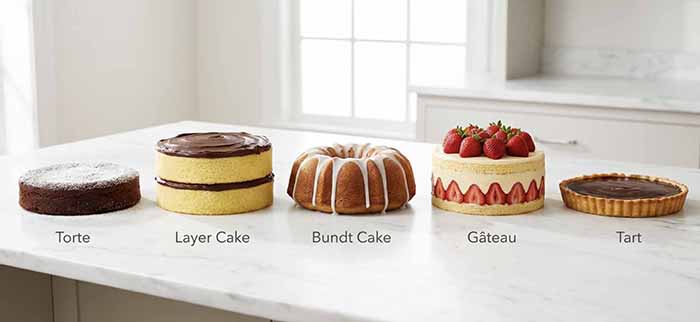
Torte vs. Cake Comparison
[7] The differences at a glance. Which would you like to eat first? (photo © The Nibble)


*Sub-categories of layer cakes (and there are even more sub-sub-categories):
> Number of layers: single-layer cake (sheet cake), two-layer cake, multi-layer cake.
> Cake base: butter cake, chiffon cake, flourless cake, sponge/génoise.
> Filling: buttercream layer cake, custard/pastry cream layer cake, jam/preserve-filled layer cake, ganache/mousse layer cake, whipped cream (with or without fruit) layer cake.
> Cultural/regional style: Black Forest Cake (Germany), Japanese Strawberry Shortcake, Opera Cake (France), Red Velvet Cake (U.S.), Tres Leches Cake (Latin America), Victoria Sponge (UK).
> Decoration: celebration cake (elaborate decoration), drip cake (a fluid topping such as ganache or caramel runs down the sides of the cake), frosted cake, naked cake.

†Tortes and gâteaux may be assembled from separately baked layers rather than a single batter.


CHECK OUT WHAT’S HAPPENING ON OUR HOME PAGE, THENIBBLE.COM.

Comments off

TOP PICKS OF THE WEEK: For The Kitchen

Recently we previewed some new housewares, just arrived on the market. Here are three that have found a permanent place in our home.
 
 
1. RITZ HOOK AND HANG TOWELS

It’s a simple invention but a very useful one: a kitchen towel with a hook attached, the whole thing going straight into the washing machine.

The soft, flexible, machine-washable handle is made of a unique rubber. It hangs on just about any drawer or cabinet pull, refrigerator handle or door knob.

In six colors, the towel blends into every decor.

Consider Hook and Hang for laundry rooms, garages and baby’s rooms as well. A set of two 18″ x 28″ towels is $25.99.

GET YOURS AT AMAZON.
 
 
2. HOT SIPS DRINKING STRAWS

Now that consumers are aware of the landfill created by plastic straws, some are turning to reusable, washable, eco-friendly straws.

Options have been on the market for a few years, but Hot Sips are particularly appealing. They’re soft, bendable and useful for hot or cold drinks.

They also prevent teeth-staining drinks, and come in a portable carrying tube. They fit most lids and travel cups.

Hot Sips’ oval, patent-pending shape even reduces the effort to sip.

They’re made of FDA grade material, are BPA free and dishwasher safe.

They’re $8.95 for two 6″ straws (photo #1)and $9.95 for 9.5″ straws. And they’ll last a long, long time.

GET YOURS AT MYHOTSIPS.COM.
 
 
3. OXO: PREP PEELERS

Everyone has a straight vegetable peeler for potatoes, carrots and other root vegetables.

But OXO has gone a bit farther to give serious cooks a complete set of peelers. In addition to the straight peeler, you can have a/an:

  • Asparagus peeler, to quickly remove the tough woody layer at the bottom.
  • Citrus peeler, to effortlessly peel and zest citrus fruits.
  • Julienne peeler, to easily peel precise strips of carrots, zucchini and more.
  • Large vegetable peeler, to easily peel large veggies like eggplant or shred cabbage quickly.
  • Serrated peeler, to peel soft fruits and vegetables with ease.
  •  

    Ritz Hook and Hang Towels
    [1] Hanging kitchen towels is elevated to an art, with Hook and Hang kitchen towels (photo courtesy John Ritz).

    Hot Sips Reusable Straws
    [2] Sip hot drinks with ease, and cool ones without throwing straws into the landfill. Shown: 6″ in cup, 9.5″ in tube. (photo courtesy My Hot Sips).

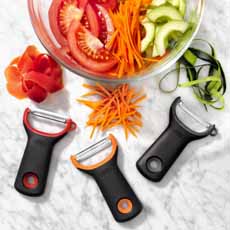
    Oxo Prep Peelers
    [3] Three of OXO’s prep peelers. The line of six makes food prep easier, even fun (photo courtesy OXO).

     
    We particularly love the easy julienne, making tomato roses with the serrated peeler, and peeling and zesting citrus (no more effort peeling grapefruits and oranges!).

    A set of three is $14.99.

    GET YOURS AT OXO.COM.
     
     
    We hope these new items are as enjoyable for you as they are for us.
     

    Comments off

    TIP OF THE DAY: 20 Ways To Serve Tortellini

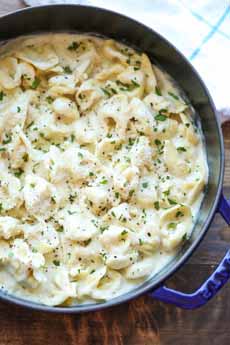
    Tortellini Alfredo
    [1] Tortellini alfredo. Here’s the recipe from Damn Delicious.

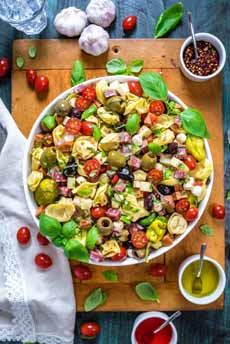
    Tortellini Antipasto Salad
    [2] Tortellini antipasto salad. Here’s the recipe from Host The Toast.

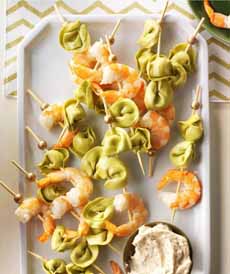
    Tortellini Shrimp Skewers
    [3] Tortellini and shrimp skewers. Here’s the recipe from Taste Of Home.

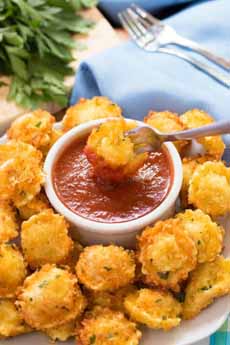
    Fried Tortellini Bites
    [4] Fried tortellini bites with marinara sauce dip. Here’s the recipe from The Cozy Cook.


    February 13th is National Tortellini Day.

    Most people think of a dish of tortellini with their favorite sauce. But tortellini can be so much more.

    Here are 20 ideas for lunch, dinner and hors d’oeuvre.
     
     
    20 WAYS TO SERVE TORTELLINI

    APPETIZERS & SALADS

  • Add to favorite salads (Caesar, caprese, cobb, etc.)
  • Antipasto skewers (recipe)
  • Appetizer with dip (recipe—serve at room temperature)
  • Green salad (recipe)
  • Fried tortellini “bites” with marinara dipping sauce (recipe)
  • Pasta salad (recipe)
  •  
    SOUP

  • Creamy tortellini tomato soup (recipe)
  • Lasagna tortellini soup (recipe)
  • Sausage tomato tortellini soup (recipe)
  • Soup dumplings (tortellini en brodo recipe)
  •  
    PASTA

  • Casserole/bake/skillet (recipe)
  • One pan tortellini, chicken and vegetables (recipe)
  • Pizza topping (recipe)
  • Stew dumplings (recipe)
  • Stir-fry (recipe)
  • Tortellini alfredo (recipe) or carbonara with bacon (recipe)
  • Tortellini in garlic butter (recipe)
  • Tortellini mac and cheese (recipe)
  • Tortellini primavera (recipe)
  • Tortellini with mushrooms and crispy sage (recipe)
  •  
     
    THE HISTORY OF TORTELLINI

    Tortellini are made by filling long strips of pasta, rolling them into tubes and cutting individual pieces, which are pinched together with the thumb and forefinger. The famous “loop” shape is said to be based on the belly button of the Venus, the Roman goddess of love.

    One of the most famous versions of the legend, written in the 14th century, tells us that that Bacchus, Mars and Venus came down to earth to intervene in a 12th century war between Bologna, the historic capital of the Emilia-Romagna region in northern Italy; and Modena, also in Emilia-Romagna, the home of balsamic vinegar (plus the Ferrari and Lamborghini sports cars.)

    The gods spent the night at an inn in Castelfranco, a small town located between the two cities.

    In the morning, Bacchus and Mars arose early to visit the battle site. When Venus awoke and could not find her companions, she called for the innkeeper, who arrived to find the goddess of love naked. Inspired by her navel, he created a new shape of pasta. (Seriously, Mr. Innkeeper—her navel is what inspired you?)

    Tortellini are made in a size that fits easily onto a soup spoon. There is a recipe for tortelloni, larger tortellini, that dates back to the 12th century. The first recipe for tortellini alla Bolognese, tomato and meat sauce, appeared in Bologna in 1550 and became a signature dish in that city. (Note that Tuscans also claim tortellini as their regional pasta.)

     
    Tortellini en brodo was the traditional Christmas soup, made with capon broth, which was favored by the ruling classes. The broth was made rich by cooking all the meat in it. The meat was then turned into a stuffing with Parmigiano-Reggiano, prosciutto crudo and/or mortadella.
     
     
    TRIVIA: TORTELLINI & RAVIOLI DIFFERENCE

    Both tortellini and ravioli are what is known as “pillow pasta”: stuffed pasta that is pillowy, compared to long strands (spaghetti, fettuccine, etc.) or short cuts (bowties, wagon wheels, etc.).

  • Tortellini translates to “little stuffed cakes.” A single layer of pasta, topped with a filling, is folded into a hat-like shape. The singular form is tortellino.
  •  

  • Ravioli, the plural of “raviolo,” translates to “little turnip.” Ravioli is two layers of pasta with a filling in-between, that form a pillow-like shape.
  •  
    FOR MORE PASTA SHAPES, CHECK OUT OUR PASTA GLOSSARY.


    Comments off


    © Copyright 2005-2026 Lifestyle Direct, Inc. All rights reserved. All images are copyrighted to their respective owners.