THE NIBBLE BLOG: Products, Recipes & Trends In Specialty Foods


Also visit our main website, TheNibble.com.

FATHER’S DAY GIFTS: Hendrick’s Midsummer Solstice Gin & Jumbo Ice Cubes

Hendrick's Midsummer Solstice Gin
[1] Don’t let the summery flowers and lavender label give the wrong impression: This floral gin is a delight for anyone who loves gin botanicals (photo courtesy Hendrick’s Gin).

Epare Jumbo Ice Cube Trays
[2] These ice cube trays make jumbo ice cubes, twice the size of standard cubes (photo courtesy Eparé).


Two Father’s Day gifts we’re giving this year: Hendricks Midsummer Solstice limited release gin, and Eparé jumbo ice cube trays, for the ultimate on-the-rocks experience.
 
 
HENDRICK’S MIDSUMMER SOLSTICE LIMITED EDITION GIN

The latest expression from Hendrick’s Gin, created at the newly-opened Hendrick’s Gin Palace in Girvan, Scotland.

The new expression captures “nature’s flavors and aromas at the peak of summer,” per Master Distiller Lesley Gracie, who also created the original Hendrick’s Gin. “…For this new expression I’ve hand-selected each floral essence to capture this intensity,” she notes.

The packaging (photo #1) features a deep purple bottle with lavender labels. The gin is clear, as always.

But don’t think that summer flowers and lavender labels mean “feminine.”

This is a full-on gin that’s perfect for sippers who enjoy the botanicals in a glass of gin, straight-up or on-the-rocks.

While Hendrick’s has created special cocktails to show off the new gin, we think that the best way to enjoy the uniqueness of any particular expression of spirits is to drink it “as is,” without the layering of other flavors or aromas.

But there are plenty of recipes online, starting with this Midsummer Spritz.

Once the small batch of bottles is gone, it’s gone forever. So in addition to Father’s Day gifts, we picked up an extra couple of bottles; maybe for gifting later on, maybe to remain in our personal stock.

For more information, visit HendricksGin.com.
 
 
EPARÉ JUMBO ICE CUBES

Eparé’s Clear Ice System has created trays for jumbo ice cubes: They’re two inches square!

They’re not just eye-catching: The larger the cube, the slower it melts.

Each ice cube tray makes six cubes (as compared to the traditional dozen regular cubes), $15.99 for a set of two trays.

The ice cube trays have lids, to protect the cubes from migrating aromas and freezer detritus.

Get yours at Empare.com, or at Overstock, Target, Wayfair and other retailers.

 
TIP: For flawless, clear ice cubes every time, use distilled water; or boil tap water twice, and let cool.

You can also use the trays to make:

  • Ice cream squares.
  • Ice cubes decorated with fruits or flowers (here’s how).
  •  
    Here are more uses for ice cube trays.


    Comments off

    FOOD FUN: Rainbow Sangria With Colored Ice Cubes

    What’s new in sangria?

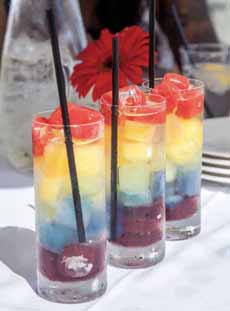
    This clever idea from I|O Godfrey, a rooftop lounge at The Godfrey Hotel in Chicago. (In fact, it’s Chicago’s largest indoor/outdoor rooftop.)

    An array of colored ice cubes is made from fresh fruit juices.

    After they’re piled high in a tall glass, a blend of Moscato and vodka is poured from a pitcher at the table. The result: food art.

    If you’d like to serve it at home, here’s a guide:
     
     
    COLORED ICE CUBES

  • Green: honeydew (juiced), lime Juice
  • Orange: cantaloupe (juiced), orange juice
  • Pink: red/pink grapefruit juice, watermelon juice
  • Purple: blueberry juice, grape juice
  • Red: cranberry juice, pomegranate juice
  • Yellow: lemonade, pineapple juice
  •  
    What about blue?

    For the blue ice cubes, you can use:

  • Blue curaçao diluted in water (so it will freeze)
  • Blue Hawaiian Punch
  • Blue food color (which won’t have flavor)
  • Homemade blue juice*
  •  
    How fun is this sangria?

    Just try it!
     
     
    MORE SANGRIA RECIPES

  • Apple Sangria
  • Cranberry Sangria
  • Halloween Sangria
  • Jubilee Sangria
  • Peach Sangria #1
  • Peach Sangria #2
  • Pomegranate Sangria
  • Red, White & Blue Sangria
  • Rosé Sangria
  • Saké Sangria
  • Stone Fruit Sangria
  • Summer Sangria
  • Winter Sangria
  •  
     
    THE HISTORY OF SANGRIA
     
     
    ________________

    *This is actually blue simple syrup. Make it and pour it into an ice cube tray.


    Rainbow Sangria
    [1] A rainbow of fruit-flavored ice cubes contribute the fruit juice to this innovative sangria from I|O Godfrey in Chicago (photo © Godfrey Hotel).

    Cranberry Sangria
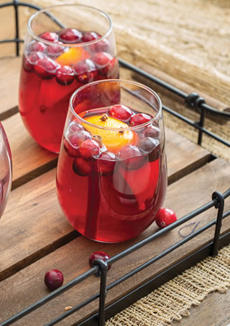
    [2] A conventional sangria adds fresh fruit to the wine mixture (photo © McCormick).

    White Sangria
    [3] Many people think of sangria as a red-wine drink, but it is made with white wine and rosé, too (photo © Dante Restaurant | New York City).


    CHECK OUT WHAT’S HAPPENING ON OUR HOME PAGE, THENIBBLE.COM.


    Comments off

    RECIPE: Mediterranean Chicken With Olives

    Chicken With Olives
    [1] Yum, yum: Mediterranean chicken with kalamata olives (both photos courtesy DeLallo).

    Kalamata Olives Jar
    [2] A more conventional spelling is kalamata (transliterated from the Greek alphabet). Regardless of the spelling, these extra-large, pitted kalamata/calamata olives from DeLallo are great.


    June 1st was National Olive Day. This year, it fell on the weekend, when we often don’t publish.

    But you won’t mind getting this delicious, easy recipe a couple of days late.

    The bright and briny flavor of the Greek kalamata olive stars in this easy-to-prepare chicken entrée.

    Accented with slices of tangy lemon and fragrant herbs, this dish gives that classic weeknight chicken dinner a marvelous Mediterranean twist.

    Thanks to DeLallo for this recipe.
     
     
    RECIPE: MEDITERRANEAN CHICKEN WITH OLIVES

    Ingredients

  • 1/4 cup lemon juice
  • 2 tablespoons extra virgin olive oil, plus more for greasing pan
  • 4 cloves garlic, minced
  • 4 boneless skinless chicken breasts
  • 1 red onion, sliced
  • 4 ounces (about 12) kalamata olives, preferably pitted (photo #2)
  • 1/2 teaspoon chopped fresh rosemary
  • 1/2 teaspoon chopped fresh oregano
  • 1 lemon, thinly sliced
  • Pinch of ground black pepper
  • Cooking spray
  •  
    Preparation

    1. PREHEAT the oven to 400˚F. Combine the lemon juice, olive oil and garlic in a small mixing bowl.

    2. MARINATE the chicken breasts in a resealable plastic bag or a deep dish, for 20 minutes. Be sure thee chicken is completely coated. Meanwhile…

    3. PREPARE a deep baking dish with a thin layer of olive oil. Arrange the marinated chicken and marinade in the pan with the onion and olives. Sprinkle with fresh herbs and top with lemon slices (photo #1).

    4. BAKE for 20-25 minutes until chicken is cooked through.


    OLIVE HISTORY

    Olives are one of the oldest cultivated foods (here are the oldest cultivated foods).

    Although its savory flavor makes many people think of it as a vegetable, it’s actually a fruit—the fruit of the olive tree.

    The olive tree is native to the Mediterranean basin. Wild olives were collected by Neolithic peoples as early as the 8th millennium B.C.E.

    The wild trees are believed to have originated in Greece, and were first domesticated in one of three places: Asia Minor, the Levant*, or in Mesopotamia (source).

    Olive tree cultivation reached Iberia (Spain) and Etruscan Etruria (western Italy) well before the 8th century B.C.E. It spread to southern Gaul (France) in the 7th century B.C.E. Olives were pressed into olive oil by 6000 B.C.E.

    The olive tree may be the oldest known cultivated tree in the world. It was cultivated before written language was invented. It was grown in Crete by 3000 B.C.E. and may have been the source of the wealth of the Minoan kingdom.

    The Phoenicians spread the olive to the Mediterranean shores of Africa and Southern Europe. Olives have been found in Egyptian tombs from 2000 B.C.E.

    The olive arrived in Greece, and then to Rome, where it was carried by Romans to other lands they conquered.

    Olives came to the New World with Franciscan missionaries, in late-18th-century California. More recently, it has become a successful commercial crop in the subtropical climates of Australia and New Zealand.

    ________________

    *The Levant was a large area in southwest Asia: south of the Taurus Mountains, with the Mediterranean Sea as the western boundary, and the north Arabian Desert and Mesopotamia in the east. “Levant” is an English term that first appeared in 1497. It originally referred to the “Mediterranean lands east of Italy.” The historical area comprises modern-day Iraq, Israel, Jordan, Lebanon, Palestine and Syria. Among other popular foods, Levantine cuisine gave birth to baklava, balafel, kebabs, mezze (including tabbouleh, hummus and baba ghanoush), pita and za’atar, among other dishes that are enjoyed in the U.S. and around the world.


    Comments off


    © Copyright 2005-2026 Lifestyle Direct, Inc. All rights reserved. All images are copyrighted to their respective owners.