THE NIBBLE BLOG: Products, Recipes & Trends In Specialty Foods


Also visit our main website, TheNibble.com.

TIP OF THE DAY: Lettuce Crudites

Mixed Greens Crudites
[1] Green goddess: a crudité plate of green lettuces (photo © Empellon | NYC

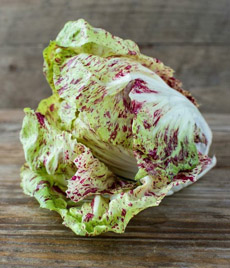
Castelfranco Chicory
[2] California-grown Castelfranco chicory (photo © Good Eggs).

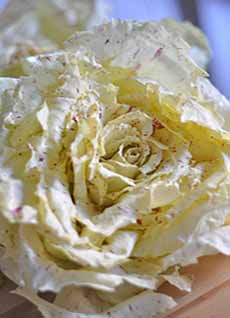
Variegated Radicchio
[3] Variegated radicchio, radicchio variegato di castelfranco IGP. IGP is an acronym for indicazione geografica protetta, meaning it can only be grown in a specified region—In this case, the Castelfranco Veneto region of Italy. It is the terroir* of this region that produces the ivory color (photo © Lavanda Peperina).

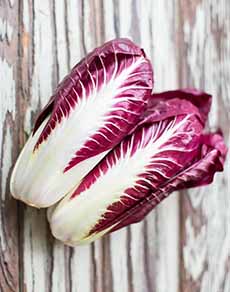
Treviso Radicchio
[4] Treviso radicchio. It is easy to confuse this radicchio with red endive, which looks similar but is a hybrid of Belgian endive and Treviso radicchio (photo © Good Eggs).


In the U.S., for decades upon decades, ladies setting a fine table began dinner with a crystal, porcelain or silver “relish tray.”

This typically consisted of raw carrots, celery sticks and radishes, plus gherkins and olives. No dip, just veggies.

The relish tray, often made with sections to separate the items, was meant as a quick bite until the first course arrived.

It was an Americanization of the French dish called crudités, which could comprise raw vegetables of every description, artfully cut and arranged on a platter.

There was no creamy dip, as many Americans serve today, but a vinaigrette with minced fresh herbs.

In the U.S., the concept has evolved to include much of which is in the produce department.Many of us even call our raw vegetable plate crudités (CROO-dih-tay).

In our home, where “more is more,” this meant quite the spread:

Bell pepper strips, broccoli and cauliflower florets, carrots and celery (of course!), cherry tomatoes, cucumbers, endive, green beans, mushrooms, radishes, scallions, snow peas or sugar snap peas, zucchini and/or yellow summer squash.

In essence: it meant (and still means) anything that tastes good raw and can easily be picked up and dipped.

We’re happy to have leftovers for the next day. If you have too many, steam some of them.

Here’s more about the history of crudités in America.
 
 
A NEW IDEA FOR CRUDITÉS

Recently, we came across this photo (photo #1) from Empellón restaurant in New York City:

An assemblage of beautiful lettuces, including radicchio and chicory, served crudites-style with a dip.

Note that in addition to categories we think of as lettuce—bibb lettuce, Boston lettuce, iceberg lettuce, leaf lettuce and romaine—these are also fall in the lettuce category:

  • Arugula
  • Chicory
  • Endive
  • Frisée
  • Kale
  • Radicchio
  • Spinach
  •  
    While watercress is a leafy vegetable, it is in a different family, genus and species from lettuce.


    NEXT STEP

    While the farmers markets still have a beautiful assortment of lettuces, serve it with whatever dip you like—from a light Dijon vinaigrette to chunky blue cheese (recipe below).

    In addition to the familiar, try the unusual. Whatever you pick should be firm enough to dip.

  • Beet greens
  • Belgian endive
  • Chicory (many types available; a rare one in photo #2)
  • Collard greens
  • Curly endive
  • Escarole
  • Kale
  • Lacinto kale, a.k.a. dinosaur kale, Tuscan kale or Tuscan cabbage (cavolo nero)
  • Mustard greens
  • Oak leaf lettuce
  • Radicchio treviso†(long as opposed to round—photo #4)
  • Red endive
  • Red leaf lettuce
  • Romaine
  • More (look for unusual cultivars like the ivory radicchio in photo #3)
  •  
     
    RECIPE: CHUNKY BLUE CHEESE DRESSING & DIP

    This dressing is good enough to eat by the spoonful. Try it on different styles of potatoes, too.

    The better the blue cheese, the more delicious the dip.

    Ingredients

  • 1/3 cup whole milk
  • 1 teaspoon distilled white vinegar
  • 5 ounces quality blue cheese, crumbled
  • 1/3 cup + 1 tablespoon sour cream
  • 1/4 cup mayonnaise
  • 4 teaspoons white wine vinegar
  • 1/2 teaspoon granulated white sugar
  • 1/4 teaspoon garlic powder
  • 1/8 teaspoon freshly-ground black pepper
  • Dash salt
  •  
    Preparation

    1. BLEND the milk and distilled white vinegar in a medium bowl. Let it sit for 5 minutes, then stir. [This creates buttermilk—a good tip for when you have a recipe that requires a small amount. To make a cup of buttermilk, add a tablespoon of distilled white vinegar (not white wine vinegar) to a one-cup measure. Fill to the rim with milk and let stand five minutes.]

    2. ADD the blue cheese to the buttermilk, and mash with a fork until the mixture is combined.

    3. ADD the sour cream, mayonnaise, white wine vinegar, sugar, garlic powder, black pepper and salt. Mix with fork to combine.

    4. PLACE into a container with a tight seal. Refrigerate and let set for at least 4 hour; preferably overnight.

    _________________

    *Pronounced tuhr-WAH, terroir is the French expression for sense of place, the unique environment in which something grows—its specific soil composition and microclimate. Microclimate includes temperature, amount of sunshine and rain. The flavor nuances of agricultural products, from grapes to olives to milk to cacao, is a function of its terroir.

    †There are numerous varieties of every green, including radicchio (rah-DEE-key-yo) and chicory. Many of them have common ancestors, and can look similar. With radicchio, an Italian leaf chicory, there are different varieties, each named after the region in Italy where it is grown. The most common variety in the U.S. is radicchio di Chioggia (pronounced key-YO-guh), a round, tightly-packed head of dark maroon leaves with thick white veins.


    Comments off

    TIP OF THE DAY: Heirloom Tomato Salads: Russian-Style & Mediterranean-Style

    Today’s tip showcases luscious summer heirloom tomatoes in two salads.

    Both are European-inspired, both are made without lettuce or other leafy greens.
     
     
    RECIPE #1: RUSSIAN TOMATO & CUCUMBER SALAD

    Our Russian grandmother used a lot of sour cream, dill and scallions: as salad dressing, in borscht, on boiled potatoes and as a general garnish.

    We grew up loving it, and since then have regularly treated ourselves to the garnish in borscht, boiled potatoes and beet salad or side.

    We made the easy transition to a garnish for baked potatoes and other foods, including fried chicken.

    We even had it on toast and bagels: a worthy stand-in for cream cheese.

    But we hadn’t thought about that salad dressing for quite some time.

    Truth to tell, as one of our annual “eat better” New Year’s resolutions, we gave up sour cream in favor of fat-free Greek yogurt at least 10 years ago.

    We simply didn’t connect that we could make the salad dressing with yogurt.

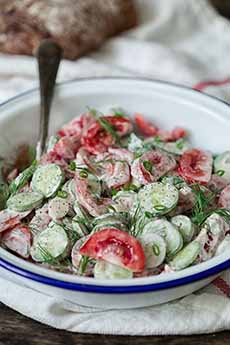
    Recently, we came across this salad recipe from Vikalinka (photo #1).

    Easy to make yet bursting with layers of flavor, it combines tomatoes, cucumbers, scallions, fresh dill and sour cream or crème fraîche.

    It’s so refreshing: tender tomatoes, crunchy cukes, crunchy and sharp scallions and a creamy dressing with sprightly dill. We love it!

    If these ingredients sound good to you, make it tonight. Note that once dressed, the salad doesn’t keep well; so don’t make more than you’re ready to eat.

    Again, here’s the recipe.
     
     
    RECIPE #2: MEDITERRANEAN TOMATO & FIG SALAD

    This salad has a Mediterranean flair.

    Wild figs originated in the Mediterranean* region, from Afghanistan to Portugal.

    Figs are believed to be the first cultivated fruit. Remains have been found in the ruins of a prehistoric village near Jericho, in the West Bank, grown some 11,400 years ago [source].

    Each Mediterranean country has its own seasonings and favorite ingredients.

    Think figs and cheese or yogurt for breakfast, fig and olive stew for dinner, and a dessert of fig cake, or a simple plate of plump fresh figs.

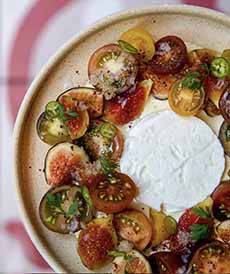
    This tomato salad (photo #2), from Empellón restaurant in New York City, combines fresh figs and cheese with heirloom tomatoes.

    While the upscale Mexican restaurant uses queso fresco as the cheese, you can substitute feta, goat cheese, ricotta or other favorite. Even blue cheese works.

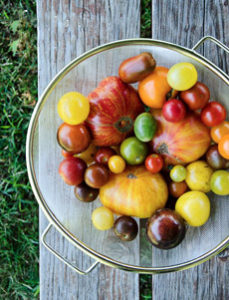
    Use small heirloom tomatoes or heirloom cherry tomatoes (photo #3). Cut them in slices or wedges, cut the figs in wedges.

    Dress the salad with a drizzle of extra virgin olive oil, with an optional drizzle of balsamic vinegar.

    You can garnish the salad with pine nuts or chopped pistachios.

    And don’t forget sea salt and the peppermill.


    Tomato Cucumber Salad
    [1] A Russian-style tomato salad with a sour cream dressing (photo © Viklinka).

    Fig & Tomato Salad
    [2] A Mediterranean tomato salad with figs (photo © Empellón Restaurant | NYC.

    Beautiful Heirloom Tomatoes
    [3] Summer’s bounty includes luscious heirloom tomatoes in regular and cherry sizes.

     
    We don’t salt the salad before serving, because when the ingredients are right, they don’t need enhancing.

    But just in case.

    ______________

    *Different fig genuses originated in Asia.


    Comments off

    TIP OF THE DAY: Rambutan, Asian Fruit

    Rambutan
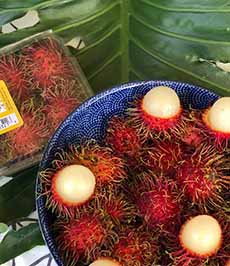
    [1] A bowl of rambutans, with some pieces peeled to reveal the white fruit inside (photo © HLB Specialties).

    Rambutan Tree
    [2] Rambutans ripening on the tree. The “haze” around the red fruits are green “hairs,” which have not yet ripened to red (photo © Bonayon).

    Rambutans
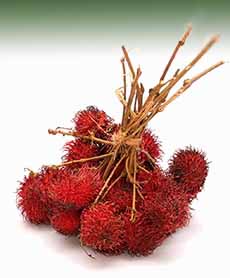
    [3] A cluster of rambutans cut from the tree. They grow in clusters of 10 to 20 berries (photo © Muhmmad Mahdi Karim | Wikipedia


    Great news for lovers of sweet fruits like lychees: For the next three weeks, from from August 22nd to September 14th, shoppers will be able to find rambutans on store shelves.

    Rambutans are the sweet berries of a tropical tree. The berries have an unusual appearance: The red peel is covered with soft red or green “hairs.”

    In fact, the name “rambutan” is derived from the Malay word rambut, meaning hair. Similarly, in Vietnam, its name is chôm chôm, meaning messy hair.

    Like lychees, rambutans have translucent white pulp (sometimes pale pink), with a large, nut-like, inedible seed. Eat them chilled, if you can resist popping them open before they hit the fridge.
     
     
    HOW DOES RAMBUTAN TASTE?

    Rambutan is sweet and refreshing, with a flavor reminiscent of lychee crossed with grape.

    Even though they are satisfyingly sweet, rambutans only have around 10 calories per berry.

    They are also very convenient for grab-and-go: They are easy to peel and eat.

    Look for rambutans at Freshfields Farms, Meijer, Trader Joe’s, Wal-Mart and Whole Foods stores.

    For more information, visit HLBSpecialties.com or call (954) 475-8808.
     
     
    RAMBUTAN HISTORY

    Rambutans, Nephelium lappaceum, are native to the Malay Archipelago.

    They grow on a tree in the family Sapindaceae or soapberry—so-called because the oil from the seeds of these plants contains saponin, which is used as a natural, low-sudsing detergent.

    The family also includes lychee, longan, guarana, and the horse chestnut and maple trees, among other genuses.

    Growing wild in Indonesia and Malaysia, rambutans have been cultivated for thousands of years.

    Arab traders and others carried the fruits to other parts of Asia, then to Africa, Central America, Colombia and Ecuador and Oceania.

    Seeds were imported into the U.S. from Java in 1906, but the trees, which want hot, humid climates, did not grow successfully in this country.

    Before 2016, rambutans were virtually unknown in the U.S. outside of Asian grocers. HLB Specialties introduced a rambutan clamshell to supermarkets at that time, and the fruit quickly gained a following.

    But it’s only around for a few short weeks, so “follow” quickly.


    RAMBUTAN NUTRITION

    The rambutan fruit is rich in vitamins and minerals, including the antioxidant vitamin C. Eating 5–6 rambutans (easy to do!) provides 50% of the daily nutrition value of C.

    Its flesh provides around 1.3–2 grams of total fiber per 3.5 ounces (100 grams), similar to apples, pears and oranges.

    Rambutan also has a good amount of copper, an essential nutrient*.

    It has smaller amounts of calcium, iron, magnesium, manganese, phosphorus, potassium and zinc, as well.

    At only 10 calories per fruit, what are you waiting for?

      
    ________________

    *Together with iron, copper enables the body to form red blood cells. It helps maintain healthy bones, blood vessels, nerves, and immune function.


    Comments off


    © Copyright 2005-2026 Lifestyle Direct, Inc. All rights reserved. All images are copyrighted to their respective owners.