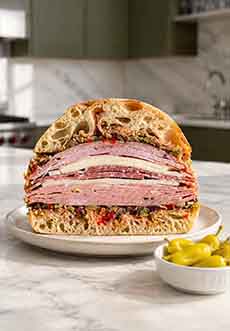
7. Muffuletta
This submarine-style sandwich is credited to a New Orleans Sicilian immigrant, Salvatore Lupo, in 1906 (photo #7). Using a round loaf, he layered meats, cheeses, and olive salad, then cut the sandwich into quarters. Lupo served his creation at his establishment, Central Grocery, located in the heart of the city’s French Quarter.
The muffuletta was designed to feed local Sicilian farmers and dockworkers who needed a hearty, portable meal that could hold up through a long workday. The sandwich’s name comes from the large, sesame-topped round loaf used to make it, modeled after traditional Sicilian muffuletta bread.
8. Neapolitan Ice Cream
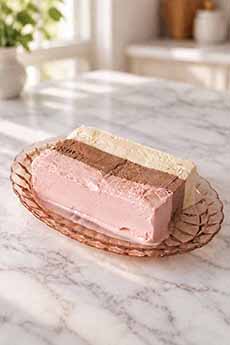
While layered ice cream exists in Italy—think spumoni and semifreddo—Neapolitan ice cream, with its side-by-side blocks of chocolate, vanilla, and strawberry, was popularized in the United States by Neapolitan immigrants and named for their hometown, Naples (photo #5). Italian immigrants brought the concept of multi-flavored layered or molded frozen desserts to the United States in the late 19th and early 20th centuries. Local ice cream makers adapted the multi-flavor tradition into a more accessible format.
By the early 1900s, commercial producers began packaging the distinct trio of chocolate, vanilla, and strawberry side-by-side in brick form. This vibrant combination not only offered a crowd-pleasing variety of flavors in a single purchase, but it also became an enduring symbol of American commercial ice cream innovation rooted in Italian tradition.
The beloved bricks of our childhood have largely been phased out due to shifts in manufacturing, packaging technology, and grocery logistics. Cylindrical round-bottom tubs and standard plastic containers became vastly cheaper, more structurally sound, and easier to seal than the rectangular cardboard boxes that held the bricks.
9. Pepperoni Pizza
Traditional Italian pizza often differs from Italian-American pizza. Italian pizzas often use a lighter hand with cheese and fewer toppings. Common Italian toppings include anchovies, corn, olives, prosciutto, and sausage.
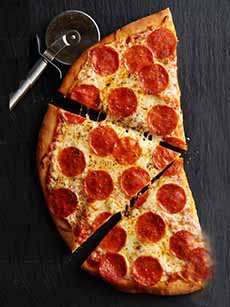
The pepperoni Americans put on pizza is Italian-American, not a traditional Italian sausage (photo #3). It was inspired by Italy’s spicy salami traditions, but developed into its own cured sausage in the United States.*
Pepperoni became the number-one added topping to pizza in America.
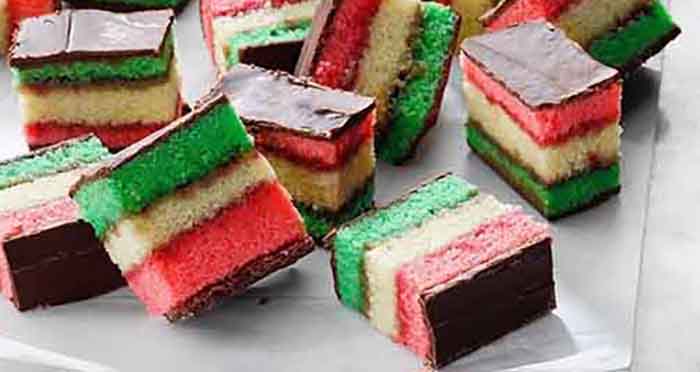
10. Rainbow Cookies
These colorful cookies consist of three layers of dense almond sponge cake, with a thin spread of fruit jam—usually seedless raspberry or apricot—between the layers, then enrobed in chocolate. They are generally associated with Italian-American pastry shops of the early 20th century. The layers are dyed red, white, and green to resemble the Italian flag.
In Italian-American neighborhoods, they are often called tricolor cookies or seven-layer cookies (the latter a folk etymology accounting for the three cake layers, two jam layers, and two chocolate coatings). They remain a staple of holiday trays and Sunday dessert spreads.

[11] Italian rainbow cookies. Here’s a recipe if you’d like to bake a batch (photo © Taste of Home).
11. Shrimp Scampi
In Italian, scampi is the plural of scampo, the word for langoustines—also called Norway lobsters—which are crustaceans distinct from shrimp. In the United States, cooks substituted readily available shrimp for langoustines, creating the Italian-American dish known as shrimp scampi, sautéing the shrimp in butter or olive oil with garlic.
In Italy, a dish of langoustines sautéed in butter/olive oil and garlic is called scampi in padella, langoustines cooked in a frying pan. They may be served simply with bread to mop up the sauce. Scampi are also incorporated into pasta dishes, risotto, and other seafood dishes, and can be grilled, baked, or sautéed.
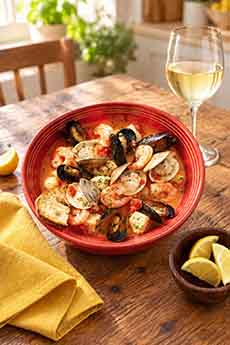
The American presentation of shrimp scampi piled atop pasta (photo #8) is an Italian-American adaptation.
12. Spaghetti and Meatballs
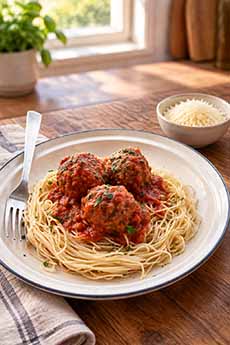
This beloved Italian-American classic is not a traditional Italian dish in its familiar American form (photo #4). Historically, meat was often expensive for poorer Italian families, and Italian meatballs (polpette) are generally smaller—often walnut-sized. You won’t find the large meatballs familiar in the United States.
In Italy, the meatballs are viewed quite differently than they are in the United States. They can be served on their own and meatballs do appear in some Italian dishes‡ including certain pasta preparations, but the heaped plate of spaghetti topped with large meatballs is Italian-American.
13. Submarine Sandwich
The submarine sandwich is an Italian-American creation that seems to have developed in several Northeastern Italian-American communities from the late 19th into the early 20th century. Immigrant Italian grocers and delicatessens put familiar cured meats, cheeses, vegetables, oil, and vinegar into portable bread for workers and other customers.
Depending on where you are in the Northeast, the sandwich takes on different local monikers—such as “grinders” in New England, “heroes” in New York City, and “hoagies” in Philadelphia—usually made with crusty Italian loaves or long rolls.
What began as a practical, filling lunch for laborers quickly became a staple of American lunchtime culture, eventually inspiring the explosive growth of modern submarine sandwich chains in the mid-to-late 20th century (Blimpie, Firehouse Subs, Jimmy John’s, Jersey Mike’s Subs, Potbelly Sandwich Works, Subway, and Quiznos).
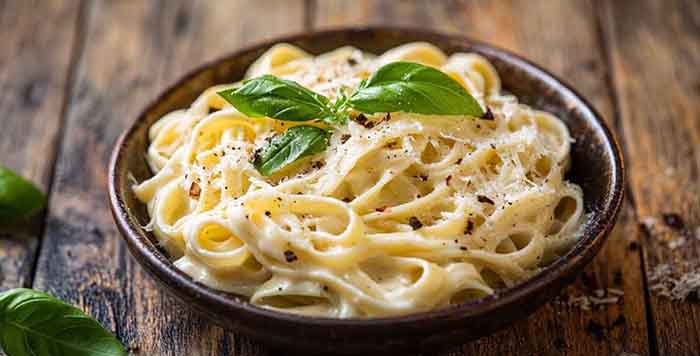
Honorable Mention: Fettuccine Alfredo
This is not an Italian-American creation. Alfredo di Lelio created fettuccine all’Alfredo in Rome around 1914, tossing fettuccine with butter and Parmigiano-Reggiano. It isn’t a standard menu item throughout Italy, although it can be found elsewhere.
Cream in the sauce is came with the later American adaptation. The dish became famous in the United States after American visitors encountered Alfredo di Lelio’s Roman restaurant; American cooks and restaurateurs subsequently developed the cream-enriched version now widely known as Fettuccine Alfredo.
> Here’s the charming history of Fettuccine Alfredo.
There are many more Italian-American dishes, of course: sausage, peppers, and onions on a roll; Sunday sauce; baked ziti; and perhaps penne alla vodka‡‡.
What would life be like without them?
[12] Fettuccine Alfredo: rich, creamy, and cheesy (photo © Stockcake).
*In Italian, peperoni is the plural word for bell peppers. In Italy, a similar spicy-meat pizza topping is often called pizza alla diavola (devil-style pizza) or ordered with salame piccante—though the salami won’t necessarily be identical to American pepperoni.
†Culinary Repatriation. Repatriation is the return of something to its origin or homeland. In a culinary context, it describes a recipe, ingredient, or style of cooking that was created or heavily evolved abroad (often by a diaspora community) and is subsequently brought back to the country of origin. Spaghetti and meatballs or Italian-American red sauce dishes are prime examples of culinary repatriation when introduced to Italian menus targeting tourists or global food trends.
Transnational Foodways/Transnational Gastronomy. Transnationalism refers to processes and relationships that cross national borders. Transnational foodways describe how ingredients, dishes, and culinary techniques don’t just move in one direction (from homeland to immigrant destination), but circulate in a continuous loop back and forth between cultures and countries.
Retrofitting or “Re-importation.” Food writers often describe these items as “re-imported” dishes. Much like California rolls returning to Japan or Tex-Mex finding its way into niche markets in Mexico, the dish is treated almost like a foreign cultural artifact exported back to the source.
The “Tourist Menu” Phenomenon (Culinary Retro-Acculturation). Food historians note that when diaspora dishes return to the homeland, they usually occupy a very specific ecosystem: restaurants catering to international tourists or locals seeking a taste of global cosmopolitanism, rather than in traditional domestic kitchens.
‡Italian meatballs, polpette, are traditionally served (1) As a secondo (main course) served entirely on their own (fried and dry, baked, or simmered in a tomato-based sauce, “al sugo”), accompanied by a simple side dish (contorno) of roasted potatoes, peas, or a green salad. (2) In broth (in brodo), tiny meatballs are served in a clear meat or vegetable broth, sometimes with small pasta shapes like pastina. (3) In pasta dishes, including pasta al forno, baked pasta with marble-sized meatballs; and perhaps the most famous pasta and meatballs dish, Abruzzese Maccheroni alla Chitarra con Pallottine: fresh egg pasta cut on a guitar-string frame (chitarra), served in a simple tomato sauce loaded with pallottine—literally translated as “little bullets.” These tiny meatballs are often no larger than a chickpea, made without breadcrumbs, and gently simmered right in the sauce. (4) As finger food or antipasto: In Rome and elsewhere in central Italy, they are often served solo as appetizers or snacks. (5) With rice rather than wheat pasta, a traditional dish in some northern regions.
‡‡The origin of penne alla vodka, a tomato-based cream sauce: (1) The New York/Italian-American Theory. Many food historians and culinary sleuths tie the dish’s creation to New York City’s vibrant restaurant and disco scene in the 1970s and 1980s. A popular attribution points to Chef Luigi Franzese, who allegedly created it at the popular Manhattan restaurant Orsini (or later at The Dante). Another American claim traces it to a promotional campaign by vodka companies looking to introduce the high-proof spirit into mainstream American cooking. Regardless of who first stirred the pot, the creamy tomato-and-vodka concoction became a beloved feature of American “red-sauce” restaurants and late-night disco culture.
(2) The Italian (Bologna or Rome) Theory: Food historian and cookbook author Pasquale Bruno Jr. popularized a counter-claim in his 1997 book, The Ultimate Pasta Cookbook: that penne alla vodka was invented at Dante restaurant in Bologna and later popularized abroad. Dante was recognized as a temple of creative, international, and high-end cuisine, earning a Michelin star in 1978. Available data indicates that the recipe was served there by the mid-to-late 1970s, fitting squarely into the global wave of experimental cream-and-spirit sauces that defined late-1970s and 1980s dining culture. Others suggest roots in Rome, where tomato, cream, and a splash of alcohol occasionally intersected in experimental post-war modern Italian cooking; or that it was a push by vodka distillers to push more product.
Why add vodka to pasta sauce? Tomatoes contain flavor compounds that are soluble in alcohol rather than in water or fat alone. The addition of a splash of vodka acts as an emulsifier, cutting through the richness of the heavy cream, binding the tomato and dairy together without curdling, into a smooth pink sauce, and releasing a sharp aromatic punch that elevates the sweetness of the tomatoes.
Editor’s note: The use of vodka was heavily fueled by marketing and 1970s counter-culture novelty rather than superior taste. From a purely culinary standpoint, wine brings a depth of fruitiness, acidity, and complex flavor profiles that vodka simply cannot match. But in the 1970s and 1980s, vodka was undergoing a massive marketing boom in the the United States, shedding its image as a harsh, medicinal spirit and being rebranded as sleek, modern, and exotic (famously pushed by campaigns for brands like Smirnoff and Absolut). Naming a dish penne alla vodka immediately sounded sophisticated, trendy, and cutting-edge on a menu compared to standard pasta al vino.
But it was a gimmick, in our opinion and that of others. Cooks had been using white and red wine to deglaze pasta sauces for centuries. Using vodka was a deliberate break from tradition to create a gimmick dish that stood out. Many Italian and American chefs agree that a splash of dry white wine or a touch of vermouth adds infinitely more character to a creamy tomato pasta than neutral grain alcohol, which leaves the taste of (surprise!) neutral grain alcohol on the palate.
CHECK OUT WHAT’S HAPPENING ON OUR HOME PAGE, THENIBBLE.COM.
|